Loose Diamonds Wholesale: A Procurement Guide for Retailers, Jewelers and Buying Houses
 by lepdogroup@gmail.com
0 comments
by lepdogroup@gmail.com
0 comments
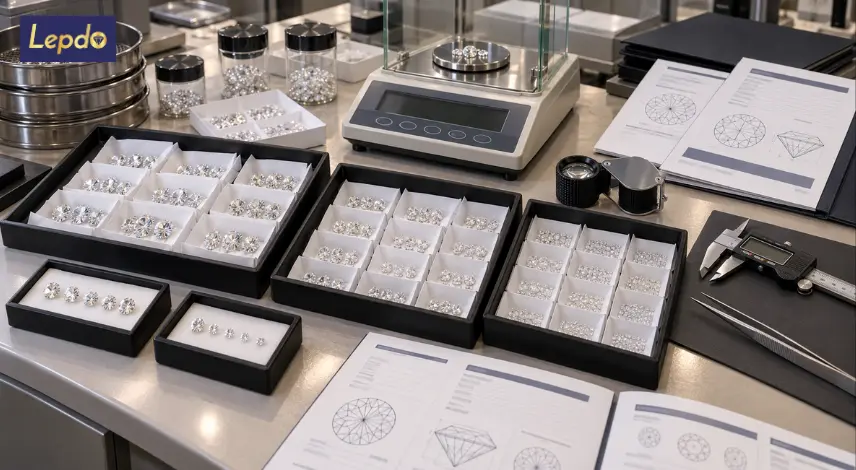
loose diamonds wholesale procurement requires more than comparing per-carat prices. Retailers, jewelers and buying houses should define grade and size tolerances, verify the diamond supplier, review grading documentation, inspect parcel consistency, compare commercial terms, and establish rejection and replacement procedures before scaling an order.
loose diamonds wholesale procurement can be misleading when buyers focus mainly on the quoted price per carat. Wholesale diamond buyers may look at carat weight, compare a few quotations, and move quickly to the next offer. That approach can result in the purchase of a large quantity of diamonds with inconsistent quality, dimensions, grading, or visual appearance.
In professional procurement, commercial value is determined by far more than carat weight. The consistency of the stones, their suitability for the intended jewelry program, their grading documentation, dimensional tolerance, and the supplier’s ability to repeat the same quality all matter.
A buying house therefore needs appropriate controls and procedures for evaluating loose diamonds wholesale in a systematic and disciplined way. These controls should exist before an order is placed. Buyers need to define quality ranges and tolerances, establish commercial terms, determine sampling and approval methods, and decide how grading reports will be evaluated.
The purpose of these controls is consistency in diamond sourcing and protection against inventory, manufacturing, and reputation risk. Once tolerances and commercial conditions are defined in advance, retailers, jewelers, and buying houses can compare offers more accurately instead of depending on vague descriptions or the lowest quoted price.
Procurement of Loose Diamonds Wholesale
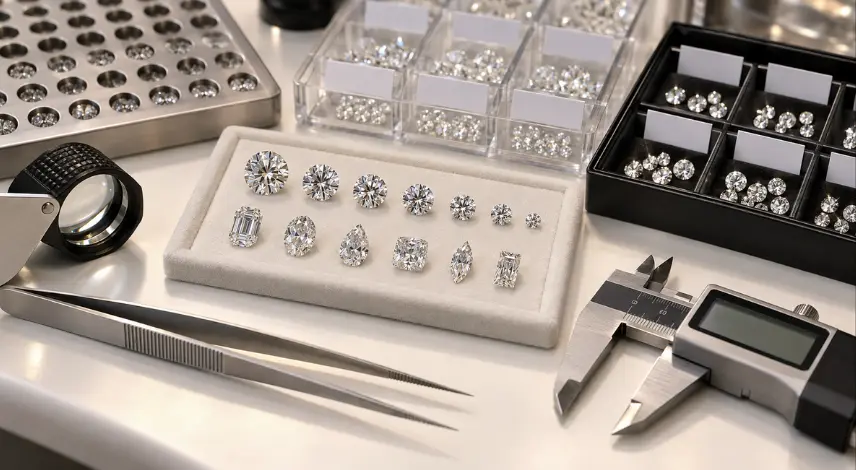
Procuring loose diamonds wholesale refers to purchasing unset polished diamonds for subsequent business-to-business sale, retail inventory, jewelry production, or commercial sourcing programs.
A buyer may establish specific requirements or approve a reference sample. Based on those requirements, a buying house can procure individual stones, matched pairs, calibrated groups, large center stones, or complete parcels containing diamonds of different sizes, grades, and shapes.
Diamond Wholesale should be treated as a separate procurement discipline rather than as a low-cost version of retail purchasing. The buyer is not simply purchasing a diamond. The buyer is procuring a supply of stones expected to meet defined commercial and quality requirements repeatedly.
loose diamonds wholesale procurement can support retailers that need made-to-order engagement rings, customer upgrades, center stones, and replacement inventory. For manufacturers and jewelers, it can support matched and calibrated production such as pavé jewelry, halos, tennis bracelets, earrings, and repetitive jewelry SKUs.
The objective of loose diamonds wholesale procurement is to obtain stones that are commercially suitable for the intended program so that the next order does not create a noticeably different finished product.
Minimize Unclear Procurement Language
Terms such as “good quality,” “commercial quality,” or “nice make” can create procurement problems because they are open to interpretation.
One supplier may interpret commercial quality as an acceptable lower clarity range. Another may interpret it primarily in terms of cut. A third may focus on price.
The loose diamonds wholesale market becomes easier to manage when subjective descriptions are converted into measurable specifications.
Establish the Grade and Size Range
An acceptable range for carat, color, and clarity should be established before requesting quotations.
For jewelry where precise stone size affects assembly, millimeter tolerance may matter more than carat weight. A bracelet, line necklace, halo, pavé design, matched pair, or calibrated production program may require dimensions to remain within a narrow range so the finished jewelry remains visually balanced.
Establish Consistent Proportionality
Diamonds within the same broad 4Cs range may still have differences in cut and proportions that affect the finished product.
Face-up spread, bow-tie visibility in some fancy shapes, outline consistency, facet pattern, polish, symmetry, and other visual characteristics may also need to be considered.
Specifying visual matching in a purchase order is reasonable when buying diamonds for an exact match, matched pair, line bracelet, earrings, or repetitive jewelry SKU.
The specification should be written before loose diamonds wholesale orders are confirmed, not after differences are found in the delivered parcel.
Create a Diamond Sourcing Process
Reliability in diamond sourcing improves when the same assessment process is applied to every supplier.
Simply asking several suppliers for their best price does not guarantee that the quoted goods are equivalent. One supplier may quote a tightly controlled parcel, while another may quote a wider range of stones with more variation.
For loose diamonds wholesale purchasing, suppliers should receive comparable specifications so the buyer can compare like with like.
A Small Test Order Can Be More Useful Than a Long Sales Presentation
For a new relationship, a controlled test order can reveal how a supplier actually performs.
The buyer should evaluate whether the sample matches the quoted grade mix, whether measured values are consistent, whether grading reports reconcile with the stones, how the supplier communicates exceptions, and whether the sample passes the agreed criteria.
The objective is not simply to approve one attractive sample. It is to determine whether the supplier can perform at the required standard when the quantity increases.
In loose diamonds wholesale, buyers should monitor supplier performance through rejection rates, replacement speed, grading consistency, shipment accuracy, response time, exception communication, and adherence to agreed tolerances.
Over time, this moves supplier selection from relationship-based decision-making toward evidence-based procurement.
A more detailed vendor-screening process can be supported by the trusted diamond supplier framework when comparing sourcing partners.
How to Evaluate a Diamond Supplier
A diamond supplier should be assessed on repeatability, not simply on whether stock is available today.
A supplier who can provide one excellent parcel may still be unsuitable for a repeat program if grading, dimensions, visual appearance, or replacement availability cannot be maintained.
Verify Business Identity and Commercial Capability
Verify the supplier’s legal business identity, invoicing details, location, contact information, and export capability when international transactions are involved.
For larger orders, a buyer may request trade references or verify the supplier’s factory or office when appropriate to the transaction.
Understand Where the Stones Come From
For lab-grown diamonds, determine whether the diamond supplier manufactures, cuts, polishes, aggregates, or trades the stones.
For natural diamonds, sourcing and documentation should be evaluated according to the buyer’s applicable compliance requirements.
The purpose is not to favor one business model automatically. The purpose is to understand the supply chain behind the product being purchased.
Treat Diamond Certification as a Verification Tool, Not a Substitute for Procurement
diamond certification is commercially useful because independent grading documentation provides standardized information about important diamond characteristics.
A buyer should compare the supplier’s description, the physical stone, the grading report, and any laser inscription where applicable.
Diamond Certification supports the transaction, but it does not replace quality control.
Diamond Grading Report information should also be reconciled with the actual stone. Buyers should not assume that a report number presented by a supplier automatically corresponds to the diamond delivered.
Variability in Report Requirements
Report requirements vary throughout the loose diamonds wholesale channel.
A retailer selling individual center stones may require a grading report for each stone. A manufacturer purchasing small calibrated diamonds may use parcel-level quality control and may not require individual reports for every stone.
The required documentation should therefore be specified in the purchase order.
For programs built around individually documented inventory, Certified Diamonds can support comparison when buyers have already defined the report requirements they need.
Verify Report Data Against the Stone
Compare measurements in the grading report with the physical diamond. Check shape, carat weight, dimensions, and inscription where applicable.
For higher-value stones, buyers may also verify reports using the verification systems provided by the issuing laboratory.
The key procurement principle is straightforward: diamond certification supports verification, but it does not replace incoming inspection.
A correctly documented stone can still be commercially unsuitable if it falls outside the size, visual, make, or matching requirements of the program.
Evaluate Parcels, Not Just Individual Stones
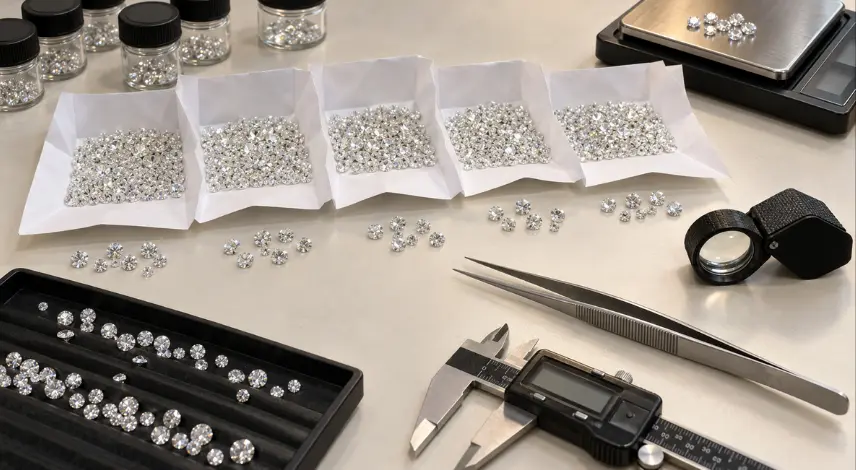
In loose diamonds wholesale, parcels, groups, and lots are frequently purchased rather than isolated individual stones.
This changes the inspection process.
A parcel may look attractive at first sight but create problems later if the grade distribution, measurements, make, or visual appearance are inconsistent.
Look at Distribution, Not Just the Average
When a parcel is offered within a color or clarity range, analyze how the stones are distributed inside that range.
A parcel concentrated near one end of the stated range may perform differently commercially from a more evenly distributed parcel.
The same applies to size. A nominal calibrated range may still contain outliers that cause mismatch or setting problems.
Inspect for Uniformity
When inspecting loose diamond parcels, sampling should represent the entire parcel rather than only the most attractive stones.
Check dimensions, make, color, clarity, transparency, and visual matching against the purchase specification.
The diamond parcel buying guide provides a useful framework for evaluating parcels before scaling an order.
Define What Happens When Goods Fail Inspection
The purchase terms should state what happens when diamonds do not meet the agreed requirements.
Will the supplier replace individual stones? Will the entire parcel be replaced? Will the buyer receive a credit? Can the goods be returned? How quickly must discrepancies be reported?
For loose diamonds wholesale, a clear replacement policy can protect production schedules and customer commitments more effectively than a small discount on an inconsistent parcel.
Evaluate the Total Commercial Value of Wholesale Quotes
When comparing quotations for loose diamonds wholesale, buyers should evaluate more than the price per carat.
Price differences may reflect quality, make, payment terms, replacement policies, quantity, grading reports, dimensional tolerance, or differences in how the supplier interpreted the specification.
Normalize the Specification Before Comparing Prices
A tightly calibrated parcel should not be compared directly with a mixed parcel.
Before evaluating price, align the grade range, size tolerance, report requirement, shape, make, and quantity.
Only after the specifications are comparable does price become a meaningful decision factor.
Check Minimum Order Quantity
Minimum order quantity affects inventory exposure.
A lower price may require the buyer to purchase more goods than the business can efficiently sell or use. Higher MOQ generally increases the amount of capital committed to inventory, so the price benefit should be evaluated against inventory turnover and demand.
The moq diamond wholesale framework can help buyers think about how much stock is commercially reasonable for a new program.
Separate Price From the Cost of Failure
Some sourcing costs never appear directly on the supplier’s invoice.
Re-sorting, replacement, production delays, remaking jewelry, matching new stones, handling returns, and carrying slow-moving inventory all create commercial cost.
For this reason, loose diamonds wholesale should be evaluated on total usable value, not simply quoted price.
For lab-grown goods, a diamond wholesale price reference can help buyers understand why supplier quotations may differ when specifications and commercial terms are not identical.
Consider the Inventory Mix for Your Business Model
A buying house, custom jeweler, and retailer do not require the same inventory mix.
Planning for loose diamonds wholesale should therefore begin with the intended end use.
Retailers
Retailers may require a mix of certified center stones, popular shapes, replacement sizes, and commercially useful grades.
Inventory should reflect customer demand rather than simply what is easiest for the supplier to sell.
A retailer building a wider selection may source standard Loose Diamonds alongside specialized inventory.
Jewelry Manufacturers and Jewelers
Jewelry manufacturers often require stable supplies of repeatable make and calibrated sizes.
For repeated manufacturing, a consistent 2.0 mm melee parcel may be more valuable than an attractive but inconsistent assortment.
Programs using Fancy Shape Diamonds may require additional controls for outline, length-to-width ratio, corners, bow-tie visibility, and facet pattern.
Buying Houses
Buying houses often need traceability across several suppliers because they may be purchasing for multiple clients.
One client’s tolerance should not automatically be substituted for another’s.
Where Fancy Color Diamonds are part of a program, visual color matching may need to be included in addition to standard dimensional and quality tolerances.
Unique Cut Diamonds may require their own dimensional and visual acceptance standards because unconventional faceting can change how weight and appearance are distributed.
Build Quality Control Into the Purchase Order
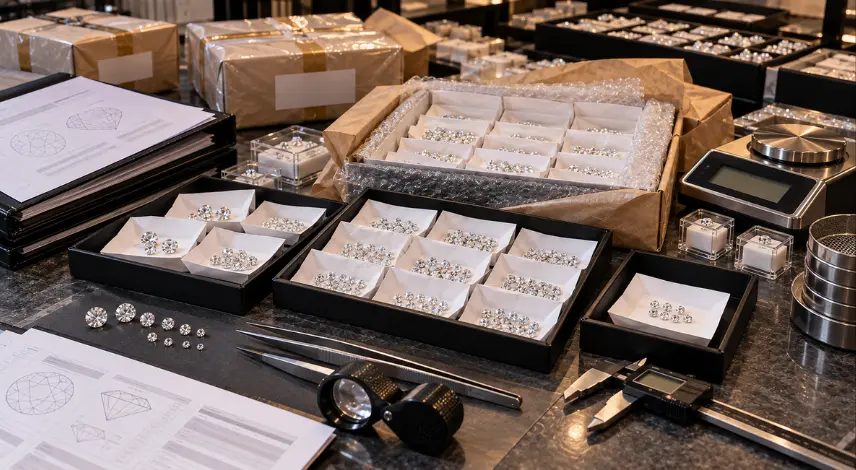
A purchase order for loose diamonds wholesale should function as a quality-control document rather than a simple confirmation of quantity and price.
Include agreed terms for stone descriptions, quantities, size, color, clarity, make expectations, reports, packaging, shipment terms, replacement procedures, and approval of substitutions.
Define Measurement Tolerances
During jewelry manufacturing and assembly, dimensional tolerance can affect symmetry and fit.
Tolerance should not be treated as one universal number. It should be connected to the design and the method used to manufacture the finished piece.
Reconcile Incoming Goods
Before acceptance, evaluate quantity, reports, measurements, and condition.
If an abnormality is found, isolate the affected stones rather than mixing them with existing inventory.
Incoming inspection is especially important in loose diamonds wholesale because once parcels are mixed, redistributed, or mounted into jewelry, determining the source of a problem becomes much more difficult.
Direct Manufacturer, Wholesaler, or Trading Supplier?
Different supplier models provide different commercial advantages.
| Supplier Type | Primary Strength | Main Procurement Consideration |
|---|---|---|
| Direct manufacturer | Production control and repeatability | Product range may be narrower |
| Wholesaler | Broad inventory and ready stock | Buyer should verify consistency across sources |
| Trading supplier | Access to varied or difficult combinations | Traceability and repeatability require careful review |
A direct manufacturer may provide repeatable production and control over specifications. A wholesaler may offer a wider selection of available inventory. A trading supplier may source combinations that one manufacturer cannot supply directly.
Lepdo Diamonds is a manufacturer in Surat, India, producing laboratory-grown diamonds using CVD and HPHT methods.
Knowledge of a supplier’s manufacturing or sourcing model can help the buyer evaluate repeatability, disclosure requirements, and documentation.
The loose diamonds wholesale buying decision should still be based on quality, commercial terms, documentation, and supplier performance rather than manufacturer status alone.
Why the Cheapest Parcel Can Become the Most Expensive
Procuring the cheapest parcel can become the most expensive decision in loose diamonds wholesale when inconsistency creates re-sorting, replacements, remakes, production delays, or slow-moving inventory.
The real question is not simply what the parcel costs. Buyers should determine how much of the parcel can move directly into the intended sale or manufacturing program.
A recent Medium analysis of diamond parcel procurement risk examines this problem from a wholesale perspective. It reinforces why retailers, jewelers, and buying houses should compare usable consistency, replacement exposure, and manufacturing suitability rather than judging a parcel only from the opening quotation.
Developing a Practical Procurement Process
A disciplined loose diamonds wholesale process can be scaled more reliably than an informal buying approach.
Begin by establishing the intended end use. Research which factors determine the quality, dimensions, appearance, and commercial suitability of the required diamonds.
Once the specification is established, verify whether the supplier can consistently meet it.
Request comparable quotations. Approve reports, reference stones, samples, or test parcels where appropriate.
Before releasing the goods into inventory or manufacturing, inspect the stones against the agreed specification.
Finally, record supplier performance from the previous procure-to-pay cycle. Rejection rates, replacement speed, grading consistency, shipment accuracy, and communication can provide useful evidence when deciding whether the same diamond supplier should receive the next order.
Common Questions
1. What Factors Do Retailers Need to Consider When Checking Loose Diamonds for Wholesale Purchase?
Retailers must verify the complete specification when checking loose diamonds for wholesale purchase. This includes a minimum and maximum range for carat and millimeter size, color, clarity, cut and make, grading-report requirements, face-up appearance, supplier terms, and replacement policy.
The quotation should align with the expected retail program. Low-priced stones may not be beneficial if they do not support the products customers are expected to purchase.
2. How Can a Buying House Compare Diamond Suppliers?
A standardized request for quotation should be used so the same specification is reviewed across suppliers.
Diamond suppliers should be compared on product quality and consistency, documentation, communication, pricing, replacement performance, shipment accuracy, and the ability to execute repeat orders.
A diamond supplier should not be selected only because the first sample looks attractive or because the initial quotation is the lowest.
3. Is It Essential to Have Diamond Grading Certification for Every Wholesale Stone?
No. The requirement depends on the value and size of the stone, the sales channel, and the buyer’s policy.
Individually sold center stones may require grading reports, while lower-value parcel goods may be controlled through a parcel-level quality system.
Buyers should state which reports are acceptable in the purchase order and compare the reported parameters against the physical stones received.
4. How Do Jewelers Control Consistency in Wholesale Parcels?
Jewelers set tolerances for parameters such as size, color, clarity, and make.
Sampling should represent the complete parcel rather than a few selected stones. For repeated production, stones from an approved reference parcel may be used as a visual or dimensional benchmark.
Incoming goods should be checked before being mixed with existing inventory or mounted into jewelry.
5. What Is the Biggest Risk in Loose Diamonds Wholesale Buying?
The biggest risk in loose diamonds wholesale is purchasing a parcel that appears acceptable from the quotation but does not serve the buyer’s actual commercial requirements.
Costs can arise from uneven grade distribution, unsuitable dimensions, inconsistent make, replacement requirements, or inventory that cannot move efficiently.
Acceptance criteria should therefore be established before quotation and verified against the stones supplied.
6. Should Buyers Opt for the Lowest Wholesale Diamond Price?
Not necessarily.
Price quotation is meaningful only after like-for-like specifications are compared. Buyers should consider quantity, grade distribution, payment terms, replacement process, sorting cost, possible jewelry remakes, and inventory risk.
The lowest quoted price may ultimately become a more expensive purchase if additional work is needed to make the goods commercially usable.
7. What Is Different About Diamond Sourcing for Fancy Shapes?
Fancy shapes introduce additional uncertainties involving outline, length-to-width ratio, bow-tie visibility, corners, and faceting, in addition to carat, color, and clarity.
Buyers should establish shape-specific dimensional tolerances and visual standards. A general request for an oval or pear shape without further specification can produce very different results across suppliers and production batches.
8. What Is the Right Way for a New Buyer to Approach Loose Diamond Wholesaling?
New buyers should begin with a written specification order. This allows the buyer to communicate requirements clearly and gives the supplier an opportunity to confirm whether the requested goods fit its product capabilities.
A controlled test order should follow. The buyer should check commercial terms, tolerances, replacement policies, shipping documentation, and the first shipment before increasing the volume of loose diamonds wholesale purchases.
Strategic Takeaways for Retailers, Jewelers, and Buying Houses
When buying diamonds, some buyers may think the best approach is to buy stones one at a time or focus primarily on obtaining the lowest possible price per carat. In many commercial situations, that approach is inefficient.
A stronger loose diamonds wholesale strategy is to treat procurement as a repeatable business process. Specifications, supplier evaluation, sampling, inspection, documentation, replacement procedures, and purchasing terms should work together from one order to the next.
For quality control, the same consistent process should be used to evaluate suppliers. When one supplier is judged on strict dimensional and grading tolerances while another is judged only by price, the comparison becomes unreliable.
The final takeaway is to support physical inspection and stone descriptions with documentation. Consistency between the stones, grading information, supplier description, purchase order, and incoming inspection helps reduce surprises in inventory and jewelry production.
A disciplined loose diamonds wholesale process does not guarantee that every stone will be identical. It gives retailers, jewelers, and buying houses a clearer system for identifying acceptable variation, controlling commercial risk, and building more repeatable supplier relationships.
For in-depth market reports, trade sourcing guides, interactive Q&As, and expert gemological perspectives, join the discussion on Lepdo Diamonds on Quora.