
Diamond manufacturer selection for global buyers should verify more than price and capacity. A reliable Indian production partner should demonstrate controlled manufacturing, quality systems, grading and report handling, treatment disclosure, traceability, export readiness, corrective action, and repeat-order consistency. The strongest audit compares claims with factory evidence, trial shipments, and written acceptance standards.
Diamond manufacturer selection cannot be reduced to logos, prices, factory photographs, or a single sample parcel. A global B2B buyer needs to determine whether an Indian production partner can consistently supply a pre-agreed specification, document each shipment, correct deficiencies, and provide reliable service after the first order.
Evaluating a diamond manufacturer requires a broader review of manufacturing capability, quality control, grading, commercial documentation, export readiness, and corrective action for nonconforming product. A strong supplier may perform well on one shipment, but repeated buying cycles reveal whether the production system is controlled well enough to deliver acceptable product again.
For larger or recurring orders, the key question is simple: which diamond manufacturer can demonstrate control over the process required to manufacture acceptable products repeatedly?
What Global Buyers Should Verify Before Approving a Diamond Manufacturer
Before awarding a diamond manufacturer a large contract, numerous questions must be answered. The manufacturer should demonstrate an integrated production system, explain its role in the overall value chain, show quality-assurance procedures for verifying conformance, and provide commercial documentation that supports each transaction.
Clarity on roles is a good place to begin for buyers studying how to source diamonds from India. Ask what the company actually does at each stage, from growing and polishing to grading, sorting, packing, and exporting. The explanation should match the samples, documents, and production evidence shown to the buyer.
Does the Company Manufacture Diamonds Itself?
A production audit should identify where each stage of the value chain is carried out. That includes growing, cutting, polishing, sorting, report handling, parcel preparation, and dispatch.
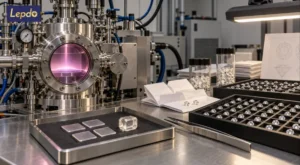
If the supplier produces laboratory-grown diamonds through CVD, HPHT, or both, the buyer should understand whether the supplier owns the growth equipment, sources grown rough from another producer, or combines both models. The same question applies to polishing and specialized cutting.
A lab grown diamond manufacturer may control growth but outsource certain polished shapes. A lab created diamond manufacturer may also purchase rough or polished inventory to complete a customer assortment. Neither structure is automatically unacceptable, but the role must be clear enough for the buyer to know who controls quality and who is responsible when the specification is missed.
Is the Entity Legally Authorized to Carry Out Business?
A buyer should verify the supplier’s legal business name, invoicing entity, bank details, export entity, and the address used for dispatch. The names appearing on quotations, purchase orders, invoices, and payment instructions should be consistent.
A diamond supplier in india may manufacture, trade, export, or operate through related entities. The buyer should understand which entity owns the goods, which entity invoices the shipment, and which entity is responsible for replacements, returns, or commercial disputes.
The Diamond Exporters Surat India resource is useful when international buyers need context on how production and export functions can differ within the Surat diamond ecosystem.
Assessing Diamond Manufacturer Production Capability
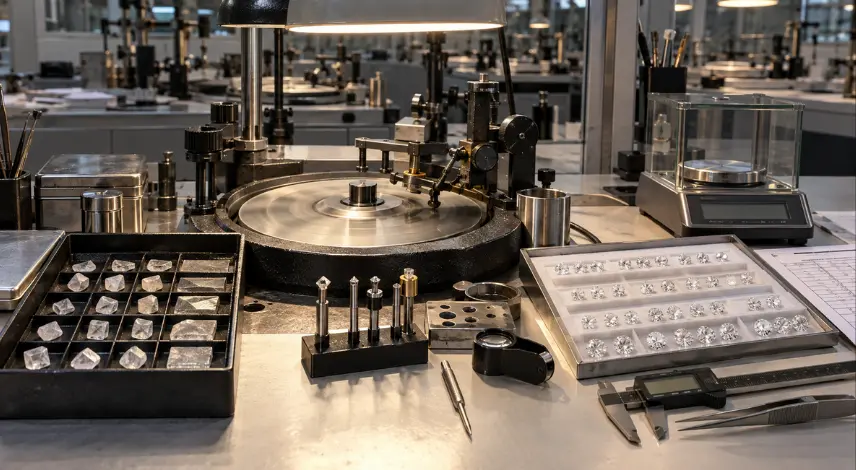
During an audit, a diamond manufacturer should explain production capability in more detail than a single monthly-output number. The supplier should show which specifications are routine, where capacity is strongest, which products require special planning, and where production limitations exist.
For laboratory-grown diamonds, buyers should distinguish rough-growth capability from polished-output capability. A manufacturer may produce substantial rough but depend on outside polishing for certain shapes or sizes. Another may have strong cutting, sorting, and calibration operations while sourcing grown rough from different production partners.
Evaluating a Lab Grown Diamond Manufacturer
When auditing a lab grown diamond manufacturer, evaluate how CVD-grown and HPHT-grown material is differentiated, recorded, and represented. Also review how post-growth treatment is handled and how the supplier controls the final quality of the polished stones.
The Lab Grown Diamond Manufacturers Surat resource provides supporting context for buyers comparing potential manufacturing partners within Surat’s laboratory-grown diamond sector.
Growth technology is only one part of the audit. The buyer still needs evidence that the diamond manufacturer can convert rough into polished inventory that meets the agreed dimensions, quality, grading, and visual requirements.
Test Capacity Claims With a Product Matrix
A statement about capacity is useful, but a product matrix provides stronger evidence. The matrix should describe the normal range of production, including shapes, carat ranges, color, clarity, cutting standards, grading options, and typical lead times.
A diamond manufacturer may excel at round brilliants but have less experience with elongated fancy shapes. Another may process DEFG colorless goods efficiently while using a different workflow for Fancy Color Diamonds.
Capacity should therefore be tested against the actual assortment the buyer intends to purchase, not against the widest assortment the supplier advertises.
Review Cutting, Polishing, and Final Sorting Controls
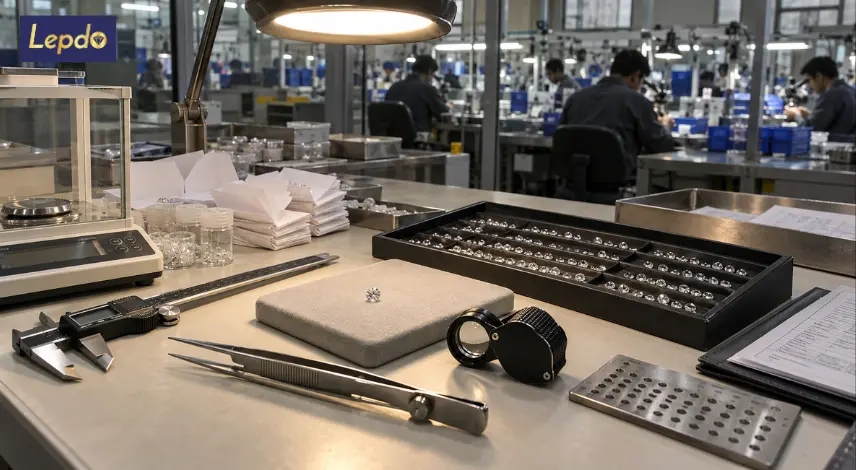
The audit should assess controls during cutting and polishing and then follow the goods through final sorting. Before shipment, finished stones should be sorted to the specified size, tolerance, and quality level.
For Fancy Shape Diamonds, extra controls may be required for length-to-width ratio, windowing, bow-tie strength, outline, and visual matching.
For Unique Cut Diamonds, an approved image or sample standard can reduce disagreements about nonstandard faceting.
The best audit evidence comes from routine production, not a specially prepared presentation sample.
Audit Routine Production, Not Just Samples
A diamond manufacturer may be able to prepare one excellent sample parcel, but global buyers need to know whether normal production remains within the same tolerance range. Routine production should therefore be compared with controls established by the purchaser.
For larger orders, approval samples should define the expected range for cut, color, clarity, measurements, appearance, and other relevant characteristics. The buyer should also state whether the sample represents a minimum acceptable standard, an average target, or an exact-match reference.
For Loose Diamonds, this becomes particularly important when the buyer needs solitaires, matched pairs, or calibrated sets produced to repeat specifications.
Define What the Approved Sample Actually Means
A reference sample is useful only when both parties interpret it the same way. If the diamond manufacturer considers the sample an ideal target but the buyer assumes it is the minimum acceptable quality, future shipments may create disputes.
The specification should therefore translate visual approval into measurable tolerances wherever possible. Carat range, dimensions, color, clarity, cut, polish, symmetry, fluorescence, and visual matching can all be documented when relevant.
This also allows the production partner to compare routine production against the buyer’s expectations instead of relying on memory or verbal descriptions.
Audit Grading and Report Handling
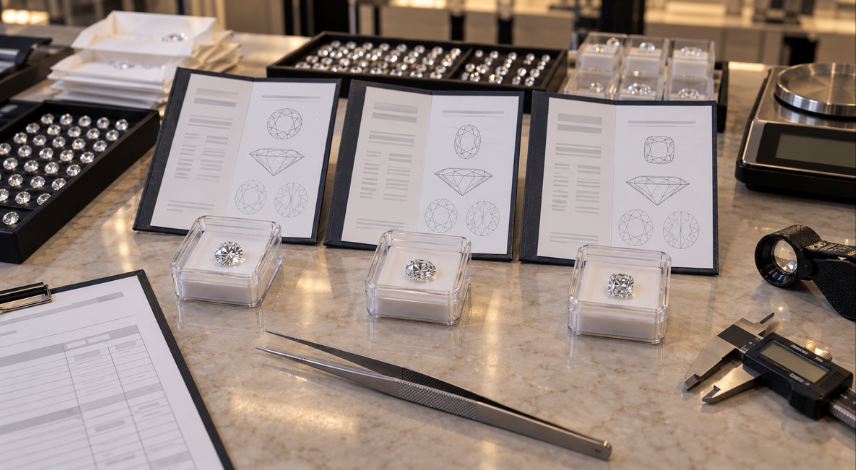
Independent gemological reports can help buyers validate characteristics, but those reports do not audit the factory. The diamond manufacturer remains responsible for making sure reports are matched to the correct stones and that parcels are not mixed during handling.
When purchasing Certified Diamonds, buyers should confirm which laboratories are accepted, which stones require individual reports, how report numbers are linked to internal stock records, and how report-to-stone matching is checked before dispatch.
The lab grown diamond quality grades B2B resource can help purchasing teams translate grading terminology into practical acceptance standards.
Reject, Rework, and Corrective-Action Procedures
What happens when a stone fails final inspection? The supplier should be able to explain whether the stone is re-polished, downgraded, replaced, removed from the shipment, or moved to a different specification.
A supplier without a defined process for nonconforming product may rely too heavily on final judgment. One isolated failure may be treated as a single event, but recurring failures should trigger a review of the underlying production process.
Corrective action matters because repeated defects often reveal more about manufacturing control than the original sample does.
Traceability, Treatment Disclosure, and Parcel Control
Traceability does not have to depend on a complex digital platform. At minimum, the diamond manufacturer should be able to link stones or parcels to internal lots, commercial invoices, grading information, treatment disclosure, and customer orders.
The system should be clear enough that a buyer can understand what was supplied and how it was represented.
Separate Growth Method From Post-Growth Treatment
For laboratory-grown stones, growth method and post-growth treatment are separate facts. A stone grown by CVD and later treated using HPHT should still be identified as CVD-grown material with the relevant post-growth treatment disclosed where applicable.
The production partner should use a consistent method for recording and communicating such information. Inconsistent terminology between sales, production, and documentation is a warning sign because it can create confusion further down the supply chain.
Compare and Reconcile Reports With Physical Lots
Ask how the supplier physically separates stones by production lot, grading status, treatment history, size, and customer specification. The way trays, packets, reports, and stock systems are organized should support the explanation provided during the audit.
A supplier serving multiple buyers should also demonstrate how different customer orders are prevented from being commingled.
For many global buyers, these controls are more useful than the size of the factory itself.
Evaluate the Commercial Side of the Diamond Manufacturer
The commercial audit deserves as much attention as the production audit. A supplier may produce acceptable diamonds but offer unclear terms, inconsistent replacements, weak communication, or commercial conditions that increase the buyer’s risk.
Before placing larger orders, review price structure, minimum order quantity, lead time, production flexibility, rejection windows, return procedures, replacement responsibility, grading costs, and logistics responsibility.
The How To Choose Lab Grown Diamond Supplier guide provides a useful framework for examining supplier responsibilities beyond manufacturing alone.
Do Not Compare Quotes Until Specifications Align
A cheaper quotation is not necessarily a better offer. One supplier may use broad dimensional and visual tolerances while another uses tighter controls. If the specification is different, the price comparison is not equivalent.
The buyer should develop the same technical specification for each quotation request. A diamond manufacturer that asks detailed questions about tolerances may be easier to audit than one that immediately focuses on the lowest price.
Price should be compared only after product requirements are aligned.
Place a Small Trial Order to Test Repeatability
A trial order should be small enough to limit exposure but large enough to reveal whether routine sorting and fulfillment processes work as described.
Evaluate communication, packing quality, documentation, assortment accuracy, measurements, grading, and conformity to the approved specification. If the shipment is defective or inconsistent, extend the audit before increasing volume.
The Trusted Diamond Supplier India resource supports buyers who want a broader supplier-verification framework before moving from a trial order to a repeat program.
How to Remotely Audit an Indian Diamond Manufacturer
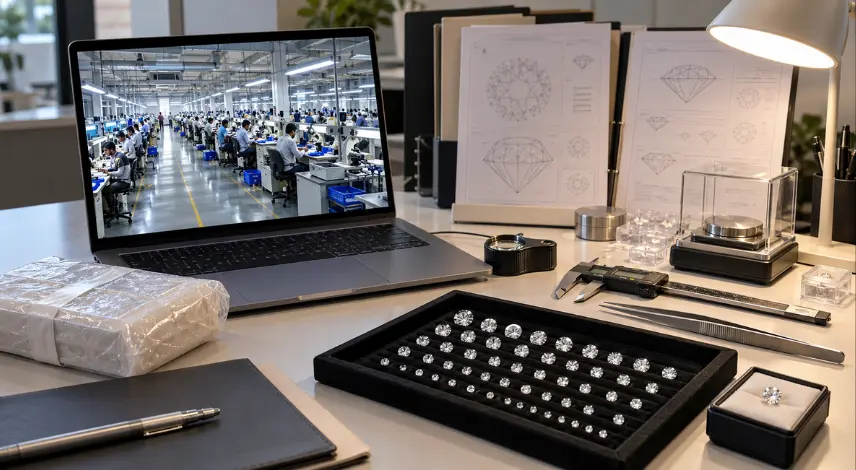
When an on-site audit is not immediately possible, buyers can request a live facility walkthrough, samples of commercial documentation, sample QC checks, packing examples, product matrices, and process records.
Remote evidence can help global buyers decide which suppliers deserve a physical visit or controlled sample order.
Ten Areas for a Production Partner Audit
A structured audit can review ten areas:
- Legal and invoice entity.
- Manufacturing and outsourced activities.
- CVD and HPHT production scope where relevant.
- Cutting, polishing, and sorting capability.
- Product specifications and tolerances.
- Quality-control procedures.
- Grading, reporting, and disclosure.
- Lot and customer-order control.
- Export, replacement, and commercial procedures.
- Trial-order performance.
This framework gives the buyer a practical way to compare one diamond manufacturer with another using evidence rather than presentation quality.
Verify What You See
A factory tour can create the impression that a buyer’s order is produced entirely at that location, but the audit should verify the actual workflow. Select one real product and follow it through measurement, inspection, sorting, recording, report matching, packing, and release.
Check whether staff members use the same tolerances written in the buyer’s specification. Strong evidence appears when the physical workflow, staff explanation, and commercial documents agree.
Surat Location Helps, but It Does Not Complete Due Diligence
Surat is an important center for diamond cutting, polishing, grading, trading, and related activities. Its depth of specialization makes it easier for global buyers to find potential manufacturing partners, but location does not prove quality, production control, or export readiness.
The Diamond Manufacturers In Surat resource provides useful context on Surat’s manufacturing ecosystem. Buyers should still audit each diamond manufacturer independently.
A Surat address should not be treated as proof that a company can meet a particular quality standard or export program.
Look Beyond the Factory Floor
A production partner serving international customers also needs effective packaging, documentation, dispatch, and post-shipment resolution processes. These functions are part of the supply relationship even when they occur after polishing is complete.
Ask who prepares export documentation, who verifies invoice descriptions, how parcels are secured, how shipping discrepancies are handled, and what happens if goods are rejected after arrival.
A production partner that understands the complete commercial chain may be easier to scale with than one that focuses only on production output.
What to Consider When Selecting a Diamond Manufacturer
Some audit requirements are obvious, while others appear only after the buyer compares statements from sales, production, and documentation teams.
Watch for claims that change between departments, samples that cannot be reproduced, reports that cannot be traced cleanly, broad tolerances hidden behind headline grades, or promises of complete control over stages that are actually outsourced.
The supplier should also state where its responsibility ends. Overpromising can be as concerning as under-explaining. The strongest due diligence focuses on consistency between claims, evidence, written specifications, and actual shipments.
A 2026 Selection Model for Global B2B Buyers
Global buyers can reduce risk by approving production partners through a series of graded assessments instead of one final decision.
Begin with document review and role clarification. Follow with a remote process audit. Then use a controlled sample or trial order. Place a repeat order under the same acceptance criteria. Increase volume only after repeated performance confirms that the diamond manufacturer can reproduce acceptable output.
This staged process is especially relevant when selecting a lab grown diamond manufacturer because ownership of growth technology does not automatically guarantee commercial repeatability.
Diamond Manufacturer Selection FAQs
1. What Does a Global Buyer Evaluate First in a Diamond Manufacturer?
A global buyer should first confirm legal identity, actual involvement in the diamond value chain, and responsibility for outsourced activities. These details help determine whether the diamond manufacturer can support production, quality control, grading, and delivery claims. Samples, routine production evidence, and documentation should then be compared before a large purchase order is approved.
2. How Do You Verify a Lab Grown Diamond Manufacturer Located in India?
Verify the legal business entity, diamond-growth methods, cutting and polishing workflow, treatment disclosure, grading process, quality control, export documents, and repeat-order capability. A factory visit can help, but sample and trial-order performance against a written specification provides stronger evidence that the lab grown diamond manufacturer can deliver the required output consistently.
3. Is a Lab Grown Diamond Manufacturer Better Than a Trader?
Not always. A manufacturer may offer closer integration of production, while a capable trader may provide efficient sourcing and service across several production partners. Global buyers should evaluate control, accountability, traceability, quality assurance, and repeatability in either model. The key issue is whether the supplier’s actual role is clear and supported by evidence.
4. How Can I Evaluate a Diamond Supplier in India Before My Visit?
A diamond supplier in india can be reviewed through business documents, live virtual facility tours, product matrices, sample reports, QC procedures, sample packaging, references where appropriate, and a controlled trial order. Remote evidence should help determine whether the supplier’s claims match its actual processes before the buyer commits to travel or higher order volume.
5. Must a Diamond Manufacturer Use Third-Party Grading?
Not every stone necessarily requires an individual third-party grading report. The requirement should follow the product specification agreed between buyer and supplier. The diamond manufacturer still needs internal grading and quality controls, and when laboratory reports are required, the factory must ensure that the correct report is paired with the correct stone.
6. How Can Diamond Manufacturer Quality Assurance Be Assessed?
Quality assurance can be assessed through repeat orders, dimensional consistency, grade distribution, parcel matching, qualifying documentation, rejection handling, and evidence of corrective action. A diamond manufacturer demonstrates stronger quality control when routine production continues to meet the buyer’s written tolerance range rather than relying on specially prepared approval samples.
7. What Factory Audit Evidence Matters Most to Global Buyers?
The strongest evidence reflects work performed on real diamond lots. Buyers should observe or review measurement, inspection, sorting, recording, report matching, packing, and release of actual parcels. Equipment alone is not enough. The audit should show employees using written tolerances and initiating corrective action when goods fall outside the buyer’s specification.
8. When Should Global Buyers Increase Orders With a New Diamond Manufacturer?
Orders should increase only after the diamond manufacturer demonstrates repeated performance against the buyer’s acceptance criteria. Review quality consistency, documentation, communication, timeliness, packing, replacement handling, and repeat-order conformity. The first order provides useful evidence, but larger commitments should be based on repetitive performance rather than one successful shipment.
Strategic Considerations for Global Buyers
Diamond manufacturer capability should be assessed through a structured qualification process rather than a search for the cheapest producer. The buyer needs to validate that the production partner can supply stones in conformity with technical requirements and agreed commercial terms.
Repeated evidence matters more than a single sample. A reliable diamond manufacturer should be able to explain its role, demonstrate production controls, reconcile reports and physical lots, handle nonconforming product, and reproduce the accepted specification across future orders.
Lepdo Diamonds operates from Surat, India as a B2B laboratory-grown diamond manufacturer using CVD and HPHT production. Global buyers evaluating any production partner should still apply their own qualification, inspection, trial-order, and repeat-performance procedures before increasing volume.
For in-depth market reports, trade sourcing guides, interactive Q&As, and expert gemological perspectives, explore the official Lepdo Group Medium platform and join the discussion on Lepdo Diamonds on Quora.