The 5Cs of Diamonds Explained: Cut, Color, Clarity, Carat, and Certification
 by lepdogroup@gmail.com
2 comments
by lepdogroup@gmail.com
2 comments
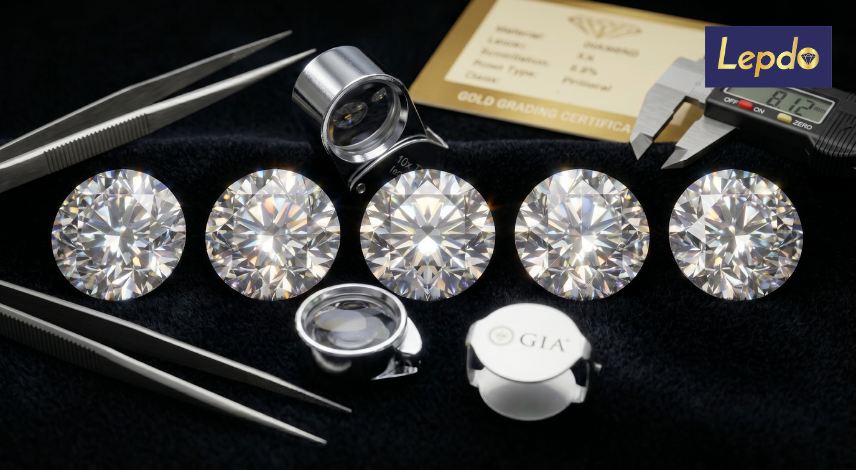
The 5Cs of diamonds are Cut, Color, Clarity, Carat, and Certification. These five factors give buyers and trade professionals a complete picture of any diamond’s quality, value, and authenticity. Certification is what separates a trusted stone from a gamble. Lepdo Diamonds carries only GIA and IGI certified stones across its full collection.
A client once handed me a one-carat diamond her fiancé had bought online for what seemed like a great price. Under 10x magnification, the stone was a mess of inclusions, its cut was far too deep, and the certificate came from a lab no reputable wholesaler would accept. The price made sense but not in the way she’d hoped.
Stories like that one are exactly why the 5Cs of diamonds matter. They give buyers a framework to evaluate any stone objectively, whether you’re shopping for an engagement ring or sourcing inventory for a retail chain. By the time you finish reading, you will know how each of the five qualities affects a diamond’s appearance and price, what GIA and IGI grading actually tells you, and how to use all five factors together when making a real purchase decision.
What Are the 5Cs of Diamonds Explained?
The GIA introduced the original 4Cs of diamonds Cut, Color, Clarity, and Carat, in the mid-20th century to give the entire diamond trade a shared grading language. Before that, dealers described quality in vague, inconsistent terms that varied by region and seller.
The 5Cs framework extends that system by recognizing Certification as the fifth quality. Certification is not just paperwork. It is the independent verification that makes all four physical qualities trustworthy and tradeable.
Quick Info Box
| Definition | A five-factor system for evaluating a diamond’s quality, value, and authenticity |
| The 5 Cs | Cut, Color, Clarity, Carat, Certification |
| Best For | Buyers, retailers, and B2B purchasers evaluating diamond quality |
| Key Difference from 4Cs | The addition of Certification as the fifth and most verifiable C |
When you shop for certified diamonds, you are not just buying a grading report. You are buying confidence in all five qualities at once.
The First C: Diamond Cut Quality
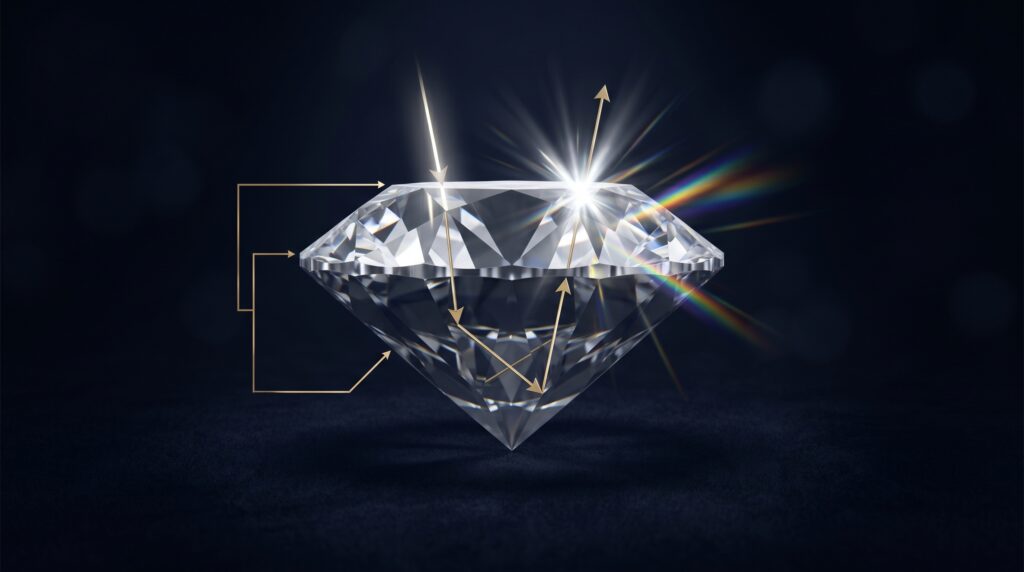
Cut is the most misunderstood of the 5Cs. Most people confuse cut with shape, but those are two entirely different things. Shape refers to the outline of the diamond: round, oval, princess, pear. Cut refers to how well a diamond’s facets are proportioned, aligned, and polished to interact with light. Diamond cut quality is the single biggest driver of a stone’s visual impact.
How Cut Affects Brilliance
Think of it this way: a diamond is essentially a light-management system built from 57 or 58 tiny mirrors. When those mirrors are angled correctly, light enters through the top of the stone, bounces between the pavilion facets, and exits back through the table as brilliance, fire, and scintillation. Brilliance is white light reflection. Fire is the dispersion of light into spectral colors. Scintillation is the flash of sparkle you see when the diamond or light source moves.
A diamond with a table percentage that is too wide or a depth percentage that is too deep loses that light through the sides or bottom. The stone looks dark. It looks dead. No amount of high clarity or fine color can compensate for a badly cut diamond.
GIA Cut Grading Scale
The GIA grades round brilliant cut diamonds on a five-point scale: Excellent, Very Good, Good, Fair, and Poor. Excellent and Very Good grades represent the top tier of diamond grading for light performance. GIA evaluates seven components to determine the cut grade: brightness, fire, scintillation, weight ratio, durability, polish, and symmetry.
You will want to pay close attention to polish and symmetry grades as well, since both appear separately on GIA reports and directly affect how clean a diamond looks under lighting. Aim for Excellent or Very Good on all three.
One important point for buyers of fancy shape diamonds: ovals, pears, marquise cuts, cushions, and other non-round shapes do not receive an official GIA cut grade. For those stones, you must evaluate proportions manually or rely on the experience of the seller. A knowledgeable diamond supplier can guide you through the key ratios to look for in each fancy shape.
The Second C: Diamond Color Scale
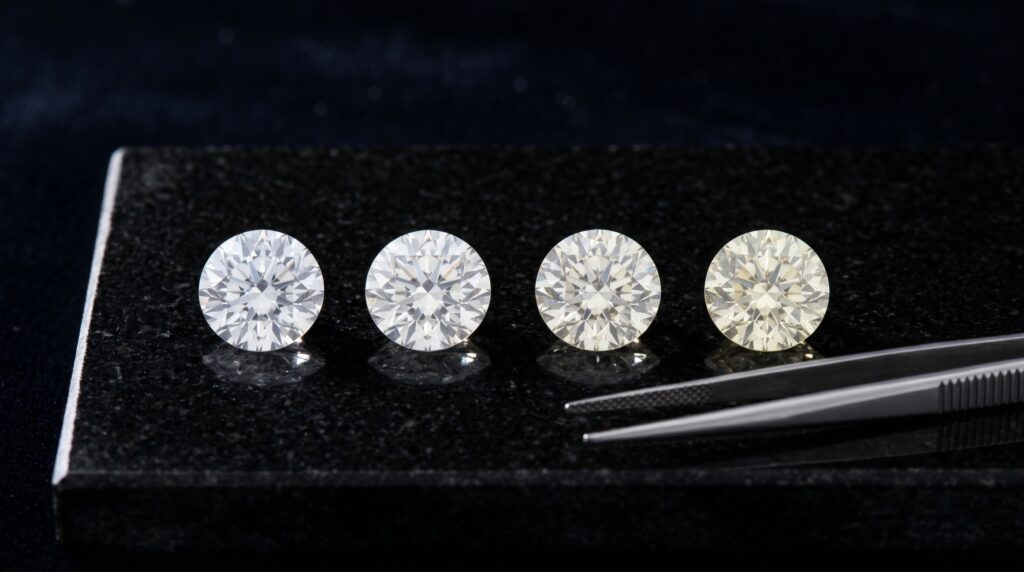
Here is what most buyers do not realize about color: the absence of color is what makes a diamond valuable in the white diamond market. The GIA color grading scale runs from D (completely colorless) to Z (light yellow or brown tint). Each letter represents a specific range of hue visible under controlled grading conditions using comparison master stones.
GIA Diamond Color Scale
- D, E, F: Colorless the rarest and most expensive range
- G, H, I, J: Near Colorless excellent value, difficult to distinguish from D-F without magnification
- K, L, M: Faint a slight warmth visible face-up, especially in larger stones
- N through R: Very Light visible yellow or brown tint in most lighting
- S through Z: Light obvious color tint, typically used for budget settings
Most buyers shop in the G to H range on the diamond color scale, and for good reason. The difference between a G and a D is essentially invisible to the naked eye in a ring setting, but the price difference can be 20 to 40 percent.
Metal choice also affects perceived color. Yellow gold settings actually mask faint warmth in K-M range stones and can make them look near-colorless by contrast. Platinum and white gold settings will show any yellow tint more readily.
Fancy color diamonds naturally occurring pinks, blues, yellows, and greens are a completely separate category graded on a different scale. The rarer the hue and the more saturated the color, the higher the value. When sourcing natural diamonds in the fancy color range, grading by GIA is especially important since color origin and intensity directly determine price.
The Third C: Diamond Clarity Grades
The GIA clarity scale covers eleven grades across six categories. From cleanest to most included: Flawless (FL), Internally Flawless (IF), Very Very Slightly Included (VVS1 and VVS2), Very Slightly Included (VS1 and VS2), Slightly Included (SI1 and SI2), and Included (I1, I2, and I3). Clarity is graded at 10x magnification by a trained gemologist.
Inclusions are internal characteristics: crystals, feathers, clouds, needles, and pinpoints formed during the diamond’s growth. Blemishes are surface marks: scratches, nicks, and chips. Neither type is visible to the naked eye in most stones above SI1 on the scale.
The sweet spot for diamond clarity grades in most retail segments is VS1 to SI1. Diamonds in this range are typically eye-clean, meaning no inclusions are visible without a loupe or microscope, but they cost considerably less than the flawless end of the scale. A well-cut VS2 will look identical to a VVS1 in a ring setting. The price difference, though, can be thousands of dollars.
When I evaluate clarity in a diamond, the first thing I check is not just the grade but the nature and position of the inclusions. A small crystal near the girdle is far less noticeable than a feather positioned directly under the table. Two diamonds with the same SI1 grade can have very different real-world appearances.
Step-cut shapes like emerald and asscher diamonds require a bit more caution. Their large, open facets act like windows into the stone, making inclusions more visible than in brilliant-cut diamonds. For those shapes, budget for VS1 or VS2 at minimum.
The Fourth C: Carat Weight Explained
Carat is the unit of mass used to measure diamonds. One carat equals exactly 200 milligrams. The word “carat” comes from the carob seeds historically used as counterweights on balance scales, since their weight was relatively consistent.
Here is what surprises many buyers: carat weight and visual size are not the same. A diamond’s face-up appearance depends far more on cut, proportions, and shape than on weight alone. A shallow-cut 1.5-carat stone can look noticeably larger than a deep-cut stone of the same carat weight diamond. Certain fancy shapes, particularly ovals and marquise cuts, tend to look larger face-up than round brilliants of the same weight because of how their surface area is distributed.
Carat weight drives price on an exponential curve, not a linear one. A two-carat stone does not cost twice as much as a one-carat stone; it typically costs three to four times as much, depending on the other quality factors.
The “magic numbers” in diamond pricing are real and worth knowing. Stones just below round numbers 0.90ct instead of 1.00ct, or 1.90ct instead of 2.00ct often sell at noticeably lower price-per-carat rates simply because they fall below a psychological threshold. A 0.96-carat diamond and a 1.00-carat diamond of identical cut, color, and clarity are essentially indistinguishable in size to the naked eye. The price difference can be 15 to 20 percent. That is a practical money-saving tip worth keeping in mind during any engagement ring search.
The Fifth C: Diamond Certification
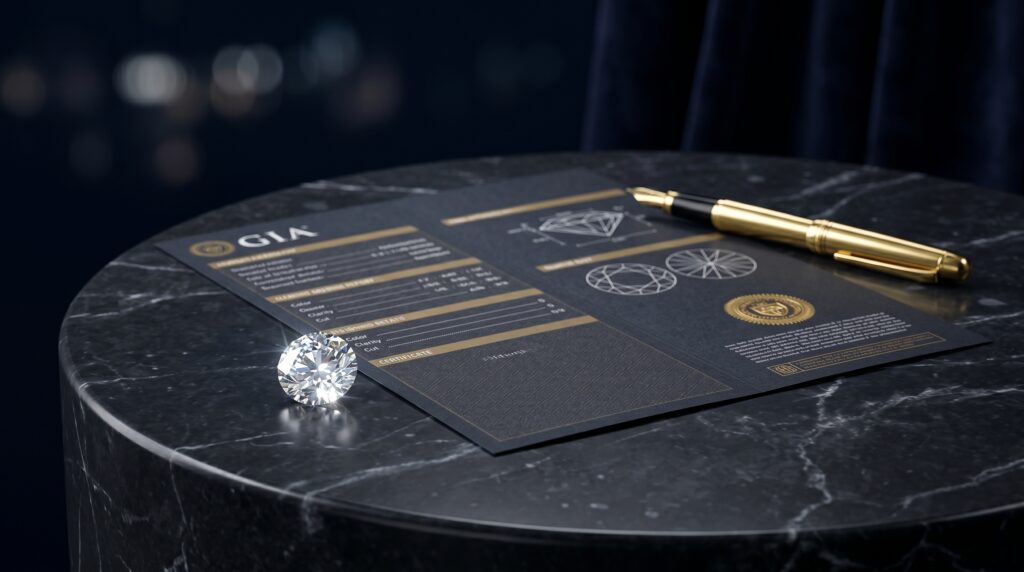
This is the C that sets the 5Cs framework apart from the original 4Cs, and it may be the most important one for anyone spending real money on a diamond.
A diamond grading report from a reputable laboratory is an independent, third-party assessment of the stone’s Cut, Color, Clarity, and Carat weight. It also records fluorescence, measurements, and additional details that simply do not appear on a jeweler’s verbal description or sales receipt. The report gives you something no handshake deal can provide: objective, documented proof of quality.
Not all grading certificates carry equal weight. GIA, the Gemological Institute of America, sets the global benchmark for natural diamond grading. When diamond professionals talk about certified diamonds, a GIA report is the standard they are referencing. GIA-certified diamonds typically command a 10 to 15 percent price premium over non-certified stones in the wholesale market, because the certificate is that trusted.
IGI, the International Gemological Institute, has become the leading certification body for lab-grown diamonds and is widely accepted by retailers, manufacturers, and wholesalers in the USA and globally. IGI applies the same grading standards as GIA for the four physical quality factors, making it a credible and practical choice for both natural and lab-grown stone sourcing.
Other certificates, like EGL (European Gemological Laboratory), have historically shown grade inflation of one to three grades compared to GIA standards. The Rapaport pricing grid, which is the wholesale pricing benchmark for the entire diamond trade, is built around GIA grades. An EGL SI1 and a GIA SI1 are not the same stone, even if the paperwork says otherwise.
Most modern grading reports also include a laser inscription on the girdle of the diamond, linking the physical stone to its specific report number. This is your traceability guarantee. Before you finalize any purchase, always ask for the lab report and confirm the inscription number matches.
IGI diamond grading for lab-grown stones uses the same scale and terminology as natural diamond grading, which makes the 5Cs framework fully portable across both origins.
How the 5Cs Work Together: A Practical Buying Guide
Understanding each C individually is useful. Knowing how to rank and balance all five when you have a real budget and a real deadline is what makes the difference.
| Priority | C | Why It Matters | Budget Tip |
|---|---|---|---|
| 1 | Cut | Determines sparkle above everything | Never compromise: choose Excellent or Very Good |
| 2 | Certification | Verifies all other Cs independently | Only accept GIA or IGI reports |
| 3 | Carat | Affects perceived size and price | Buy just below magic numbers (0.90, 1.90, 2.90) |
| 4 | Color | Visible to the naked eye above H | G-H range gives the best value per dollar |
| 5 | Clarity | Often hidden by cut and setting | VS2 to SI1 is typically eye-clean and well-priced |
Most buyers get this order wrong. They lead with carat weight because bigger feels better. That logic consistently leads to overpaying for size at the expense of the qualities that actually make a diamond beautiful to look at. A smaller, well-cut stone in a G VS2 with a GIA certificate will outperform a larger, poorly cut stone at the same price every single time.
Five practical steps when shopping with the 5Cs:
- Set your cut grade first commit to Excellent or Very Good and do not move from it.
- Request the certificate before you see the price, let the grades guide your expectations.
- Use carat magic numbers to save on weight: drop to 0.90ct or 1.90ct and reallocate that budget to cut or color.
- Choose G or H color for white metal settings; consider H or I if you plan to set in yellow gold.
- View the stone in natural light if possible, not just under jewelry store lighting, before making a final decision.
Before you finalize any purchase, always ask for the lab report, confirm the girdle inscription number, and verify the report on the issuing laboratory’s online database.
What B2B Diamond Buyers and Wholesalers Should Know About the 5Cs
For diamond manufacturers, wholesalers, and retail buyers sourcing inventory, the 5Cs are not just a consumer education tool. They are the operational language of the entire trade.
Rapaport pricing, the wholesale benchmark used across the USA and international diamond markets, is built directly around the 4Cs. Stones are priced by their certified color and clarity grades in a matrix format, with cut quality and certification lab affecting premiums and discounts applied on top of the base Rap price. Consistency in diamond grading is everything in bulk sourcing. A parcel described as G VS2 GIA means something precise and verifiable. A parcel described with an EGL certificate does not carry the same certainty, and experienced buyers price it accordingly.
That said, IGI certification has gained significant ground in the wholesale market, particularly for lab-grown inventory. Many USA-based retailers now spec their lab-grown orders entirely to IGI standards, and supply chains have adapted around this.
When specing diamonds for retail orders using the 5Cs, wholesalers typically anchor on three fixed parameters and allow variance in two. A common spec might lock in Excellent cut and GIA certification while allowing G-H color and VS2-SI1 clarity to float depending on availability.
In my years working with B2B buyers across the USA market, the single most common sourcing mistake I see is inconsistent certification. Mixing GIA, IGI, and lesser labs within the same retail parcel creates pricing confusion and erodes consumer trust. Building an inventory around one or two trusted labs is not just good grading practice. It is a business decision.
GIA certified diamonds set the resale floor. IGI certified diamonds, particularly in the lab-grown segment, offer competitive pricing with strong documentation. Both belong in a well-structured retail or wholesale diamond program.
Conclusion
The 5Cs of diamonds explained exist because quality is invisible without a framework to measure it. Cut determines whether a diamond dazzles or disappears under light. The combination of color and clarity defines how pure and clean the stone looks to the naked eye. Carat tells you how much diamond you actually have. And Certification ties all four qualities together with independent, documented proof that what you are buying matches what you are paying for.
The truth is, no single C tells the whole story on its own. A flawless diamond with a poor cut grade is a disappointment in person. A large diamond with no credible certificate is a risk you are absorbing entirely yourself. The buyers who consistently make smart decisions, whether they are shopping for one engagement ring or sourcing a thousand stones for retail inventory, are the ones who understand how all five factors interact.
Most buyers who read this will approach their next diamond conversation differently. That is the point. When you are ready to buy with confidence, explore our certified diamond collection at Lepdo Diamonds, where every stone comes backed by the documentation you need to buy without second-guessing.
At Lepdo Diamonds, we believe the right diamond is not the biggest one or the most expensive one. It is the one you fully understand before you buy it.
Frequently Asked Questions About the 5Cs of Diamonds
1: What are the 5Cs of diamonds?
The 5Cs of diamonds explained are Cut, Color, Clarity, Carat, and Certification. They build on the GIA’s original 4Cs framework by adding Certification as the fifth and most verifiable factor. Together, these five qualities determine a diamond’s appearance, rarity, and market value, giving buyers and professionals a standardized language to evaluate any stone confidently.
2: What is the most important of the 5Cs of diamonds?
Cut is the most important of the 5Cs for visual quality because it controls how much light a diamond reflects back to your eye. A poorly cut two-carat stone can look duller than a well-cut one-carat stone. For investment and trade purposes, Certification ranks equally high because it independently verifies all other quality claims made about a stone.
3: What is the difference between 4Cs and 5Cs of diamonds?
The 4Cs of diamonds Cut, Color, Clarity, and Carat were developed by the GIA as the global grading standard. The 5Cs framework adds Certification as the fifth quality, recognizing that a lab grading report from GIA or IGI is what makes the other four Cs independently verified, trusted, and tradeable in today’s diamond market.
4: How does diamond cut affect brilliance and value?
Diamond cut quality directly controls how light enters, travels through, and exits a stone. A well-cut diamond reflects most light back through the table as brilliance and fire. GIA grades round brilliant cuts from Excellent to Poor. An Excellent cut grade can add 10 to 20 percent to a diamond’s market value compared to a Good grade on the same stone.
5: What diamond clarity grade is best for an engagement ring?
VS2 to SI1 clarity grades are the best range for most engagement rings. Diamonds in this range are typically eye-clean, meaning inclusions are invisible without magnification, yet they cost significantly less than VVS or Flawless stones. For step-cut shapes like emerald or asscher, move up to VS1 or VS2, since those shapes make inclusions more visible to the naked eye.
6: Does a higher carat weight always mean a bigger looking diamond?
No. A higher carat weight does not always mean a visually larger diamond. Cut quality, depth percentage, and girdle thickness all affect how large a diamond appears face-up. A shallow-cut 1.5ct stone can look larger than a deep-cut 1.5ct stone of the same weight. Fancy shapes like ovals and marquise often look larger than round brilliants at equal carat weight.
7: Are GIA and IGI diamond certifications equally trusted?
GIA and IGI are both respected, internationally recognized grading laboratories but serve slightly different markets. GIA is the global benchmark for natural diamonds and commands the highest resale confidence. IGI is the leading certifying body for lab-grown diamonds and is widely accepted by retailers and wholesalers. Other certificates, such as EGL, carry significantly less market trust and trade at discounted prices.
8: Do lab-grown diamonds use the same 5Cs grading system?
Yes. Lab-grown diamonds are graded using the same 5Cs framework as natural diamonds. IGI is the most commonly used laboratory for grading lab-grown stones and applies the same Cut, Color, Clarity, and Carat standards. The Certification component is equally important for lab-grown diamonds, as it confirms origin, quality, and authenticity for both retail buyers and wholesale purchasers.