
A diamond manufacturer can examine thousands of stones and still miss one critical detail: the atomic structure behind the beauty. A diamond may have identical carat weight, color grade, and clarity grade on paper, yet its internal growth history can influence transparency, strain, and long-term market value.
CVD Diamond Spectroscopy & Crystal Physics has become one of the most important scientific areas in modern diamond evaluation because it reveals what the eye cannot see. Through advanced testing methods such as photoluminescence spectroscopy diamond testing, FTIR spectroscopy diamond type analysis, and UV-Vis absorption spectroscopy, laboratories can identify growth characteristics, defects, and treatments in lab-grown diamonds.
For manufacturers, wholesalers, and consumers comparing diamonds using the 4Cs of Diamonds, understanding crystal physics creates a stronger buying decision. The combination of GIA research standards, IGI certification practices, and modern material science helps the industry evaluate diamonds beyond appearance alone.
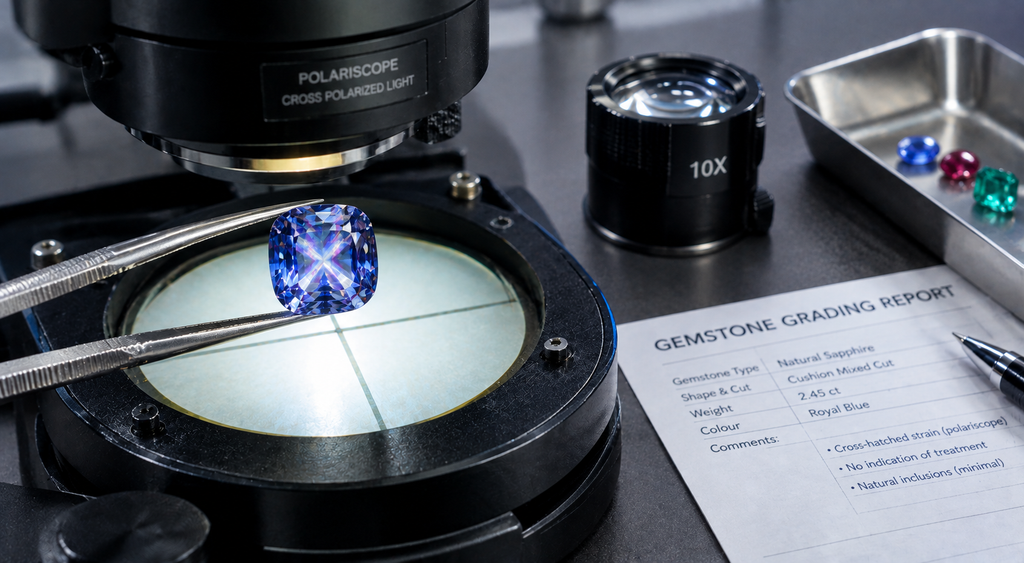
What the Topic Is
CVD Diamond Spectroscopy & Crystal Physics is the scientific study of how diamonds form at the atomic level and how spectroscopy methods analyze their internal structure, defects, and optical behavior.
Quick Info Box:
Definition: CVD Diamond Spectroscopy & Crystal Physics examines the atomic arrangement, growth patterns, and light interaction properties of diamonds produced through chemical vapor deposition technology.
Key Types or Varieties: Type IIa CVD diamonds, nitrogen-containing CVD diamonds, silicon-vacancy diamonds, HPHT-treated CVD diamonds, single-crystal CVD diamonds.
Best For: Diamond manufacturers, jewelry retailers, wholesalers, engagement ring buyers, and collectors seeking verified lab-grown diamond quality.
Key Difference or Advantage: Scientific testing identifies hidden characteristics that traditional visual inspection cannot detect.
For businesses and buyers looking for professionally graded stones, Lepdo Diamonds provides access to certified diamond inventories tested through recognized grading standards.
Sub-facet or Key Technical Characteristic 1
The foundation of diamond performance begins with its crystal lattice structure. A diamond is made of carbon atoms arranged in a three-dimensional cubic structure where each carbon atom bonds strongly with four neighboring atoms.
This arrangement creates diamond’s exceptional hardness, thermal conductivity, and optical properties. In a perfect single-crystal diamond lattice structure, light travels efficiently through the material, producing the brilliance and fire consumers expect from a polished diamond.
However, laboratory-grown diamonds can contain growth-related features such as dislocations, vacancies, and strain patterns. These characteristics are not always visible but can be identified using spectroscopy.
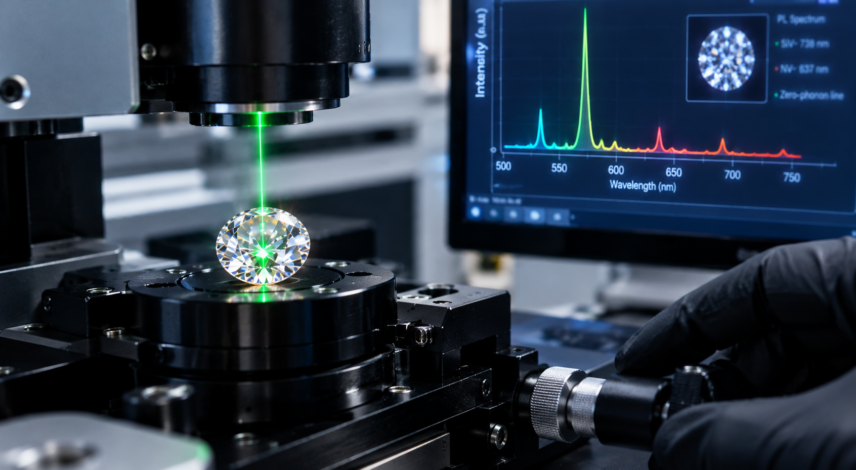
Photoluminescence spectroscopy diamond testing detects specific atomic defects by measuring light emitted from diamond after laser excitation. One well-known example is the 737nm silicon-vacancy center, which indicates silicon-related defects commonly associated with CVD growth environments.
The takeaway is simple: diamond beauty starts at the atomic level.
Sub-facet or Key Technical Characteristic 2
Commercial diamond evaluation depends on connecting scientific data with grading standards. A diamond’s crystal structure influences clarity, color appearance, and how effectively its facets return light.
Most buyers focus on the visible characteristics of a gemstone, but laboratories analyze much deeper information. Type classification is one important example. Type IIa diamonds contain extremely low nitrogen levels and represent some of the purest diamonds available.
FTIR spectroscopy diamond type analysis helps identify whether a diamond is Type IIa or Type Ia by measuring infrared absorption patterns caused by impurities. Natural and lab-grown diamonds can both belong to these categories.
Here is what makes this valuable for buyers: two diamonds with the same clarity grade may have different internal characteristics that affect rarity, origin identification, and certification results.
Most Popular Types or Variations of CVD Diamond Material Science
CVD diamond material science covers several diamond categories based on growth conditions, impurity levels, and intended use. Each variation serves different commercial purposes, from luxury jewelry to advanced industrial applications.
Top Variation or Primary Category 1: Type IIa CVD Diamonds
Type IIa CVD diamonds are among the most sought-after lab-grown diamonds because they contain minimal nitrogen impurities. They often display exceptional transparency and can achieve premium color grades such as D, E, and F.
For engagement rings and fine jewelry, Type IIa stones appeal to buyers who prioritize purity and optical performance. Many high-quality CVD diamonds in the market fall into this category after controlled growth and processing.
As-grown Type IIa diamond certification criteria focus on verifying chemical composition, growth characteristics, and absence of unwanted treatments.
Top Variation or Primary Category 2: Silicon-Vacancy CVD Diamonds
Silicon-vacancy centers, commonly called SiV centers, are atomic defects where a silicon atom interacts with a missing carbon position inside the diamond lattice.
These centers create a recognizable optical signature near 737 nanometers, making them valuable markers in laboratory identification. Advanced photoluminescence systems can detect these signals even when diamonds appear visually identical.
SiV centers are especially important in research because they demonstrate how controlled defects can influence future quantum technology applications.
Top Variation or Primary Category 3: Nitrogen-Vacancy CVD Diamonds
Nitrogen-vacancy centers, known as NV centers, occur when a nitrogen atom replaces carbon and sits next to an empty lattice position.
In gemology, NV centers help researchers understand diamond growth environments and defect behavior. In technology, they are studied for quantum sensing applications because they can interact with magnetic fields at atomic scales.
For jewelry buyers, the presence of these defects does not automatically indicate poor quality. Their impact depends on concentration, location, and whether they affect visible appearance.
Top Variation or Primary Category 4: HPHT-Annealed CVD Diamonds
Some CVD diamonds undergo HPHT annealing, a high-pressure high-temperature process used to improve color or modify certain growth-related characteristics.
Post-growth HPHT annealing defect detection is performed through advanced laboratory testing because treatments may not be obvious through standard inspection.
Reliable diamond certification documents treatment information so buyers understand exactly what they are purchasing.
Top Variation or Primary Category 5: Single-Crystal CVD Diamonds
Single-crystal CVD diamonds are grown with a continuous crystal structure rather than multiple crystal regions.
They are preferred for high-end jewelry applications because they provide excellent transparency and predictable optical performance. They are also used in specialized industries requiring strong thermal properties.
Top Variation or Primary Category 6: Industrial CVD Diamonds
Industrial CVD diamonds are designed for applications beyond jewelry, including cutting tools, heat management systems, and scientific equipment.
Their value depends on thermal conductivity, durability, and structural consistency rather than traditional gemstone appearance.
Top Variation or Primary Category 7: Fancy Color CVD Diamonds
Fancy color CVD diamonds achieve unique shades through controlled growth conditions or treatment processes.
Colors such as pink, blue, and yellow are evaluated through absorption spectroscopy and defect analysis to understand their origin and stability.
Top Variation or Primary Category 8: CVD Diamond Rough
CVD diamond rough refers to the unpolished material immediately after laboratory growth.
Manufacturers analyze rough diamonds for strain, crystal orientation, and potential yield before cutting. Octahedral cleavage planes in CVD diamond planning help determine the safest cutting approach and maximize final polished value.
Diamond Crystal Physics, Spectroscopy & Material Science
Topic vs Main Alternative: CVD Diamond Spectroscopy & Crystal Physics vs Natural Diamond Material Science
CVD Diamond Spectroscopy & Crystal Physics and traditional natural diamond analysis use many of the same scientific principles, but their evaluation focuses on different growth histories. Both require advanced testing to understand crystal structure, impurities, and optical performance.
| Factor | CVD Diamond Spectroscopy & Crystal Physics | Natural Diamond Material Science |
|---|---|---|
| Growth Origin | Created through controlled chemical vapor deposition growth | Formed naturally under extreme geological pressure and temperature |
| Defect Analysis | Focuses on growth patterns, SiV centers, NV centers, and treatment detection | Focuses on natural inclusions, nitrogen aggregation, and geological indicators |
| Main Testing Methods | Photoluminescence, FTIR, UV-Vis absorption spectroscopy | FTIR, Raman spectroscopy, microscopy, and advanced origin testing |
| Common Type Classification | Frequently Type IIa with controlled impurity levels | Type Ia is most common, with nitrogen-related characteristics |
| Market Evaluation | Based on certification, cut quality, color, clarity, and growth verification | Based on rarity, geological origin, certification, and 4Cs |
The main difference is not chemical composition because both are carbon crystals. The difference comes from formation environment, growth patterns, rarity factors, and buyer expectations.
Critical Differentiator: Performance and Aesthetics
Diamond performance is determined by how efficiently light enters, travels through, and exits the stone. A well-cut diamond creates strong brilliance, fire, and scintillation regardless of whether it was created naturally or through CVD technology.
The truth is, consumers usually cannot identify a high-quality CVD diamond from a natural diamond by visual inspection alone. Advanced laboratory instruments are required to analyze atomic-level characteristics.
Cut precision, pavilion angles, table percentage, and facet alignment influence visible beauty more than origin alone. A poorly cut diamond with premium material can appear weaker than a well-cut diamond with optimized proportions.
Think of it this way: crystal quality provides the foundation, but cutting determines how the diamond performs in real-world lighting.
Critical Differentiator: Cost Structure and Sourcing Economics
CVD diamonds generally offer a different pricing structure because production can be controlled through laboratory growth cycles. This allows manufacturers and retailers to create inventory planning strategies based on customer demand.
Wholesale pricing depends on factors including carat weight, color grade, clarity grade, certification, and market availability. A 1-carat CVD diamond with D color and VVS clarity may be priced differently depending on certification source, cutting quality, and supply conditions.
To be fair, traditional round brilliants still command high market volume because of decades of consumer recognition and established resale expectations. However, growing demand for transparency and value has expanded interest in lab-grown diamonds.
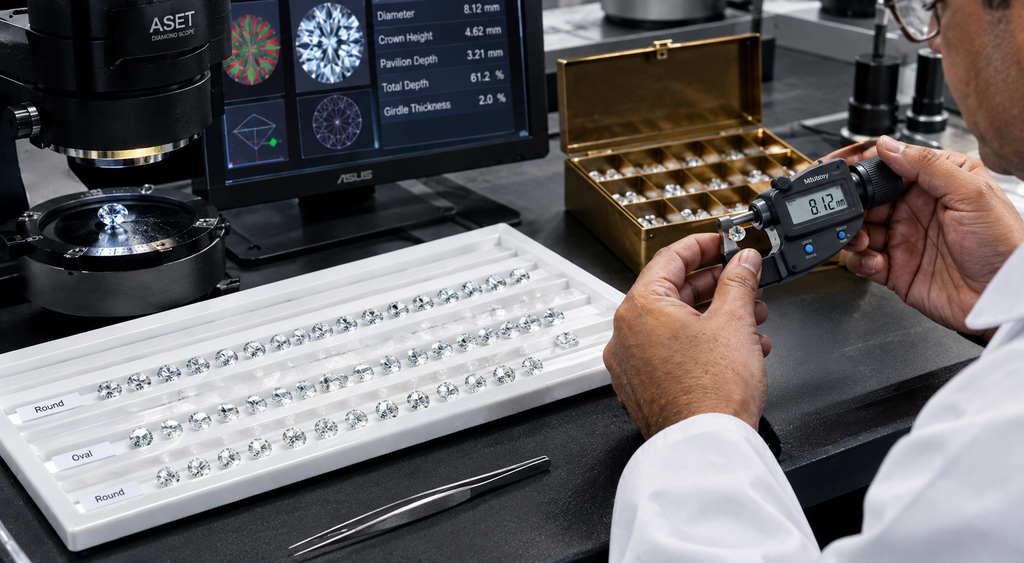
How to Choose the Right CVD Diamond for Your Style or Inventory
Selecting a diamond requires more than comparing carat weight and price. The best choice depends on how the diamond will be worn, displayed, sold, or incorporated into a jewelry collection.
Most buyers focus first on size, but experienced professionals evaluate the complete relationship between crystal quality, cut proportions, setting design, and budget.
1. Personal Style, Silhouette, or Physical Fit
Diamond shape influences how large a stone appears on the hand. Elongated shapes such as oval, emerald, pear, and marquise often create a larger face-up appearance compared with round diamonds of similar carat weight.
For modern engagement rings, unique diamond shapes have gained popularity because buyers want individuality rather than traditional designs.
A buyer choosing a 2-carat oval diamond, for example, may prioritize length-to-width ratio because it directly affects the visual personality of the stone.
2. Metal Setting, Mounting, and Structural Use-Case Compatibility
The setting must support the diamond’s shape and protect vulnerable areas. Pear and marquise diamonds require careful prong placement because pointed ends can be exposed.
Bezel settings provide additional protection, while classic solitaire settings highlight maximum light exposure.
The structural design should match both lifestyle and aesthetic goals.
3. Optical Performance, Cut Proportions, and Light Behavior
A diamond’s brilliance depends on how effectively it returns light. Factors such as pavilion depth, table percentage, crown height, and facet symmetry influence the final appearance.
A diamond with excellent material properties can still appear dull if proportions are poorly calculated.
Photoluminescence testing and structural analysis verify material characteristics, while visual inspection evaluates cut performance.
4. Budget Allocation and Pricing Advantages vs Standard Alternatives
Budget decisions should prioritize visible beauty rather than invisible specifications. Many buyers overspend on clarity grades that do not create noticeable differences.
A VS clarity diamond may appear identical to a higher clarity stone when viewed without magnification, depending on inclusion placement.
Smart allocation often means selecting strong cut quality first, then optimizing color and clarity based on personal preference.
5. Intended Occasion: Bridal, Everyday Fine Jewelry, Custom Bespoke, or Retail Stock
The ideal diamond depends on usage.
Bridal customers often prioritize symbolism, durability, and certification. Retail inventory buyers usually focus on demand patterns, availability, and margin opportunities.
Custom jewelry clients may prioritize unusual shapes, rare colors, or specific design compatibility.
6. Lab-Grown vs Natural Considerations
Lab-grown diamonds are chemically, physically, and optically real diamonds. The main difference is their origin and formation process.
Lab-grown diamond material science helps explain how CVD and HPHT technologies recreate the diamond growth environment. Buyers should compare certification, quality, and intended value rather than relying only on origin labels.
For buyers researching verified stones, reviewing certified diamonds through recognized laboratories helps establish confidence before purchase.
Before you finalize your choice, examine certification details, growth information, cut performance, and how the diamond fits your actual purpose.
Balancing Proportions, Ratio, and Setting Security
Professional diamond selection requires understanding measurements beyond carat weight.
The length-to-width ratio determines whether an elongated diamond appears slim, balanced, or wide. For example, many oval diamonds are visually preferred around ratios between 1.30 and 1.50, although personal preference remains important.
Depth percentage influences how light behaves inside the stone. Excessive depth can reduce face-up size, while shallow proportions may create window effects where the background becomes visible through the diamond.
Setting security also matters. Thin girdles may require protective designs, while thicker girdles can influence visual spread.
Navigating Price Tiers vs Visual Return
The highest clarity grade does not always provide the highest visual return.
Most buyers cannot distinguish between internally flawless and well-selected VS clarity diamonds without magnification. The practical choice often depends on inclusion visibility, certification quality, and overall cut performance.
Here is what makes professional advice valuable: a diamond should maximize beauty per dollar, not simply maximize laboratory grades.
What B2B Buyers and Diamond Manufacturers Should Know
CVD Diamond Spectroscopy & Crystal Physics has changed how manufacturers, wholesalers, and jewelry brands evaluate diamond inventory. Modern buyers require deeper verification than basic appearance checks.
A successful procurement strategy combines scientific testing, consistent manufacturing, reliable certification, and market understanding.
For companies sourcing finished stones or production-ready inventory, working with an experienced fancy cut diamond manufacturer requires attention to grading consistency, supply reliability, and documentation.
Lepdo Diamonds supplies certified lab-grown diamonds including IGI, GIA, and SGL certified stones across multiple shapes, colors, and clarity ranges.
Wholesale Procurement Models: Memo Programs vs Direct Sourcing
Wholesale diamond purchasing commonly follows different models depending on inventory requirements.
Memo programs allow retailers to display diamonds without immediate ownership transfer. This reduces upfront capital requirements but may create limitations around availability and pricing control.
Direct sourcing provides stronger inventory control and potential margin benefits but requires accurate demand forecasting.
Manufacturers often use a combination of both approaches depending on market conditions.
A first-person expert trade tip: “When I review wholesale parcels, I always check consistency before volume. Ten stones that match perfectly often create more retail value than fifty mixed-quality diamonds.”
Batch Consistency, Calibration, and Tolerance Standards
Large-scale buyers require strict sorting standards.
Professional manufacturers evaluate parcels according to:
• Millimeter size consistency
• Color tolerance ranges
• Clarity distribution
• Cut symmetry
• Fluorescence behavior
• Certification matching
For example, a retail collection featuring 1-carat oval diamonds requires consistent measurements so customers receive predictable visual comparisons.
Laboratory testing also helps screen metallic catalyst inclusions in lab-grown diamonds, particularly when reviewing HPHT-related growth characteristics.
Topic Jewelry Trends (2026 to 2027)
CVD Diamond Spectroscopy & Crystal Physics is influencing jewelry trends because modern buyers increasingly want scientific transparency alongside visual beauty. Between 2026 and 2027, the jewelry market is expected to continue moving toward certified lab-grown diamonds, customized designs, and value-focused luxury.
According to industry research from organizations including the International Gemological Institute (IGI), lab-grown diamond demand has expanded significantly as consumers seek larger stones, ethical sourcing information, and transparent pricing structures.
The modern buyer is not only asking, “How large is the diamond?” They are also asking, “How was it created, tested, and certified?”
Contemporary Setting Styles and Architectural Mountings
Contemporary jewelry design is moving toward clean structures and personalized silhouettes.
Bezel settings are becoming increasingly popular because they combine modern aesthetics with everyday protection. East-west mountings are also gaining attention because they create a distinctive appearance by positioning elongated diamonds horizontally rather than traditionally vertically.
Multi-stone configurations, including three-stone rings, toi et moi designs, and mixed-shape combinations, are also attracting buyers who want meaningful storytelling through jewelry.
Diamond manufacturers are adapting production strategies to support these trends by offering consistent shapes, calibrated sizes, and wider inventory options.
Shifting Consumer Demographics and Purchasing Drivers
Modern diamond buyers are more informed than previous generations. They compare certification documents, research diamond grading, and evaluate price differences before purchasing.
Here is what has changed: consumers now view transparency as part of luxury.
Younger buyers often compare natural diamonds and lab-grown diamonds based on size, design flexibility, certification, and budget efficiency.
For retailers, this means education has become a major part of the selling process. A knowledgeable customer is more likely to appreciate quality differences when those differences are clearly explained.
How to Evaluate Quality in CVD Diamonds
When I assess a CVD diamond, the first thing I check is not the price tag. I examine the relationship between crystal quality, optical performance, and certification details.
A beautiful diamond requires harmony between material structure and cutting precision. The 4Cs remain important, but advanced evaluation adds another layer by analyzing growth characteristics, defects, and treatment history.
Professional assessment includes the following rules:
1. Verify Crystal Structure and Growth Characteristics
A quality CVD diamond should have documented growth information and reliable laboratory verification.
Advanced methods such as photoluminescence spectroscopy identify NV and SiV centers, while FTIR spectroscopy diamond type analysis determines impurity patterns.
A Type IIa classification often indicates extremely low nitrogen content, but certification remains essential because growth methods and treatments must be properly disclosed.
2. Examine Cut Quality, Brilliance, Fire, and Scintillation
Cut quality determines how a diamond interacts with light.
Brilliance refers to white light reflection, fire describes colored flashes, and scintillation represents sparkle created through movement.
Experts review:
• Pavilion depth
• Table percentage
• Crown proportions
• Facet symmetry
• Light return performance
A diamond with excellent material but weak cutting may fail to deliver the expected visual impact.
3. Analyze Color Grade and Clarity Grade Carefully
Color and clarity evaluation should consider the entire diamond.
High-quality CVD diamonds can achieve premium color grades from D to F and clarity grades ranging from VVS to VS depending on growth and processing.
However, buyers should understand that laboratory grades are not the only factor. The location and visibility of inclusions can influence actual appearance.
4. Review Treatment History and Defect Detection
Some CVD diamonds undergo HPHT annealing after growth.
Post-growth HPHT diamond manufacturer Surat annealing defect detection helps laboratories identify changes in internal structure and confirm accurate disclosure.
A professional buyer should always review whether treatments are listed on certification documents.
5. Confirm Diamond Certification and Laboratory Documentation
Reliable certification provides confidence for both consumers and trade buyers.
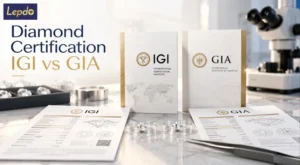
Gemological Institute of America (GIA), International Gemological Institute (IGI), and other recognized laboratories provide reports describing diamond characteristics.
Buyers searching for verified inventory should focus on certified diamonds supported by proper documentation rather than relying only on seller claims.
Analyzing Light Return: Spotting Bow-Ties, Windows, and Extinction
Light performance separates an average diamond from an exceptional one.
The bowtie effect is a dark area commonly seen across elongated diamond shapes such as ovals, pears, and marquise cuts. It occurs when facet angles prevent proper light reflection.
Windows appear when the pavilion area allows background colors to pass through the diamond, reducing brightness.
Extinction refers to areas where light is blocked, creating unwanted dark zones.
A skilled evaluator checks these issues through multiple lighting environments because a diamond should perform beyond a single showroom spotlight.
Think of it this way: a diamond should look alive in motion, not only under perfect lighting.
Assessing Diamond Reports and Grading Discrepancies
Diamond reports provide essential information, but understanding them requires experience.
Buyers should examine:
• Laboratory name
• Diamond measurements
• Diamond Color Grades: Complete Guide to Understanding Diamond Color Quality
• Cut information where available
• Treatment disclosures
• Inclusion mapping
Different laboratories may apply slightly different grading approaches, so comparing reports requires attention to reputation and consistency.
Rapaport market references also influence trade pricing discussions, although actual transactions depend on supply, demand, certification, and stone characteristics.
Strategic Takeaways for Buyers and Jewelers
CVD Diamond Spectroscopy & Crystal Physics has changed how the diamond industry evaluates quality, origin, and long-term value. The first strategic lesson for buyers is that diamond beauty begins with crystal structure, but the final visual performance depends on precision cutting, proportion control, and light behavior.
The second lesson is that certification and scientific verification have become essential parts of modern diamond purchasing. Whether you are a consumer selecting an engagement ring or a retailer building inventory, understanding testing methods such as FTIR, photoluminescence, and UV-Vis spectroscopy helps create better buying decisions.
The third lesson is that successful diamond sourcing requires consistency. Manufacturers, wholesalers, and jewelry brands need reliable partners who understand crystal physics, grading standards, and market expectations.
For buyers seeking certified lab-grown diamonds with verified quality standards, Lepdo Diamonds offers certified inventory across different shapes, colors, and clarity ranges. Explore more about verified sourcing through Lepdo Diamond.
The future of diamonds will not be defined only by size or price. It will be shaped by scientific transparency, responsible sourcing, and the ability to understand what exists beneath the surface of every stone.
Frequently Asked Questions About CVD Diamond Spectroscopy & Crystal Physics.
1. What is CVD Diamond Spectroscopy & Crystal Physics?
CVD Diamond Spectroscopy & Crystal Physics studies the atomic structure, defects, and optical behavior of diamonds created through chemical vapor deposition. Within CVD Diamond Spectroscopy & Crystal Physics, techniques like FTIR, photoluminescence, and UV-Vis absorption spectroscopy identify impurities, growth patterns, and treatments. Ultimately, CVD Diamond Spectroscopy & Crystal Physics helps laboratories verify diamond quality beyond traditional visual inspection.
2. Is CVD Diamond Spectroscopy & Crystal Physics Cheaper Than Natural Diamond Analysis?
CVD Diamond Spectroscopy & Crystal Physics is not simply cheaper or more expensive than natural diamond testing because CVD Diamond Spectroscopy & Crystal Physics costs depend on laboratory equipment, analytical complexity, and certification requirements. While natural gems require origin testing, CVD Diamond Spectroscopy & Crystal Physics provides specialized defect analysis. Both diamond evaluation approaches and CVD Diamond Spectroscopy & Crystal Physics require professional equipment to provide accurate quality information.
3. In CVD Diamond Spectroscopy & Crystal Physics, Which Diamond Shape Looks Biggest on the Hand?
Under the principles of CVD Diamond Spectroscopy & Crystal Physics, elongated CVD diamond shapes such as oval, emerald, pear, and marquise often appear larger because they cover more finger area. CVD Diamond Spectroscopy & Crystal Physics shows that visual impact depends on cut proportions, length-to-width ratio, and face-up measurements. Through CVD Diamond Spectroscopy & Crystal Physics analysis, a well-cut 2-carat elongated diamond can appear significantly larger than round diamonds of identical carat weight.
4. Does CVD Diamond Spectroscopy & Crystal Physics Have an Official GIA Cut Grade?
CVD Diamond Spectroscopy & Crystal Physics does not receive a separate GIA cut grade because CVD Diamond Spectroscopy & Crystal Physics describes scientific characteristics rather than traditional visual appearance grading. GIA evaluates diamond cut properties through established grading systems, whereas CVD Diamond Spectroscopy & Crystal Physics identifies intrinsic material features such as lattice defects, post-growth treatments, and growth characteristics.
5. What Defect Does CVD Diamond Spectroscopy & Crystal Physics Identify as the Biggest Quality Risk?
The biggest quality risks evaluated in CVD Diamond Spectroscopy & Crystal Physics include visible strain patterns, unwanted inclusions, poor cutting, and undisclosed treatments. Advanced CVD Diamond Spectroscopy & Crystal Physics can detect growth-related defects and post-synthesis HPHT processing effects. CVD Diamond Spectroscopy & Crystal Physics indicates that buyers should review certification reports and examine optical performance, as material quality and cutting precision work together.
6. How Does CVD Diamond Spectroscopy & Crystal Physics Evaluate If Lab Diamonds Are Chemically Identical to Natural Ones?
CVD Diamond Spectroscopy & Crystal Physics confirms that lab-grown CVD diamonds and natural diamonds share the exact same carbon crystal lattice and physical properties. Through CVD Diamond Spectroscopy & Crystal Physics, gemologists understand that the fundamental difference is origin, not authenticity. Advanced CVD Diamond Spectroscopy & Crystal Physics instruments identify growth patterns and spectroscopic defects that reveal whether a diamond formed geologically or via laboratory technology.
7. How Does CVD Diamond Spectroscopy & Crystal Physics Verify Durability for an Everyday Engagement Ring?
CVD Diamond Spectroscopy & Crystal Physics confirms that high-quality CVD diamond manufacturer India are exceptionally durable for everyday engagement rings because CVD Diamond Spectroscopy & Crystal Physics treats diamond as the hardest known material. Based on CVD Diamond Spectroscopy & Crystal Physics assessments, practical ring choices include stones with strong cut quality, suitable clarity, secure protective settings, and reliable laboratory certification.
8. How to Use CVD Diamond Spectroscopy & Crystal Physics Standards to Choose a Reliable Wholesale Supplier?
Applying CVD Diamond Spectroscopy & Crystal Physics standards helps buyers choose a manufacturer based on certification accuracy, quality consistency, transparent disclosure, and production expertise. A reliable supplier utilizing CVD Diamond Spectroscopy & Crystal Physics should provide transparent laboratory documentation, verified grading details, and stable inventory across all requested shapes. Trade buyers rely on CVD Diamond Spectroscopy & Crystal Physics to evaluate sorting accuracy and overall manufacturing capability.
For in-depth market reports, trade sourcing guides, interactive Q&As, and expert gemological perspectives, explore the official Lepdo Group Medium platform and join the discussion on Lepdo Diamonds on Quora.