GIA Certified Diamonds from Surat: Understanding GIA Grading and Why It Matters
 by lepdogroup@gmail.com
3 comments
by lepdogroup@gmail.com
3 comments
GIA certified diamonds from Surat are natural or lab-grown diamonds cut in India’s diamond capital and independently graded by the Gemological Institute of America, the world’s most recognized authority on diamond quality. For US buyers, a GIA certificate removes guesswork by documenting cut, color, clarity, and carat weight to a globally accepted standard. Lepdo Diamonds connects buyers directly with Surat’s top GIA-certified suppliers.
A jewelry retailer in Dallas recently placed an order for fifty 1.50-carat round brilliant diamonds, sourced through an overseas contact offering prices 40 percent below market. The stones arrived without GIA reports. Each one failed the Rapaport price benchmarks, three showed color grades two levels below what the supplier claimed, and the retailer spent months managing chargebacks. This scenario plays out more often than the industry publicly admits, and it is precisely why GIA certified diamonds from Surat have become the preferred sourcing standard for careful US buyers.
Surat, the Indian city that handles more than 90 percent of the world’s diamond cutting and polishing, now ships GIA certified diamonds directly to US retailers, wholesalers, and consumers at prices that were unthinkable a decade ago. The combination of India’s manufacturing scale with the GIA’s grading authority has created a sourcing window that smart buyers are moving quickly to use.
This post covers how the GIA grading process actually works, what a GIA certificate includes, how GIA compares to IGI for Indian-sourced stones, what B2B buyers need to know about bulk procurement, how to evaluate cut quality specific to Surat production, and what the US market looks like heading into 2026.
What Is a GIA Certified Diamond from Surat?
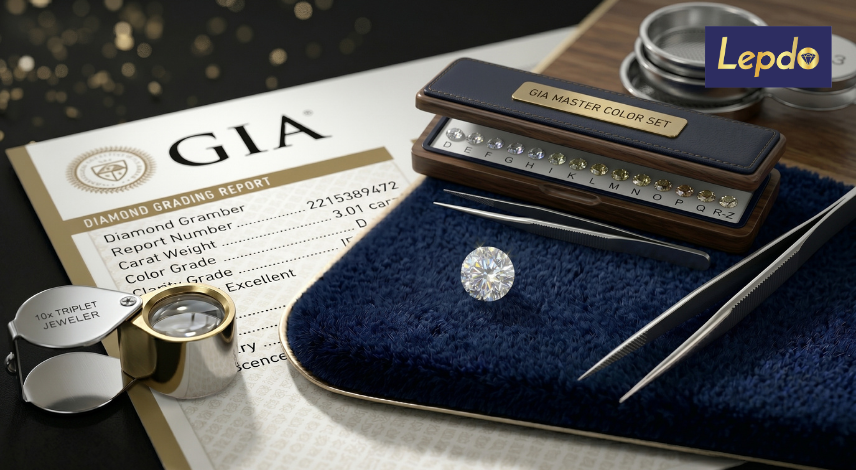
A GIA certified diamond is a natural or lab-grown diamond that has been evaluated and graded by the Gemological Institute of America, the nonprofit research and educational organization widely recognized as the founding authority on diamond grading science. GIA developed the 4Cs grading system, created the standardized diamond grading report, and trains the majority of credentialed gemologists currently working in the US market.
When a diamond from Surat carries a GIA report, it means the stone was physically submitted to a GIA laboratory, where trained graders assessed its cut quality, color grade, clarity grade, and carat weight under controlled conditions. The resulting certificate is a permanent, independently verifiable document tied to the stone’s laser-inscribed girdle number.
Definition: A GIA certified diamond is a stone graded by the Gemological Institute of America using the standardized 4Cs system, with a traceable report number inscribed on the girdle.
Key Types: Round brilliant GIA Excellent cut, fancy shape GIA Very Good, natural diamonds, lab-grown diamonds, fancy color diamonds
Best For: Engagement rings, investment-grade purchases, B2B wholesale sourcing, fine jewelry retail, US consumer confidence buying
Key Advantage: GIA reports are verifiable online in real time, making certificate fraud immediately detectable and providing buyers with a standardized quality baseline across every supplier.
For a full technical explanation of how GIA grading works, the GIA Certified Diamonds glossary page at Lepdo Diamonds is a clear reference point before you place your first order.
Most Popular GIA Certified Diamond Types from Surat, And Who They Are For
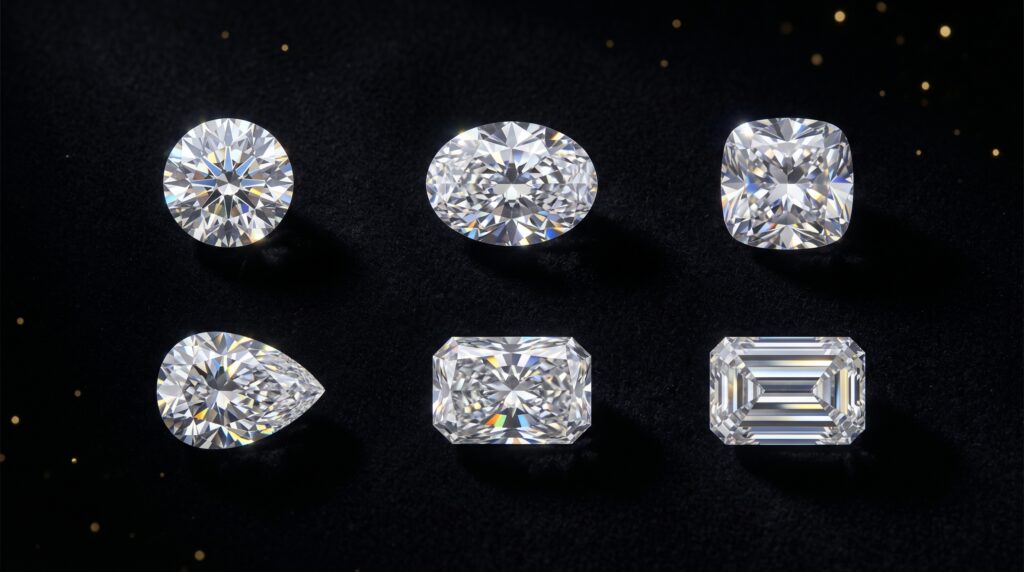
Surat manufacturers produce GIA certified diamonds across every major category. Here is what the supply side actually looks like when you break it down by buyer profile and use case.
1. GIA Excellent-Cut Round Brilliants (D to J Color, VVS to SI Clarity)
This is the highest-demand category for US buyers by volume and by dollar value. A GIA Excellent-cut round brilliant from Surat represents the full convergence of Indian cutting precision and GIA’s stringent optical performance standards. The GIA cut grade for rounds is calculated from seventeen separate measurements and proportions, meaning a GIA Excellent stone from Surat has cleared a bar that no other grading lab matches in rigor. These stones serve solitaire engagement rings, three-stone settings, and any application where the buyer or their customer requires documentation they can verify independently.
2. GIA-Certified Fancy Shape Diamonds: Oval, Cushion, Elongated Radiant
Surat’s cutting talent has advanced significantly in fancy shape production since 2022. GIA-graded ovals, cushions, and elongated radiants from Surat now consistently receive Very Good or Excellent polish and symmetry ratings, and their light performance under magnification is competitive with stones cut in Antwerp or New York. The price advantage over Western cutting centers is meaningful for US retailers stocking fancy shapes in the 1.00 to 3.00 carat range. GIA does not issue a cut grade for fancy shapes, so buyers must rely on GIA polish and symmetry grades plus their own visual evaluation.
3. GIA-Certified Lab-Grown Diamonds from Surat
GIA began grading lab-grown diamonds in 2020 and has issued full 4Cs reports for CVD and HPHT stones grown in India ever since. GIA-certified lab-grown diamonds from Surat offer buyers the same report rigor as natural diamond reports, including disclosure of whether post-growth treatment was applied. This category has grown sharply as US retailers demand certified lab-grown inventory that their customers can verify the same way they verify natural stones.
4. GIA-Certified Melee and Commercial Parcels:
Smaller stones below 0.30 carats are not individually GIA-certified in most bulk transactions, but Surat manufacturers increasingly submit representative stones from melee parcels for GIA grading to establish lot quality benchmarks. For B2B buyers requiring documented consistency, this matters during supplier qualification.
5. GIA-Certified Large Stones (3 Carats and Above):
Surat manufacturers have broken into the large-stone category with GIA-certified natural diamonds at competitive prices. The 3-carat-plus segment now represents one of the fastest-growing wholesale categories for US luxury retailers sourcing from India.
6. GIA-Certified Fancy Color Natural Diamonds:
Yellow, pink, and blue natural fancy color diamonds from Indian parcels are increasingly submitted to GIA for color grading. These stones serve the bespoke design and estate jewelry segments, and GIA’s color grading for fancy colors is considered the global standard.
GIA Certified Diamonds vs IGI Certified Diamonds: The Real Difference
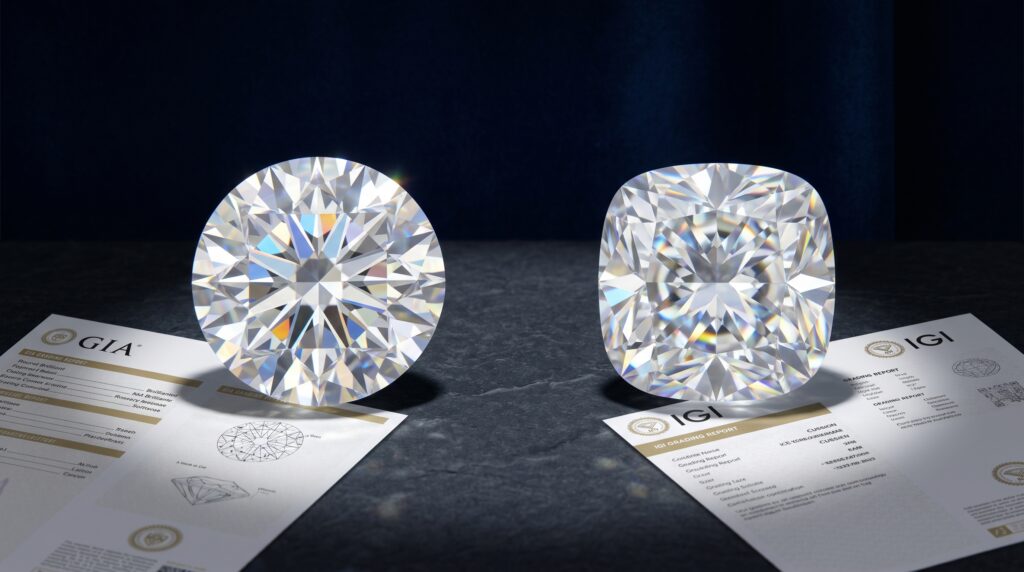
Most buyers sourcing gia diamond india options encounter a genuine dilemma: GIA reports carry a higher market premium, but IGI is the dominant certification standard in Surat production. Understanding the practical difference between these two grading labs will shape every sourcing decision you make.
| Factor | GIA Certified Diamond | IGI Certified Diamond |
| Grading Reputation | Founded 1931; considered the global standard by most US retailers and consumers | Founded 1975; dominant for Indian CVD and lab-grown production; growing US acceptance |
| Cut Grade for Rounds | Excellent to Poor; mathematically rigorous 17-factor calculation | Ideal to Poor; similar scale with slight methodology differences |
| Fancy Shape Cut Grade | Polish and symmetry only; no formal cut grade for fancy shapes | Issues cut grades for ovals, cushions, and other major fancy shapes |
| Market Price Premium | GIA-graded stones typically command 5 to 15 percent premium over comparable IGI stones at US retail | Lower certificate cost passed through to buyer; better value for budget-sensitive sourcing |
| Lab-Grown Disclosure | Full 4Cs report with treatment disclosure; lab-grown notation on certificate | Full 4Cs report; widely used for CVD and HPHT Indian production |
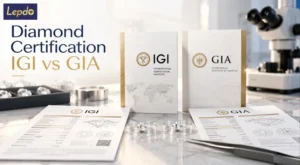
The truth is, neither certificate is universally superior for every use case. A US consumer buying an engagement ring will often feel more confident with a GIA report, because GIA name recognition in the American market is higher. A B2B buyer sourcing lab-grown melee in volume will often prefer IGI because the certificate cost is lower and the turnaround faster. For a complete side-by-side breakdown of what each lab actually grades and how their standards compare, the IGI vs GIA page at Lepdo Diamonds covers the specific differences that affect your purchasing decisions.
How to Choose the Right GIA Certified Diamond from Surat for Your Needs
Choosing a GIA certified diamond is not just about the report grade. It involves the buyer’s aesthetic priorities, the setting, the occasion, and a clear-eyed view of budget versus value. Here is a decision framework that works for both retail consumers and B2B inventory buyers.
- Personal style and visual personality: Round brilliants maximize scintillation and suit traditional preferences. Ovals and elongated radiant deliver a modern, elongating look on the finger. Cushion cuts carry warmth and vintage appeal. Choose based on the wearer’s actual aesthetic, not just current search trends.
- Body and finger compatibility: Longer shapes like oval, pear, and marquise elongate shorter fingers visually. Wider shapes like cushion and Asscher read larger face-up for the same carat weight. Always factor in hand proportion when recommending a shape to a retail customer.
- Setting compatibility: A GIA Excellent-cut round brilliant destined for a solitaire prong setting demands strict optical performance because every facet is exposed. Bezel or channel settings are more forgiving and work well with Very Good-rated fancy shapes sourced from Surat.
- Budget advantage vs alternatives: GIA certified diamonds sourced from Surat manufacturers offer meaningful savings over equivalent stones from Western cutting centers, even after factoring in the GIA certification cost. That gap is widest in the 1.00 to 2.00 carat range, where Indian production volume is highest.
- Occasion: For engagement rings, prioritize GIA cut grade and verify the report online before purchase. For fashion jewelry and stackable pieces, a GIA-graded stone in the SI clarity range with Very Good polish is perfectly appropriate. For investment purposes, only GIA or IGI-certified stones with documented 4Cs should be considered.
- Lab-grown vs natural consideration: Lab-grown diamonds certified by GIA are graded to identical 4Cs standards as natural diamonds. For buyers interested in maximizing size or clarity within a fixed budget, GIA-certified lab-grown options from Surat are worth serious evaluation. The IGI Certified Diamonds glossary at Lepdo Diamonds covers lab-grown certification benchmarks that apply whether you are sourcing from the natural or lab-grown side of Surat’s supply.
Before you finalize your choice, request the actual GIA report number from your supplier and verify it directly at GIA’s online verification portal. Any report that cannot be independently confirmed should disqualify the transaction. For lab-grown certification benchmarks, see the IGI Certified Diamonds page for a complete reference.
What B2B Buyers and Diamond Manufacturers Should Know
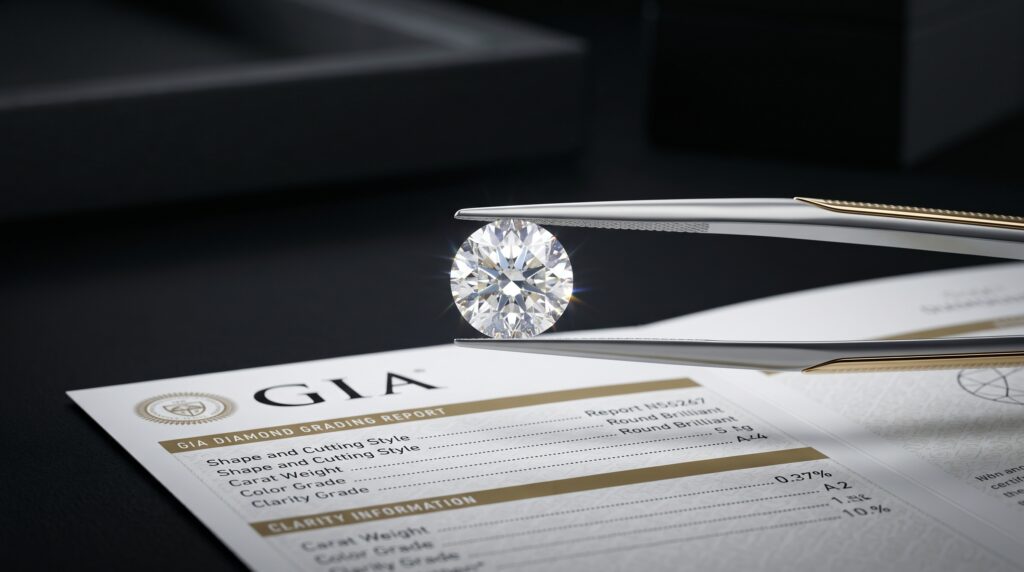
Most buyers focus on per-stone quality when they evaluate a Surat supplier. The more experienced B2B buyers focus on something different: grading consistency across a full parcel. When you order 200 GIA-certified 1.00-carat rounds from an Indian manufacturer, you are betting that the grading, the cutting standards, and the treatment disclosure are consistent across every stone in that order.
Here is what separates reliable suppliers from those who create problems downstream. First, insist that every stone in a parcel carries its own individual GIA or IGI report, not a batch certificate covering the lot. Individual reports protect you legally and protect your downstream customers when resale disputes arise. Second, benchmark every offer against the Rapaport Lab-Grown Price List or the standard Rapaport Natural Price List, depending on your stone category. GIA certified diamonds from Surat should trade at a predictable, documentable discount to Rapaport values, and any supplier quoting prices that seem disconnected from those benchmarks is worth scrutinizing carefully.
Third, understand the diamond certification landscape fully before qualifying a new Indian supplier. The Diamond Certification guide at Lepdo Diamonds covers the specific due-diligence questions experienced US buyers ask when onboarding new partners, including questions about reactor type for lab-grown, post-growth treatment disclosure, and grading lab relationships.
In my experience working directly with Surat manufacturers over many years, the single most reliable indicator of a trustworthy supplier is not their price list. It is how quickly and completely they can provide GIA report numbers before you commit to a purchase. Any hesitation on that point ends the conversation.
GIA Certified Diamond Jewelry Trends in the USA (2026 to 2027)
The US fine jewelry market crossed a meaningful threshold in 2025: GIA-certified lab-grown diamonds from Indian manufacturers entered the mainstream engagement ring conversation at price points that make the 2.00-carat-plus size category accessible to a much larger segment of US buyers. That shift is accelerating into 2027, not stalling.
Design-wise, the dominant movement is toward East-West oval settings, hidden halo constructions, and minimalist solitaires that let the GIA-certified center stone carry the full visual weight of the piece. Yellow gold settings with colorless GIA-graded diamonds have surged in demand, reversing a decade of white metal dominance. Three-stone anniversary rings and eternity bands set with GIA-graded melee are outperforming natural equivalents at every price point in the $4,000 to $10,000 US retail bracket.
Celebrity engagement ring announcements, while impossible to predict by name, continue to drive shape preferences with a one to two quarter lag. GIA certified diamond jewelry in fancy shapes, particularly elongated ovals and cushions, saw a sharp demand increase in early 2026 that Surat manufacturers scaled to meet quickly. Most buyers who track this demand report it is not softening. The US consumer appetite for certified stones with documented provenance is, if anything, becoming more specific and more sophisticated year over year.
How to Evaluate Quality in GIA Certified Diamonds from Surat
When I assess a GIA certified diamond from an Indian manufacturer, the first thing I check is not the certificate summary page. It is the full proportion data listed in the grading report, specifically the table percentage, depth percentage, and crown angle. These numbers tell me whether the cutter prioritized light performance or maximized weight retention from the rough, and that trade-off is more common in high-volume Surat production than most buyers realize.
You will want to pay attention to these five evaluation points before committing to any significant purchase of GIA certified diamonds from Surat.
- Cut grade and proportions for rounds: For GIA Excellent-cut rounds, look for table percentages between 54 and 58 percent and depth percentages between 61 and 62.5 percent. Stones outside these ranges sacrifice brilliance and fire for carat weight, even when they carry an Excellent grade at the outer edges of GIA’s acceptance range.
- Polish and symmetry for fancy shapes: GIA’s polish and symmetry grades are the primary documented quality indicators for ovals, cushions, pears, and marquises. Very Good or Excellent ratings on both are the minimum standard for retail-quality GIA certified fancy shapes from Surat. Good-rated stones may show visible symmetry issues under a loupe.
- Color nuance beyond the grade: Some GIA-graded D or E stones from Surat carry subtle warmth or gray modifiers visible face-up in natural light that the certificate’s single letter grade does not capture. Always view the stone in neutral daylight or a controlled lighting environment, not just under store spotlights.
- Clarity inclusions specific to Surat production: Pinpoint inclusions and minor graining are common in high-volume Indian rough. Feathers are less common. For GIA certified stones graded VS2 or better, clarity should be effectively invisible to the naked eye. SI1 stones from Surat vary: some are eye-clean, some show inclusions in certain positions. View every SI stone individually.
- Certification verification as the final check: Once you have evaluated the stone physically, confirm the GIA report number at GIA’s online verification portal. The portal confirms shape, measurements, grade, and treatment status in real time. For natural diamonds, it confirms the stone’s entry into GIA’s permanent database.
For a complete reference on what a grading report from either major lab includes, the Diamond Certification glossary at Lepdo Diamonds explains exactly what each section of a GIA or IGI report communicates and how to read it accurately.
Conclusion: Why GIA Certified Diamonds from Surat Deserve Your Serious Attention
Three things stand out after covering the full landscape of GIA certified diamonds from Surat. First, the quality ceiling for Indian cutting has risen to a level where GIA Excellent grades from Surat manufacturers are no longer a pleasant surprise; they are the reliable expectation for buyers who know which suppliers to work with. The infrastructure connecting Surat’s cutting floors to GIA’s grading laboratories has matured into a system that US buyers can source from with the same confidence they bring to any established Western cutting center.
Second, the economics are genuinely compelling. GIA certified diamond india pricing from verified Surat suppliers offers meaningful savings across every size category, with the widest gap in the 1.00 to 2.00 carat range where Indian production volume is highest. Whether you are a retailer expanding your certified inventory or a consumer searching for an engagement ring that delivers both documented quality and real-world value, Surat is the right place to source. Third, the trends are reinforcing this direction, not reversing it: US consumer demand for GIA certified diamonds with verified provenance is rising, and Surat’s manufacturers are more prepared to meet it than at any previous point in the industry’s history.
To explore certified diamonds with full GIA documentation, transparent pricing, and direct access to Surat’s best manufacturers, the GIA Certified Diamonds India page at Lepdo Diamonds is the right place to start. You can also review live Diamond Price data to benchmark your current supplier against the market.
The certification standard that protects buyers is not changing. The question is whether you are sourcing through suppliers who meet it.
Frequently Asked Questions About GIA Certified Diamonds from Surat
1. What are GIA certified diamonds from Surat?
GIA certified diamonds from Surat are natural or lab-grown diamonds cut and polished in Surat, India, that have been graded by the Gemological Institute of America. Each stone receives a GIA report documenting its 4Cs, including cut, color, clarity, and carat weight, giving buyers worldwide an independent, standardized quality assurance they can verify online using the GIA’s public report check tool. Surat accounts for the majority of GIA-certified stones currently entering the US market.
2. Are GIA certified diamonds from India cheaper than GIA diamonds from other origins?
Yes, generally. GIA certified diamonds sourced through Indian manufacturers tend to carry lower wholesale prices than comparable stones from Western cutting centers, because labor costs and manufacturing overhead in Surat are significantly lower. The GIA certificate itself carries the same cost regardless of where the stone was cut. The savings come from the manufacturing side. For current price benchmarks, review the Diamond Price guide at Lepdo Diamonds for live market reference data.
3. Which GIA certified diamond shape looks most impressive?
A GIA Excellent-cut round brilliant consistently delivers the highest light return and face-up brilliance of any shape. For buyers who want a dramatic modern look, GIA-certified oval and elongated radiant cuts from Surat manufacturers offer strong visual impact at a lower per-carat price than rounds. Ovals appear larger face-up than rounds of the same carat weight due to their elongated surface area, making them particularly popular in the US market for buyers maximizing visible size.
4. Does a GIA certificate include a cut grade for all diamond shapes?
GIA assigns a formal cut grade only for round brilliant diamonds, ranging from Excellent to Poor. For fancy shapes, including ovals, cushions, pears, and marquises, GIA assesses polish and symmetry but does not issue a cut grade. Buyers evaluating fancy shapes should focus on GIA polish and symmetry grades alongside their own visual assessment of light performance, including scintillation and the absence of undesirable optical patterns.
5. What is the biggest quality risk with GIA certified diamonds from Surat?
The most common risk is certificate mismatch: a stone presented with a GIA report that belongs to a different diamond. Always verify the GIA report number directly on GIA’s online verification portal before purchase. A secondary risk is weight-optimized cutting, where Surat cutters prioritize maximizing carat weight from rough rather than optical performance, producing stones that are technically graded but underperform visually compared to a well-proportioned stone at the same grade.
6. Are lab-grown GIA certified diamonds as good as natural GIA certified diamonds?
Physically and optically, yes. GIA grades both Natural Diamonds and lab-grown stones using identical 4Cs standards, and the diamonds themselves share the same carbon crystal structure, hardness, and optical properties. The difference is origin and market value. Lab-grown GIA certified diamonds from Surat are priced significantly below natural equivalents, making them attractive for buyers prioritizing size or clarity within a fixed budget.
7. Which GIA certified diamond is best for an engagement ring?
A GIA Excellent-cut round brilliant is the most reliable choice for an engagement ring because GIA’s cut grade for rounds is a mathematically verified measure of light performance. That said, oval, cushion, and elongated radiant GIA certified diamonds from Surat are gaining ground fast. Buyers who want a distinctive shape should prioritize GIA Very Good or better in both polish and symmetry, and view the stone through a high-resolution video or in person before purchasing.
8. How do I choose a reliable GIA certified diamond supplier in Surat or India?
Look for a supplier that provides original GIA reports for every stone, offers verifiable report numbers you can check on GIA’s website, has a documented track record with US-based buyers, and publishes transparent pricing benchmarked against Rapaport values. Lepdo Diamonds is a verified supplier in India with a proven record of supplying GIA certified diamonds to US wholesale and direct consumer buyers across both natural and lab-grown categories.