VVS1 vs VVS2 vs VS1 vs VS2 Diamond Clarity: Full Retailer and Buyer Guide
 by lepdogroup@gmail.com
0 comments
by lepdogroup@gmail.com
0 comments
VVS1 vs VVS2 vs VS1 vs VS2 diamond clarity refers to four grades measuring how visible internal inclusions are under 10x magnification, with VVS being nearly flawless and VS showing minor, often invisible-to-eye characteristics. For most buyers, VS1 or VS2 offers the best value. Lepdo Diamonds supplies IGI and GIA certified stones across all four grades for informed comparison.
A VS2 diamond, for example, can be completely eye-clean in normal viewing conditions, while a VVS1 diamond may cost considerably more without showing any obvious visual improvement in an engagement ring. For many buyers, that difference creates an opportunity to put the money saved on clarity toward carat weight, color, or a better cut.
This is particularly important for jewelry retailers and wholesale buyers. When two diamonds have similar proportions but sit in very different price brackets because of clarity, understanding what you are actually gaining for the additional cost can make a significant difference to inventory decisions.
VVS1 and VVS2 diamonds contain inclusions that are extremely difficult for trained graders to locate under 10x magnification. VS1 and VS2 diamonds have characteristics that are easier to find under magnification, but many remain completely invisible without it.
The shape of the diamond also changes the conversation. Emerald and Asscher cuts have large, open facets that can make inclusions easier to notice. Round, oval, and cushion diamonds generally have more complex facet patterns that can help disguise minor characteristics.
Size matters as well. As a diamond gets larger, an inclusion can become easier to notice simply because there is more visible stone to examine.
That is where the VVS1 vs VVS2 vs VS1 vs VS2 comparison becomes useful.
What Diamond Clarity Actually Means
Diamond clarity describes the internal inclusions and external blemishes present in a diamond. These characteristics develop during the diamond’s formation, whether the stone is natural or laboratory-grown, although their types and formation processes can differ.
GIA and IGI use standardized grading procedures involving 10x magnification and controlled viewing conditions when assigning clarity grades.
The complete clarity scale runs from Flawless through Internally Flawless, VVS, VS, SI, and Included grades.
Quick Info Box
- Definition: Clarity describes the visibility, size, position, and nature of a diamond’s internal and external characteristics when examined under 10x magnification.
- Key Types or Varieties: FL, IF, VVS1, VVS2, VS1, VS2, SI1, SI2, I1, I2, and I3.
- Best For: Buyers who want to balance an eye-clean appearance, budget, carat weight, and overall diamond quality.
- Key Difference or Advantage: VVS grades provide exceptionally high clarity, while VS grades can offer an excellent visual result without the same premium.
If you want a broader explanation of the entire grading system, our Diamond Clarity glossary explains how the different clarity levels are evaluated.
The Four Grades And Who They’re Actually For
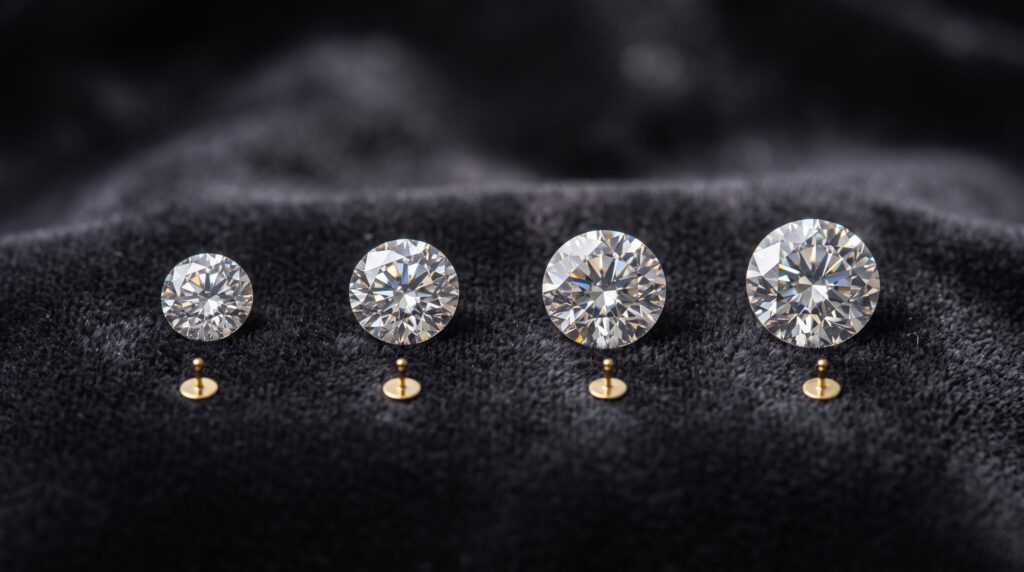
There is no single clarity grade that makes sense for every customer.
A buyer purchasing a 4-carat diamond for a high-end solitaire may have very different priorities from someone looking for a 1-carat engagement ring while staying within a fixed budget.
Here’s how the four grades compare in practical buying situations.
VVS1 Diamond Clarity
VVS1 is one of the highest clarity grades available below Flawless and Internally Flawless.
The inclusions are extremely difficult to locate under 10x magnification, even for an experienced grader. In many cases, the grader has to spend time searching the stone carefully before identifying the characteristic.
For buyers who place a premium on rarity and documented clarity, VVS1 can be attractive.
It is particularly relevant for larger diamonds, premium solitaires, luxury jewelry, and buyers who want the reassurance of having a very high clarity grade on the laboratory report.
However, there is an important distinction between grading rarity and visual beauty.
A VVS1 diamond is not automatically more brilliant than a well-cut VS1 diamond.
Our VVS1 Diamond page provides a more detailed explanation of the grade and what buyers should look for.
VVS2 Diamond Clarity
VVS2 sits immediately below VVS1.
The inclusions may be slightly easier for a trained grader to locate, but they are still extremely difficult to identify under 10x magnification.
This is one reason VVS2 is attractive to buyers who want a very high clarity grade without paying the full premium associated with VVS1.
For a customer who wants a premium-looking diamond but is also conscious of value, VVS2 can be a sensible compromise.
In many finished jewelry pieces, the difference between VVS1 and VVS2 will not be apparent without magnification.
You can read more about this grade on our VVS2 Diamond resource.
VS1 Diamond Clarity
VS1 is where the value discussion becomes particularly interesting.
A VS1 diamond contains minor inclusions that a trained grader can locate under 10x magnification, but those characteristics are often difficult to find.
For many engagement ring buyers, VS1 represents an excellent middle ground. The stone can look completely clean to the unaided eye while avoiding some of the premium associated with VVS clarity.
That means the buyer may have more budget available for carat weight, color, or cut quality.
For retailers, VS1 can also be an attractive inventory category because it combines consumer-friendly pricing with strong visual appeal.
Our VS1 Diamond guide covers the grade in greater detail.
VS2 Diamond Clarity
VS2 allows slightly more noticeable inclusions than VS1.
But “more noticeable under magnification” does not mean “visible to everyone.”
Many VS2 diamonds remain eye-clean once they are mounted in jewelry, especially when the inclusions are small, well-positioned, and located away from the center of the stone.
This is why VS2 should never be rejected automatically.
Instead, inspect the individual diamond.
Two VS2 diamonds can have very different inclusion characteristics. One may have a tiny crystal hidden near the edge, while another may have a feature close to the table that is easier to notice.
Our VS2 Diamond page explains what buyers should consider when evaluating this grade.
What About the Other Clarity Grades?
Understanding the neighboring grades helps put VVS and VS into context.
IF (Internally Flawless): No inclusions are visible at 10x magnification, although surface blemishes may be present. These stones are generally positioned toward the premium end of the market.
SI1: Some SI1 diamonds can be eye-clean, but the actual inclusion pattern needs to be inspected carefully from stone to stone.
SI2: SI2 provides a lower price point, but inclusion visibility varies considerably between individual diamonds.
I1-I3: Inclusions are generally much easier to see and can sometimes affect transparency, appearance, and, depending on their nature and location, durability.
VVS vs VS Diamond Clarity — The Real Difference
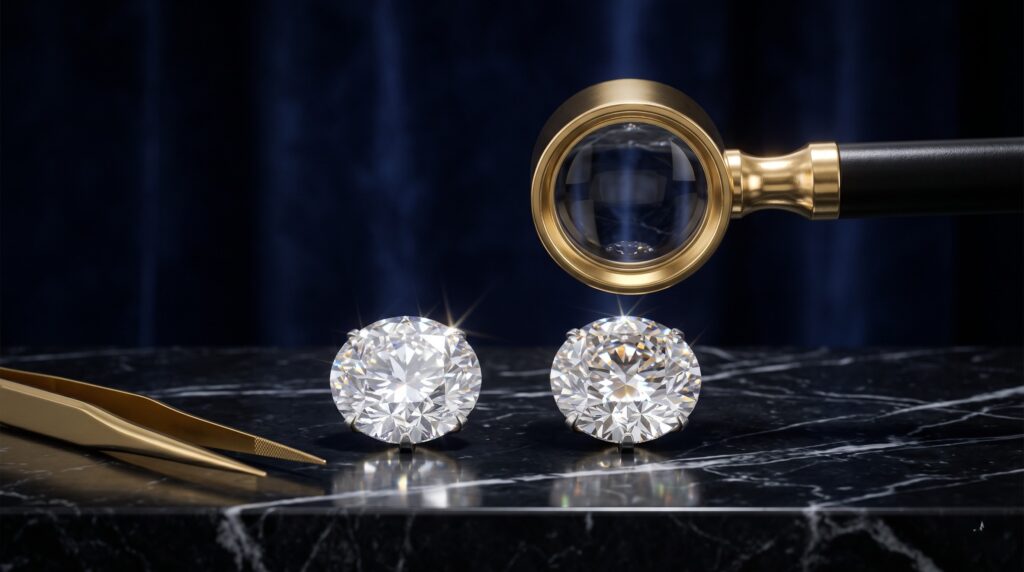
The perceived gap between VVS and VS clarity is often larger on a price sheet than it is when the diamond is actually being worn.
| Factor | VVS (VVS1/VVS2) | VS (VS1/VS2) |
|---|---|---|
| Inclusion visibility at 10x | Extremely difficult to detect | Minor characteristics, generally easier for a trained grader to locate |
| Eye-clean appearance | Yes | Often yes, depending on the individual stone |
| Typical price premium | Often 15–30% higher than comparable VS grades | Lower price point |
| Best carat range | 2ct and above, premium or high-clarity focused purchases | Under 3ct and many engagement ring purchases |
| Resale/investment value | Can offer stronger premium positioning | Strong value proposition with less upfront premium |
These figures should be treated as general market guidance rather than fixed pricing rules. Actual premiums vary according to carat weight, color, cut, shape, certification, market conditions, and whether the diamond is natural or laboratory-grown.
For most engagement ring buyers, a well-cut VS1 or VS2 diamond can look remarkably similar to a VVS diamond under normal viewing conditions.
That does not mean VVS is unnecessary.
There are customers who specifically want the higher clarity grade, particularly for large stones, luxury pieces, collector-oriented purchases, or simply because they value having a premium grade documented on the report.
The important point is that the visual improvement is not necessarily proportional to the price increase.
Our VVS2 vs VS2 comparison explores this difference in more detail.
How to Choose the Right Clarity Grade for Your Style
Choosing between VVS1, VVS2, VS1, and VS2 becomes much easier when you consider the complete diamond rather than the clarity grade alone.
1. Think about how closely the diamond will be examined
Some customers enjoy inspecting their jewelry under a loupe and want to know that the stone has an exceptionally high clarity grade.
For those buyers, VVS may justify the additional cost.
For someone primarily concerned with how the diamond looks from normal viewing distance, VS clarity may provide much better value.
2. Consider the setting
The setting can influence how much of the diamond is visible.
A halo or traditional prong setting may leave more of the stone exposed, while a bezel setting can conceal portions of the edge.
The location of an inclusion therefore matters.
An inclusion near the girdle may be much less noticeable than a similar characteristic positioned directly beneath the table.
3. Match clarity to the diamond shape
Shape should be one of the first things considered when setting a clarity budget.
Emerald and Asscher cuts have broad, open facets that make inclusions easier to see.
Round, oval, cushion, and other brilliant-style cuts can often disguise minor inclusions more effectively because of their faceting and light return.
This is why a buyer who is comfortable with VS2 in a round diamond may prefer VS1 or VVS2 when purchasing an emerald cut.
4. Consider where the money will make the biggest difference
If moving from VVS2 to VS1 saves 15–25% on a comparable stone, that money may be better used elsewhere.
For example, the buyer might choose:
- A slightly larger carat weight
- A better cut
- A higher color grade
- A more desirable diamond shape
- A higher-quality setting
In many cases, these changes can have a more noticeable effect on the finished jewelry than moving up one clarity grade.
5. Think about how the jewelry will be worn
An engagement ring that is worn every day should be selected with more than clarity in mind.
Cut quality, setting security, durability, and the location of inclusions all deserve attention.
A high-clarity diamond is not automatically the best everyday diamond if its cut is poor.
For investment-oriented or showcase jewelry, however, buyers may place greater importance on VVS or IF grades.
6. Consider lab-grown vs natural diamonds
Lab-grown diamonds have changed the value equation considerably.
Because high-clarity laboratory-grown diamonds can be available at more accessible prices than comparable natural diamonds, some buyers choose VVS grades without stretching their budget as much as they would with a natural stone.
Others still prefer VS clarity because they would rather allocate the savings toward a larger diamond.
You can explore the broader category through our Lab Grown Diamonds resource.
What B2B Buyers and Diamond Manufacturers Should Know
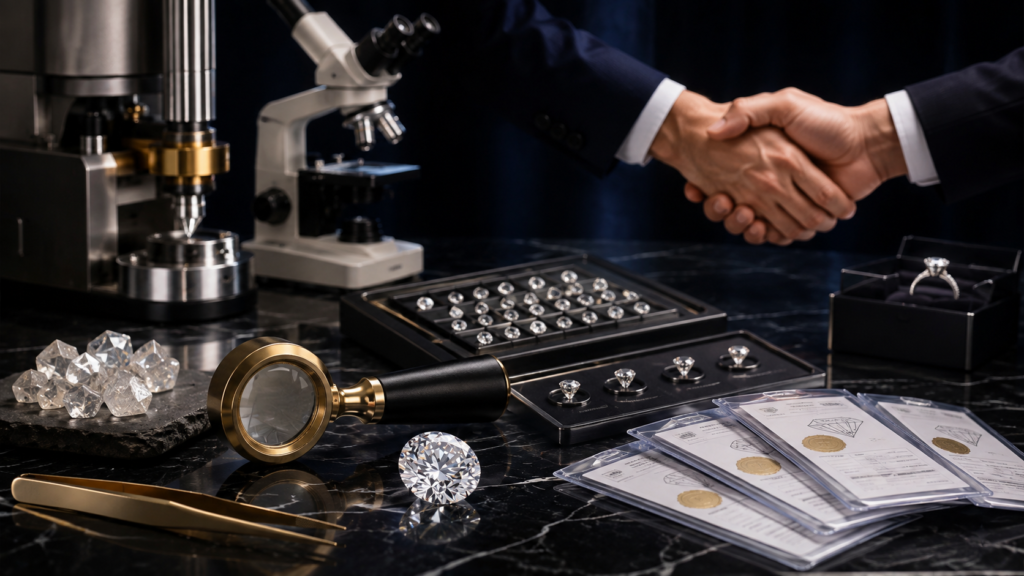
Clarity purchasing becomes more complicated when the buyer is ordering diamonds in quantity.
A consumer may only need to find one beautiful stone. A retailer may need 20, 50, or several hundred stones that meet a consistent specification.
That changes the purchasing priorities.
A parcel of VS1 diamonds, for example, should not simply meet the clarity grade on paper. Retailers also need reasonable consistency in cut, color, proportions, fluorescence, and overall appearance.
Cut deserves particular attention.
A poorly cut VVS1 diamond can look less attractive than a beautifully cut VS1 because brilliance and light return have a direct impact on what the customer sees.
This is one of the most common mistakes I see when buyers become too focused on clarity.
A certificate can tell you that a diamond is VVS1.
It cannot, by itself, guarantee that the stone is the most attractive option at its price.
GIA and IGI certification can provide important documentation for B2B transactions. Buyers should nevertheless compare stones on their actual characteristics and not assume that two similarly graded parcels will automatically look identical.
When comparing natural and laboratory-grown diamonds, retailers should also compare certification, pricing, cut quality, and supplier grading consistency rather than treating the clarity label as the only deciding factor.
For manufacturers and wholesalers, consistency is especially important with fancy shapes.
An oval, pear, cushion, or emerald diamond can have the same carat weight, color, clarity, and certification yet still look quite different because of proportion and facet arrangement.
This is where an experienced manufacturing partner becomes valuable.
Lepdo Diamonds, operating from Surat’s major diamond manufacturing ecosystem, supplies CVD and HPHT lab-grown diamonds to international B2B buyers and can support retailers looking for consistent clarity ranges across different shapes.
For buyers sourcing VVS and VS parcels, it is worth asking about sample selection, grading standards, certification, and how closely repeat orders are matched to the original parcel.
Diamond Clarity Trends in the USA (2026–2027)
The way consumers think about diamond clarity is changing.
Buyers have more information available than ever before. They can compare laboratory reports, examine inclusion plots, research diamond proportions, and compare prices across multiple suppliers before visiting a jewelry store.
As a result, VS1 and VS2 are increasingly attractive to shoppers who want what might be called smart luxury: an eye-clean diamond without paying a substantial premium for microscopic differences that are invisible during normal wear.
This does not mean VVS demand is disappearing.
High-clarity diamonds remain popular among buyers who want premium specifications, particularly for larger stones and luxury jewelry.
The shape of the diamond also affects clarity preferences.
Vintage-inspired designs and step-cut diamonds, especially emerald and Asscher shapes, require more careful clarity selection because their broad facets can reveal inclusions more easily.
Meanwhile, oval and cushion diamonds continue to be important choices for customers looking beyond the traditional round brilliant.
Lab-grown diamonds are also making higher clarity grades more accessible to a wider group of buyers. A customer who might have had to choose between carat size and clarity in a natural diamond can sometimes achieve both in a laboratory-grown stone at a different price level.
For retailers, that means clarity should be considered alongside origin, shape, color, cut, carat weight, certification, and customer budget.
How to Evaluate Quality in VVS and VS Diamonds
When I evaluate a VVS or VS diamond, I do not begin by asking whether the stone has the highest possible clarity.
I start with how the diamond performs.
A VVS1 diamond with weak proportions will not suddenly become brilliant because the clarity grade is excellent.
Here are five checks worth making before purchasing:
- Review pavilion angle and depth percentage. Proportions have a direct relationship with how efficiently the diamond returns light, although ideal ranges vary by shape.
- Look at table percentage alongside the other proportions. A table number should never be evaluated in isolation.
- Check for bow-tie effects in oval, pear, and marquise diamonds. A strong bow tie can create a noticeably darker area across the center.
- Evaluate color together with clarity. A high-clarity diamond with an unsuitable color for the intended setting may not deliver the premium appearance the buyer expects.
- Verify the certification and physical stone. Check that the report information corresponds with the diamond, including measurements and laser inscription where applicable.
For wholesale purchasing, these checks become even more important because a small difference repeated across a large parcel can have a meaningful financial impact.
Conclusion
The VVS1 vs VVS2 vs VS1 vs VS2 diamond clarity comparison is ultimately about value rather than simply ranking four grades from best to worst.
VVS1 and VVS2 offer exceptionally high clarity and appeal to buyers who want premium specifications, rarity, or the reassurance of having a very high grade documented on their report.
VS1 and VS2 are where many buyers can find a better balance.
When the diamond is well cut and the inclusions are properly positioned, a VS stone can look completely clean in normal viewing conditions. That can allow the buyer to redirect part of the budget toward carat weight, color, cut quality, or the setting itself.
For retailers, the same principle applies to inventory.
A higher clarity grade is not automatically a better business decision. The right grade depends on customer demand, price sensitivity, diamond shape, average carat weight, supplier consistency, and how the finished jewelry is expected to perform.
For B2B buyers sourcing certified lab-grown diamonds, Lepdo Diamonds supplies stones across VVS1, VVS2, VS1, and VS2 clarity ranges, with GIA and IGI certification options.
You can explore the broader collection through Lepdo Diamonds when planning bridal inventory, wholesale parcels, or specialty diamond collections.
The smartest clarity purchase is rarely the diamond with the highest grade.
It is the diamond where clarity, cut, color, carat, certification, and price all make sense together.
Frequently Asked Questions About VVS1 vs VVS2 vs VS1 vs VS2 Diamond Clarity
1. What is VVS1 vs VVS2 vs VS1 vs VS2 diamond clarity?
These are four diamond clarity grades used to describe how noticeable a diamond’s inclusions are under 10x magnification.
VVS1 is higher than VVS2, followed by VS1 and then VS2.
The important distinction is that the grading difference is based on what a trained grader can identify under magnification, not necessarily what a customer can see with the naked eye.
2. Is VS clarity cheaper than VVS?
Generally, yes.
Comparable VS1 and VS2 diamonds typically cost less than VVS1 and VVS2 stones. The exact difference varies according to carat weight, color, cut, shape, certification, origin, and current market conditions.
For many buyers, the savings can be substantial enough to justify choosing VS clarity.
3. Which clarity grade looks biggest or most impressive?
Clarity does not determine how large a diamond looks.
Carat weight, face-up dimensions, proportions, and cut have a much greater effect on apparent size.
A well-cut VS1 diamond can therefore look just as large and visually impressive as a VVS1 diamond with the same carat weight and shape.
4. Does clarity grade come with a GIA cut grade?
No.
Clarity and cut are separate grading characteristics.
A diamond can have VVS1 clarity but a weaker cut, while another diamond can have VS1 clarity and excellent light performance.
This is why buyers should evaluate clarity and cut independently.
5. What is the biggest quality risk with VS2 clarity?
The main concern is not the VS2 label itself but the type and position of the inclusion.
Some VS2 diamonds have inclusions that are easily hidden, while others may contain a characteristic closer to the center of the stone that is more noticeable.
The inclusion plot and actual visual inspection are therefore important.
6. Are lab-grown VVS and VS diamonds as good as natural diamonds?
Lab-grown diamonds have the same fundamental chemical composition and crystal structure as natural diamonds.
A laboratory-grown diamond can receive VVS or VS clarity grades based on its observed characteristics and the grading laboratory’s standards.
The primary distinction between lab-grown and natural diamonds is their origin, not whether one is fundamentally “real” diamond and the other is not.
7. Which clarity grade is best for an engagement ring?
For many engagement ring buyers, VS1 or VS2 offers an excellent balance between appearance and price.
However, the best choice depends on the diamond shape.
Round and other brilliant cuts can often accommodate lower clarity while remaining eye-clean, whereas emerald and Asscher cuts may benefit from higher clarity because their open facets make inclusions easier to see.
8. How do I choose a reliable clarity-grade diamond manufacturer or supplier?
Look for suppliers that provide recognized laboratory certification, transparent specifications, consistent grading practices, and clear inclusion information.
For B2B orders, do not evaluate a supplier only from one sample stone.
Ask about parcel consistency, repeat-order matching, cut standards, certification, return policies, and the ability to supply the same quality range over time.
For larger wholesale purchases, requesting sample parcels before committing to a substantial order can help you determine whether the supplier’s actual inventory matches the specifications you require.