The 4Cs of Diamonds Explained: Cut, Color, Clarity & Carat – Ultimate Guide by Brijes Pansuriya
 by lepdogroup@gmail.com
1 comment
by lepdogroup@gmail.com
1 comment
4Cs of diamonds explained by Brijes Pansuriya refers to the four universal quality criteria, cut, color, clarity, and carat used to grade every polished diamond. Understanding these four factors helps buyers avoid overpaying and ensures they select a stone that delivers real visual beauty, not just a number on paper. Lepdo Diamonds offers fully certified inventory graded against these standards, with expert guidance from diamond advisor Brijes Pansuriya.
Every year, buyers in the United States spend billions of dollars on diamonds and a surprising number of them overpay for stones that look worse, not better, than a less expensive option. The difference almost always comes down to one thing: they did not understand the 4Cs of diamonds explained clearly enough before they bought.
The 4Cs cut, color, clarity, and carat are the global language of diamond quality. Developed by the GIA (Gemological Institute of America), this framework gives every buyer, retailer, and manufacturer a shared vocabulary for evaluating and comparing polished diamonds. Whether you are shopping for an engagement ring, building inventory for a jewelry brand, or sourcing stones at the wholesale level, these four criteria determine both the price and the real-world beauty of every stone.
This guide walks you through each of the 4Cs in plain, practical terms. You will learn how the grades work, what they mean for visual performance, and exactly where to put your money when trade-offs become necessary. Both B2C buyers and trade professionals will find actionable information here.
What the 4Cs of Diamonds Actually Are
The 4Cs give diamond professionals and consumers a standardized way to assess the quality of any polished diamond, regardless of shape, origin, or price point. Before the GIA formalized this system in the mid-20th century, buying a diamond required blind trust. Today, any certified stone comes with a consistent, verifiable quality profile.
Quick Info Box:
- Definition: The 4Cs are cut, color, clarity, and carat weight four measurable factors that together determine a diamond’s quality and market value.
- Key Types or Varieties: Excellent/Ideal cut grades, D-Z color scale, FL-I3 clarity scale, carat weight from 0.30ct to 10ct+
- Best For: Engagement ring buyers, fine jewelry retailers, diamond wholesalers, manufacturers, and investment buyers
- Key Difference or Advantage: Provides an objective, internationally recognized quality standard that removes guesswork from diamond pricing and purchasing
Understanding the full scope of the 4Cs of Diamonds is the single most important step any buyer can take before putting money on the table.
The Four Criteria, Each One Explained for Buyers
Cut: The Most Important C
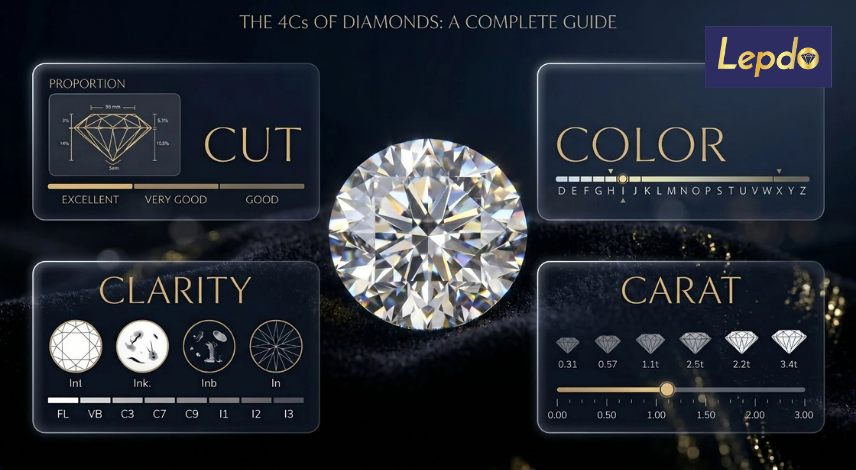
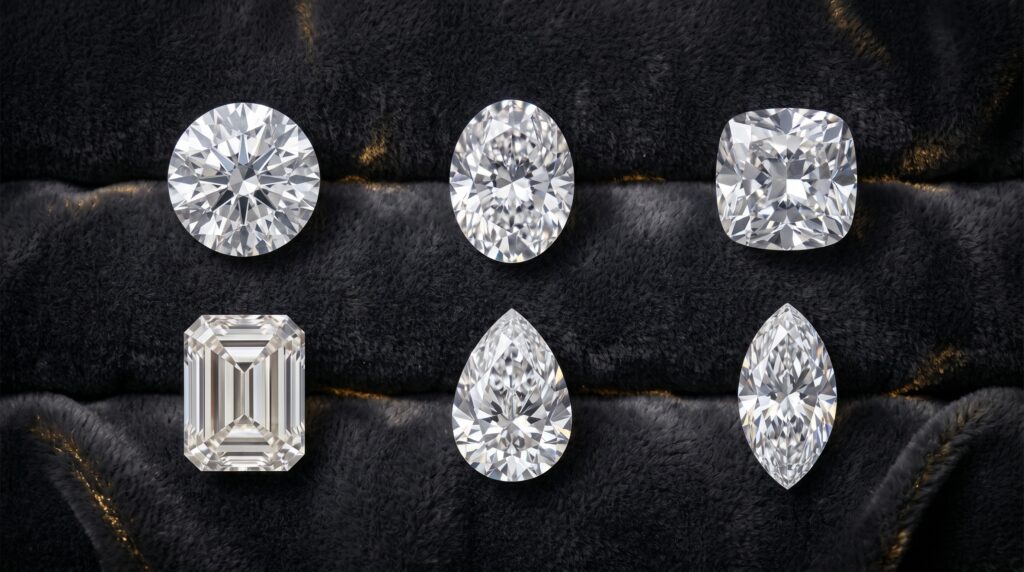
Cut is the single factor that determines how much light a diamond captures, reflects, and releases back to the eye. It is not about the shape of the stone. It is about the precision of the facets, the angles, and the proportions. A diamond with a poor cut can look dull even if it has a high color and clarity grade. Conversely, a well-cut stone in a lower color grade can outshine a better-graded but poorly proportioned stone.
The GIA grades round brilliant cut diamonds on a five-point scale: Excellent, Very Good, Good, Fair, and Poor. These grades factor in brightness, fire (the dispersion of colored light), and scintillation (the sparkle you see when the stone moves). For fancy shapes, there is no formal GIA cut grade, which makes proportions and light performance images even more important to evaluate independently.
Explore the detailed breakdown on Diamond Cut to understand how each proportional element affects visual output.
Color: What You See Face-Up
The GIA color scale runs from D (colorless) to Z (light yellow or brown). For white diamonds, buyers generally want to stay in the colorless (D-F) or near-colorless (G-J) range. That said, the difference between a D and a G is nearly invisible to the naked eye when a diamond is mounted in a white gold or platinum setting. Where color becomes more relevant is in larger stones, step-cut shapes like emerald and Asscher cuts, and side-by-side comparisons.
For detailed grade definitions, see Diamond Color Grades.
Clarity: What You Cannot See
Clarity measures the presence, size, location, and type of internal characteristics (inclusions) and surface features (blemishes) in a polished diamond. The GIA clarity scale runs from Flawless (FL) at the top to Included 3 (I3) at the bottom. In practical terms, most buyers are well-served by VS2 or SI1 grades stones where inclusions exist but are not visible to the naked eye without magnification.
The two grades that require the most care are SI2 and I1, where inclusions can begin to affect both appearance and structural integrity. Step-cut diamonds like emerald cuts are less forgiving of inclusions than brilliant cuts, because their broad, open facets act like windows into the stone.
Review the full Diamond Clarity breakdown to understand which grades suit which buyers.
Carat: Weight Is Not the Same as Size
Carat is a unit of weight, not physical dimension. One carat equals 0.2 grams. The relationship between carat weight and visible size varies significantly by shape and by how the stone is cut. A shallow-cut one-carat diamond can look larger face-up than a deep-cut one-carat stone, even though they weigh exactly the same. A one-carat oval or marquise almost always appears larger than a one-carat round brilliant because of its elongated surface area.
See Diamond Carat for a full size-to-weight reference.
The Remaining Variations: Fancy Colors and Lab-Grown
Beyond the classic white diamond range, fancy color diamonds, naturally occurring yellows, pinks, blues, and greens are graded on a separate color intensity scale. Lab-grown diamonds follow the same 4Cs grading system as natural diamonds and are certified by both GIA and IGI.
Step-Cut vs. Brilliant-Cut Shapes
Step cuts (emerald, Asscher, baguette) emphasize clarity and color because of their large, open facets. Brilliant cuts (round, oval, cushion, radiant) scatter light across dozens of facets, masking inclusions and color tints more effectively. The right shape depends on which C you want to prioritize.
Mixed-Cut Diamonds
Some fancy shapes combine elements of both step and brilliant cutting. The princess cut and the radiant cut are excellent examples. These offer a middle ground between the clean elegance of a step cut and the light performance of a brilliant, making them popular in commercial and retail markets.
The 4Cs vs. Light Performance Testing: The Real Difference
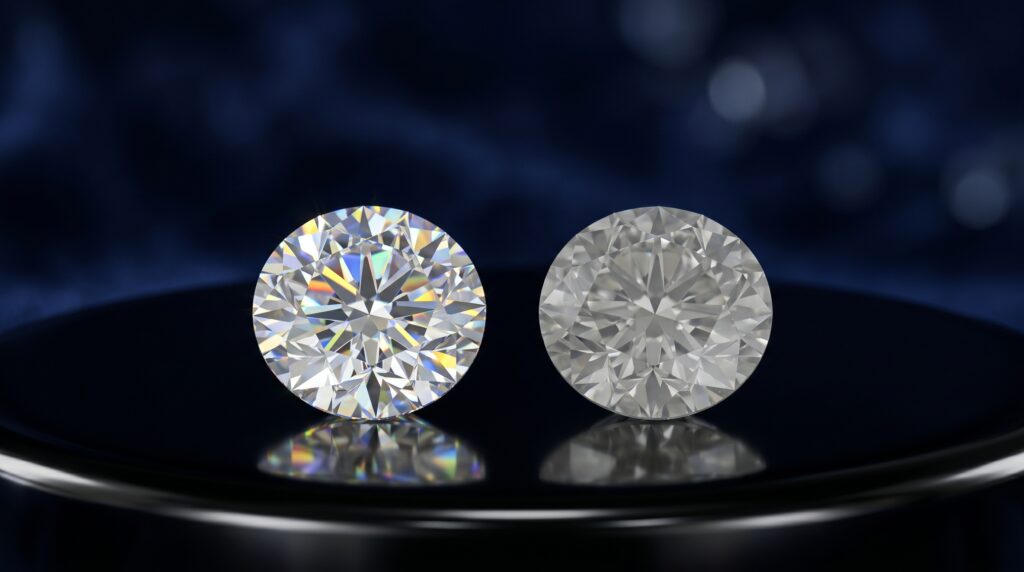
Many buyers assume that a good GIA certificate tells the whole story. It does not. Here is where the grade report and real-world visual performance can diverge in ways that matter.
| Factor | 4Cs Grade Report | Light Performance Testing |
|---|---|---|
| What it measures | Cut, color, clarity, carat by standardized criteria | Brilliance, fire, scintillation in live conditions |
| Who performs it | GIA or IGI laboratory graders | Gemologist or imaging technology (ASET, Ideal-Scope) |
| Reflects real beauty | Partially, especially for cut | More directly shows actual light return |
| Best used for | Price comparison and certification verification | Final selection and quality confirmation |
| Addresses fancy shapes | No official cut grade | Yes, especially useful for ovals, cushions, pears |
Think of it this way: the 4Cs give you the ingredient list, and light performance testing shows you how the finished dish actually tastes. The grade report is essential for pricing, comparison, and certification. But for the final decision on a specific stone, a video, ASET image, or in-person examination using a diamond quality guide for buyers is irreplaceable.
Most buyers who regret a diamond purchase focused entirely on the certificate and never saw the stone perform. That said, for remote and wholesale transactions, certified grades remain the industry standard for pricing and valuation.
How to Choose the Right Diamond by the 4Cs for Your Style and Budget
- Personal style and visual preference. If you prefer a classic, timeless look, prioritize an Excellent round brilliant cut with a G-H color and VS2 clarity. If you want something more distinctive, fancy shapes like ovals and pears offer similar light performance with more personality.
- Size vs. quality trade-offs. Elongated shapes like oval and marquise diamonds look larger per carat than round stones. If face-up size matters, you can often step down one color grade (from G to H) and put that savings toward carat weight without a visible loss in beauty.
- Setting compatibility. A bezel or halo setting can make a lower color grade look whiter by framing the diamond. A solitaire in platinum or white gold is the least forgiving setting for color, it is where D-F grades genuinely earn their premium.
- Budget positioning. The highest value per dollar is typically found in the G-H color and VS2-SI1 clarity range with an Excellent or Very Good cut. Paying for D-E color or VVS clarity is a choice for collectors and investment buyers, not a requirement for a beautiful everyday stone.
- Occasion and intended use. Engagement rings and fine jewelry benefit from stones graded VS2 and above for long-term durability of appearance. Commercial and fashion jewelry can make excellent use of SI1-SI2 grades where face-up beauty is the priority and certification costs are being managed.
- Lab-grown vs. natural diamonds. Lab-grown diamonds offer the same 4Cs grading standards as natural stones, certified by IGI, at a significantly lower price point. For buyers who want maximum carat weight and visual quality at a given budget, lab-grown diamonds are a legitimate and increasingly popular option. Before you finalize your choice, consider that natural diamonds currently retain stronger resale value over time, while lab-grown stones deliver better upfront value per carat.
What B2B Buyers and Diamond Manufacturers Should Know
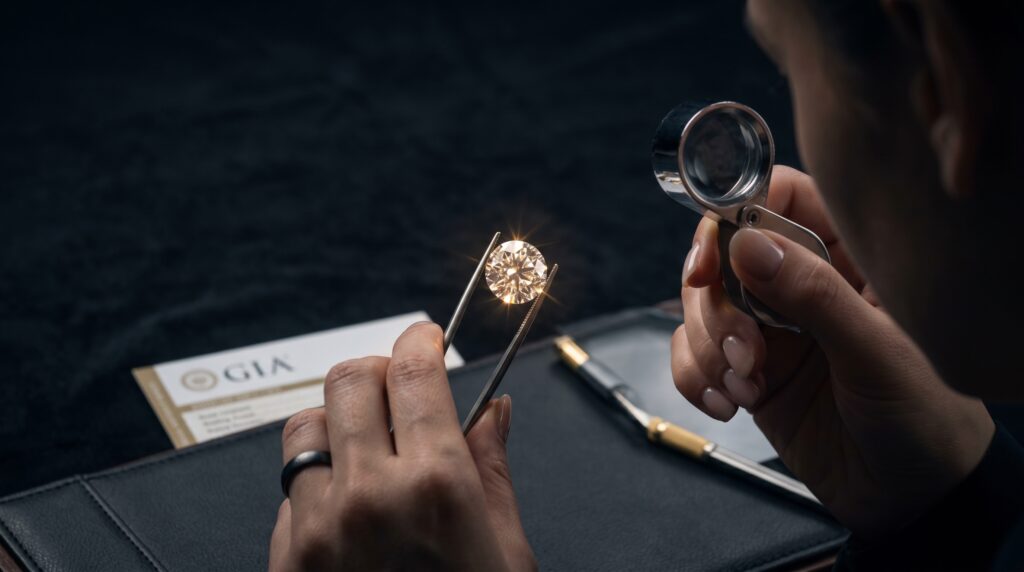
Here is what changes when you are buying at the trade level: the certificate is not the final word on price. It is the starting point.
For wholesalers and manufacturers sourcing polished goods, Rapaport pricing provides the baseline, but the actual transactional price depends on cut quality consistency, make, and the specific fancy shape premium or discount relative to round brilliant values. A well-made oval or cushion with excellent symmetry can command a 10 to 20 percent premium over a generic stone at the same grade.
IGI-certified goods have become widely accepted across the US market, particularly for lab-grown diamonds. GIA certification still commands the highest premium for natural stones, especially in the 1.00ct and above range where the difference in buyer confidence translates directly into price realization at retail. For fancy shapes, requesting GIA grading alongside a proportions breakdown is a standard expectation for premium B2B transactions.
When sourcing fancy shapes at volume, consistency across a parcel matters as much as individual stone quality. Two VS1 ovals from different manufacturers can look entirely different depending on depth percentage, culet size, and bow-tie presence. This is where working with a vetted manufacturer who understands Diamond Cut Grades at the production level makes a genuine commercial difference.
In my experience evaluating parcels for US retail clients, the most consistently overlooked factor in B2B transactions is cut quality documentation for fancy shapes. Buyers negotiate hard on color and clarity but often accept whatever cut they receive. Pushing for detailed proportions data on every parcel reduces returns, elevates customer satisfaction, and protects your brand.
Diamond Jewelry Trends in the USA: 2026 to 2027
The US diamond market has shifted meaningfully in the past two years. Fancy shape diamonds now represent a growing share of engagement ring sales, with oval and elongated cushion cuts leading the trend. According to recent trade data from IDEX, fancy shape demand among US retailers increased by double digits year-over-year through 2024 and into 2026, driven largely by social media influence and a consumer desire for individuality over convention.
To be fair, round diamonds still dominate engagement ring sales in terms of raw volume. But the gap is narrowing, and the premiums on well-made fancy shapes have grown accordingly. East-west settings, bezel-set ovals, and three-stone combinations featuring pear or marquise side stones are particularly visible in current US retail catalogs.
Yellow gold has returned as a dominant setting metal, which is pushing buyers toward warmer color grades. A K or L color diamond that would have been commercially challenging in a white metal setting looks stunning in 18k yellow gold, opening up a new tier of pricing opportunity for buyers who understand how setting choice interacts with the color grade. For 2027, expect continued momentum in colored diamond accents, east-west orientations, and lab-grown stones in larger carat weights.
How to Evaluate Diamond Quality Using the 4Cs
When I assess a diamond for a client, the first thing I check is cut quality, specifically the table percentage, depth percentage, and symmetry grade. For round brilliants, an Excellent or Ideal cut designation with a table between 54 and 58 percent and a depth between 59 and 62.5 percent is the foundation. Everything else builds from there.
Here are the key evaluation steps you will want to apply consistently:
- Review the proportions first. For round brilliants, use the depth and table percentages as your cut screening criteria before looking at color or clarity. For fancy shapes, request a proportions diagram or ask about length-to-width ratio and depth percentage.
- Check light performance independently. A stone that grades Excellent on paper should deliver strong brilliance and scintillation when viewed under standard lighting. If it does not, there is a cutting fault the grade report is not capturing. ASET or Ideal-Scope imaging reveals light leakage in seconds.
- Inspect the clarity grade in context of shape. A VS2 in a round brilliant is almost always eye-clean. A VS2 in an emerald cut or Asscher cut may or may not be, depending on where the inclusion sits. Always ask for a clarity photograph or magnified image for step-cut shapes.
- Evaluate color in the correct setting context. A D color stone in a yellow gold setting reads visually as G or H to the eye. Color grading is done loose, face-down, against a white background. Real-world appearance is always setting-dependent.
- Cross-reference the Diamond Clarity Grades against the certificate comments section. The written comments about inclusion type and position can tell you more about a stone’s real appearance than the letter grade alone.
You will want to pay attention to the pavilion angle in particular for round brilliants: even small deviations from the ideal range of 40.6 to 41.0 degrees can significantly reduce light return and visual brilliance.
Conclusion
The 4Cs of diamonds explained by Brijes Pansuriya come down to three practical realities. First, cut is king: no other quality factor has more direct impact on how a diamond looks in real life, which is why it should be the first filter in any diamond purchase. Second, the grade report is a starting point, not an ending point understanding how color, clarity, and carat interact with cut, shape, and setting is what separates a smart purchase from an overpriced one. Third, whether you are buying a single engagement ring or sourcing parcels for a retail chain, the same framework applies. The 4Cs give you a consistent, defensible basis for every decision.
Before you make your next diamond purchase, take the time to explore the certified diamond inventory at Lepdo Diamonds, where every stone is graded, documented, and presented with the transparency that serious buyers expect. Whether you need a single show stopping stone for an engagement ring or a matched parcel for a commercial run, the right diamond is one you understand completely.
The best diamond is not the most expensive one. It is the one where every C was chosen with intention.
Frequently Asked Questions About the 4Cs of Diamonds
1. What is 4Cs of diamonds explained by Brijes Pansuriya?
The 4Cs of diamonds explained by Brijes Pansuriya diamond advisor refers to the four GIA-standardized quality criteria cut, color, clarity, and carat, used to grade every polished diamond. Brijes Pansuriya applies these four criteria to help buyers, retailers, and wholesalers evaluate diamond quality consistently, make better purchasing decisions, and understand exactly what drives value in any given stone.
2. Is a higher diamond carat weight always worth more money?
Not necessarily. A larger carat weight increases base price, but a poorly cut or low-clarity diamond can be worth far less than a smaller, well-graded stone. Carat weight is a measure of mass, not beauty. A well-cut 1.00ct diamond can outperform a poorly cut 1.50ct stone in both visual appeal and resale value. Cut quality should always come first in any buying decision.
3. Which diamond cut looks the biggest for its carat weight?
Elongated fancy shapes like oval, marquise, and pear cuts tend to look larger than their actual carat weight because of their spread and length-to-width ratio. A 1.00ct oval can appear visually comparable to a 1.20ct round brilliant. Among all shapes, the marquise often delivers the most visible surface area per carat, making it a strong choice for buyers who prioritize face-up size on a fixed budget.
4. Does the GIA assign a cut grade to all diamond shapes?
No. The GIA only assigns an official cut grade to standard round brilliant diamonds. For fancy shapes like ovals, cushions, pears, and emerald cuts, GIA reports do not include a formal cut grade. Evaluating cut quality in fancy shapes requires assessing proportions, length-to-width ratio, light performance, and symmetry independently, which is why working with an experienced diamond advisor adds real value in these purchases.
5. What is the biggest quality risk when buying a diamond online?
The biggest risk is relying solely on the GIA or IGI certificate without seeing the actual stone or its light performance video. Two diamonds with identical grades can look very different face-up. Issues like a strong bow-tie effect in fancy shapes, poor symmetry, or unflattering depth percentage are not always reflected on a grading report. Always request video, ASET imaging, or expert review before finalizing an online purchase.
6. Are lab-grown diamonds as good as natural diamonds by the 4Cs?
Yes. Lab-grown diamonds are physically, chemically, and optically identical to natural diamonds and are graded by the same 4Cs standards cut, color, clarity, and carat by IGI and GIA. The primary differences are origin, price (lab-grown are significantly less expensive), and long-term resale value, which currently favor natural diamonds. For buyers prioritizing maximum visual quality at a given price, lab-grown is a genuinely strong option.
7. Which diamond grade combination is best for an engagement ring?
For most engagement ring buyers, the sweet spot is an Excellent or Very Good cut, G or H color, VS2 or SI1 clarity, in a carat weight that fits the budget. This combination delivers a visually clean, bright diamond at a realistic price. Prioritizing cut above all other Cs gives you the most visible return on investment. A poorly cut D-FL diamond will be outperformed face-up by a well-cut G-VS2 every time.
8. How do I choose a reliable diamond manufacturer or supplier using the 4Cs?
Look for suppliers who provide GIA or IGI-certified stones, publish consistent grading data, and can show light performance images or videos. Ask about cut grading consistency, sourcing transparency, and Rapaport pricing benchmarks. Lepdo Diamonds, advised by Brijes Pansuriya, provides fully certified inventory with transparent grading for both B2B buyers and direct consumers with expert guidance available at every step.