
GIA diamond certification commonly refers to a GIA grading report, but GIA does not certify diamonds or guarantee value. For wholesale buyers, the report documents gemological characteristics and supports verification, while pricing, supplier reliability, batch consistency, visual matching, resale, and commercial performance still require separate due diligence and quality control.
A grading report gives a wholesale buyer useful information, but business risk remains. GIA diamond certification, for example, does not assure price, supplier performance, visual consistency, or future resale. GIA reporting is often confused with diamond identification, valuation, and commercial certification.
GIA calls these documents grading reports. The terms grading report, diamond certificate, and diamond grading are often used interchangeably, but they are not identical. A GIA grading report describes the characteristics of a diamond examined under GIA procedures. It does not protect the buyer against risks outside the laboratory examination.
A wholesale buyer should therefore interpret GIA diamond certification in two stages. First, examine what the laboratory evaluated. Second, identify what it did not determine and what still requires commercial review, receiving controls, supplier assessment, and visual inspection.
What GIA Diamond Certification Means for Wholesale Buyers
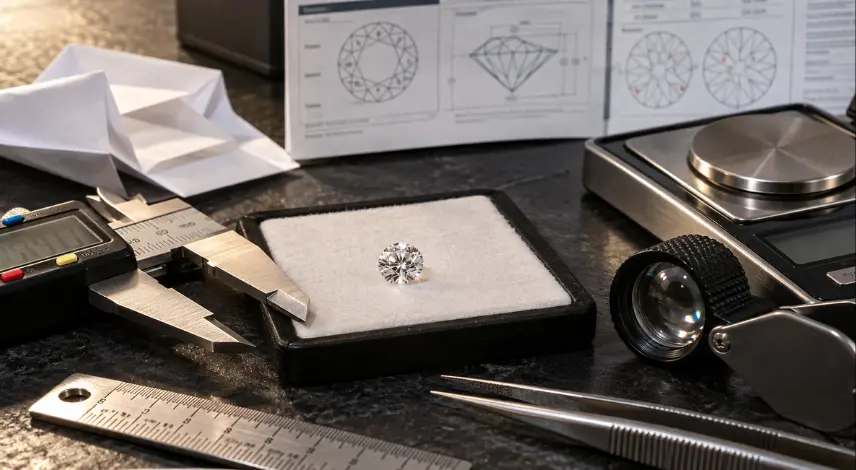
The search question what is GIA diamond certification usually refers to the laboratory documentation issued after GIA examines a diamond. GIA itself states that it does not certify or appraise the submitted material. From a trade perspective, however, the phrase GIA diamond certification is commonly used to describe the report attached to a diamond.
For naturally colored D-to-Z diamonds, GIA report services can provide information such as carat weight, measurements, color, clarity, shape, cutting style, polish, symmetry, fluorescence, and other relevant characteristics. Reports for eligible round brilliant diamonds can also include GIA’s assessment of cut.
Reports help wholesale buyers compare a supplier’s description with an independent laboratory finding. They can also support invoice records, shipment records, purchasing specifications, and receiving controls.
When evaluating Certified Diamonds, buyers should use the grading report alongside other commercial and visual evaluations. The report should not be the sole basis for determining whether a stone is suitable for a specific buying program.
Reports Reflect the Results of an Examination
A GIA report records the results of an examination of a diamond. It does not state that the diamond will be valued at a particular price, sold at a particular price, match another diamond, or meet a retailer’s internal visual standards.
That distinction is central to GIA diamond certification. A laboratory report should not be interpreted as a warranty covering every part of the transaction. It is a technical reference point for the characteristics that were actually examined.
For a wholesale buyer, the practical question is not simply, “Does the stone have a report?” The better question is, “What does this specific report establish, and what still needs to be checked separately?”
What Kinds of Information Are Included in a GIA Natural Diamond Report?
A GIA natural diamond report can include a report number and date, shape and cutting style, measurements, carat weight, color grade, clarity grade, polish, symmetry, fluorescence, cut grade when applicable, and clarity characteristics. Some report types also include plotted clarity diagrams, proportion information, laser inscriptions, or other features.
The exact fields depend on the report service. For wholesale teams, that means the absence of a field does not automatically indicate that something was missed. It may mean the selected service does not include that field.
GIA diamond certification should therefore be interpreted by report type, not by laboratory name alone. Procurement instructions that simply state “GIA required” may be too vague when a particular service, report format, or field is needed.
What a GIA Report Accomplishes
A GIA report helps separate laboratory findings from information supplied by the seller. That separation is valuable because it gives buyers an independent technical reference against which supplier representations can be checked.
When a report is issued for a diamond, parties across the distribution chain can refer to the same recorded characteristics. The wholesaler, supplier, jewelry manufacturer, and retailer no longer need to rely only on verbal descriptions.
For buyers working with Loose Diamonds, the report can support documentation and comparison, but it does not replace face-up inspection when appearance or matching is commercially important.
Identity, Origin Category, and Known Treatments
GIA grading services can help determine whether submitted material is natural diamond or laboratory-grown diamond and can identify known treatments within the scope of the service. Treatment information matters because treatments can affect representation, price, appearance, durability, or disclosure requirements.
This is why buyers should not reduce GIA reporting to the 4Cs alone. Origin category and treatment information can matter when a stone is resold, mounted, grouped into an assortment, or represented to another buyer.
For Fancy Color Diamonds, treatment disclosure and color origin can have an especially important effect on representation and price. Buyers should therefore read the complete report rather than stopping at the headline grades.
The 4Cs and Other Aspects of Diamonds
GIA evaluates diamond characteristics and records the findings in its reports. Grades and supporting information help wholesale buyers compare stones against purchase specifications, but the report cannot answer every question about visual suitability.
For example, a report may show weight, color, clarity, polish, symmetry, and measurements. Those details may suggest whether a stone fits a particular range, but they may not show whether the stone has the exact face-up appearance a buyer wants.
The strongest approach is to use report data as a technical foundation, then complete a visual and commercial evaluation where the program requires it.
What GIA Diamond Certification Does Not Provide
There are important limits to GIA diamond certification, and wholesale buyers need to understand them before they treat the report as a complete purchasing safeguard. GIA states that its reports are not guarantees, appraisals, or valuations. The report records the results of an examination using the techniques and equipment available at the time.
For wholesale buyers, these limits matter because price, supplier reliability, visual matching, inventory turnover, and future resale all require separate judgment.
It Does Not Provide Market Value
A diamond can have several different values across its commercial lifecycle. Wholesale value, retail value, replacement value, resale value, and liquidation value are not necessarily the same.
Those values are influenced by factors beyond the physical characteristics recorded in a report. Supply, demand, location, buyer urgency, market conditions, trading terms, and sales channel can all affect the price attached to a stone.
For that reason, Diamond Certification should not be confused with valuation. GIA diamond certification can document gemological characteristics, but it does not tell a wholesale buyer what price to pay or what future price the diamond will achieve.
It Does Not Ensure Aesthetics
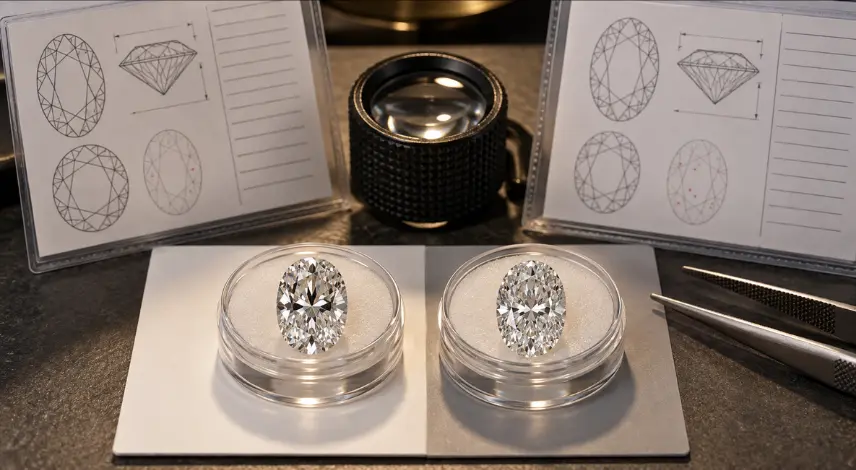
A GIA report can document measurements, polish, symmetry, clarity, color, and other characteristics, but it cannot guarantee that a diamond will satisfy a buyer’s visual preferences.
This is especially important with Fancy Shape Diamonds. Buyers may need to evaluate bow-tie strength, windowing, extinction, facet pattern, spread, outline, and overall face-up character in addition to reviewing the report.
The same principle applies to Unique Cut Diamonds. When a stone has an unusual outline or faceting arrangement, images, video, or agreed visual standards may be required to determine whether it fits the buyer’s expectations.
The report lowers uncertainty about recorded characteristics, but it does not make visual judgment unnecessary.
It Does Not Evaluate the Supplier’s Business Performance
A GIA report concerns the diamond examined by the laboratory. It does not analyze the supplier’s business practices, production controls, delivery consistency, replacement policy, financial reliability, or ability to reproduce the same specification.
A supplier may state that it can repeatedly produce stones to a given tolerance, but that claim must be tested through order performance and receiving inspection. See How To Choose Lab Grown Diamond Supplier.
For a jeweler or wholesale diamond buyer, the report can reduce gemological uncertainty while supplier qualification, purchase specifications, tolerances, documentation, and repeatability remain separate responsibilities.
Report Verification Still Matters
Buyers should verify GIA report information through GIA’s Report Check system and compare the report details with the physical stone. A PDF, photocopy, screenshot, or printed copy should not automatically be treated as the most current source of report information.
Receiving controls should therefore match the report number, measurements, carat weight, shape, inscription where applicable, and other identifying characteristics with the diamond received.
A proper Diamond Report Verification workflow includes verification as part of quality control rather than treating the presence of a document as the end of the process.
Distinguishing GIA Report Types Is Vital During Purchasing
Purchasing teams can create avoidable errors when the required GIA report service is not clearly communicated.
GIA offers several natural diamond report services, and each service can contain different information. These services include the Diamond Grading Report, Diamond Dossier, Diamond eReport, Diamond Focus Report, and Diamond Origin Report.
A purchase order should therefore define the acceptable report service when a specific format or data field is required.
Diamond Grading Report and Diamond Dossier
The Diamond Grading Report provides the 4Cs and can include supporting information such as clarity characteristics and proportion details, depending on the service. It is designed to document the quality characteristics of eligible natural diamonds in a standardized format.
The Diamond Dossier is another report service used for eligible smaller natural diamonds and includes laser inscription of the report number. If a wholesale program accepts Diamond Dossier reports, the acceptable service and size range should be clearly stated in the procurement specification.
A requirement that says only “GIA report required” may not be precise enough. The specific report type can matter to the buyer’s receiving process.
Diamond Origin Report, eReport, and Focus Report
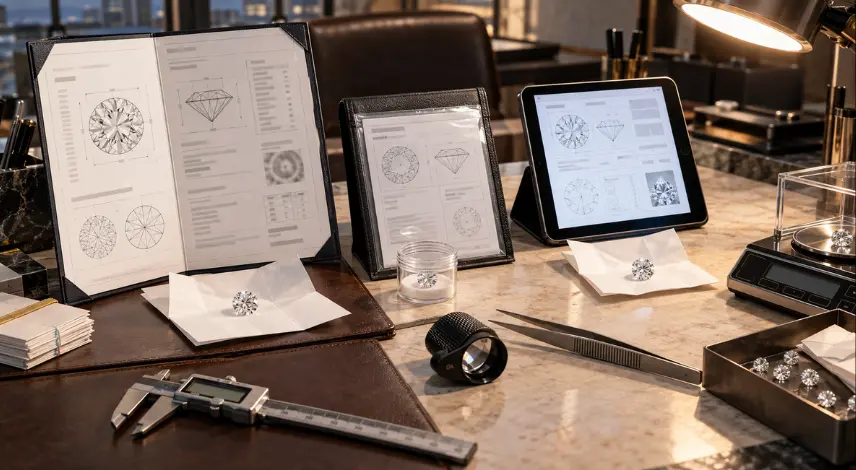
The Diamond Origin Report can provide country-of-origin information for eligible natural diamonds when the required GIA origin process has been completed. A standard grading report does not automatically establish country of mining origin.
The eReport delivers grading information in digital form and may include supporting visual information. Diamond Focus is also a digital service, but it does not necessarily include every feature available in a full Diamond Grading Report.
The business lesson remains consistent: the purchasing specification should define the report service rather than relying on the laboratory name alone. See GIA Certified Diamonds Surat.
GIA Diamond Certification for Laboratory-Grown Diamonds in 2026
The terminology surrounding laboratory-grown diamonds changed significantly in late 2025. Effective October 1, 2025, GIA changed its framework for eligible colorless to near-colorless laboratory-grown diamonds. Instead of using the natural-diamond color and clarity nomenclature in the previous way, the service now uses overall Premium or Standard quality assessments.
That change is important for GIA diamond certification in 2026 because a buyer cannot assume that a laboratory-grown assessment will use the same terminology or structure as a natural-diamond grading report.
Wholesale buyers should check the date, service type, terminology, and exact information provided before comparing stones. See Lab Diamond Certification.
Premium and Standard Are Not Natural-Diamond 4Cs Grades
Premium and Standard should not be interpreted as direct replacements for natural-diamond color and clarity grades. GIA’s current laboratory-grown quality assessment applies its own criteria to eligible stones.
For wholesale buyers, the main risk is comparing unlike reporting systems as though they communicate identical information. The purchasing team should record the laboratory, service type, report date, origin category, measurements, and quality terminology exactly as issued.
In other words, laboratory-grown GIA assessments and natural-diamond grading reports should not be treated as structurally identical documents.
CVD and HPHT Supply Still Requires Manufacturing QC
A laboratory assessment does not replace production controls. In CVD or HPHT manufacturing programs, the supplier remains responsible for production consistency, calibration, sample matching, disclosure of treatments where relevant, and conformity with the agreed purchase specification.
Lepdo Diamonds is a Surat, India-based laboratory-grown diamond manufacturer and B2B supplier. Buyers sourcing repeat laboratory-grown inventory should combine GIA diamond certification or other accepted laboratory documentation with their own procurement and acceptance standards.
The report can support the process, but it cannot replace manufacturing quality control.
Diamond Certification IGI vs GIA: What Changes for Buyers?
The query diamond certification IGI vs GIA matters because the two laboratories can use different report structures, terminology, and service approaches.
Both laboratories provide reporting services for diamonds, including laboratory-grown diamonds. IGI reports can include shape, cutting style, measurements, and 4Cs assessments where applicable. GIA’s current eligible colorless to near-colorless laboratory-grown service uses overall Premium or Standard quality assessments.
When comparing reports, wholesale buyers should focus on what is actually communicated rather than assuming that similar-looking labels or laboratory names mean the documents are equivalent. See IGI vs GIA vs SGL Certificate.
The key B2B question is whether the buyer, supplier, manufacturer, and downstream customer interpret the chosen report consistently. GIA diamond certification is useful only when the purchasing specification and internal systems are aligned with the report type actually supplied.
Five Requirements Wholesale Buyers Must Validate Before Purchase
Evaluating GIA diamond certification inside a B2B transaction requires a repeatable control process.
- Verify the report type and report number. Confirm which GIA service was performed and check the current report status through GIA’s verification system.
- Match the physical characteristics of the diamond with the report details. Shape, measurements, carat weight, inscription where applicable, and other identifying information should agree.
- Review comments and supporting fields. Do not stop at color and clarity if other information on the report could affect the purchase.
- Evaluate visual characteristics separately. A report does not determine whether the stone meets the buyer’s aesthetic or matching standards.
- Assess the supplier’s repeatability and commercial performance. Supplier controls, shipment accuracy, tolerance compliance, and order terms remain outside the laboratory report.
A complete review of GIA diamond certification should confirm what the laboratory establishes while also identifying the controls that still belong to the buyer, supplier, and manufacturer.
Common Wholesale Errors With GIA Reports
The first common error is calling every document a certificate and assuming that anything described as certified is guaranteed. GIA refers to its documents as reports and specifically limits how they should be represented.
The second error is reading only the report heading. Multiple GIA report formats exist, and the information included in each format can vary.
The third error is applying expectations from a natural diamond report to a laboratory-grown diamond assessment. Current GIA laboratory-grown terminology is different from the natural-diamond grading nomenclature.
The fourth error is assuming GIA diamond certification guarantees that two stones with similar report information will look the same. Visual matching still requires separate evaluation.
The fifth error is assuming the report guarantees how a supplier will handle the diamond or perform commercially. Supplier controls remain outside the report.
The correct approach is to base gemological conclusions on what the report actually states and create separate controls for everything outside the report.
Frequently Asked Questions About GIA Diamond Certification
1. What Is a GIA Diamond Certificate?
The term GIA diamond certification is commonly used to describe documentation issued after GIA examines a diamond, but GIA itself uses the term report rather than certificate. Depending on the service, the report may contain information about identity, origin category, 4Cs, measurements, finish, fluorescence, treatments, and other characteristics of the examined stone.
2. Do GIA Reports Set a Diamond’s Value?
No. A GIA report does not set a diamond’s monetary value. Wholesale, retail, replacement, resale, and liquidation values can differ because market conditions and transaction circumstances affect price. GIA diamond certification provides technical information about the examined diamond, while valuation and price analysis remain separate commercial processes.
3. Does a GIA Report State the Seller or Manufacturer?
No. A GIA report concerns the diamond examined by the laboratory. It does not certify the seller, wholesaler, retailer, or manufacturer involved in the transaction. Buyers must evaluate supplier identity, commercial performance, quality-control procedures, delivery consistency, and purchase terms separately from GIA diamond certification.
4. Does a GIA Report Show the Country of Origin?
Not every GIA report provides country-of-origin information. The GIA Diamond Origin Report is a specific service for eligible natural diamonds that have gone through the required origin process. A standard GIA diamond certification report should not automatically be interpreted as proof of the diamond’s mining country.
5. Is GIA Diamond Certification Only for Round Brilliants?
No. GIA reports are available for more than round brilliant diamonds. However, an overall cut grade is not provided in the same way for every shape. Fancy shapes require evaluation of proportions, facet arrangement, light behavior, outline, and other visual factors, so GIA diamond certification should be combined with shape-specific visual assessment.
6. What Is the Process for Verifying a GIA Report?
A wholesale buyer can use GIA Report Check to confirm that the report information matches GIA’s current database. The buyer should also compare the report details with the physical diamond. Report number, measurements, carat weight, shape, and inscription where applicable should be checked during receiving inspection.
7. What Changed for GIA Laboratory-Grown Reports in 2026?
Since October 1, 2025, GIA has used Premium or Standard overall quality assessments for eligible colorless to near-colorless laboratory-grown diamonds rather than continuing to use the natural-diamond color and clarity nomenclature in the previous way. Buyers should check the date and service type before interpreting GIA diamond certification for laboratory-grown inventory.
8. Is GIA Diamond Certification Sufficient for Wholesale Buying?
No. GIA diamond certification is useful for documenting characteristics of the examined stone, but it does not replace price analysis, physical inspection, supplier evaluation, tolerance controls, purchase-order requirements, or commercial due diligence. For wholesale buyers, laboratory documentation should operate as one component of a broader sourcing and quality-control system.
Insights for Wholesale Customers
Precision is at the center of GIA diamond certification. Knowing exactly what was examined and what was recorded gives the report its value. A buyer can compare documented characteristics across a transaction and maintain clearer records when the exact report type is understood.
The report also has clear limits. It does not assure uniform market value, beauty, supplier reliability, visual matching, or future trade performance.
For a wholesale diamond business, GIA diamond certification should therefore be treated as one component of a broader assessment and sourcing system. The buyer still needs to examine the stone, compare it with the purchase specification, verify the report, and evaluate the supplier before accepting the transaction.
For in-depth market reports, trade sourcing guides, interactive Q&As, and expert gemological perspectives, explore the official Lepdo Group Medium platform and join the discussion on Lepdo Diamonds on Quora.