• Diamonds

    Fancy Shape Diamonds

    SHOP NOW

    Fancy Color Diamonds

    SHOP NOW

    Loose Diamonds

    SHOP NOW

    Certified Diamonds

    SHOP NOW

    Unique Cut Diamonds

    SHOP NOW
  • About
    • About us
    • Why Us
    • Our Customers
    • Workshop
    • Our Alliances
  • Support
    • FAQs
    • Size Chart
    • Our Policies
    • KYC Form
  • Resources
    • Blog
    • CSR Work
    • Glossary
  • Contact Us

Search

  • All categories

Search

  • All categories
Lepdo Logo
  • Home
  • Diamonds
    • Fancy Shape
    • Fancy Color
    • Loose Diamonds
    • Certified Diamonds
  • About Us
    • About us
    • Why Us
    • Our Customers
    • Workshop
    • Our Alliances
  • Support
    • Contact Us
    • FAQs
    • Size Chart
    • Our Policies
    • KYC Form
  • Resources
    • Blog
    • CSR Work
    • Glossary

Home / News / Micro-Pavé Lab Diamond Jewelry: 2026’s Fastest-Growing Wholesale Category

Micro-Pavé Lab Diamond Jewelry: 2026's Fastest-Growing Wholesale Category
News August 12, 2026

Micro-Pavé Lab Diamond Jewelry: 2026’s Fastest-Growing Wholesale Category

by lepdogroup@gmail.com 0 comments

Micro pave lab grown diamond jewelry uses tiny, closely set lab-grown stones (usually under 0.01 carats each) to create a continuous sparkle across a piece. Buyers want it because it delivers high visual impact at accessible price points. Lepdo Diamonds supplies IGI and GIA certified micro pave stock for retailers building this category.

Micro-Pavé Lab Diamond Jewelry: 2026’s Fastest-Growing Wholesale Category

A single micro pave lab grown diamond earring can contain more than 100 individual stones, yet weigh less than a standard stud. That statistic alone explains why wholesale buyers across the USA are reordering this category faster than almost any other fine jewelry segment right now. Micro-Pavé Lab Diamond Jewelry: 2026’s Fastest-Growing Wholesale Category is not just a headline. It reflects a measurable shift in consumer demand, retailer purchasing behavior, and wholesale inventory planning across the jewelry industry.

Retail buyers keep asking the same question this season: why does everyone suddenly want more sparkle for less carat weight? The answer sits in a setting technique that jewelers have used for decades, now paired with micro pave lab grown diamond manufacturing and reintroduced to a generation raised on maximalist, everyday luxury.

Here is what changed. Lab-grown production scaled up, prices softened, and suddenly micro pave lab grown diamond designs that once felt reserved for red carpet pieces became accessible for daily wear. Consumers respond to the way dozens of small stones catch light from every angle, creating exceptional brilliance while using a relatively small total carat weight. This effect closely mirrors the brilliance, fire, and scintillation that jewelers evaluate under the 4Cs.

This article explores why Micro-Pavé Lab Diamond Jewelry: 2026’s Fastest-Growing Wholesale Category has become one of the most important sourcing opportunities for retailers and distributors. We will explain what micro pave lab grown diamond jewelry actually is, the styles driving 2026 demand, how it compares with larger center-stone pieces, and what manufacturers and retailers need to know before placing bulk orders. Consumers shopping for their next piece will also find practical guidance on choosing micro pave lab grown diamond jewelry that delivers maximum visual impact without requiring a large center-carat budget.

What Micro Pave Lab Grown Diamond Jewelry Actually Is

Micro pave describes a setting method where very small diamonds, often between 0.005 and 0.01 carats each, sit in tiny drilled holes and get secured with miniature metal beads. The stones sit close together, almost touching, so the metal nearly disappears and the surface reads as one continuous shimmer.

This differs from standard pave, which uses slightly larger stones with more visible spacing. A Pavé Setting relies on the same bead-and-hole technique but at a scale that leaves more metal showing between stones.

Quick Info Box

  • Definition: A setting style using dozens to hundreds of tiny diamonds set close together to create continuous surface sparkle.
  • Key Types or Varieties: Full pave, half pave, French pave, shared prong, U-pave, common prong.
  • Best For: Earrings, eternity bands, halo rings, tennis bracelets, and layered stacking pieces.
  • Key Difference or Advantage: Higher perceived brilliance per carat compared to single larger stones.

Most Popular Micro Pave Styles and Who They Are For
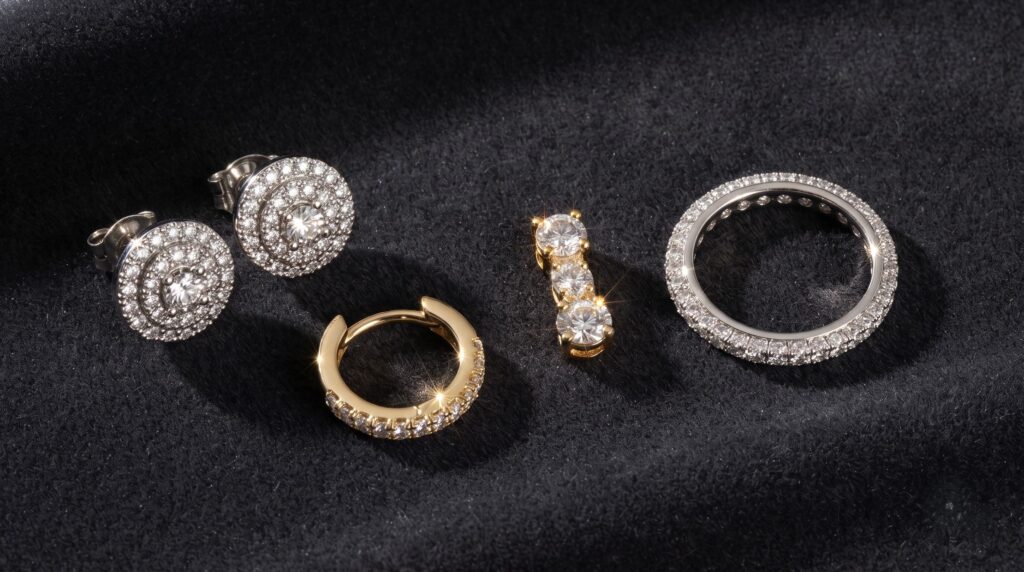
micro pave lab grown diamond

Micro pave lab grown diamond jewelry now spans nearly every category, but a handful of formats dominate 2026 wholesale orders.

Micro Pave Diamond Stud Earrings

These remain the entry point for most first-time buyers. A cluster of micro pave stones set into a halo or floral shape around a small center stone gives the visual weight of a larger Diamond Stud Earrings piece without the matching carat cost. This is the single fastest-moving SKU category retailers report right now.

Micro Pave Eternity and Stacking Bands

Thin bands lined edge to edge with micro pave stones sell well as stackable pieces. Consumers buy two or three at once to wear layered, which pushes average order value up for retailers stocking multiple widths.

Micro Pave Halo Engagement Rings

A center stone surrounded by a dense ring of micro pavé diamonds, often extending down the shank, remains one of the strongest-performing jewelry styles in both retail and wholesale markets. The design creates the illusion of a significantly larger center diamond because the surrounding micro pavé stones add continuous sparkle and visual spread from every angle. For shoppers who want a bold, luxurious appearance without paying for a much larger center carat weight, this style offers an excellent balance of impact and value.

It is especially popular in engagement rings, anniversary rings, and fashion jewelry collections where brilliance is the primary selling point. Beyond these core designs, huggie hoop earrings, tennis bracelets with micro pavé side rails, cocktail rings, and halo pendants have become important extensions of the category. Wholesale buyers increasingly treat micro pavé jewelry as a coordinated collection rather than a single-item purchase, since consumers are now far more likely to buy matching earrings, bracelets, pendants, and rings that can be layered or stacked together for a cohesive look.

Another misconception in the market is that micro pavé works best only in white gold or platinum settings. In reality, yellow gold micro pavé has emerged as one of the fastest-growing sub-trends through 2025 and into 2026, particularly when paired with high-color DEFG lab-grown diamonds. The contrast between warm yellow gold and bright white micro pavé stones creates a rich, contemporary aesthetic that appeals to younger buyers as well as luxury shoppers looking for a more distinctive alternative to traditional white-metal jewelry.

Micro Pave vs Larger Solitaire Settings — The Real Difference
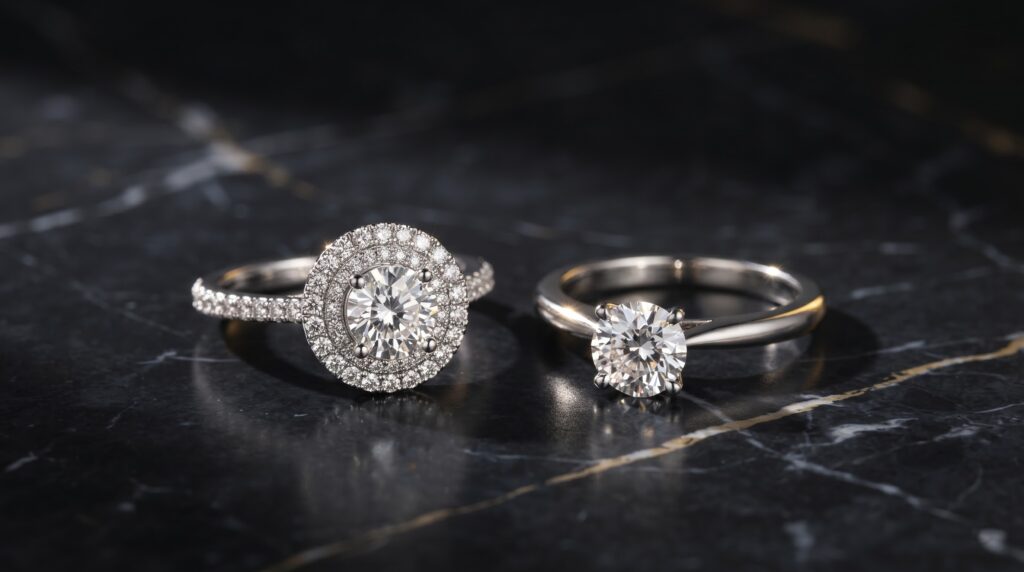
Micro pave diamond ring compared side by side with solitaire diamond ring

Shoppers often stand between a single larger stone and a micro pave cluster, unsure which delivers better value. Both routes use the same underlying material, but they perform differently on the hand and in the light.

FactorMicro Pave Lab Grown DiamondSolitaire / Larger Center Stone
Perceived sizeLarger visual footprint per dollarTrue carat weight, less spread
Sparkle patternContinuous, scattered brillianceConcentrated fire from one cut
Everyday durabilitySmall stones, low individual loss risk valueHigher risk if chipped or lost
Price per visual impactGenerally lowerGenerally higher
Resale/upgrade flexibilityHarder to resize or resetEasier to reset into new pieces

The table shows why so many retailers pair both options side by side rather than picking one over the other. A shopper choosing between a Pavé vs Micropavé Setting comparison usually cares about how the piece photographs and how it feels against skin daily, not just the certificate numbers. To be fair, round solitaires still dominate classic engagement ring sales, and that is unlikely to change soon. Micro pave has carved out its own lane instead of replacing the solitaire category outright.

How to Choose the Right Micro Pave Lab Grown Diamond Piece for Your Style

  1. Match the setting to your skin tone and existing jewelry. Warmer yellow gold micro pave tends to suit warmer undertones, while platinum and white gold read cooler.
  2. Check hand or ear proportions before buying. Micro pave earrings with wide halos can overwhelm smaller earlobes, so try before committing to a bold cluster.
  3. Confirm the setting suits your lifestyle. Shared prong and U-pave settings hold up better for active daily wear than delicate French pave.
  4. Compare the budget advantage honestly. A micro pave halo ring can cost 20 to 35 percent less than a single stone of equivalent visual size, though exact savings vary by retailer.
  5. Think about the occasion. Engagement pieces benefit from denser pave coverage, while fashion pieces for everyday wear can use lighter, more open settings.
  6. Decide on lab-grown versus natural early. A lab grown diamond micro pave wholesale piece typically costs 60 to 75 percent less than natural equivalents at the same clarity and color, and buyers should ask for Lab Diamond Certification documentation regardless of which route they choose.

Think of it this way: micro pave is less about the size of any single stone and more about how the whole piece behaves as one surface. Before you finalize your choice, ask to see the piece under natural light and indoor light both, since micro pave brilliance can shift noticeably between the two.

What B2B Buyers and Diamond Manufacturers Should Know
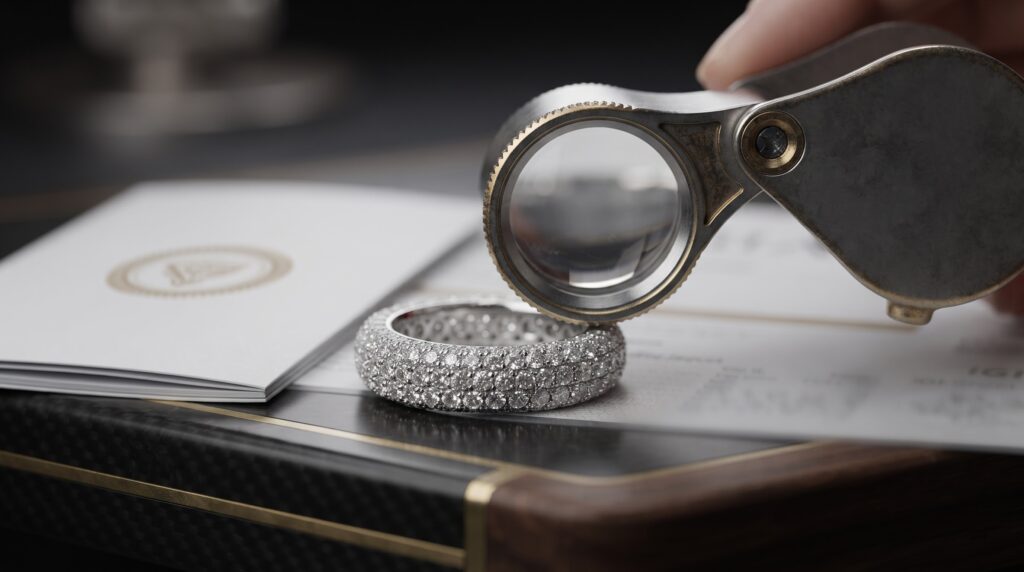
Jeweler examining micro pave lab grown diamond jewelry with certification report

Wholesale buyers sourcing micro pave jewelry wholesale face a different set of concerns than retail consumers. Consistency across a production run matters more than any single stone’s individual grade, since a mismatched cluster stands out immediately under a jeweler’s loupe.

Cut grading consistency becomes the priority when ordering in bulk. Manufacturers like Diamond Jewelry Manufactures based in Surat typically pre-sort parcels by melee size and color range before setting, which keeps a full eternity band or halo visually uniform. IGI certification standards for melee-scale stones focus on parcel-level consistency rather than individual stone reports, while GIA reports remain more common for larger center stones within the same piece.

Rapaport pricing for lab-grown melee has continued to soften year over year, which is part of why micro pave jewelry wholesale margins have improved for retailers even as average selling prices dropped. In my experience sourcing melee parcels, the biggest cost driver is not the stones themselves but the labor hours needed for precise bead setting, so factor that into wholesale quotes rather than judging price purely on carat weight. Buyers evaluating suppliers for lab diamond micro pave wholesale sourcing often start by requesting a sample parcel, something Lepdo Diamonds offers to verified B2B accounts before larger production runs.

Micro Pave Jewelry Trends in the USA (2026 to 2027)

Micro pave earrings trend 2026 data points to layered ear stacking as the dominant style, with three or more micro pave pieces worn together rather than a single statement pair. Retailers report that mixed-metal stacking, combining yellow and white gold micro pave in the same ear, has moved from niche to mainstream over the past two seasons.

Red carpet and social media exposure continues to push demand for dense, continuous pave coverage rather than sparse accent stones. Cultural influence from celebrity engagement announcements and award season jewelry has historically shifted consumer search interest toward similar styles within weeks, and 2026 has followed that same pattern.

Small diamond pave jewelry trend growth also shows up in bridal shower and gifting categories, where buyers purchase micro pave pieces as milestone gifts rather than exclusively for engagements. Industry trade data has flagged pave-set melee jewelry as one of the faster-growing subcategories within fine jewelry over the past two years, a shift retailers can track through Diamond Jewelry Trends reporting.

How to Evaluate Quality in Micro Pave Lab Grown Diamond Jewelry

When I assess a micro pave piece, the first thing I check is stone-to-stone consistency rather than any single diamond’s grade. A cluster with mismatched color or clarity grade will show visible gaps in brilliance, even if every individual stone technically passes certification.

  1. Check for uniform color across the cluster. Even a one-grade shift between stones becomes visible once light hits the piece.
  2. Look for even light return. Poor pavilion angles on melee stones cause dark spots instead of consistent fire and scintillation.
  3. Inspect prong or bead security under magnification. Loose beads eventually lead to lost stones, especially in shared prong settings.
  4. Ask about table percentage consistency. Melee cut to similar table and depth percentage produces a more uniform sparkle pattern across the surface.
  5. Confirm certification for the parcel or center stone. Reputable suppliers provide Diamond Setting documentation alongside grading reports, not just a general quality claim.

You will want to pay attention to how the piece looks in dim indoor lighting, not just under a jeweler’s spotlight, since that is where most consumers actually wear their jewelry day to day.

Conclusion

Micro pave lab grown diamond jewelry earned its place as one of 2026’s strongest wholesale categories for a straightforward reason: it delivers visible brilliance at a price point that works for daily wear, gifting, and stacking culture all at once. Retailers who understand the difference between micro pave and standard pave, and who prioritize consistent melee sourcing, position themselves ahead of a trend that shows no signs of slowing through 2027.

Consumers benefit from the same fundamentals that matter to wholesale buyers. Checking certification, comparing settings honestly against solitaire alternatives, and paying attention to how a piece performs under everyday light all lead to better purchases. That truth applies whether someone is buying a single pair of studs or a retailer is placing a bulk order.

Retailers and manufacturers ready to explore this category can start with Lepdo Diamond for certified lab-grown stock built specifically for micro pave production. Sparkle sells, but consistency is what keeps customers coming back, and that is the real story behind the micro pave lab grown diamond boom.

Frequently Asked Questions About Micro Pave Lab Grown Diamond Jewelry

1. What is a micro pave lab grown diamond?

A micro pave lab grown diamond is a small, lab-created stone, typically under 0.01 carats, set closely alongside many others using the bead and prong pave technique. Together, dozens or hundreds of these stones create one continuous surface of sparkle rather than a single focal point.

2. Is micro pave lab grown diamond jewelry cheaper than solitaire settings?

Yes, in most cases. A micro pave lab grown diamond piece typically costs 20 to 35 percent less than a solitaire of equivalent visual size, since total carat weight is spread across many small stones rather than concentrated in one larger, pricier cut.

3. Which micro pave style looks biggest or most impressive?

Halo micro pave settings, where stones surround a center diamond and continue down the band or earring, create the largest visual footprint. The continuous coverage tricks the eye into perceiving more size than the actual total carat weight suggests.

4. Does micro pave lab grown diamond jewelry have a GIA cut grade?

Individual melee stones under 0.18 carats generally do not receive a formal GIA cut grade. Larger center stones within a micro pave piece can carry full GIA or IGI reports, while the surrounding melee is typically graded and sorted at the parcel level instead.

5. What is the biggest quality risk with micro pave lab grown diamond jewelry?

Inconsistent stone matching poses the biggest risk. If melee color, clarity grade, or cut varies noticeably within one cluster, the piece shows uneven brilliance and looks visibly patchy rather than uniform once light hits the surface.

6. Are lab-grown micro pave diamonds as good as natural ones?

Yes, chemically and optically identical. Lab-grown and natural diamonds share the same crystal structure, hardness, and light performance. The only meaningful differences are origin and price, with lab-grown melee typically costing significantly less per carat.

7. Which micro pave style is best for an engagement ring?

Halo micro pave with a shared prong or U-pave band tends to work best for engagement rings, since it balances visual impact with everyday durability. Consumers who want more surface coverage often extend pave down the shank as well.

8. How do I choose a reliable micro pave diamond manufacturer or supplier?

Look for suppliers offering IGI or GIA certification, consistent melee sorting practices, and transparent Rapaport-based pricing. Requesting a sample parcel before a full wholesale order remains the most reliable way to judge stone matching and setting quality firsthand.
Share Tweet Pin it Linkedin
previous post
Mixed Diamond Shapes: The Tennis Bracelet and Necklace Trend Retailers Should Stock
next post
Why Smart Retailers Are Avoiding the Lab Diamond Price War in 2026

Related Post

Diamond isotopes scientific analysis of a polished diamond
News
Diamond Isotopes: How Science Reveals the Hidden Identity of Diamonds.
Diamond anisotropy analysis showing crystal structure and optical behavior in a polished diamond
News
Diamond Anisotropy: How Crystal Direction Affects Diamond Performance
Diamond birefringence testing with a loose round diamond, gemological tools, and an optical grading diagram.
News
Diamond Birefringence: How Double Refraction Affects Diamond Quality
Laboratory testing demonstrating CVD Diamond Spectroscopy & Crystal Physics on a faceted stone.
News
Diamond Crystal Physics, Spectroscopy & Material Science.
Tiffany Setting Guide featuring a six-prong solitaire diamond ring on deep navy velvet.
News
Tiffany Setting Guide: What Jewelry Retailers Need to Know About This Iconic Ring Style
diamonds vs emeralds retailers comparison guide
News
Diamonds vs Emeralds: Profit and Demand Comparison for Jewelry Retailers
Pearls vs Diamonds
News
Pearls vs Diamonds: Which Gemstone is Better for Jewelry Retailers?
Diamond Milky Effect: How to Identify and Avoid Milky Diamonds When Buying Wholesale
News
Diamond Milky Effect: How to Identify and Avoid Milky Diamonds When Buying Wholesale
VS2 Diamond: Is It the Best Value Clarity Grade for Jewelry Retailers?
News
VS2 Diamond: Is It the Best Value Clarity Grade for Jewelry Retailers?
VVS1 vs VVS2 vs VS1 vs VS2 Diamond Clarity: Full Retailer and Buyer Guide
News
VVS1 vs VVS2 vs VS1 vs VS2 Diamond Clarity: Full Retailer and Buyer Guide
SGL Diamond Certificate: Complete B2B Buyer Guide
News
SGL Diamond Certificate: Complete B2B Buyer Guide
Do Diamonds Conduct Electricity? The Science Every Buyer Should Know
News
Do Diamonds Conduct Electricity? The Science Every Buyer Should Know
What Is a Diamond Pendant? Complete Guide for Jewelry Retailers
News
What Is a Diamond Pendant? Complete Guide for Jewelry Retailers
AI in Diamond Production and Grading: What's Changing in 2026
News
AI in Diamond Production and Grading: What’s Changing in 2026
lab grown diamond certification importance
News
Lab Grown Diamond Certification: Why It’s Becoming Non-Negotiable for Buyers in 2026
Why Smart Retailers Are Avoiding the Lab Diamond Price War in 2026
News
Why Smart Retailers Are Avoiding the Lab Diamond Price War in 2026
Micro-Pavé Lab Diamond Jewelry: 2026's Fastest-Growing Wholesale Category
News
Micro-Pavé Lab Diamond Jewelry: 2026’s Fastest-Growing Wholesale Category
Mixed diamond shape tennis bracelet with alternating round and pear cut diamonds
News
Mixed Diamond Shapes: The Tennis Bracelet and Necklace Trend Retailers Should Stock
2 carat lab grown diamond ring trend
News
Bigger, Bolder, Better Value : Why More Couples Are Choosing 2-3 Carat Lab Grown Centre Stones in 2026
Why Lab Grown Diamonds Are Now the Default Choice for US Engagement Rings
News
Why Lab Grown Diamonds Are Now the Default Choice for US Engagement Rings
Lab Grown Diamond Carbon Footprint vs Mined Diamonds: The Real Environmental Comparison
News
Lab Grown Diamond Carbon Footprint vs Mined Diamonds: The Real Environmental Comparison
How to Test If a Diamond is Lab Grown
News
How to Test If a Diamond is Lab Grown: A Complete Diamond Tester Guide
Are Lab Grown Diamonds Conflict-Free
News
Are Lab Grown Diamonds Conflict-Free? The Kimberley Process Explained
Halo Setting Diamond Rings: A Wholesale Buying Guide for Retailers
News
Halo Setting Diamond Rings: A Wholesale Buying Guide for Retailers
Prong vs Bezel vs Pave Setting: A Buying Guide for Jewelry Retailers
News
Prong vs Bezel vs Pave Setting: A Buying Guide for Jewelry Retailers
Private Label Lab Grown Diamond Jewelry Manufacturing Guide for Retailers and Brands
News
Private Label Lab Grown Diamond Jewelry Manufacturing Guide for Retailers and Brands
IIJS Mumbai Jewellery Show Guide for International Buyers: What to Expect and How to Prepare
News
IIJS Mumbai Jewellery Show Guide for International Buyers: What to Expect and How to Prepare
MOQ in Diamond Wholesale: How Much Should You Order as a B2B Buyer
News
MOQ in Diamond Wholesale: How Much Should You Order as a B2B Buyer
Incoterms for Diamond Export: FOB vs CIF Explained for International Buyers
News
Incoterms for Diamond Export: FOB vs CIF Explained for International Buyers
Diamond Carat to MM Size Chart: Convert Carat Weight to Millimeter Diameter
News
Diamond Carat to MM Size Chart: Convert Carat Weight to Millimeter Diameter
Diamond Brilliance, Fire and Scintillation Explained: What Makes a Diamond Sparkle
News
Diamond Brilliance, Fire and Scintillation Explained: What Makes a Diamond Sparkle
Diamond Cut Grade Guide: Excellent vs Very Good vs Good Explained for Buyers
News
Diamond Cut Grade Guide: Excellent vs Very Good vs Good Explained for Buyers
Australia Lab Grown Diamond Wholesale Guide: Sourcing from India for Retailers
News
Australia Lab Grown Diamond Wholesale Guide: Sourcing from India for Retailers
Turkey's Diamond Jewelry Market: A Sourcing Guide for International Buyers
News
Turkey’s Diamond Jewelry Market: A Sourcing Guide for International Buyers
Italy's Jewelry Market: A Sourcing Guide for Lab Grown Diamonds from India
News
Italy’s Jewelry Market: A Sourcing Guide for Lab Grown Diamonds from India
How Canadian Jewelers Can Source Lab Grown Diamonds from India: Complete Guide
News
How Canadian Jewelers Can Source Lab Grown Diamonds from India: Complete Guide
UK Diamond Import Guide for Jewelry Retailers: Sourcing Lab Grown Diamonds from India
News
UK Diamond Import Guide for Retailers: Sourcing Lab Grown Diamonds from India
Lab Grown Diamond Suppliers for Israel's Jewelry Trade: A Sourcing Guide for B2B Buyers
News
Lab Grown Diamond Suppliers for Israel’s Jewelry Trade: A Sourcing Guide for B2B Buyers
How to Import Diamonds from India to the USA: A Step-by-Step Guide for B2B Buyers
News
How to Import Diamonds from India to the USA: A Step-by-Step Guide for B2B Buyers
Diamond Import Duties in the USA for Lab Grown Diamonds: What B2B Buyers Need to Know
News
Diamond Import Duties in the USA for Lab Grown Diamonds : What B2B Buyers Need to Know
Lab Grown Diamond vs Natural Diamond Wholesale : A Cost and Margin Comparison for Retailers
News
Lab Grown Diamond vs Natural Diamond Wholesale : A Cost and Margin Comparison for Retailers
Are Lab Grown Diamonds Worth Buying Wholesale? A Profitability Analysis for Retailers
News
Are Lab Grown Diamonds Worth Buying Wholesale? A Profitability Analysis for Retailers
How Are Lab Grown Diamonds Made? The Complete Science Behind CVD and HPHT Diamonds
News
How Are Lab Grown Diamonds Made? The Complete Science Behind CVD and HPHT Diamonds
Lab Grown Diamond Quality Grades for B2B Buyers: A Practical Grading Guide for Retailers
News
Lab Grown Diamond Quality Grades for B2B Buyers: A Practical Grading Guide for Retailers
HPHT Diamond Process Guide: How High Pressure High Temperature Diamonds Are Made
News
HPHT Diamond Process Guide: How High Pressure High Temperature Diamonds Are Made
CVD Diamond Manufacturing Process Explained: How Chemical Vapor Deposition Creates Diamonds
News
CVD Diamond Manufacturing Process Explained: How Chemical Vapor Deposition Creates Diamonds
Lab Grown Diamond Wholesale Market in the USA: Trends, Demand and Sourcing Insights for 2026
News
Lab Grown Diamond Wholesale Market in the USA: Trends, Demand and Sourcing Insights for 2026
How to Buy Diamonds in Bulk: A Step-by-Step Guide for Wholesale Buyers
News
How to Buy Diamonds in Bulk: A Step-by-Step Guide for Wholesale Buyers
US-India Diamond Tariff Deal 2026: What It Means for Lab Grown Diamond Buyers
News
US-India Diamond Tariff Deal 2026: What It Means for Lab Grown Diamond Buyers
Diamond Parcel Buying Guide: How to Evaluate and Purchase Diamond Parcels Wholesale
News
Diamond Parcel Buying Guide: How to Evaluate and Purchase Diamond Parcels Wholesale
How to Source Diamonds from India: A Complete B2B Guide for International Buyers
News
How to Source Diamonds from India: A Complete B2B Guide for International Buyers
How to Start a Diamond Import Business in the USA: Complete Step-by-Step Guide
News
How to Start a Diamond Import Business in the USA: Complete Step-by-Step Guide
How to Choose the Right Lab Grown Diamond Supplier: 10 Things Jewelry Retailers Must Check
News
How to Choose the Right Lab Grown Diamond Supplier: 10 Things Jewelry Retailers Must Check
Lab Grown Diamond Wholesale Price Guide 2026: How Much Do Lab Diamonds Cost at B2B Level?
News
Lab Grown Diamond Wholesale Price Guide 2026: How Much Do Lab Diamonds Cost at B2B Level?
How to Import Lab Grown Diamonds from India: Step-by-Step Guide for USA, UK and UAE Buyers
News
How to Import Lab Grown Diamonds from India: Step-by-Step Guide for USA, UK and UAE Buyers
Lab Grown Diamond Resale Value: What Retailers and Investors Need to Know in 2026
News
Lab Grown Diamond Resale Value: What Retailers and Investors Need to Know in 2026
Lab Grown Diamonds Last Forever
News
Do Lab Grown Diamonds Last Forever? Are They Real Diamonds? Complete Guide
VVS1 vs VVS2 vs VS1 vs VS2 Diamond Clarity
News
VVS1 vs VVS2 vs VS1 vs VS2 Diamond Clarity: Complete Guide for Buyers and Retailers
HRD Diamond Certificate
News
HRD Diamond Certificate: What is HRD Antwerp Certification and How Does It Compare to IGI and GIA?
Is SGL Certification Reliable for Lab Grown Diamonds
News
SGL Certificate Explained: Is SGL Certification Reliable for Lab Grown Diamonds?
Which Diamond Certification Should You Trust
News
IGI vs GIA vs SGL Certificate: Which Diamond Certification Should You Trust?
Melee Diamonds Wholesale from India: How to Source Small Diamonds for Jewelry Manufacturing
News
Melee Diamonds Wholesale from India: How to Source Small Diamonds for Jewelry Manufacturing
The Future of Diamond Industry in India: Trends, Growth and Opportunities in 2026 and Beyond
News
The Future of Diamond Industry in India: Trends, Growth and Opportunities in 2026 and Beyond
Round Diamonds Are India's Top Export
News
Round Brilliant Diamond Suppliers in India: Why Round Diamonds Are India’s Top Export
Lab Grown Diamond Price in India 2026
News
Lab Grown Diamond Price in India 2026: How Much Do Lab Diamonds Cost Compared to Natural?
Buy Diamonds Online in India: Tips for Getting the Best Quality at the Right Price
News
How to Buy Diamonds Online in India: Tips for Getting the Best Quality at the Right Price
Surat Diamond Bourse: Why It's the World's Largest Diamond Trading Hub
News
Surat Diamond Bourse: Why It’s the World’s Largest Diamond Trading Hub
Diamond Jewelry Manufacturers in Surat: From Raw Diamonds to Finished Jewelry
News
Diamond Jewelry Manufacturers in Surat: From Raw Diamonds to Finished Jewelry
Fancy Color Lab Grown Diamonds in India: Yellow, Pink, Blue and More at Wholesale Prices
News
Fancy Color Lab Grown Diamonds in India: Yellow, Pink, Blue and More at Wholesale Prices
Diamond Wholesalers in Gujarat: Finding the Best Diamond Deals in India's Diamond Hub
News
Diamond Wholesalers in Gujarat: Finding the Best Diamond Deals in India’s Diamond Hub
Fancy Cut Diamonds from India: A Complete Guide to Shapes, Prices and Where to Buy
News
Fancy Cut Diamonds from India: A Complete Guide to Shapes, Prices and Where to Buy
Genuine Natural Diamonds at the Best Price
News
Natural Diamond Suppliers in India: How to Source Genuine Natural Diamonds at the Best Price
GIA Certified Diamonds from Surat
News
GIA Certified Diamonds from Surat: Understanding GIA Grading and Why It Matters
IGI Certified Lab Grown Diamonds in India
News
IGI Certified Lab Grown Diamonds in India: Why Certification Matters When Buying Lab Diamonds
Diamond Exporters Surat India
News
Diamond Exporters in Surat, India: How Surat Supplies Diamonds to the World
Loose Diamonds Wholesale from Surat
News
Buy Loose Diamonds Wholesale from Surat: Your Ultimate Sourcing Guide
HPHT Diamond Manufacturers in India
News
HPHT Diamond Manufacturers in India: Everything You Need to Know About High Pressure Lab Diamonds
CVD Diamond Manufacturers India
News
CVD Diamond Manufacturers in India: How Chemical Vapor Deposition is Changing the Diamond Industry
Lab Grown Diamond Manufacturers in Surat: Leading the Global CVD & HPHT Revolution
News
Lab Grown Diamond Manufacturers in Surat: Leading the Global CVD & HPHT Revolution
Trusted Diamond Supplier India
News
How to Find a Trusted Diamond Supplier in India: Complete Buyer’s Guide
Top Diamond Manufacturers in Surat
News
Top Diamond Manufacturers in Surat: Why Surat is the Diamond Capital of the World
sourcing loose diamonds wholesale from Surat India
News
How to Source Loose Diamonds Wholesale from Surat India: Complete Guide for Jewelry Businesses
The 5Cs of Diamonds Explained
News
The 5Cs of Diamonds Explained: Cut, Color, Clarity, Carat, and Certification
The-4Cs-Of-Diamonds-Explained-Brijes-Pansuriya
News
The 4Cs of Diamonds Explained: Cut, Color, Clarity & Carat – Ultimate Guide by Brijes Pansuriya
Unique Diamond Cuts That Are Trending in 2026: Kite, Hexagon, Shield, Rose & More
News
Unique Diamond Cuts That Are Trending in 2026: Kite, Hexagon, Shield, Rose & More
trusted diamond supplier India Lepdo
News
Why Indian Jewelers & Global Buyers Trust Lepdo Diamonds: GIA, IGI, SDB & Our Story
Diamond Manufacturers in Surat: Complete Guide to India's Diamond Industry (2026)
News
Diamond Manufacturers in Surat: Complete Guide to India’s Diamond Industry (2026)
Moissanite-Vs-Diamond-What-Every-Jeweler-Needs-To-Know
News
Moissanite vs Diamond: What Every Jeweler Needs to Know Before Stocking in 2026
Natural-Diamonds-vs-Lab-Grown-B2B-Buyers-Guide.
News
Natural Diamonds vs Lab Grown: Complete B2B Buyer’s Guide for Jewelers & Retailers
Fancy-Color-Diamonds-Yellow-Pink-Blue-Green
News
Fancy Color Diamonds: Yellow, Pink, Blue & Green – Rarity, Grading & Investment Value
Diamond Buying Guide | Lepdo Diamonds - Types, Quality, Clarity & Price
News
Diamond Buying Guide | Lepdo Diamonds – Types, Quality, Clarity & Price
GIA Certified Diamonds: Why Certification Matters and Where to Buy in India
News
GIA Certified Diamonds: Why Certification Matters and Where to Buy in India
Lab Grown Diamond Price India in 2026: How Much Should You Actually Pay?
News
Lab Grown Diamonds Price Guide 2026: How Much Should You Actually Pay?
Custom Jewelry Ideas Using Lab Grown Diamonds Certified
News
Custom Jewelry Ideas Using Lab Grown Diamonds Certified
How to Buy EGL Certified Diamonds Safely Online
News
How to Buy EGL Certified Diamonds Safely Online
Diamond Certification: The Complete Guide for Buyers, Retailers & Wholesalers (2026 - 27)
News
Diamond Certification: The Complete Guide for Buyers, Retailers & Wholesalers (2026 – 27)
How to Buy Certified Loose Diamonds Online Safely
News
How to Buy Certified Loose Diamonds Online Safely
How Fancy Color Diamonds Get Their Stunning Natural Hues
News
How Fancy Color Diamonds Get Their Stunning Natural Hues
How Diamond Fancy Shapes Enhance the Brilliance of Lab Grown Diamonds (1)
News
How Diamond Fancy Shapes Enhance the Brilliance of Lab-Grown Diamonds
How to Choose the Perfect Fancy Shape Diamonds for Your Style
News
How to Choose the Perfect Fancy Shape Diamonds for Your Style

Leave A Comment Cancel

Your email address will not be published. Required fields are marked *

FILTERS Close
Search
Categories
  • News
  • Tips
Latest Posts
Diamond isotopes scientific analysis of a polished diamond

Diamond Isotopes: How Science Reveals the Hidden Identity of Diamonds.

September 10, 2026
Diamond anisotropy analysis showing crystal structure and optical behavior in a polished diamond

Diamond Anisotropy: How Crystal Direction Affects Diamond Performance

September 9, 2026
Diamond birefringence testing with a loose round diamond, gemological tools, and an optical grading diagram.

Diamond Birefringence: How Double Refraction Affects Diamond Quality

September 8, 2026
Archives
  • September 2026
  • August 2026
  • July 2026
  • June 2026
  • May 2026
  • April 2026
  • March 2026
  • February 2026
  • January 2026
  • December 2025

Sign up for our newsletter

By signing up you agree with our Terms & Conditions and Privacy Policy. To opt out, click Unsubscribe in our emails.

Lepdo Diamonds & Jewelry logo with gold gradient lettering and a diamond icon.

Lepdo Diamonds: Leap Into Luxury

COMPANY
  • About Us
  • Why Us
  • Our Customers
  • Our Alliances
  • CSR Work
  • Blog
SUPPORT
  • Contact Us
  • FAQ
  • Policies
  • Size Chart
  • Workshop
  • Connect
DIAMONDS
  • All Diamonds
  • Lab-Grown Diamonds
  • Fancy Shape
  • Fancy Color
  • Loose Diamonds
  • Certified Diamonds

GET IN TOUCH

Facebook Linkedin Instagram Quora Medium-m Youtube Pinterest
  • Call us at: +91 9173776393
  • Email us at: info@lepdo.com
  • No product
Head Office

Office No. B - 901,902, Pragati it park, opp. AR mall, Mota Varachha, Surat, Gujarat 394101

Market Office

202/Devniranjan Building, LB Chowk, Mahidharpura, Surat, Gujarat, India, 395003

Copyright © 2026 – 2027 Lepdo Diamonds. All Rights Reserved

Login

Register

Continue with Google Continue with Facebook
or

Lost your password?