Do Diamonds Conduct Electricity? The Science Every Buyer Should Know
 by lepdogroup@gmail.com
0 comments
by lepdogroup@gmail.com
0 comments
Do diamonds conduct electricity? Most diamonds are excellent electrical insulators because their tightly bonded carbon atoms leave no free electrons to carry current. Only rare type IIb diamonds, containing trace boron, actually conduct electricity. This distinction helps buyers and gemologists tell genuine diamonds apart from simulants. Lepdo Diamonds supplies IGI and GIA certified lab-grown stones with verified, documented properties.
A jeweler in Dallas once told me she lost a five-figure sale because a client’s home tester flagged a natural diamond as fake. The tester was not wrong about conductivity. It was simply testing the wrong property. That single mix-up is why so many buyers ask do diamonds conduct electricity before they trust any stone, tester, or seller.
Here is what most people assume: diamonds are pure carbon, so they should behave like graphite and carry a current. They do not, and understanding why matters more than most buyers realize when they are comparing a GIA report against a gut feeling at the counter.
If you have ever searched do diamonds conduct electricity explained, the short answer is that most natural and lab-grown diamonds are electrical insulators, not conductors. The longer answer involves crystal structure, trace elements, and the way professional diamond testers actually identify stones. That distinction is what often separates a confident purchase from an expensive misunderstanding.
This piece breaks down diamond electrical conductivity in plain terms, covers the rare exceptions that trip up even experienced sellers, and shows you how this single physical property connects to the 4Cs, diamond testing machines, and the certificates you rely on. Whether you are a retail buyer choosing an engagement stone or a wholesaler stocking parcels for the season, you will walk away knowing exactly what conductivity does and does not tell you about a diamond’s authenticity.
Think of it this way: carat weight tells you size, clarity grade tells you internal purity, and conductivity tells you something almost nobody discusses openly, which is how the stone’s atomic structure behaves under a probe. That gap in buyer knowledge is exactly what this guide closes.
Do Diamonds Conduct Electricity? Understanding the Basic Science
Diamond electrical conductivity refers to how well a diamond allows electric current to pass through its crystal structure. For nearly all diamonds, the answer is that they barely conduct at all. Carbon atoms in a diamond lattice bond so tightly that almost no free electrons remain to carry a charge, which is the short answer to whether are diamonds electrical insulators in the vast majority of cases you will encounter in a showroom or manufacturing facility.
Quick Info Box
Definition: Diamond electrical conductivity measures how freely electric current moves through a diamond’s carbon lattice.
Key Types or Varieties: Type Ia, Type Ib, Type IIa, Type IIb (boron-doped, conductive)
Best For: Gemologists, diamond testers, manufacturers verifying stone identity
Key Difference or Advantage: Only Type IIb diamonds conduct electricity, making this property a precise identification tool
Buyers researching Diamond Electrical Conductivity often expect a simple yes or no answer, but the real story depends on which type of diamond sits under the loupe. That nuance is exactly what separates a confident buyer from a confused one.
The confusion usually starts because people picture diamond and graphite as the same element behaving the same way. Graphite conducts electricity easily because its carbon atoms sit in loose, stacked sheets that let electrons roam freely between layers. Diamond carbon atoms lock into a rigid three-dimensional lattice instead, and that structural difference is the entire reason diamonds are electrical insulators while graphite is not. Once a buyer understands that single structural fact, the answer to do diamonds conduct electricity stops feeling mysterious and starts feeling logical.
The Different Types of Diamonds and Their Electrical Behavior
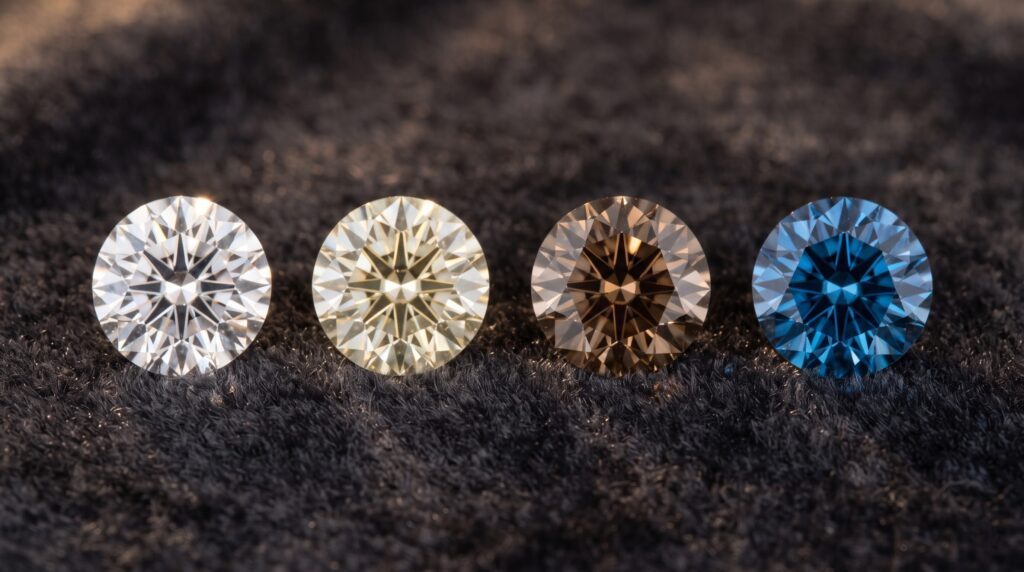
Not every diamond behaves the same way under an electrical probe, and that difference is the whole reason diamond testing machines exist. Most buyers never learn the type classification behind their stone, yet it directly shapes how a diamond conductivity test performs at the counter.
Type IIb Diamonds: The Rare Conductors
Type IIb diamonds contain trace amounts of boron woven into the carbon lattice, and that boron creates just enough free electrons to carry a small current. These stones make up less than 0.1% of natural diamond production and include famous blue diamonds like the one housed at the Smithsonian. If you ever wondered can diamonds conduct electricity in any real-world scenario, this is the answer: yes, but only this rare category does.
Lab-Grown CVD and HPHT Diamonds
Lab-grown diamonds produced through CVD or HPHT methods typically fall into Type IIa, meaning they carry no meaningful boron content and remain strong insulators, just like most natural stones. Manufacturers can intentionally dope certain HPHT diamonds with boron to create blue lab-grown stones, and those doped diamonds will conduct electricity in a measurable way.
Diamond Simulants Like Moissanite
Moissanite, a popular diamond alternative, behaves very differently from diamond under a conductivity probe, and that difference has become one of the most reliable ways to detect substitutions at the wholesale level. Cubic zirconia, glass, and other common diamond simulants each have their own electrical signature, which is why professional testers can often separate them from natural diamonds within seconds.
Beyond these alternatives, buyers should know that brown and yellow natural diamonds (Type Ia and Type Ib) remain strong electrical insulators regardless of how intense their color appears. Colorless diamonds across every clarity grade also test essentially the same way electrically, and most treated diamonds retain the conductivity profile of their original diamond type unless the treatment specifically introduces boron into the crystal structure.
This is one of the most important points in do diamonds conduct electricity explained discussions: conductivity is not a quality grade. It is a material property. A buyer chasing brilliance and fire for an engagement ring gains nothing from a conductive diamond if the cut proportions are poor, and a poorly cut Type IIb diamond can still look less impressive than a well-cut colorless stone. Conductivity functions more like a fingerprint than a ranking system. It helps identify a diamond’s chemical composition rather than determine its beauty or value on its own.
The short version of do diamonds conduct electricity explained comes down to atomic bonding. In a diamond, every carbon atom shares all four of its valence electrons through strong covalent bonds, leaving virtually no free electrons available to carry an electrical current. Type Ia diamonds, which account for roughly 98% of natural diamond production, contain dispersed nitrogen impurities and remain excellent electrical insulators.
Type Ib diamonds, which are much rarer and often responsible for vivid yellow coloration, behave the same way electrically despite their striking appearance. Understanding where a particular stone falls within these diamond types is part of what a professional grading report helps establish, even though most certificates do not explicitly list electrical conductivity as a grading factor. In practical terms, do diamonds conduct electricity explained means recognizing that conductivity is determined by the diamond’s atomic structure and impurities, not by its color, clarity, or overall beauty.
Diamond Electrical Conductivity vs Diamond Thermal Conductivity: The Real Difference
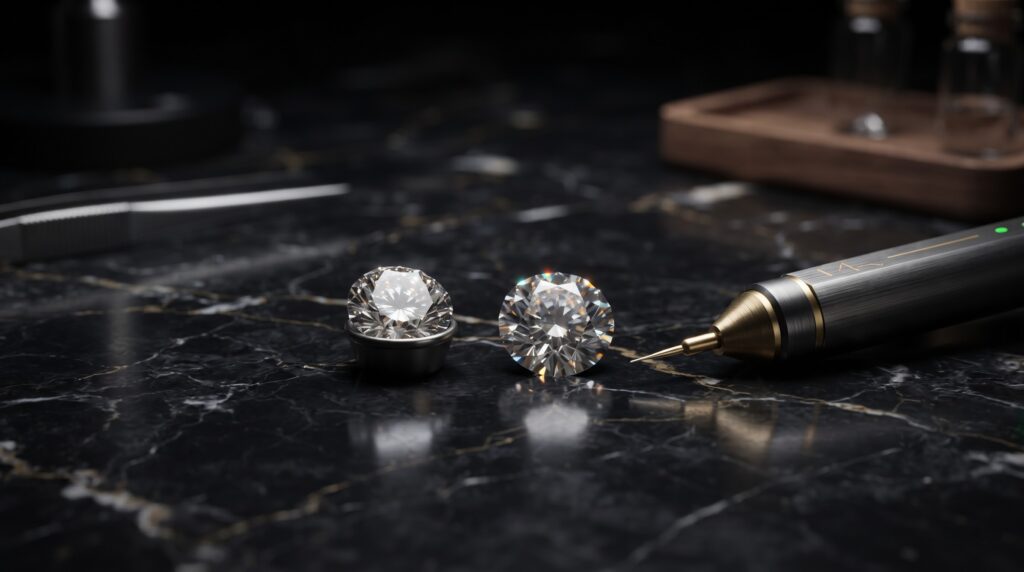
Most buyers confuse electrical conductivity with thermal conductivity, and that mix-up costs real money at the counter. A standard diamond tester pen actually measures how fast heat moves through a stone, not electricity, which is why it can be fooled by moissanite.
| Factor | Electrical Conductivity | Thermal Conductivity |
|---|---|---|
| What it measures | Movement of electric charge through the lattice | Speed of heat transfer through the stone |
| True for most diamonds | Insulator (does not conduct) | Excellent conductor, among the highest known |
| Common testing tool | Electrical conductivity probe | Thermal probe or diamond tester pen |
| Reliability against moissanite | Very reliable, since moissanite conducts electricity | Unreliable alone, since moissanite also conducts heat well |
| Rare exception | Type IIb boron-bearing diamonds | None significant; nearly all diamond types conduct heat well |
The table above explains why serious labs run both tests together. A thermal probe alone will often mistake moissanite for a genuine stone because both materials move heat quickly, but adding an electrical check exposes the difference in seconds. That combination is why reputable dealers pair a Diamond Thermal Conductivity reading with a secondary electrical pass before certifying a parcel as diamond.
How to Use This Knowledge When Choosing or Testing a Diamond
Understanding do diamonds conduct electricity is not just trivia, it should shape how you shop, sell, and verify stones. Here is how to apply it practically.
- Know what your tester actually measures. Many handheld testers only check thermal conductivity, so ask your jeweler or supplier whether electrical testing was also performed.
- Match the test to the stone type. A blue diamond needs a different verification path than a colorless one, since Type IIb stones will register conductive on both thermal and electrical scales.
- Consider setting compatibility. Conductivity has no bearing on how a stone sits in a prong or bezel setting, but knowing your stone’s type helps a jeweler anticipate any unusual reactions during resetting or repair work.
- Weigh the budget difference. Verified stones with dual testing typically carry a small premium over unverified parcels, and that premium buys real peace of mind.
- Match the stone to the occasion. Engagement buyers should prioritize certification over conductivity trivia, while collectors chasing a rare blue Type IIb stone should specifically ask for conductivity confirmation in writing.
- Decide between lab-grown and natural. Lab-grown diamonds test identically to their natural counterparts on conductivity scales, so this property will never help you distinguish origin. For that decision, a Diamond Buying Guide that covers origin, certification, and pricing is far more useful.
Before you finalize your choice, ask your supplier directly which conductivity tests were run on your specific stone and request that detail in writing alongside the grading report.
What B2B Buyers and Diamond Manufacturers Should Know
Wholesalers and retailers sourcing bulk parcels cannot rely on visual inspection alone, and conductivity testing has become a standard checkpoint in serious quality control programs. Cut grading consistency still matters most for value, but a quick electrical pass protects an entire shipment from a single mislabeled stone.
IGI and GIA certification standards do not report electrical conductivity directly on a grading document, yet both labs use internal conductivity and spectroscopy checks as part of their identification process before a stone ever receives a report number. Buyers referencing GIA Certified Diamonds or IGI Certified Diamonds should understand that this behind-the-scenes verification is part of what they are paying for when they choose a certified stone over an uncertified one.
Rapaport pricing factors focus on the 4Cs rather than conductivity, but fancy cut diamond manufacturer partners who run conductivity checks as a standard screening step tend to build stronger trust with international buyers, since it demonstrates a real quality control layer beyond paperwork. Manufacturers like Lepdo Diamonds, based in Surat’s diamond manufacturing hub, work with IGI and GIA certified lab-grown stock and lean on Diamond Testing Machines as one layer of a broader verification process before parcels ship internationally. This practical approach is often overlooked in do diamonds conduct electricity explained conversations, yet it is one of the reasons professional diamond suppliers can confidently verify large shipments before export.
In my experience sourcing parcels across Surat’s supplier network, buyers who ask pointed questions about testing protocol upfront save themselves costly disputes later. That single habit separates seasoned wholesale buyers from newer entrants to the trade.
For wholesale inquiries on conductivity-tested fancy shapes or certified parcels, suppliers who document their testing chain tend to earn repeat business faster than those who simply quote price. A retailer who can answer do diamonds conduct electricity explained with confidence, backed by real documentation from their supplier, sells with more authority at the counter. That authority translates directly into fewer returns and stronger client trust over time, which matters far more to a growing business than winning on price alone.
Diamond Jewelry Trends in the USA (2026 to 2027)
American engagement ring buyers are showing renewed interest in fancy shapes and colored center stones, a shift that has quietly increased curiosity about how blue and other fancy-color diamonds differ at the atomic level. Industry pricing data from Rapaport has tracked steady demand growth for fancy shapes relative to round brilliants over the past two reporting cycles, and that trend shows no sign of slowing through 2027.
Setting styles are also moving toward low-profile bezels and hidden halos that allow more light to reach the pavilion, pairing naturally with consumer interest in brilliance, fire, and scintillation rather than size alone. Cultural influences from film, music, and celebrity engagement rings continue to push shoppers toward unconventional stone colors, which has sparked more questions about fancy cut diamond jewellery and the science behind rare colored stones such as Type IIb blue diamonds.
Retailers who can confidently answer do diamonds conduct electricity explained questions are discovering that this kind of educational selling builds trust faster than price discussions alone. Explaining why a blue diamond may conduct electricity while a typical white diamond does not helps buyers understand that not all diamonds are identical at the atomic level, even when they appear similar in a display case.
Social media has also turned diamond physical properties explained content into genuine entertainment. Short videos demonstrating diamond testers, conductivity probes, and rare stone behavior are attracting far more engagement than traditional product photography alone. Buyers walking into a showroom in 2026 often arrive having already watched a video about diamond conductivity, which shifts the sales conversation from basic education toward deeper trust-building, certification, and stone selection.
How to Evaluate Quality When Diamond Testing Involves Conductivity
When I assess a diamond that has tested as electrically conductive, the first thing I check is color origin, since a natural Type IIb blue diamond commands a dramatically different value than a treated or synthetic one showing the same reading. Conductivity confirms boron presence, not origin or treatment history, so it is only one piece of a larger puzzle.
- Verify the clarity grade under 10x magnification before assuming color quality drives the value alone.
- Check the table percentage and pavilion angle for light return, since even a rare conductive stone loses appeal with poor proportions.
- Assess brilliance, fire, and scintillation together, not just one in isolation, under consistent lighting.
- Confirm length-to-width ratio for fancy shapes, since a mismatched ratio undercuts even excellent color.
- Request full diamond certification rather than relying on a conductivity reading alone as proof of authenticity or value.
To be fair, conductivity testing alone will never replace a full grading report, and no responsible gemologist would suggest otherwise. You will want to pay attention to whether your seller offers full Diamond Certification alongside any conductivity claim, since paperwork protects your purchase far more than a single test result.
Is it possible to fall in love with a stone before confirming any of this? Absolutely, and that is exactly why sellers exist to walk buyers through the properties of diamonds buyers guide details before a final decision. A polished diamond that passes every visual check still deserves a documented conductivity and thermal pass behind the scenes, especially for higher-value purchases where the cost of a mistake climbs quickly.
Conclusion
The truth is that most diamonds insulate rather than conduct, and that single fact quietly protects buyers from costly mix-ups every day. Understanding do diamonds conduct electricity explained gives you a sharper lens for reading test results, questioning suppliers, and recognizing why rare Type IIb blue diamonds command such attention in the trade. Pair that knowledge with solid certification habits, and you reduce your risk whether you are buying one engagement stone or sourcing a full parcel.
Retailers and wholesalers sourcing certified lab-grown diamonds can explore Lepdo Diamond‘s current stock to see how conductivity-aware quality checks fit into a broader sourcing strategy. The next time someone asks do diamonds conduct electricity explained in five seconds, you will have a real answer, not a guess, and that confidence is worth more than any single test result. In the end, do diamonds conduct electricity explained is not just a scientific curiosity. It is practical knowledge that helps buyers verify authenticity, understand rare diamond types, and make more informed purchasing decisions.
Frequently Asked Questions About Diamond Electrical Conductivity
1. What is do diamonds conduct electricity explained in simple terms?
Do diamonds conduct electricity explained simply: almost all diamonds act as electrical insulators because their carbon atoms leave no free electrons to carry current. Only rare boron-bearing Type IIb diamonds, often blue in color, actually conduct electricity in any measurable way.
2. Is a conductive diamond cheaper than a standard insulating diamond?
No, conductive Type IIb diamonds are typically more expensive because they are extremely rare and often display natural blue color. Standard insulating diamonds make up the vast majority of supply, so conductivity itself signals rarity rather than a discount. This is an important part of do diamonds conduct electricity explained, because conductivity is linked to rarity, not value grading.
3. Which diamond type looks biggest or most impressive?
Look and impressiveness come down to cut quality, carat weight, and light performance, not conductivity. A well-cut Type IIa diamond will appear just as brilliant as a Type IIb stone of similar proportions and size.
4. Does diamond electrical conductivity affect the GIA cut grade?
No, GIA cut grades evaluate proportions, symmetry, and polish, not electrical properties. Conductivity relates to a diamond’s internal chemistry, while cut grade relates entirely to how the stone is shaped and finished. In other words, do diamonds conduct electricity explained is a materials-science question, not a cut-quality question.
5. What is the biggest quality risk tied to diamond electrical conductivity testing?
The biggest risk is relying on a single test method. Thermal-only testers can mistake moissanite for diamond, so buyers should confirm that sellers use combined thermal and electrical testing for accurate identification.
6. Are lab-grown diamonds as reliable on conductivity tests as natural diamonds?
Yes, lab-grown diamonds test identically to natural diamonds of the same type. A Type IIa lab-grown stone insulates just like a natural one, and boron-doped lab-grown blues conduct electricity the same way natural Type IIb stones do. This is another useful example of do diamonds conduct electricity explained in real-world diamond testing.
7. Which diamond type is best for an engagement ring?
Most engagement buyers choose colorless Type Ia or IIa diamonds for their brilliance and wide availability. Rare Type IIb blue diamonds make striking statement rings but come with a significant price premium tied to their scarcity.
8. How do I choose a reliable diamond manufacturer or supplier for conductivity-tested stock?
Choose suppliers who combine IGI or GIA certification with in-house verification steps like conductivity and thermal testing. Ask directly about their testing protocol and request documentation before committing to a bulk order. Retailers who understand do diamonds conduct electricity explained can evaluate supplier testing standards more confidently and reduce the risk of costly identification errors.