
lab grown diamond wholesale conditions in 2026 are defined by continued price compression, uneven movement across carat sizes, and greater inventory risk for buyers holding slow-moving stones. B2B buyers should prioritize faster inventory turns, specification-based purchasing, smaller replenishment cycles, supplier consistency, and landed-cost analysis rather than choosing stock solely on the lowest quoted price.
lab grown diamond wholesale market conditions will look very different in 2026. Diamonds can sell at one price while replacement inventory costs less, creating an uncomfortable situation for jewelers and wholesalers. A good purchase has traditionally been defined by getting the lowest price, but if a shipment is not selling and inventory cost is falling, getting the best price does not necessarily protect the buyer.
Traditional diamond pricing structures are changing. Falling production costs have forced buyers to reevaluate their inventory, purchasing strategy, and supplier negotiations.
For lab grown diamond wholesale buyers, the focus has shifted from simply finding the lowest price.
The relevant question is how long inventory of a particular specification should be held, how much should be sourced, and which supplier should provide it.
This question will be central to professional diamond purchasing in 2026. For lab grown diamond wholesale planning, the timing of each replenishment order becomes part of the purchasing decision.
Lab Grown Diamond Wholesale Market Changes for 2026
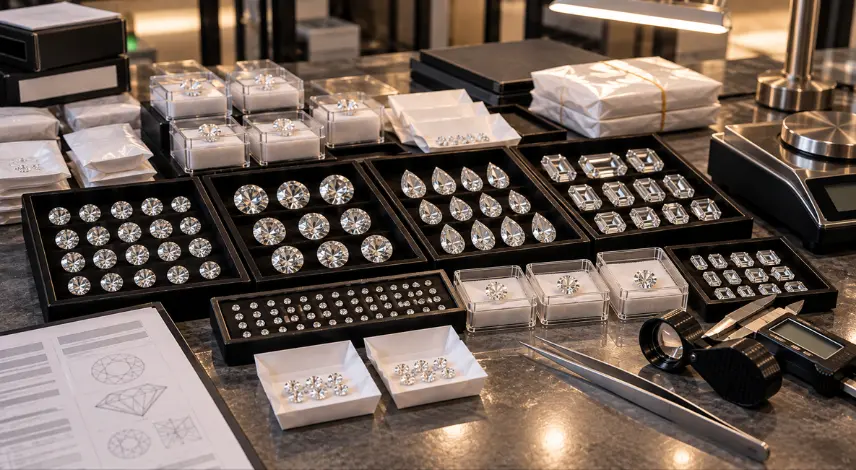
Historically, the trend for lab-grown diamonds has been a falling price, but 2026 shows why not all diamonds should be viewed as one product category.
During the second quarter of 2026, the source material records that lab-grown diamond prices fell an average of 13% from the previous year. Falling prices were not evenly distributed. Larger diamonds experienced greater price pressure, while the price behavior of 1 carat round diamonds was different.
For a retailer, falling price pressure on three months of inventory of a given specification creates a very different situation from price pressure on a fast-moving specification that is continuously replenished.
This difference makes lab grown diamond wholesale purchasing increasingly dependent on inventory velocity instead of the quoted cost alone.
Buyers who want additional pricing context can also review the Lepdo Diamonds wholesale pricing guide, which focuses specifically on B2B pricing considerations.
Price Movements for Individual SKUs
Price movements for lab-grown diamonds should be analyzed at the SKU level to understand the full impact.
Market reports can sometimes combine many types of diamonds and evaluate price movements at an aggregate level. That approach can hide important commercial differences between individual products.
Price movements for a lab-grown diamond product are governed by many factors, including:
- Carat weight
- Cut
- Color
- Clarity
- Shape
- Millimeter size
- Certification or grading documentation
- Growth method
- Inventory turnover
- Availability
- Make quality
- Current consumer demand
For this reason, a lab grown diamond wholesale buyer should not automatically apply an overall market decline to every stone in inventory.
A 1 carat round brilliant may behave differently from a 2 carat pear. A calibrated parcel may behave differently from individually selected center stones. A finely made diamond may behave differently from a commercially cut product even when basic report specifications appear similar.
Uneven Price Movements
In the diamond marketplace, price movements for one product category can affect another category.
For example, movement in the price of lower-carat diamonds may encourage buyers to move toward larger diamonds when the additional cost becomes commercially attractive. As a result, smaller stones may become less marketable even if overall consumer interest in lab-grown diamonds remains strong.
Market behavior for round diamonds may also differ from the behavior of fancy shapes.
Upper-tier diamonds can behave differently from lower-tier products. In the same way, a finely crafted diamond can behave differently from a more commercially cut stone.
Consideration should also be given to finished jewelry rather than looking exclusively at individual loose stones.
The economics of a loose diamond and the economics of a finished ring, pendant, bracelet, or necklace are not always identical because setting, labor, design, marketing, and retail demand also affect the final value proposition.
Based on this analysis, lab grown diamond wholesale price movements cannot be explained effectively using broad market averages alone.
The better approach is product-level analysis. A lab grown diamond wholesale strategy built around SKU-level data can separate fast-moving categories from inventory that carries higher markdown risk.
This creates a market where the overall direction may be downward while selected product categories remain stable or temporarily improve.
Efficiency and Change in Lab-Grown Diamond Production
There is a difference in economics between natural diamond production and laboratory-grown diamond manufacturing.
Cultured diamond production can be optimized, adjusted, and improved through manufacturing processes designed to increase yield and improve consistency.
Changes in diamond growth, cutting, polishing, planning, energy efficiency, process control, and production yield can influence the economics of a lab grown diamond manufacturer.
Buyers researching manufacturing relationships can review Surat diamond manufacturers for additional context on the Surat manufacturing ecosystem.
Manufacturing Efficiency Creates Replacement Risk
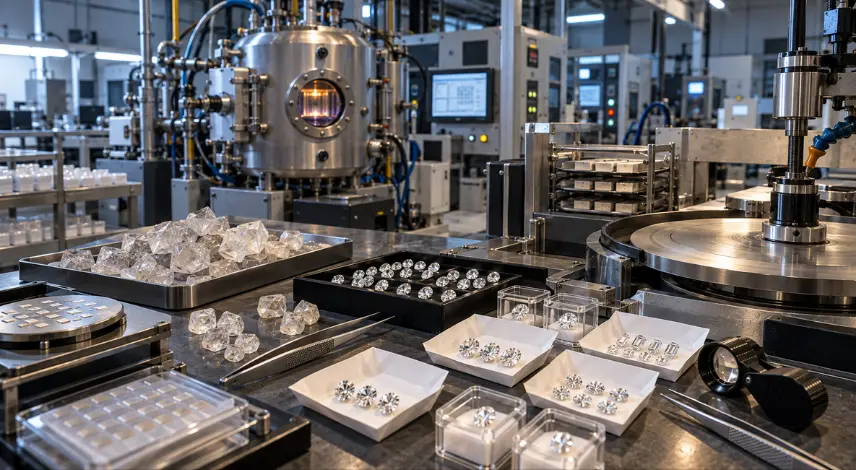
The buyer of laboratory-grown diamonds is exposed to replacement risk.
Consider a jewelry manufacturer that purchases a large bulk shipment because the available price per carat appears attractive.
If diamonds with the same diameter, quality, or even larger dimensions are later produced and supplied by competitors at a lower cost, the jewelry manufacturer may be forced to reduce prices on existing inventory.
The initial transaction may have looked attractive.
Commercially, however, the cost has to be evaluated according to how long the stock remains unsold.
A lab grown diamond wholesale buyer should therefore consider inventory duration as part of the true cost of purchasing.
The supplier price is only one part of the calculation. In lab grown diamond wholesale purchasing, replacement cost and sell-through speed should be reviewed together.
The Greatest Risk in 2026 May Not Be the Price Paid for Inventory
The reduction in the value of inventory becomes commercially significant when discounted inventory does not move.
Suppose a diamond manufacturer reduces the price at which it is willing to sell inventory to customers.
Manufacturers controlling significant supply may gain additional flexibility in terms of product availability, quantities, specifications, and negotiation.
Large-volume purchases can also improve purchasing terms, production planning, and logistical efficiency.
The real issue is how quickly the purchased inventory is likely to turn.
That measure is inventory velocity. For lab grown diamond wholesale inventory, velocity helps show whether a lower purchase price is likely to remain commercially useful.
For lab grown diamond wholesale procurement, buying a large quantity is not automatically a mistake. The risk appears when the quantity purchased is greater than the business can sell within a commercially reasonable period.
Inventory Age as a Key Procurement Indicator
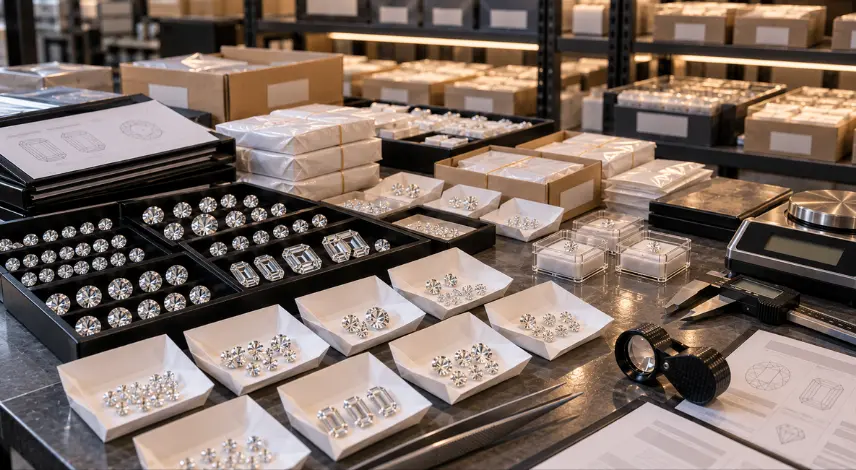
Buyers should understand the average age of their inventory and act accordingly.
Inventory may remain with a buyer for:
- 30 days
- 60 days
- 90 days
- More than 90 days
The appropriate periods depend on the business.
A jewelry manufacturer may carry very different stock from a B2B diamond supplier, online retailer, bridal jeweler, or loose-diamond wholesaler.
The objective is not to apply one universal inventory rule.
The objective is to identify products for which replacement cost has changed materially while the original stock remains unsold.
In lab grown diamond wholesale purchasing, old inventory can reduce pricing flexibility even when the original purchasing decision appeared profitable.
Aging Inventory Can Reduce Margin
Understanding total cost rather than only quoted price is essential for complete procurement analysis.
Cost can include:
- Purchase terms
- Shipping
- Insurance
- Customs
- Evaluation costs
- Grading costs where applicable
- Sorting
- Replacements
- Rematching
- Financing or working-capital cost
This is especially relevant to diamond procurement.
Buyers evaluating the Indian market can also compare broader price conditions through India diamond pricing.
On-time delivery of diamonds with the correct attributes can significantly improve overall purchasing economics.
The Lowest Priced Diamond Can Create Expensive Problems
The total carat weight in a shipment may be correct, while variances in dimensions, make, color, or clarity may still fall outside the approved purchasing standard.
That creates additional sorting.
Some diamonds may need to be rejected.
Others may need to be rematched.
Production may also slow while the buyer waits for replacement goods.
For jewelry manufacturers working with repeat designs, these inconsistencies can affect stone setting, finished appearance, labor efficiency, and delivery schedules.
For that reason, usable yield becomes more important than nominal price in many lab grown diamond wholesale transactions.
A low quotation has limited commercial value when a significant percentage of the parcel cannot be used immediately.
The Best Inventory Strategy for 2026
Core inventory will usually consist of specifications that show repeat-sale patterns.
This can include inventory with known sales velocity that supports an established design, marketing, retail, or manufacturing program.
Opportunistic inventory is different.
It may be purchased because a supplier offers an attractive price or because a buyer expects future demand that has not yet been proven.
That inventory may require a dedicated sales or marketing program to support the purchase.
Because laboratory-grown diamonds can lose wholesale value over time, speculative inventory can become tied-up capital.
For lab grown diamond wholesale purchasing, the goal is not simply to reduce order quantity.
The objective is to balance purchasing cost with operating efficiency while considering the risk of obsolescence. This makes lab grown diamond wholesale inventory planning a continuing process rather than a one-time buying decision.
Measure Sell Through by Specification
The purpose of measuring sell through by specification is to identify inventory that does not move even when overall company sales remain positive.
A company may have strong laboratory-grown diamond revenue while simultaneously accumulating slow-moving combinations.
Examples could include specific 2 carat pear shapes, high-color emerald cuts, or other combinations for which customer demand is limited.
These products should not automatically receive another replenishment order merely because total laboratory-grown diamond sales are performing well.
Establish Maximum Inventory Limits
Purchasers can establish limits on how long a particular diamond specification should remain in stock.
By creating these limits, buyers maintain control over when and how the company purchases inventory, even when a supplier offers an attractive quantity discount.
For lab grown diamond wholesale buyers, disciplined replenishment can reduce the temptation to purchase inventory simply because it appears inexpensive.
Large Orders Versus Smaller Repeat Orders
Larger purchases can produce benefits.
They may provide:
- Lower cost per unit
- Stronger purchasing terms
- Better production planning
- Increased immediate availability
- Reduced frequency of logistics
However, when inventory fails to turn, the buyer can become overstocked with goods that no longer match customer demand or current replacement pricing.
Smaller and more frequent purchases can reduce that exposure.
The better strategy depends on sales velocity, supplier reliability, lead time, and demand predictability. Lab grown diamond wholesale buyers should therefore connect order size directly to real replenishment needs.
Supplier Selection Becomes More Important in a Competitive Market
It is useful for lab grown diamond wholesale buyers to implement a procurement process focused on continuous improvement.
A competitive market may cause buyers to assume that supplier selection becomes less important because many businesses can quote apparently similar products.
For professional procurement, supplier selection can become more important.
Many factors beyond the initial quote affect the success of a purchasing relationship.
Buyers should consider:
- Specification discipline
- Batch-to-batch consistency
- Communication
- Replacement procedures
- Grading consistency
- Production control
- Packing quality
- Repeat manufacturing capability
- Export documentation
- Delivery reliability
For a broader supplier evaluation framework, see how to assess a trusted diamond supplier.
A dependable lab grown diamond supplier should be evaluated according to what arrives in the shipment, not simply according to what appears on the quotation. That distinction is especially important in lab grown diamond wholesale programs requiring repeat batches.
Manufacturer, Wholesaler, Dealer or Broker?
It is important to determine whether the supplier is a manufacturer, wholesaler, dealer, or broker.
A manufacturing relationship can provide the ability to plan production around an ongoing buying program.
This can be useful when the purchaser requires consistent sizes, repeat batches, controlled specifications, or larger recurring volumes.
A dealer may offer another advantage.
Dealers can provide wider access to goods from multiple production sources and may be able to fill smaller or one-time requirements more efficiently.
For lab grown diamond wholesale buyers, neither business model is automatically better.
The appropriate source depends on the order.
Buyers sourcing directly from Surat can review wholesale diamonds from Surat when evaluating B2B sourcing options.
Understanding Growth Method and Production Control
From the buyer’s perspective, it is also important to understand the growth method and the level of production control exercised by the manufacturer.
CVD and HPHT manufacturing represent different production processes.
Buyers researching direct CVD sourcing can review CVD diamond manufacturers.
For HPHT-specific production information, HPHT diamond manufacturers provides the related manufacturing perspective.
Growth method alone does not determine whether a diamond is commercially suitable.
Finished quality, cutting, consistency, grading, specifications, and availability remain important.
Quality and Consistency for Calibrated Jewelry Programs
Quality and consistency become particularly important for calibrated jewelry programs.
A manufacturer may require many stones with closely controlled millimeter measurements so they can be set efficiently into a repeated jewelry design.
If one parcel contains significant variation, additional labor may be required to sort and rematch diamonds.
For this reason, lab grown diamond wholesale procurement for jewelry manufacturing should focus on repeatability as well as grade.
Buyers can review loose polished diamonds when considering sourcing requirements for loose goods.
Construct a Written Purchase Specification
A purchase specification for laboratory-grown diamonds may include:
- Shape
- Carat weight range
- Color tolerance
- Clarity level
- Cut
- Polish
- Symmetry
- Fluorescence
- Grading and assessment
- Matching
- Quantity
- Packing
- Replacement
- Other purchase-specific requirements
Creating a written specification eliminates ambiguity in communication with the supplier.
For repeat orders, a previously approved parcel or reference stone can also be used to communicate requirements.
A laboratory report may not communicate every commercial requirement of the buyer.
Two diamonds can appear similar on paper while differing in dimensions, make, visual character, or suitability for a particular jewelry program.
Certification and Reporting Considerations
Purchasers are becoming more familiar with evolving laboratory reporting systems for laboratory-grown diamonds.
The systems used to describe colorless and near-colorless laboratory-grown diamonds may differ from traditional systems used for natural diamonds.
For trade purposes, differences between reporting systems should be understood clearly by both parties.
“Certified” diamonds should still be evaluated to confirm that they conform to the representations and warranties established in the commercial agreement between purchaser and supplier.
Buyers comparing documented stones can also review certified diamonds.
For lab grown diamond wholesale transactions, documentation should support procurement rather than replace physical quality control. A lab grown diamond wholesale buyer should treat reports as one part of the complete quality-control process.
Lab-Grown Diamond Sourcing From India and Surat
India and Surat are major centers for laboratory-grown diamond production and trading.
When evaluating a lab grown diamond supplier in India, buyers should consider sample approval, specification, repeatability, communication, quality, commercial terms, and replacement procedures.
Lepdo Diamonds is a CVD and HPHT laboratory-grown diamond producer based in Surat, India.
The key question for an international buyer is whether Lepdo Diamonds or another supplier can consistently provide the required specifications, quantities, and size ranges.
Location alone does not determine supplier performance.
Repeatability does. For lab grown diamond wholesale sourcing, consistent fulfillment can be more valuable than a temporary discount that cannot be repeated.
International buyers planning direct procurement can also review diamond imports from India for sourcing and import considerations.
Negotiation for Lab Grown Diamond Wholesale in 2026
There are many negotiable terms outside the price per carat.
A strong lab grown diamond wholesale negotiation should consider the entire supply arrangement.
Terms of a Purchase Order
Suppliers may be able to assure inventory through repeated shipments rather than one large delivery.
This can allow the buyer to maintain access to goods without carrying the entire expected requirement in inventory.
Specification Limits
Tighter limits may increase the cost of diamonds.
A narrow color, clarity, dimension, or matching tolerance can require more sorting and reduce available supply.
Buyers should determine which limits are essential to the finished product.
Replacement Terms
The process for nonconforming diamonds should be defined before an order is placed.
The agreement should clarify what happens when delivered stones do not meet the accepted specification.
Payment Terms
Payment terms can influence the effective cost of a transaction.
Discounts may reduce price, while extended terms may help working-capital management.
A buyer should evaluate payment structure alongside inventory turnover.
Terms of a Contract
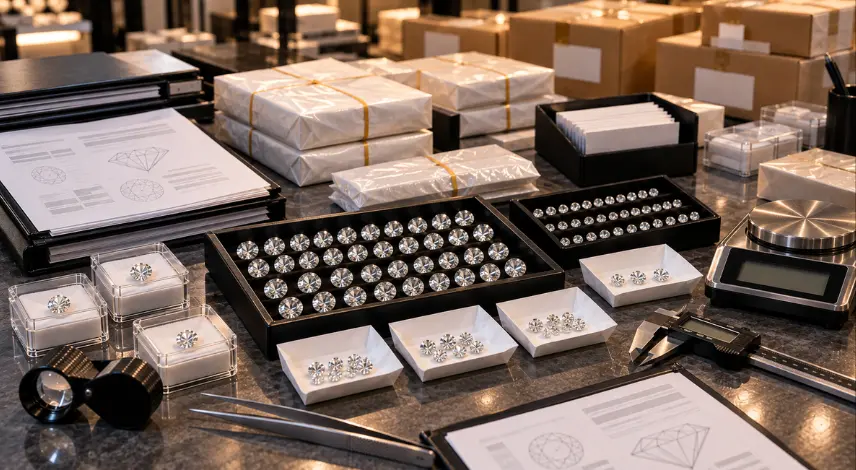
The central question is whether the supplier can provide what is needed when it is needed.
Reliability may sometimes be commercially more important than the lowest price. In lab grown diamond wholesale negotiations, reliability supports production continuity and repeat customer demand.
An unavailable stone can cause a jeweler to lose a sale.
A delayed parcel can cause a manufacturer to miss a production deadline.
A wholesaler may lose a repeat customer when stock cannot be replenished.
This is why lab grown diamond wholesale negotiations increasingly involve supply reliability, not merely price per carat.
Minimizing Inventory Is Not the Objective
The objective is not to hold the smallest possible inventory. Lab grown diamond wholesale inventory should be sized according to demand, replenishment speed, and working-capital exposure.
Rapid demand for standard diamonds may justify deeper inventory.
Fancy shapes may also require strategic stock when a business serves customers looking for specific designs.
Buyers sourcing shape-specific goods can review fancy shape diamonds.
Rare shapes and specialized designs may require even more demand-based purchasing because the buyer needs confidence that a market exists before committing capital.
For specialized inventory, unique cut diamonds provides additional context around less conventional diamond cuts.
For lab grown diamond wholesale procurement, optimized inventory is more useful than either maximum inventory or minimum inventory.
Evaluating the Risk of a Large Purchase Order
There are several factors to consider when determining the risk associated with a large purchase order.
A buyer should evaluate:
- How quickly the customer’s market is changing.
- How long the merchandise is likely to take to sell.
- How consistently the supplier meets specifications.
- The quality and condition of the shipment at delivery.
- How much working capital will remain tied to inventory.
- How quickly replacement prices are changing.
- Whether future demand for the specification is established or speculative.
Instead of evaluating quotations exclusively to find the lowest lab grown diamond wholesale price, the buyer should evaluate quotations according to risk-adjusted commercial value.
That is one of the biggest changes in purchasing strategy for 2026. Lab grown diamond wholesale decisions increasingly need to be evaluated on risk-adjusted commercial value.
Answers to Common Questions
1. What will happen to lab-grown diamond prices in 2026?
The source material expects continued pressure on lab-grown diamond wholesale pricing in 2026, while emphasizing that different sizes and shapes may not move at the same rate. Buyers should therefore examine current price information for the exact specifications they purchase rather than applying a single market percentage to every stone.
2. Why do falling prices for lab-grown diamonds create risk for retailers?
A previously purchased diamond may have to compete against newly sourced diamonds offered at a lower replacement cost. If the retailer cannot sell older inventory at the expected margin, the selling price may need to be reduced. The risk increases when inventory turns slowly while replacement prices continue to change.
3. How should lab grown diamond wholesale price quotes be evaluated?
Buyers should evaluate quotations holistically. Dimensions, quality, tolerances, matching, grading, shipping, payment terms, replacement procedures, sorting requirements, and consistency should be considered alongside the quoted price. An apparently cheaper parcel may ultimately cost more when additional handling, rejection, or replacement is required.
4. Is it better to purchase lab-grown diamonds from a manufacturer?
Manufacturers can be suitable for large, complex, recurring, or specification-controlled orders. Dealers and distributors may be useful for smaller purchases or requirements involving greater variety. The appropriate source depends on quantity, lead time, quality control, replacement requirements, and the supplier’s ability to deliver consistently.
5. Is it necessary for a jeweler to carry lab-grown diamond inventory?
There is no single correct inventory level. A jeweler needs enough stock to support consumer demand, seasonal sales, and common combinations of size and quality. Less common shapes or specifications may not require deep stocking when demand is uncertain. Inventory decisions should therefore follow actual selling patterns.
6. What questions should buyers ask a lab grown diamond supplier before purchasing?
Buyers should ask about diamond dimensions, growth method, tolerances, sample approval, matching, minimum order quantity, payment process, shipping, replacement procedures, and batch consistency. Buyers should also determine how closely repeat orders can reproduce previously approved specifications.
7. Are HPHT and CVD diamonds priced the same?
Not necessarily. Growth method is only one factor affecting commercial pricing. Quality, size, shape, supply, market demand, cutting, grading, production economics, and availability can also affect the price. Buyers should evaluate the finished polished product and supply arrangement rather than relying solely on growth method.
8. How should lab-grown diamond buyers operate in a deflationary market?
A risk-controlled lab grown diamond wholesale strategy connects order quantities with sales velocity, reduces unnecessary lead times, monitors inventory age, maintains clear product specifications, and evaluates suppliers on consistency. Buyers should also monitor replacement costs so that slow-moving stock can be identified before margin pressure becomes significant.
Key Lessons for B2B Purchasing
Lower lab-grown diamond prices do not automatically simplify purchasing.
Instead, the focus moves toward supplier development, inventory timing, working capital, sell-through, repeatability, and inventory turnover.
First, buyers should expect laboratory-grown diamond inventory to keep flowing through the business rather than remaining static for long periods.
A deep discount provides limited value when inventory can no longer be sold profitably.
For lab grown diamond wholesale purchasing, replenishment should therefore remain closely connected to actual sales.
Second, batch consistency helps protect margins.
A supplier who repeatedly delivers the required dimensions, make, quality, and matching can reduce sorting, rematching, replacement orders, and production delays.
Third, buyers should maintain clear specification requirements.
A strong specification allows purchasers to compare different supply routes without lowering quality standards simply because one quotation appears cheaper.
The central commercial lesson for lab grown diamond wholesale in 2026 is that purchasing lower-priced product alone does not create the most effective strategy.
The stronger strategy combines the right price with inventory velocity, specification discipline, reliable supply, quality consistency, working-capital control, and the ability to respond quickly when replacement costs change.
For in-depth market reports, trade sourcing guides, interactive Q&As, and expert gemological perspectives, join the discussion on Lepdo Diamonds on Quora.