
HPHT Diamond Manufacturers in India: Everything You Need to Know About High Pressure Lab Diamonds
 by lepdogroup@gmail.com
4 comments
by lepdogroup@gmail.com
4 comments
HPHT diamond manufacturers in India use high pressure high temperature technology to grow real diamonds that are physically and chemically identical to mined stones, producing near-colorless and vivid fancy color gems at scale. India, centered in Surat, is now a major HPHT production hub, giving US buyers direct access to certified lab-grown diamonds at a fraction of mined diamond prices. Lepdo Diamonds connects you with verified Indian HPHT suppliers for both wholesale and retail purchasing.
Ask any veteran US diamond buyer where lab-grown stone quality has improved fastest over the past five years, and the answer almost always includes one word: HPHT. High pressure high temperature diamonds have quietly moved from niche industrial applications to the center of fine jewelry conversations, and HPHT diamond manufacturers in India are the reason why. The country now supplies a substantial share of global HPHT production, with Surat-based operations combining advanced press technology with deep cutting expertise to deliver stones that meet even the most demanding GIA and IGI grading standards.
American buyers, whether you are a retailer building a lab-grown case, a manufacturer sourcing certified parcels, or a consumer shopping for an engagement ring, are entering this market at an interesting moment. The hpht diamond price in India has shifted considerably as production volumes have grown and cutting quality has improved. At the same time, questions about how HPHT compares to CVD, how to verify quality, and which suppliers can be trusted are more pressing than ever.
This post covers the HPHT process from the ground up: how the technology works, which types of stones Indian manufacturers produce, how to compare HPHT against CVD alternatives, what B2B buyers need to negotiate effectively, and what trends are reshaping demand through 2026.
What Are HPHT Diamonds and How Are They Grown?
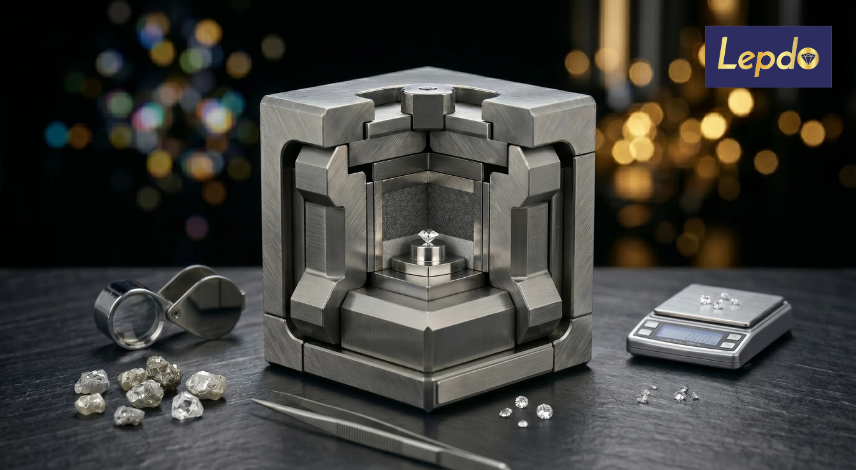
High pressure high temperature diamonds are grown by replicating the same extreme conditions that formed natural diamonds deep inside the Earth billions of years ago. A small diamond seed crystal is placed inside a growth cell alongside a carbon source, typically graphite, and a metal catalyst. The entire assembly is then subjected to pressures exceeding 1.5 million pounds per square inch and temperatures above 1,300 degrees Celsius inside a hydraulic press. Under those conditions, the carbon dissolves into the metal catalyst and then recrystallizes onto the seed as a genuine diamond.
The result is a single-crystal diamond with the same chemical composition, optical properties, and hardness as a mined stone. It scores a 10 on the Mohs scale. It produces the same brilliance, fire, and scintillation under light. No jeweler examining it without specialized spectroscopic equipment will be able to distinguish it from a natural diamond.
| Definition: | HPHT diamonds are lab-grown diamonds produced by subjecting a carbon source and diamond seed to extreme pressure and heat inside a hydraulic press, mimicking the natural diamond formation process. |
| Key Types: | Standard white HPHT, fancy yellow HPHT, fancy blue HPHT, HPHT-treated CVD diamonds, large certified HPHT (3 carats and above) |
| Best For: | Engagement rings, fancy color jewelry, wholesale parcels, investment-grade certified diamonds, B2B bulk sourcing |
| Key Advantage: | Produces consistent near-colorless and vivid fancy colors with strong crystal purity, making it ideal for color-critical applications |
To understand the full technical details behind the growth process, visit the HPHT Diamonds glossary page at Lepdo Diamonds for a complete breakdown of the process, crystal types, and grading considerations.
Most Popular HPHT Diamond Types from Indian Manufacturers: And Who They Are For
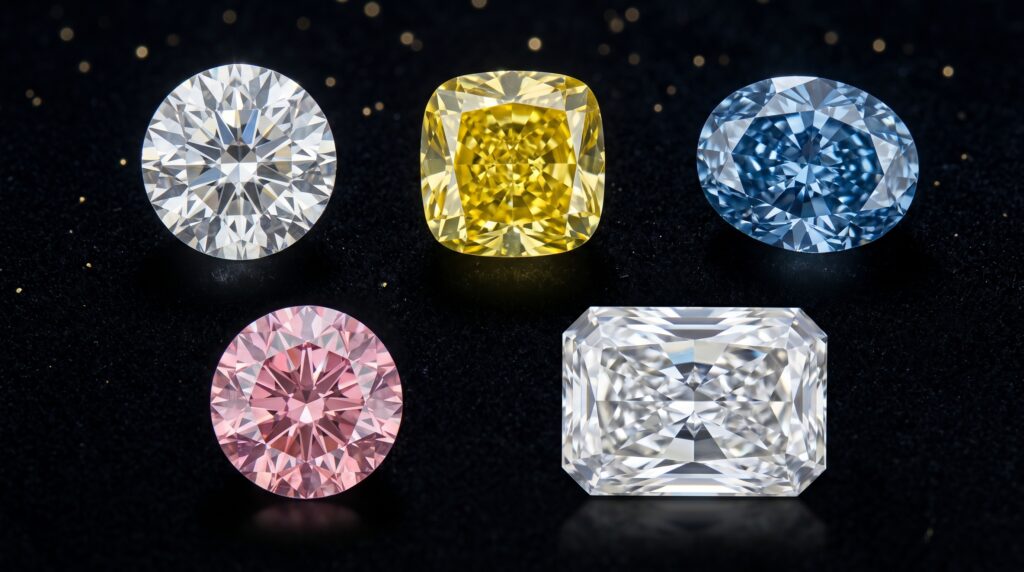
Not every high pressure high temperature diamond coming out of India serves the same buyer or application. Here is what the supply landscape actually looks like when you examine what Indian manufacturers are producing today and who is buying it.
1. Standard White HPHT Diamonds (D to J Color, VS to SI Clarity)
This is the workhorse of Indian HPHT production. These stones are grown without post-growth treatment and certified by IGI or GIA. They are the primary category for US retailers building lab-grown engagement ring inventory. Most buyers in the 1.00 to 2.50 carat range shop here, particularly for round brilliant and cushion cuts where color and clarity consistency across multiple pieces matters for display cases.
2. Fancy Yellow HPHT Diamonds
HPHT technology produces vivid yellow diamonds more reliably than almost any other method because nitrogen incorporation during growth is highly controllable. Indian manufacturers have invested significantly in this category, and the output of Fancy Intense and Fancy Vivid yellow HPHT stones from Surat has reached a quality level that genuinely rivals natural fancy yellows at a fraction of the price. These stones are popular with US jewelry designers and high-end fashion retailers looking to create signature statement pieces.
3. Fancy Blue and Pink HPHT Diamonds
Blue HPHT diamonds are grown with boron incorporation during the growth cycle, producing stones that range from Faint Blue to Fancy Deep Blue. Pink HPHT diamonds typically require post-growth treatment to achieve consistent color, though advances in growth control have improved natural pink output. Both categories serve the luxury and bespoke market segments in the US, where fancy color lab-grown diamonds have seen demand rise sharply since 2023.
4. HPHT-Treated CVD Diamonds: A large portion of Indian production involves using HPHT treatment as a post-growth step on CVD rough that has grown with a greyish or brownish tint. The treatment cycle nudges color toward D, E, or F by relieving lattice strain. This category requires full disclosure on the lab certificate, and any buyer who does not verify treatment status on the IGI or GIA report is taking a real risk.
5. Large Certified HPHT Stones (3 Carats and Above): Indian HPHT manufacturers have made significant gains in the 3-carat-plus segment, which was once almost entirely natural diamond territory. IGI-certified HPHT stones in this size range now appear regularly in US wholesale listings and carry a price premium over smaller goods, though they still represent dramatic savings compared to natural equivalents.
6. Commercial Melee and Parcel HPHT: Stones under 0.30 carats in high-volume lots for pave work, halo settings, and eternity bands. Indian HPHT melee has captured significant US wholesale market share due to its color consistency and competitive pricing, though CVD melee still leads total volume in this sub-category.
HPHT vs CVD Diamond: The Real Difference
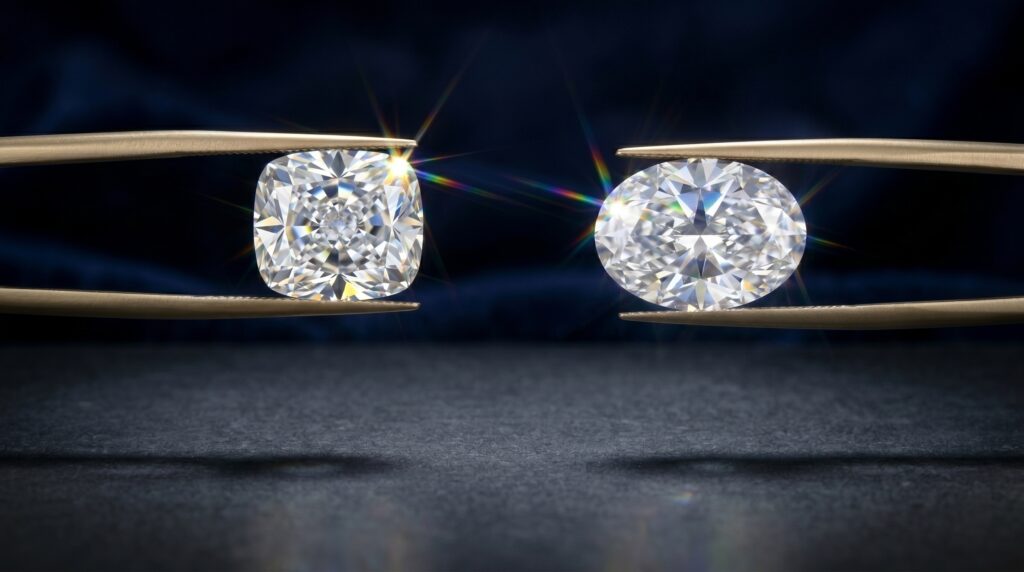
Most buyers entering the lab-grown market ask this question early: which is better, HPHT or CVD? The honest answer is that neither is universally superior. They differ in growth process, typical characteristics, and price profile, and understanding those differences helps you choose the right stone for the right application.
| Factor | HPHT Diamond | CVD Diamond |
| Production Method | High pressure high temperature press replicating Earth’s mantle conditions | Chemical vapor deposition in a reactor chamber; carbon deposited atom by atom |
| Crystal Structure | Can produce Type Ia, Ib, IIa, or IIb; crystal type varies by seed and catalyst | Predominantly single-crystal Type IIa; very high purity in most commercial production |
| Color Range | Near-colorless to vivid fancy colors; excellent natural fancy yellow output | Near-colorless primary output; post-growth HPHT treatment used for color improvement |
| Price Per Carat (Wholesale) | Slightly higher in most size categories due to capital-intensive equipment | Typically lower; high-volume output and scalable process keep wholesale costs competitive |
| Certification Standard | IGI and GIA both grade HPHT; report notes growth method and any post-growth treatment | Same IGI and GIA grading applies; report notation differs for process identification |
In a finished jewelry piece, a well-graded HPHT diamond and a well-graded CVD Diamonds stone will look virtually identical to the naked eye. The distinction matters most to B2B buyers managing inventory categories and to consumers who care about the specific origin story. That said, HPHT holds a genuine advantage in fancy color production, while CVD leads in large, high-clarity white stones at the most competitive wholesale prices. Understanding which application you are sourcing for makes the choice straightforward.
How to Choose the Right HPHT Diamond for Your Style
Choosing a high pressure high temperature diamond involves more than reading a certificate. Personal taste, budget reality, setting requirements, and intended use all play a role. Here is a decision framework that works for both retail consumers and B2B buyers selecting inventory.
- Shape and visual personality: Round brilliant HPHT diamonds deliver the highest light return and suit traditional buyers perfectly. Cushion cuts carry warmth and vintage character that many US buyers associate with heirloom jewelry. Oval and elongated radiant HPHT stones create a visually elongating effect and photograph exceptionally well, which has driven their surge in social-media-influenced engagement ring demand.
- Finger and setting compatibility: Longer shapes like oval and pear visually elongate shorter fingers. Wider shapes like cushion and Asscher read larger face-up than their carat weight suggests. Always consider the wearer’s hand proportion before recommending a shape, particularly for retail staff advising engagement ring buyers.
- Setting compatibility: An HPHT diamond going into a prong solitaire needs strong cut grades and high symmetry because every facet is exposed to scrutiny. Bezel and channel settings are more forgiving and work well with commercial-grade HPHT stones in the VS2 to SI1 clarity range. Fancy color HPHT stones tend to read best in yellow gold settings that complement the warm color.
- Budget advantage vs alternatives: HPHT diamonds from Indian manufacturers offer 50 to 75 percent savings compared to equivalent natural diamonds. A buyer who would have purchased a 1.00-carat natural diamond at a given budget can often access a 1.75 to 2.00-carat HPHT diamond at the same price point. That size advantage is compelling for US consumers who prioritize visual impact.
- Occasion: For engagement rings, prioritize cut quality and certification above every other factor. For fashion jewelry and stackable pieces, commercial-grade HPHT in SI clarity is completely appropriate. For investment-grade purchases, insist on GIA or IGI-certified stones with explicitly documented characteristics and no undisclosed treatments.
- Lab-grown options: The Lab Grown Diamonds glossary at Lepdo Diamonds covers the key certification benchmarks you should require for any HPHT purchase, whether you are buying a single stone or sourcing a full parcel.
Before you finalize your choice, verify the certificate number directly on the IGI or GIA website. Any certificate that cannot be independently confirmed is not a certificate at all.
What B2B Buyers and Diamond Manufacturers Should Know
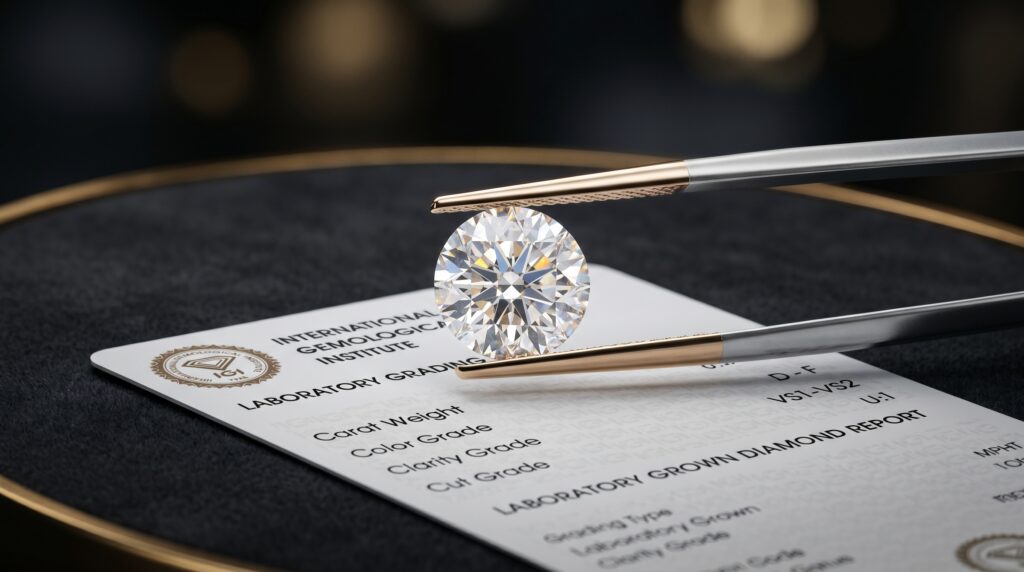
The truth is, buying hpht diamond india at the wholesale level requires a different evaluation framework than consumer retail purchasing. Cut grading consistency across a parcel, not just an individual stone, is the first metric any serious B2B buyer should assess. When you place an order for 200 pieces of 0.75-carat cushion HPHT diamonds from an Indian manufacturer, you are making a bet that the grading holds consistent across the entire lot.
Here is what separates a reliable hpht diamond supplier in India from one that will create problems downstream. First, insist on individual IGI certificates for every stone, not batch reports covering an entire lot. Individual certificates protect your downstream buyers and prevent disputes about grade misrepresentation. Second, understand how the Rapaport Lab-Grown Price List applies to HPHT goods specifically: HPHT stones in some fancy color categories trade at a premium to equivalent CVD, while in standard white categories the spread can go either way depending on current supply.
For bulk sourcing strategy and due-diligence steps, the Diamond Industry resource at Lepdo Diamonds covers the qualification process experienced US buyers use when evaluating new Indian HPHT suppliers, including what reactor type disclosures to request and how to verify grading lab affiliations.
In my experience working directly with Indian HPHT manufacturers, the most reliable indicator of a trustworthy supplier is not their price list. It is their willingness to disclose post-growth treatment status without being asked. Any manufacturer who hesitates on that question should be removed from your approved vendor list immediately.
HPHT Diamond Jewelry Trends in the USA (2026 to 2027)
The US lab-grown diamond jewelry market crossed 10 percent of total diamond jewelry sales by retail value in 2024, and HPHT stones are capturing an outsized share of the premium and fancy color segments within that growth. The most significant shift heading into 2026 is the mainstreaming of fancy color HPHT diamonds in engagement jewelry, a category that was still considered specialty just three years ago. Vivid yellow HPHT solitaires with white diamond pave halos have emerged as one of the fastest-moving configurations in US jewelry retail.
Design-wise, the dominant movement is toward maximalist center stones in yellow gold settings, hidden halo constructions that add visual size without adding price, and three-stone configurations where the HPHT center is flanked by either matching lab-grown side stones or natural diamond accents. East-West oval HPHT diamonds have gained significant traction, driven by a broader fashion industry shift toward horizontal ring designs. Celebrity and influencer engagement ring reveals have continued to drive shape-specific demand spikes, with cushion cut hpht lab grown diamond india stones seeing renewed interest following several high-profile announcements in early 2026.
The US appetite for larger lab-grown diamonds is also accelerating. The 2.00 to 3.00-carat HPHT segment is growing faster than any other size category in the wholesale market right now, as consumers who entered the lab-grown category at 1.00 carat are now returning to upgrade.
How to Evaluate Quality in HPHT Diamonds from Indian Manufacturers
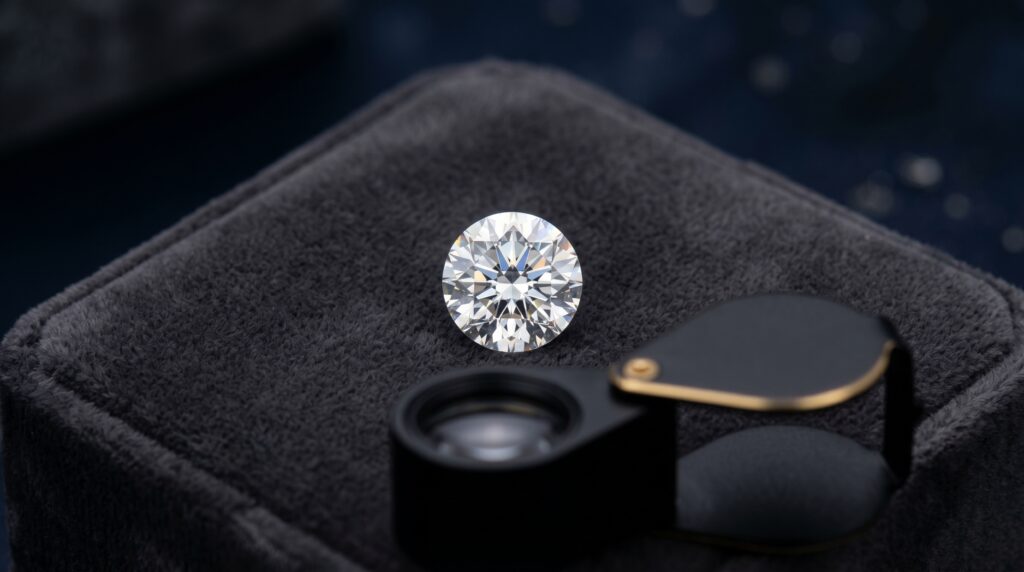
When I assess an HPHT diamond, the first thing I check is not the certificate. It is the stone under magnification with cross-polarized light. HPHT diamonds have a distinct growth pattern, and examining the crystal under polarized conditions tells me immediately whether the growth was controlled or rushed. Rapid growth often produces more internal strain, which can subtly affect light performance even when the stone grades cleanly on paper.
You will want to pay attention to these five evaluation points before committing to any significant HPHT diamond purchase:
- Cut grade and proportions: For round brilliants, target table percentages between 54 and 58 percent and depth percentages between 61 and 62.5 percent. Stones outside these ranges sacrifice fire and scintillation in favor of carat weight retention, which is a common trade-off in high-volume Indian production.
- Metallic inclusions: HPHT growth uses metal flux catalysts, so some stones contain tiny metallic inclusions not found in CVD diamonds. These appear as dark, reflective pinpoints under magnification and are unique to the HPHT process. In VS clarity and above, they are typically well below the visibility threshold, but in SI goods they can affect appearance.
- Color consistency: Some HPHT diamonds show subtle color zoning, where color intensity is slightly uneven across the crystal. This is more common in fancy color stones than in near-colorless white goods. View the stone face-up and face-down in neutral light to check for any color irregularity the certificate’s single letter grade may not capture.
- Clarity and inclusions specific to HPHT: Pinpoint inclusions and metallic flux particles are the most common clarity characteristics in HPHT rough. Feathers and clouds are rarer than in natural diamonds. IGI clarity grading uses the same scale as natural diamonds, so a VS2 HPHT stone will have characteristics not visible to the naked eye.
- Certification verification: Always cross-reference the certificate number against the Diamond Certification database directly on the IGI or GIA portal. Confirm that treatment status, growth method notation, and all 4Cs match the physical stone and the seller’s representation.
Conclusion: Why HPHT Diamond Manufacturers in India Deserve Your Serious Attention
Three things stand out after covering the full landscape of HPHT diamond manufacturers in India. First, the quality ceiling for Indian HPHT production has risen dramatically over the past five years. Stones that once carried inconsistent color or grading irregularities are now regularly certified D to F by IGI with Excellent cut scores, and the transparency around post-growth treatment disclosure has improved significantly as US buyer expectations have raised the standard.
Second, the economics of hpht diamond wholesale india pricing are compelling in the right categories. For fancy color applications, HPHT from India represents the most cost-effective way to access vivid yellow, blue, and pink stones at a quality level previously available only through natural diamond channels at many times the price. For standard near-colorless goods, HPHT competes directly with CVD, and for buyers where the growth process matters to their customers, having an HPHT option adds differentiation value to the inventory mix.
Third, the trends point clearly forward. US consumer acceptance of lab-grown diamonds continues to grow across every age and income segment, and Indian buy hpht diamond india suppliers are meeting that demand with better technology, tighter grading, and more direct access than the market has seen before. The HPHT manufacturers based in Surat are not waiting for the market to come to them. They are actively building the supply infrastructure to serve it.
To explore certified HPHT diamonds with full IGI documentation, transparent pricing, and direct access to India’s verified manufacturers, the Lepdo Diamonds marketplace is the right place to start. The diamond industry is changing faster than most buyers realize, and the HPHT manufacturers in India are at the center of that transformation.
Frequently Asked Questions About HPHT Diamond Manufacturers in India
1. What are HPHT diamond manufacturers in India?
HPHT diamond manufacturers in India are companies that grow real diamonds using the high pressure high temperature process, replicating the natural conditions found deep inside the Earth. India, particularly Surat and parts of Gujarat, has developed a significant HPHT production base alongside its dominant CVD operations, combining reactor technology with the country’s long expertise in diamond cutting and polishing. These manufacturers supply certified HPHT diamonds directly to US retailers, wholesalers, and consumers.
2. Is HPHT diamond cheaper than CVD diamond in India?
Not always. HPHT diamonds from India typically carry a slightly higher wholesale price per carat than comparable CVD stones, largely because the equipment required for high pressure high temperature production involves greater capital investment. That said, prices vary significantly by carat weight, color grade, and certification type, so direct comparisons should always be made stone to stone. For current reference pricing, check the
Diamond Price guide at Lepdo Diamonds for live market benchmarks.
3. Which HPHT diamond type looks most impressive?
An HPHT diamond graded D to F in color and VS1 to VS2 in clarity, cut to Excellent or Ideal standards, produces the most visually striking result. HPHT stones are especially prized for their near-colorless to vivid fancy color output. A well-cut HPHT round brilliant with strong color and a high polish grade will deliver exceptional brilliance and fire in any setting, often outperforming a higher-clarity stone with a poor cut grade.
4. Does an HPHT diamond get a GIA cut grade?
Yes. GIA grades HPHT lab-grown diamonds and assigns cut grades for round brilliants, including Excellent, Very Good, Good, Fair, and Poor. For fancy shapes, GIA assesses polish and symmetry but does not assign a formal cut grade. IGI, widely used across Indian HPHT producers, assigns cut grades for both round brilliants and popular fancy shapes such as oval, cushion, and elongated radiant, making it a practical choice for B2B buyers managing shape-diverse inventory.
5. What is the biggest quality risk with HPHT diamonds from India?
The most common concern is metallic inclusions. Because HPHT growth uses metal catalysts such as iron, nickel, or cobalt to facilitate crystallization, some HPHT diamonds contain tiny metallic flux inclusions unique to this process. These do not affect visual beauty in lower clarities but can be detected under magnification. Always insist on an IGI or GIA certificate that documents the clarity characteristics, and verify the report independently before purchasing any significant stone.
6. Are HPHT lab-grown diamonds as good as natural diamonds?
Chemically and physically, yes. An HPHT lab-grown diamond is 100 percent carbon with the same crystal structure, hardness, brilliance, and fire as a mined diamond. The only difference is origin. GIA and IGI both certify HPHT lab-grown diamonds using the same 4Cs grading standards applied to natural stones. In any finished jewelry setting, a well-graded HPHT stone will look identical to its natural equivalent. The value proposition for buyers focused on size, quality, and budget is genuinely compelling.
7. Which HPHT diamond type is best for an engagement ring?
A round brilliant HPHT diamond is the safest and most popular choice for engagement rings due to its maximum light return and universal appeal. That said, HPHT oval and cushion cuts have gained considerable ground with buyers who want a modern or vintage look at a better price per carat. For a solitaire setting, always prioritize an Excellent or Ideal cut grade from an IGI or GIA-certified stone and confirm that no undisclosed post-growth treatment appears on the report.
8. How do I choose a reliable HPHT diamond manufacturer or supplier in India?
Look for a supplier that provides IGI Certified Diamonds for every transaction, publishes transparent pricing tied to current Rapaport benchmarks, and has a documented track record with USA-based B2B clients. Avoid any source that cannot provide verifiable third-party lab reports. Lepdo Diamonds is a verified trusted diamond supplier in India with a proven record of supplying certified HPHT and CVD diamonds to the US market across both wholesale and direct consumer channels.