Fancy Color Diamonds: Yellow, Pink, Blue & Green – Rarity, Grading & Investment Value
 by Lepdo Diamonds
0 comments
by Lepdo Diamonds
0 comments
Fancy color diamonds are natural or lab-grown diamonds graded by GIA for the presence, intensity, and purity of color, spanning yellow, pink, blue, green, and beyond. For buyers and investors, they represent some of the rarest gemstone inventory in the world, with Fancy Vivid grades commanding premiums that far exceed colorless diamonds. Lepdo Diamonds, a certified color diamond manufacturer in Surat, India, offers transparent grading and competitive wholesale pricing for the US market.
A single one-carat Fancy Vivid pink diamond can sell for over $1.2 million at auction. A comparable colorless diamond of the same carat weight? Closer to $12,000. That gap is not a fluke. It reflects something fundamental about how rarity, color science, and collector demand intersect at the highest end of the gemstone market.
If you work in the diamond industry or you are shopping for something that stands apart from the standard round solitaire fancy color diamonds India sourcing has become a major topic worth understanding. Surat-based manufacturers have built serious infrastructure around color diamond cutting, and US buyers are paying attention.
This post covers what makes each major color category rare, how GIA grades them, what B2B buyers need to know about pricing and certification, and how to choose the right stone for jewelry or investment. You will also find eight practical FAQs at the end that address the questions real buyers ask most.
What Are Fancy Color Diamonds?
A fancy color diamond is any natural or lab-grown diamond that falls outside the standard D-to-Z colorless grading scale used by GIA. Once a diamond’s color is strong enough to be considered attractive rather than a defect, it earns the “fancy color” designation. Here is what that means in practice.
Quick Info Box:
- Definition: A diamond graded by GIA or IGI for the presence of a distinct, attractive body color – yellow, pink, blue, green, orange, red, purple, or brown.
- Key Varieties: Yellow, Pink, Blue, Green, Orange, Red, Brown, Violet
- Best For: Engagement rings seeking distinction, investment portfolios, statement fine jewelry, collector pieces
- Key Advantage: Rarity-driven value; the stronger the color saturation, the higher the premium above colorless equivalents
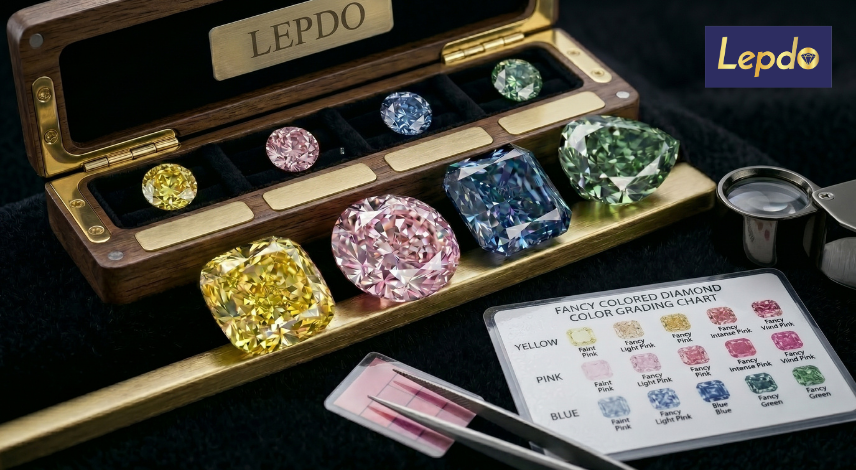
GIA’s color grading scale for fancy diamonds runs from Faint through Very Light, Light, Fancy Light, Fancy, Fancy Intense, Fancy Deep, and Fancy Vivid with Fancy Vivid representing the most saturated, commercially desirable grade. To understand the full grading framework, Lepdo’s glossary on Fancy Color Diamonds is a solid reference point.
The Most Popular Fancy Color Varieties And Who They Are For
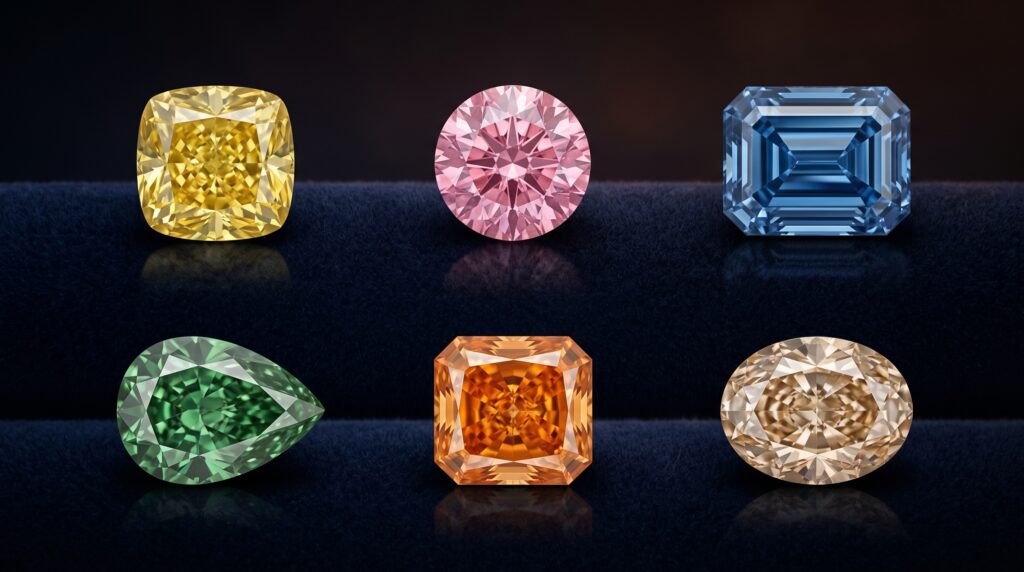
Yellow Diamonds
Yellow Diamonds are the most commercially accessible category in the fancy color world. Their color comes from nitrogen atoms absorbed into the crystal lattice during formation. Fancy Vivid Yellow stones are the benchmark, they show a pure, bold canary hue that performs spectacularly under warm lighting. This color is ideal for yellow gold settings, which amplify the stone’s saturation.
Who buys them: jewelry retailers looking for a high-margin alternative to colorless diamonds, B2B buyers placing wholesale orders for engagement ring programs, and end consumers who want color without the extreme price of pink or blue.
From a yellow diamond wholesale India perspective, Surat manufacturers cut a significant volume of fancy to fancy vivid yellow stones annually many certified by GIA or IGI before export to US buyers.
Pink Diamonds
Pink Diamonds are the category that has seen the most dramatic price appreciation over the past decade. Their color origin is still not fully understood unlike yellow or blue diamonds, pink color does not come from a single identified trace element. It is believed to result from structural distortion in the crystal lattice.
Who buys them: luxury jewelry brands, collectors, and investment-focused buyers. With the closure of the Argyle Mine in Australia in 2020, which produced over 90% of the world’s pink diamonds natural supply has tightened considerably.
The pink diamond supplier India market has responded by offering more lab-grown pink diamonds alongside natural certified stones, giving buyers at different price points access to this desirable color.
Blue Diamonds
Blue Diamonds owe their color to trace amounts of boron. They are among the rarest diamonds on earth natural blue diamonds represent well under 0.1% of all diamonds mined globally. GIA grades blues from Faint Blue through Fancy Vivid Blue, with deep, saturated blues at the top of the value ladder.
Who buys them: ultra-high-net-worth collectors, auction houses, and jewelry houses creating one-of-a-kind pieces. Blue diamonds hold their value exceptionally well and are considered one of the safest hard-asset investments in the gemstone category.
Green Diamonds
Green Diamonds are rare in a geologically distinct way. Their color forms when the diamond is exposed to natural radiation during its formation process often for millions of years. Because radiation affects only the outer skin of the crystal, green color in natural diamonds is sometimes shallow and can be cut away. That makes GIA’s origin-of-color determination on green diamonds especially critical.
Who buys them: collectors who prioritize geological curiosity, buyers seeking unique pieces with authenticated natural origins, and retailers building niche inventory.
Orange Diamonds
Orange diamonds are exceptionally rare. A clean Fancy Vivid Orange with strong saturation and no brownish modifier is among the most valuable diamonds per carat in any category. They appeal to collectors and investment buyers more than retail consumers.
Brown and Champagne Diamonds
Often overlooked, brown and champagne diamonds sit at the more accessible end of the fancy color spectrum. They are popular for fashion jewelry and are sourced in large quantities through India’s wholesale market. Retailers use them to hit lower price points while still offering color diamond product lines.
Red and Purple Diamonds
Red diamonds are effectively the rarest gemstones on earth. Stones over one carat with strong red saturation are museum-grade. Purple diamonds are similarly uncommon. Both categories are primarily held by collectors and institutional buyers.
Fancy Color Diamonds vs Colorless Diamonds: The Real Difference
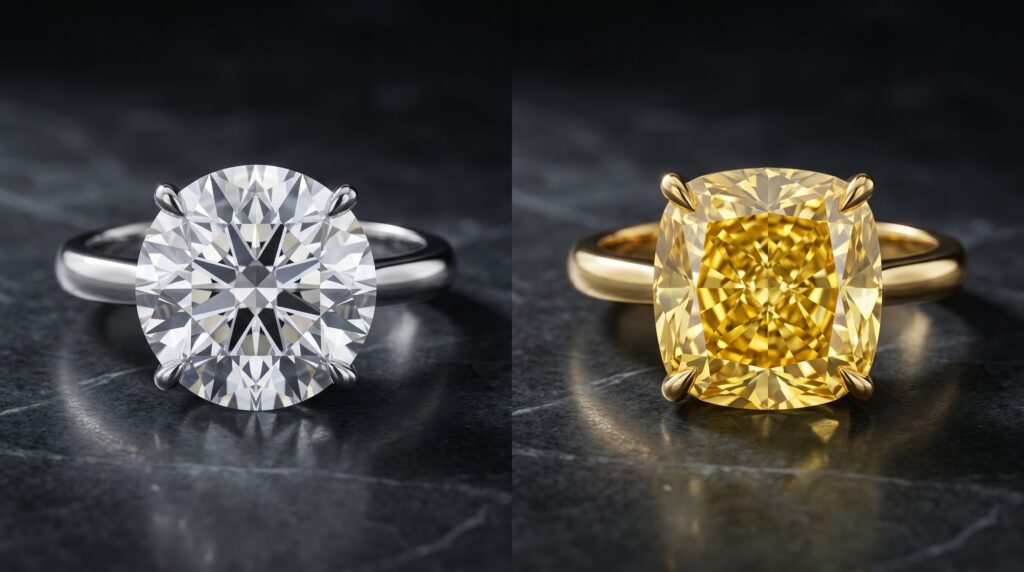
The question comes up constantly: why spend more on a colored diamond when a colorless diamond is universally loved? Here is a direct comparison across the five factors that matter most for buyers.
| Factor | Fancy Color Diamond | Colorless Diamond (D-F) |
|---|---|---|
| Rarity | Extremely rare; color intensity determines supply | Available in large quantities globally |
| GIA Grading | Color grade by hue, tone, saturation no cut grade | Full 4Cs grading including cut grade |
| Price Driver | Color intensity (Vivid commands highest premiums) | Cut quality and clarity drive value most |
| Investment Case | Strong for Vivid pink, blue, green supply shrinking | Stable but less appreciation potential |
| Jewelry Appeal | Unique, statement-making, emotionally resonant | Timeless, universally accepted, versatile |
The truth is, colorless diamonds still dominate engagement ring sales in the US market, and they likely will for years to come. But the segment of buyers looking for something genuinely rare, whether for a collector’s portfolio or a ring that nobody else will have, has grown steadily. That segment consistently turns to fancy color diamonds.
From a natural color diamond price standpoint, GIA’s color grade is the single biggest driver of value. A one-carat Fancy Vivid Yellow can trade at three to five times the price of a Fancy Light Yellow of identical carat weight and clarity. The intensity matters more than almost any other factor.
How to Choose the Right Fancy Color Diamond for Your Needs
The decision is not as simple as picking your favorite color. Here are six factors that should guide every purchase.
- Personal style and aesthetic: Warm personalities and bold fashion sensibilities tend to gravitate toward yellow and orange diamonds. Pink appeals to romantic or feminine styles. Blue and green suit understated elegance and collector mentality.
- Setting metal compatibility: Fancy yellow diamonds reach peak saturation in yellow gold settings, which reflect warmth back into the stone. Pink and blue diamonds look cleaner in white gold or platinum, which doesn’t compete with their hue.
- Use case, jewelry vs investment: If the stone is primarily for wearing, prioritize eye-visible color intensity and cut quality. If investment is the goal, prioritize GIA certification, natural origin confirmation, and Fancy Intense or Vivid grade. Lower intensity grades do not hold value as well.
- Budget planning: Yellow diamonds offer the most color for the money at every carat weight. Pink and blue will stretch the budget significantly. For buyers who want pink or blue without a six-figure commitment, a lab-grown option offers the same optical beauty at 70 to 90% less cost.
- Occasion: For engagement rings, yellow and pink are the most popular choices, with strong emotional resonance. For fashion jewelry and stackable pieces, lighter fancy grades in any color offer flexibility. For gifting at milestone occasions, a GIA-certified natural fancy color stone carries lasting meaning.
- Lab-grown vs natural: Lab-grown fancy color diamonds are chemically identical to natural ones and fully certifiable by IGI. For buyers focused on jewelry wear, they are an excellent value. For buyers who care about long-term resale or investment potential, natural Fancy Vivid grades from GIA-certified sources are the standard. You can explore the difference further in our Diamond Color Grades glossary page.
Before you finalize your choice, get the GIA or IGI report in hand, view the stone under multiple lighting conditions, and confirm that the color appears consistent face-up, not just from the side.
What B2B Buyers and Diamond Manufacturers Should Know
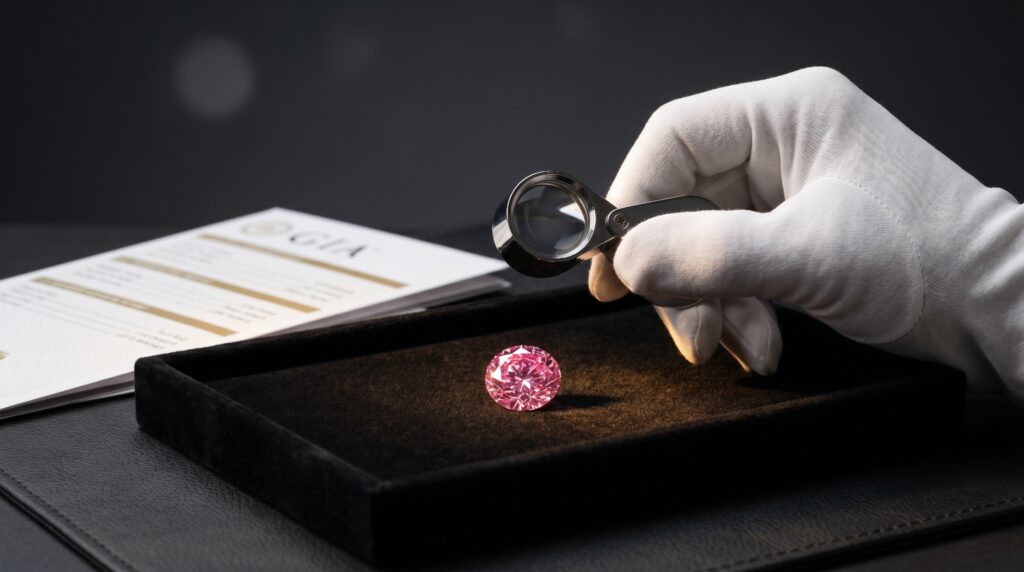
Most of the conversation about fancy color diamonds in trade publications focuses on individual consumer sales. What gets less attention is how the B2B sourcing process works and what manufacturers and retailers actually need to evaluate when building color diamond inventory.
Here is what matters at the wholesale level.
First, color grading consistency is not guaranteed across batches. Even within a single parcel of Fancy Yellow diamonds certified by GIA, the visible color difference between a Fancy and Fancy Intense grade can be dramatic face-up. Buyers placing wholesale orders need to view parcels in person or request detailed light performance imaging, not just rely on certificate grades alone.
Second, Rapaport pricing for fancy color diamonds does not follow the same structured grid as colorless diamonds. Fancy color is sold at negotiated premiums above Rapaport, driven heavily by market demand at the color and intensity level. A Fancy Vivid Yellow in a strong market can trade at 80 to 120% above Rap. Buyers who do not track fancy color market movements risk overpaying.
Third, IGI certification has become increasingly accepted in the US retail market for fancy color diamonds, particularly in the lab-grown segment. GIA remains the gold standard for natural fancy color stones destined for high-end retail or investment buyers.
That said, when I evaluate parcels for B2B clients, the first thing I always ask for is a breakdown of color distribution within the parcel, specifically the ratio of Fancy to Fancy Intense to Fancy Vivid stones. That ratio determines the real commercial value of the lot, far more than the average certificate grade suggests.
As a color diamond manufacturer Surat based operation, Lepdo Diamonds provides full GIA and IGI documentation, direct manufacturing transparency, and parcel-level grading breakdowns for wholesale buyers.
Fancy Color Diamond Jewelry Trends in the USA (2025 to 2026)
The US luxury jewelry market has shifted noticeably toward color over the past three years. Yellow diamonds, once seen as a niche choice, have entered the mainstream engagement ring conversation. Design-forward retailers in New York and Los Angeles are reporting that color diamond inquiries now account for a meaningful share of their fine jewelry consultations a shift that was barely visible five years ago.
Setting styles have evolved alongside this demand. Halo settings that surround a fancy color center stone with white pavé diamonds have become a signature look, as the contrast amplifies the center stone’s color saturation. East-west oval settings in yellow gold with a Fancy Vivid Yellow center have been particularly popular, appearing across major bridal shows and in editorial spreads in US jewelry publications.
Cultural influence has played a role too. High-profile appearances of pink and yellow fancy color diamond jewelry at award events and in celebrity engagement announcements have consistently generated spikes in consumer search activity for those color categories. The ripple effect hits retailers within days.
The lab-grown fancy color diamond category has also expanded rapidly. Fancy color diamond jewellery in the lab-grown category now occupies prominent display cases in US retail chains that would not have carried color diamonds a decade ago. This democratization of fancy color has expanded the total buyer pool significantly.
How to Evaluate Quality in a Fancy Color Diamond
When I assess a fancy color diamond, the first thing I check is the color face-up under diffused daylight, not under spotlights, and not while looking through the pavilion. The face-up appearance is what the wearer sees every day, and it often looks different from what the certificate describes in laboratory conditions.
Here are the five evaluation steps I run through on every stone.
- Color consistency: Check for color zoning, where the hue clusters in one area of the stone. In some cuts like radiant and cushion, the cut is designed to spread color evenly. In others, like an elongated pear or marquise, zoning can be visible.
- Hue purity: Look for color modifiers. A Fancy Yellow with a greenish modifier trades at a discount. A Fancy Pink with an orangey modifier is less valuable than a pure pink. GIA’s report describes the primary hue and any modifiers clearly.
- Brilliance and fire: A fancy color diamond still needs to perform optically. Poor pavilion depth or an overly thick table percentage will trap light rather than returning it as brilliance and fire. Scintillation should be visible when the stone moves.
- Clarity grade and inclusion type: Clarity grade matters less in fancy color diamonds than in colorless ones, because the body color masks inclusions. Buyers can often accept VS2 or SI1 clarity in a fancy color stone without visible compromise but feather inclusions that affect durability are non-negotiable.
- Certification: Only buy a fancy color diamond with a GIA or IGI certificate that explicitly states the color grade, saturation level, and natural vs treated color origin. Treated fancy color diamonds, which have had their color enhanced by irradiation or heat trade at a fraction of the value of natural color stones. The certificate is your protection.
You will want to pay attention to the “Color Origin” field on a GIA fancy color report. “Natural” is the only designation that supports full investment-grade value. Any other notation warrants further investigation before purchase.
Conclusion
Three things stand out from everything covered here. First, the value of a fancy color diamond is almost entirely determined by its GIA-graded color intensity, Fancy Vivid stones at any color command premiums that multiply rapidly with carat weight. Second, natural supply is tightening in the pink and blue categories in ways that make well-certified natural stones increasingly difficult to replace at previous price points. Third, the B2B sourcing landscape for fancy color diamonds India has matured significantly, with manufacturers like Lepdo Diamonds offering the kind of grading transparency and certification standards that US buyers rightly expect.
Whether you are a retailer building a color diamond program, a wholesaler comparing parcel values, or a consumer shopping for an engagement ring that says something genuinely different, the starting point is always the same: know your color grade, trust your certification, and work with a supplier who can back every stone with documentation.
Explore Lepdo Diamonds’ full range of Fancy Color Diamonds or reach out directly for wholesale inquiries and custom sourcing consultations.
The rarest diamonds in the world should come with the clearest information and that is exactly what Lepdo Diamonds is built to provide.
Frequently Asked Questions About Fancy Color Diamonds
1. What are fancy color diamonds?
Fancy color diamonds are natural or lab-grown diamonds that display a distinct, attractive body color graded by GIA or IGI. Colors include yellow, pink, blue, green, orange, and red, among others. GIA grades their intensity on a scale from Faint to Fancy Vivid. These stones are rarer than colorless diamonds and priced according to the strength, purity, and hue of their color.
2. Are fancy color diamonds from India cheaper than those from other sources?
Fancy color diamonds India suppliers, particularly those based in Surat, often offer more competitive wholesale pricing than US or European traders because of lower processing overhead and direct manufacturing access. However, price is ultimately governed by GIA-graded color intensity, carat weight, and clarity. Origin does not override the grade on a certified stone.
3. Which fancy color diamond looks the most impressive for jewelry?
Fancy Vivid Yellow diamonds are widely considered the most visually striking choice for jewelry, as their saturated color reads even in natural ambient light. Pink diamonds carry a strong romantic appeal, while blue diamonds project rare, cool elegance. The most impressive stone for any individual depends heavily on the setting metal and the wearer’s personal style.
4. Does GIA provide a cut grade for fancy color diamonds?
No. GIA does not assign an official cut grade to fancy color diamonds the way it does for round brilliant diamonds. GIA reports for fancy color stones describe shape and cutting style, but cut quality evaluation is left to the buyer. Cut still matters greatly a well-cut stone distributes color evenly and maximizes scintillation but you must assess it independently.
5. What is the biggest quality risk when buying fancy color diamonds?
Color zoning is the most common issue, where the hue appears uneven or concentrated in one part of the stone. A second significant risk is purchasing stones with overstated color grades from non-GIA certificates. Always request a GIA or IGI report, view the stone face-up under multiple lighting conditions, and verify that color is distributed consistently across the table.
6. Are lab-grown fancy color diamonds as good as natural ones?
Lab-grown fancy color diamonds are chemically and optically identical to natural diamonds. They offer excellent color saturation at 70 to 90% less cost. For buyers prioritizing jewelry wearability, they are a compelling value. For investment purposes, natural fancy color diamonds, particularly pink and blue with GIA certification hold significantly stronger long-term value due to geological scarcity.
7. Which fancy color diamond is best for an engagement ring?
Fancy Yellow diamonds are the top engagement ring choice because they are the most available, the most affordable in the fancy color category, and they pair beautifully with yellow gold settings. Fancy Pink diamonds are the most romantic option. Blue diamonds suit buyers who want something genuinely rare. All three perform well in halo and solitaire settings.
8. How do I choose a reliable fancy color diamond manufacturer or supplier?
Look for a manufacturer that provides GIA or IGI certification on every stone, offers transparent grading documentation, and has direct cutting and polishing capabilities rather than purely trading stock. Ask for light performance imaging and color distribution breakdowns on parcel orders. A reputable color diamond manufacturer in Surat will welcome that level of scrutiny, not deflect it.