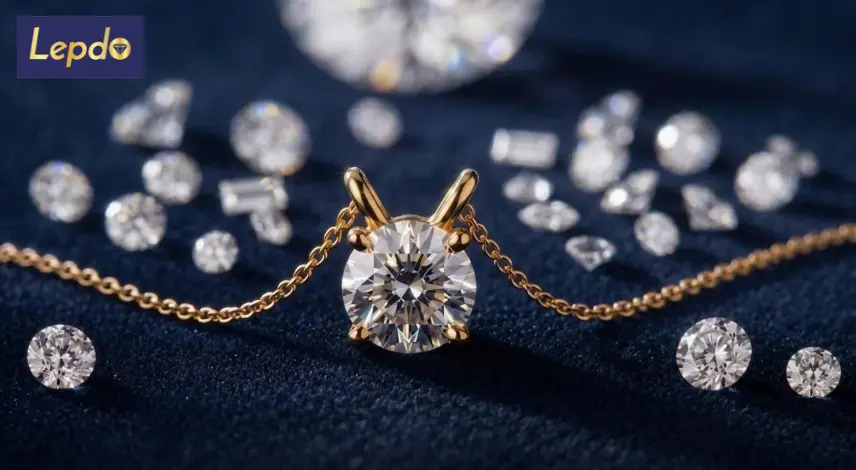

A diamond pendant is a necklace piece where one or more diamonds hang from a chain, typically set in a bail or halo mounting. For retailers, pendants offer strong margins, year-round demand, and lower price barriers than rings. Buyers exploring wholesale sourcing often start with certified lab-grown options for consistent quality and pricing.
A single diamond pendant can outsell three engagement rings in the same display case during the holiday season. That’s not an exaggeration. Retailers who track category performance know that pendants convert faster because they carry less financial weight and less emotional pressure than a ring purchase.
So, what is a diamond pendant? A diamond pendant is a necklace centerpiece featuring one or more diamonds, mounted so it hangs at the collarbone or chest. The category spans everything from a simple solitaire to elaborate halo designs, and it attracts buyers across every price point and every occasion, from a first anniversary gift to a milestone birthday.
For retailers, understanding what is a diamond pendant is more than a basic jewelry definition. It is a category with strong year-round demand, high giftability, and excellent merchandising flexibility. Pendants are often easier for customers to purchase than engagement rings, making them a valuable inventory category for both independent jewelers and large retail chains.
This guide breaks down what is a diamond pendant, the styles worth stocking, how pendants compare with other diamond jewelry categories, and what wholesale buyers need to know before placing an order. You’ll also find a clarity and cut breakdown based on real GIA and IGI grading standards rather than marketing language.
Whether you’re a retailer filling a showcase, a manufacturer setting production priorities, or a buyer comparing a solitaire diamond pendant wholesale offer against a halo design, this article provides the practical knowledge needed to make confident sourcing and inventory decisions.
What Is a Diamond Pendant?
A diamond pendant is a piece of jewelry where a diamond or diamond cluster is suspended from a chain or cord, usually secured by a small loop called a bail. Unlike earrings or rings, a pendant sits at a fixed focal point on the body, which is part of why it photographs so well for e-commerce and social selling.
Quick Info Box
- Definition: A necklace centerpiece where diamonds hang from a chain via a bail or mounting.
- Key Types or Varieties: Solitaire, halo, cluster, drop, station, and pave pendants.
- Best For: Everyday wear, gifting, layering, and entry-level fine jewelry buyers.
- Key Difference or Advantage: Lower average price point than rings, with faster inventory turnover.
Most retailers treat the pendant case as a training ground for new fine jewelry buyers. It’s often the first real diamond purchase someone makes before they’re ready for a diamond pendant necklace that anchors a larger jewelry wardrobe.
Most Popular Types or Variations, and Who They Are For
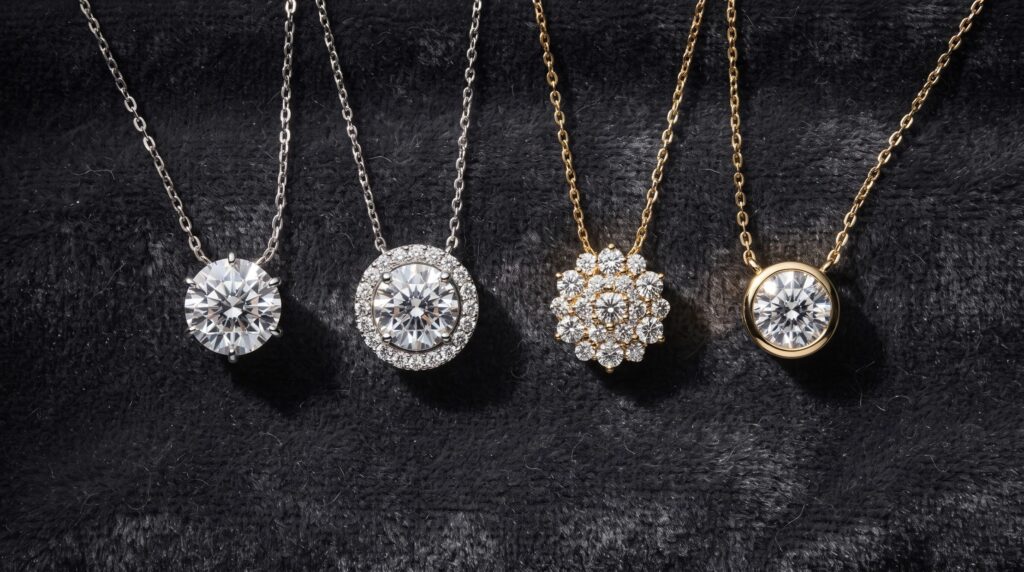
Not every pendant style serves the same customer. Here is what most retailers overlook: stocking one dominant style and calling it coverage. A well-rounded case needs range across price, size, and design language.
Types of Diamond Pendants Retailers Should Stock
Understanding What Is a Diamond Pendant? becomes much easier when you look at the major styles that drive retail sales. For jewelry retailers, the most profitable pendant inventory usually includes a balanced mix of entry-level, mid-range, and premium designs that appeal to different customer budgets and gifting occasions. A well-planned pendant display should not rely on a single trend. Instead, it should include timeless solitaire pieces, high-impact halo designs, and fashion-forward cluster or pavé styles that attract repeat buyers throughout the year.
Solitaire Pendants
A solitaire diamond pendant features a single round or fancy-shape diamond set in a simple prong or bezel mounting. This is often the first style that comes to mind when customers ask, What Is a Diamond Pendant?, because it represents the most classic and recognizable version of the category. Solitaire pendants are the entry point for many first-time diamond buyers and are especially popular for birthdays, anniversaries, graduations, and holiday gifting. They typically perform well in price ranges below $1,000, although premium versions can reach significantly higher values depending on carat weight and certification.
From a retailer’s perspective, solitaire pendants are exceptionally versatile because they photograph cleanly for e-commerce listings, layer easily with other necklaces, and require minimal explanation during the sales process. They also pair well with matching earrings and rings, making them an effective category for upselling coordinated jewelry sets.
Halo Pendants
Halo pendants feature a center diamond surrounded by a circle or decorative arrangement of smaller accent diamonds. This design creates the illusion of a larger center stone while keeping the overall cost considerably lower than purchasing a significantly larger solitaire diamond. For retailers trying to answer What Is a Diamond Pendant? in terms of customer value, halo styles are one of the strongest examples because they deliver exceptional visual impact per dollar spent.
They remain particularly popular among younger consumers, bridal shoppers, and buyers looking for a luxurious appearance on a moderate budget. Halo pendants also offer greater design flexibility, including round, oval, pear, cushion, and emerald-cut center stones, allowing retailers to create multiple price tiers within a single product category. Because the style catches light from many angles, it tends to perform exceptionally well under showcase lighting and in social media photography.
Cluster and Pavé Pendants
Cluster and pavé pendants use multiple small diamonds set closely together to create the appearance of a larger shape, floral pattern, geometric motif, or abstract fashion design. These pendants are ideal for customers who prefer texture, sparkle, and contemporary styling over a single dominant center stone. When retailers think beyond the basic definition of What Is a Diamond Pendant?, cluster and pavé designs often become the category that attracts fashion-conscious repeat buyers rather than one-time gift purchasers.
They work particularly well for trend-driven collections, seasonal launches, and younger demographics interested in statement jewelry. From a manufacturing standpoint, these designs can also provide attractive margin opportunities because they efficiently utilize calibrated melee diamonds while creating a product that appears substantially larger and more intricate than its total carat weight might suggest.
Bezel-set pendants offer a secure, low-profile setting that appeals to customers seeking durability for daily wear, travel, or active lifestyles. Convertible pendants, which can detach from earrings, bracelets, or modular jewelry systems, are gaining traction as retailers increasingly promote multi-use jewelry to value-conscious shoppers who want greater versatility from a single purchase.
For wholesale buyers and jewelry retailers, understanding What Is a Diamond Pendant? is not only about design terminology. It is about knowing which styles turn inventory quickly, which products support higher margins, and which collections encourage repeat purchases. The strongest pendant programs usually combine classic solitaire designs for consistent year-round demand, halo styles for visual impact and gifting occasions, and cluster or pavé collections for fashion-driven customers, creating a display case that appeals to multiple demographics while maximizing inventory performance and wholesale buying efficiency.
Diamond Pendant vs Diamond Ring: The Real Difference
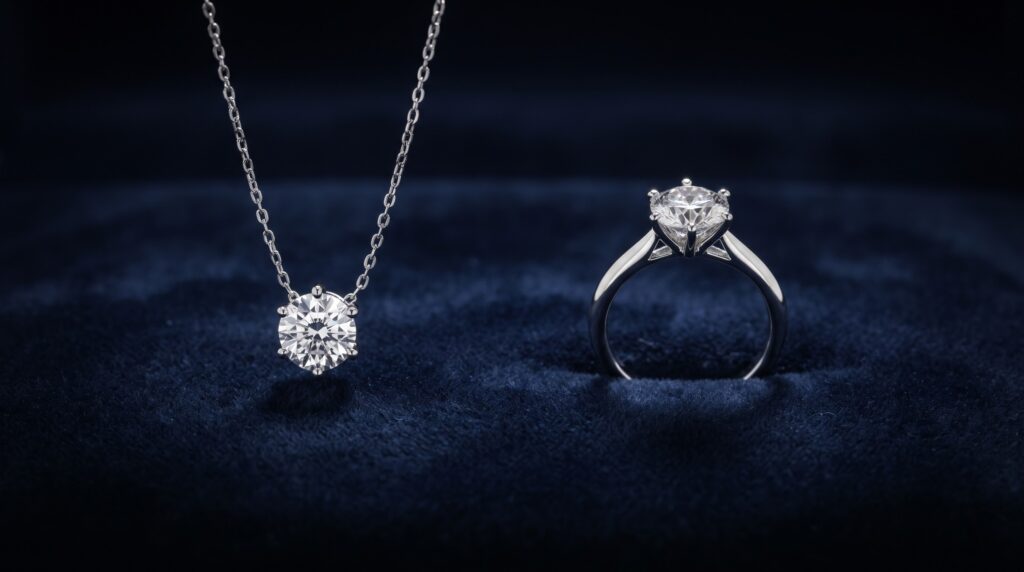
Retailers often get asked why a pendant costs less than a ring with a similar center stone. The answer comes down to metal weight, setting complexity, and production time.
| Factor | Diamond Pendant | Diamond Ring |
|---|---|---|
| Average metal weight | Lower (chain sold separately) | Higher (full shank and setting) |
| Setting complexity | Simpler, fewer prongs | Complex, structural demands |
| Typical price point | Entry to mid-range | Mid-range to premium |
| Occasion tied to purchase | Everyday, gifting, self-purchase | Engagement, anniversary |
| Sizing requirements | None | Requires exact ring size |
The truth is, pendants carry less production overhead, which is exactly why margins can stay healthy even at a lower retail price. A ring requires structural engineering to hold a stone securely through decades of wear, while a pendant only needs to hold its shape while hanging still. That difference in mechanical demand shows up directly in labor cost and, eventually, in shelf price.
How to Choose the Right Diamond Pendant for Your Style
Choosing a pendant isn’t just about the stone. Retailers advising customers, and buyers selecting stock, should walk through the same six factors.
- Personal style or physical fit – A solitaire suits minimalist wardrobes, while a halo or cluster suits customers who wear statement pieces.
- Chain length and neckline compatibility – Shorter chains suit crew necks, longer pendants suit V-necks and layered looks.
- Setting compatibility – Prong settings maximize light return, bezel settings maximize durability for active lifestyles.
- Budget advantage vs alternatives – Pendants typically cost 20 to 40 percent less than a ring with a comparable center stone, and pairing a mid-range setting with the best diamond clarity for budget stretches that value further.
- Occasion – Everyday wear favors smaller, secure settings, while gift-giving occasions often favor a statement halo.
- Lab-grown vs natural option – A lab grown diamond pendant delivers the same optical properties as a natural stone at a lower carat-for-carat price, which matters for buyers stretching a budget toward a larger visual size. Many retailers now stock lab grown diamonds as their primary pendant offering for this reason.
Before you finalize your choice, think about how the piece will actually be worn day to day, not just how it looks under store lighting.
What B2B Buyers and Diamond Manufacturers Should Know
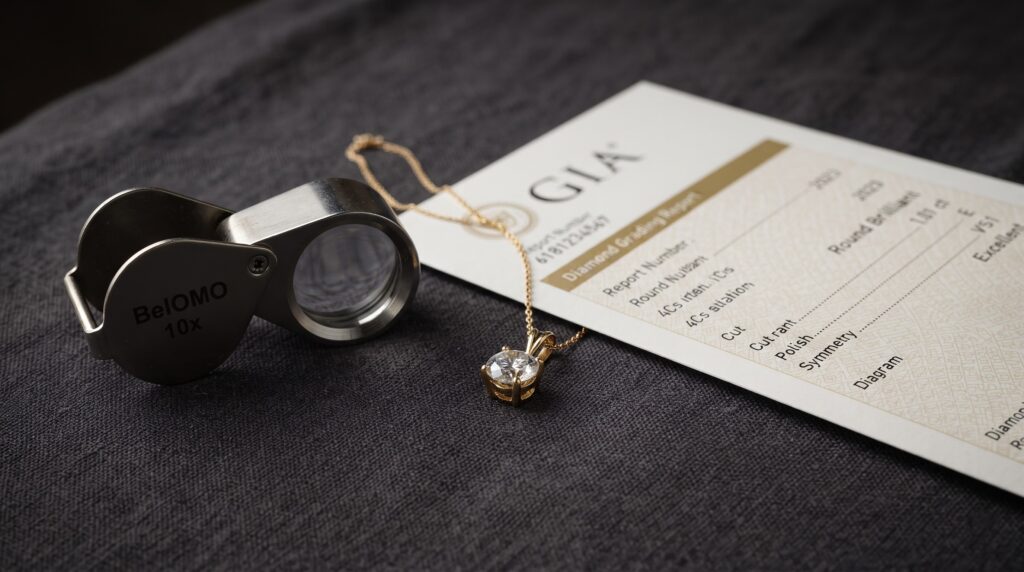
Wholesale buyers evaluate pendants differently than retail shoppers. Consistency matters more than any single standout piece.
Bulk sourcing requires attention to cut grading consistency across a parcel, since even a small variance in table percentage or pavilion depth can create visible differences in brilliance from stone to stone. A fancy cut diamond manufacturer working at volume needs tight tolerances, not just a good average grade. Retailers building a full pendant assortment should understand the difference between a diamond wholesaler vs retailer model, since sourcing directly from manufacturers typically means better price stability and faster reorder turnaround.
When evaluating what is a diamond pendant from a retailer’s sourcing perspective, certification and pricing are just as important as design. IGI certification has become the standard for most lab-grown diamond parcels, while GIA remains the dominant grading authority for natural stones. Before quoting a customer, retailers should always confirm which laboratory issued the report, because certification can directly affect pricing, buyer confidence, and resale perception.
Rapaport pricing still influences most natural diamond quotes, but lab-grown diamond pricing moves independently and has generally trended downward year over year. Retailers who understand what is a diamond pendant in terms of inventory economics know that this distinction matters when planning markups, promotional pricing, and long-term stock rotation.
In my experience working with manufacturing partners, the retailers who build successful pendant programs are usually the ones who order matched parcels rather than one-off stones, because matched parcels keep a display case visually consistent and easier to merchandise. Manufacturers such as Lepdo Diamonds, based in Surat’s diamond manufacturing hub, typically evaluate CVD and HPHT stones against recognized IGI and GIA quality benchmarks before parcels ship, giving retailers a more predictable starting point for their own quality-control checks and inventory planning.
Diamond Pendant Jewelry Trends in the USA (2026 to 2027)
Pendant styles are shifting toward personalization and layered minimalism. Retailers report growing demand for smaller, stackable pendants worn in twos and threes rather than a single statement piece, a shift driven partly by social media styling trends and celebrity red carpet layering.
Bezel-set and East-West oriented pendants are gaining ground among younger buyers who want a modern silhouette over a traditional prong look. Yellow gold has also reclaimed shelf space after nearly a decade of white metal dominance, and industry reporting shows lab-grown diamond jewelry sales continuing to grow faster than natural diamond jewelry sales in the US fine jewelry market.
That said, round and oval solitaires still make up the bulk of unit sales, which means retailers should balance trend-forward stock with dependable classics. Watching broader diamond jewelry trends helps retailers time their reorders instead of guessing at seasonal shifts.
How to Evaluate Quality in a Diamond Pendant
When I assess a pendant for quality, the first thing I check is how the stone performs in motion, not just under a static loupe. A pendant moves constantly against skin and fabric, so light return needs to hold up from multiple angles, not just face-up.
Brilliance, fire, and scintillation together determine how alive a diamond looks, and all three depend heavily on cut precision rather than carat size alone. Pavilion angle and table percentage should fall within GIA’s excellent or very good cut range, since even a well-matched color and clarity grade can look flat with a poor cut. Clarity grade matters less in a pendant than in a ring, since a pendant sits farther from close-up view than a ring does, so understanding diamond clarity helps buyers avoid overpaying for grades that won’t be visible anyway.
- Check the depth percentage against the ideal range for the specific shape.
- Look for a visible bowtie effect in elongated shapes like oval or marquise.
- Confirm the length-to-width ratio matches the intended silhouette.
- Review the certification report for consistency with the physical stone.
- Ask whether the stone carries GIA or IGI certification, and request the report number.
Isn’t it worth a few extra minutes of inspection before a piece goes on the sales floor? A quick certification check at intake saves far more time than a customer return later.
Conclusion
A diamond pendant earns its place in any retail case because it works across nearly every budget, occasion, and customer type. The category rewards retailers who stock a real mix of solitaire, halo, and cluster styles rather than betting on one look, and it rewards wholesale buyers who prioritize cut consistency and certification over price alone. Lab-grown options have made the category more accessible than ever, giving customers larger, brighter stones without stretching budgets past comfort.
To be fair, natural diamonds still hold appeal for buyers focused on rarity and resale value, so a balanced inventory serves both preferences well. Retailers looking to strengthen their pendant program can explore our diamond pendant collection at Lepdo Diamonds for certified, consistently graded stock built for wholesale reorder cycles. A well-chosen pendant doesn’t just sell once. It builds the kind of customer trust that brings them back for the next piece.
Frequently Asked Questions About Diamond Pendants
1. What is a diamond pendant?
A diamond pendant is a necklace piece featuring one or more diamonds suspended from a chain, typically secured by a bail. It ranges from a simple solitaire to elaborate halo or cluster designs. Retailers value the category for its lower price point and broad appeal across gifting and everyday wear occasions.
2. Is a diamond pendant cheaper than a diamond ring?
Yes, a diamond pendant is generally cheaper than a ring with a comparable center stone. Rings require more metal, structural engineering, and labor to withstand daily wear at the finger. Pendants need less mechanical support, which lowers both production cost and final retail price for buyers.
3. Which diamond pendant looks biggest or most impressive?
Halo pendants typically look largest for their carat weight because the surrounding diamonds extend the visual footprint of the center stone. Elongated shapes like oval, pear, and marquise also appear larger than round diamonds of equal carat weight due to their surface area.
4. Does a diamond pendant have a GIA cut grade?
Round diamonds receive an official GIA cut grade, while fancy shapes like oval, pear, and cushion do not, since GIA hasn’t published a formal cut grading system for those shapes yet. Buyers should instead evaluate proportions like pavilion depth, table percentage, and length-to-width ratio directly.
5. What is the biggest quality risk with a diamond pendant?
The biggest risk is a poorly cut stone that looks dull despite a strong color and clarity grade. Cut quality drives brilliance and fire far more than carat weight does. Always review the certification report’s proportions section before finalizing a purchase or wholesale order.
6. Are lab-grown diamond pendants as good as natural ones?
Yes, lab-grown diamonds share the same chemical, physical, and optical properties as natural diamonds. They earn identical GIA and IGI grading criteria for cut, color, and clarity. The main difference is origin and price, with lab-grown stones typically costing 60 to 85 percent less per carat.
7. Which diamond pendant is best for an engagement ring?
This question usually reflects confusion between categories: pendants are necklace pieces, not ring settings. However, buyers shopping for engagement jewelry sets often pair a matching pendant with the ring, typically choosing the same diamond shape for visual consistency across the set.
8. How do I choose a reliable diamond pendant manufacturer or supplier?
Look for suppliers offering IGI or GIA certified stock, transparent pricing, and consistent cut grading across parcels. Ask for sample parcels before committing to bulk orders. Reviewing a supplier’s certification practices and reorder turnaround time tells you more than price alone ever will.