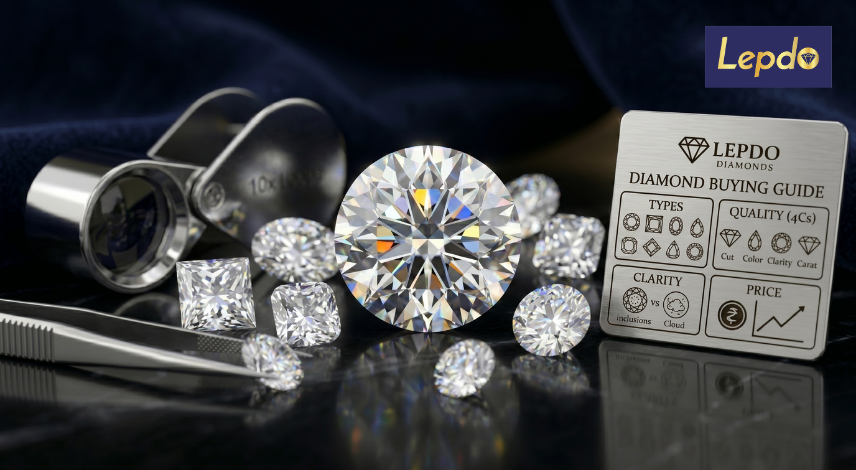

A diamond buying guide is a practical framework for evaluating diamonds based on cut, clarity, color, and carat weight before making a purchase. For buyers in the USA, understanding these factors prevents costly mistakes and ensures you get real value at any price point. Lepdo Diamonds provides certified, manufacturer-direct stones with full grading transparency to make that decision straightforward.
Close to 35 percent of first-time diamond buyers in the United States admit they felt underprepared at the point of purchase. That is a significant number of people walking into a four, five, or even six-figure decision without the right information in hand. A solid diamond buying guide does not just help you avoid overpaying. It helps you understand what you are actually getting for your money, which is a completely different and more valuable thing.
The 4Cs, first standardized by GIA, remain the foundation of any serious diamond buying guide. But the real knowledge gap for most buyers sits between understanding those four letters and knowing how to apply them to a specific stone in a specific shape at a specific price. That gap is what this guide closes.
By the time you finish reading, you will know how to assess types of diamonds by name, read a diamond buying guide purity chart accurately, understand what the best clarity of diamond actually means in practical terms, and make a purchase decision with the kind of confidence that typically takes years in the industry to develop.
What Is a Diamond Buying Guide and Why Does It Matter?
A diamond buying guide is a structured educational resource that teaches buyers how to evaluate diamond quality across four primary dimensions: cut, color, clarity, and carat weight. It translates grading lab language into practical buying decisions.
Here is what makes it genuinely useful. The diamond market operates on information asymmetry. Sellers almost always know more than buyers, and that gap costs consumers real money every year.
Quick Info Box:
- Definition: A diamond buying guide is a framework that helps buyers assess diamond quality, types, and value using standardized grading criteria.
- Key Types or Varieties: Round brilliant, oval, cushion, princess, emerald, pear, marquise, radiant, asscher, heart
- Best For: Engagement ring shoppers, fine jewelry buyers, B2B wholesalers, investment diamond buyers
- Key Difference or Advantage: Turns technical grading language into actionable buying decisions, reducing the risk of overpaying or choosing the wrong stone
Understanding diamond quality is the starting point for every purchase, whether you are sourcing a single engagement stone or placing a wholesale order of fifty certified diamonds.
Most Popular Types of Diamonds and Who They Are For
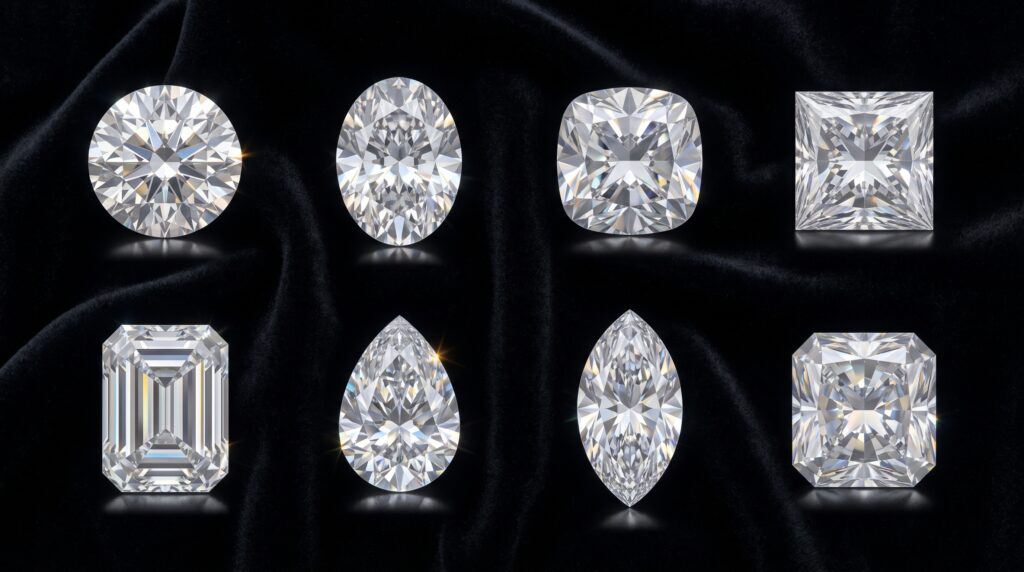
The types of diamond available today span a wide range of shapes, cutting styles, and light performance profiles. Knowing the difference between them is not just aesthetics. It affects price per carat, visual size on the finger, cut grading availability, and resale value.
Round Brilliant
The round brilliant is the best-known diamond shape in the world, and for good reason. Its 58 facets are engineered to maximize light return, brilliance, and fire. GIA issues a formal cut grade for round brilliants, which no other shape currently receives. To be fair, round diamonds still dominate engagement ring sales in the United States, accounting for roughly 40 to 50 percent of all diamond purchases annually. They carry a price premium over fancy shapes, but that premium reflects genuine optical performance and unmatched demand.
Oval Cut
The oval cut has been the fastest-growing fancy shape in the USA market over the past three years. Its elongated silhouette creates the illusion of greater size and flatters a wide range of finger types. Most buyers don’t realize that two oval diamonds of identical carat weight can look dramatically different face-up depending on their length-to-width ratio. The ideal range for most buyers falls between 1.35 and 1.50. Ovals do carry a potential bowtie effect in the center, which buyers should examine before purchasing.
Cushion Cut
The cushion cut blends a square or rectangular shape with rounded corners and larger facets that produce a soft, romantic light pattern. It reads as vintage-inspired but fits equally well in modern settings. Most buyers gravitating toward cushion cuts want something that feels warmer and softer than a princess cut. They are popular choices for halo settings.
Princess Cut: Square outline, sharp corners, and strong brilliance make this a popular value choice. It typically costs less per carat than a round brilliant of the same quality grade.
Emerald Cut: A step-cut shape with long, parallel facets. It emphasizes clarity over brilliance, which means inclusions are more visible. Buyers choosing emerald cuts should prioritize the best clarity of diamond they can afford within their budget.
Pear Shape: A hybrid of the round and marquise. When worn with the point toward the fingertip, it elongates the hand significantly. Popular for pendant settings and as center stones in east-west ring designs.
Marquise: The most face-up efficient of all diamond shapes. A one-carat marquise can look 20 to 30 percent larger than a one-carat round. Strong bowtie effect risk, so always view before buying.
Radiant: A rectangular or square shape with trimmed corners and brilliant-style faceting. It combines the clean lines of an emerald cut with the light performance of a round. One of the most flexible shapes for different setting styles.
Natural Diamonds vs. Lab-Grown Diamonds: The Real Difference
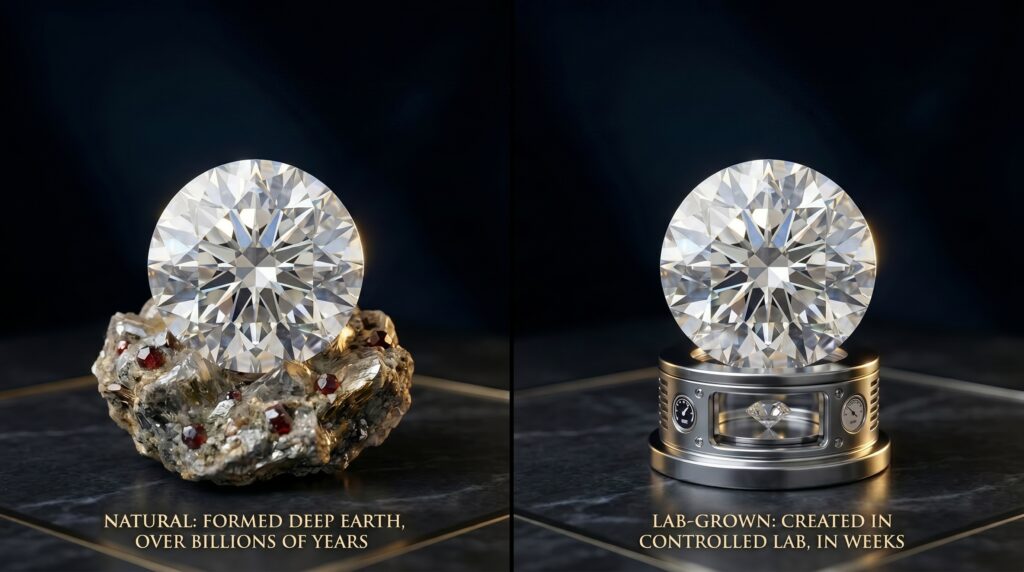
The most consequential split in diamond buying guide today is not between shapes or sizes. It is between natural and lab-grown diamonds. Both are real diamonds, but the buying experience, pricing, and long-term value differ meaningfully.
| Factor | Natural Diamonds | Lab-Grown Diamonds |
|---|---|---|
| Chemical Composition | Pure carbon, identical structure | Pure carbon, identical structure |
| Price Per Carat | Higher, market-driven by rarity | 50 to 80% lower than natural equivalents |
| Certification | GIA, IGI, HRD | IGI primary, GIA also certifies |
| Resale Value | Retains moderate value over time | Currently limited secondary market value |
| Ethical and Environmental Footprint | Varies by mining source and practices | Lower land disruption; energy use varies |
The truth is, for buyers who prioritize diamond quality, size, and optical beauty over geological origin, lab-grown diamonds offer extraordinary value per dollar. The 4Cs apply identically to both categories. A lab-grown diamond with VS1 clarity and an Excellent cut grade will outperform a poorly cut natural diamond every single time. For B2B buyers, lab-grown diamonds also provide more consistent per-unit cost predictability when sourcing in volume.
How to Choose the Right Diamond for Your Style
Most buyers make this decision harder than it needs to be. Here is a practical six-point framework for getting it right.
- Personal style and aesthetic preference. If your taste runs classic and timeless, the round brilliant is hard to beat. If you want something distinctive and modern, oval and elongated shapes are the stronger choice. Know your aesthetic before you evaluate stones.
- Finger shape and hand compatibility. Elongated shapes like oval, marquise, and pear create a slimming, lengthening effect on shorter fingers. Wider hands can carry larger, more statement-oriented stones without looking overdone.
- Setting and use-case compatibility. Pointed shapes like pear and marquise require protective prong settings to prevent chipping at the tips. Step cuts like emerald and asscher shine in bezel or four-prong solitaire settings that showcase their open table. Always match the shape to the setting style.
- Budget advantage relative to alternatives. Fancy shapes generally cost 15 to 40 percent less per carat than round brilliants of equivalent grading. That price difference can mean stepping up a full clarity or color grade without increasing your budget.
- Occasion and intended use. Engagement ring diamonds benefit from maximum brilliance and durability, which favors round, oval, or cushion. Fashion jewelry and pendants allow for more adventurous shapes. Investment buyers typically gravitate toward certified round brilliants with top-tier grades.
- Lab-grown vs. natural decision. If you are buying diamonds for personal use or as gifts and want maximum size and quality at your price point, lab-grown is the smarter financial decision. If origin and geological rarity carry meaning for you or your recipient, natural diamonds fulfill that need. For B2B buyers sourcing inventory, understanding Diamond Clarity grades across both categories is essential for accurate pricing and client communication.
Before you finalize your choice, ask yourself one honest question: are you buying for beauty, for meaning, for investment, or for resale? The answer should drive your decision more than any single grading metric.
What B2B Buyers and Diamond Manufacturers Should Know
Sourcing diamonds at a commercial scale requires a completely different analytical lens than retail buying. Here is what wholesalers, retailers, and manufacturers need to get right.
Cut grading consistency is the first thing I look at when evaluating a parcel of stones for bulk purchase. A batch may be labeled Excellent cut across the board, but table percentages and depth percentages can vary enough to create visible inconsistencies in a finished piece. For fancy shapes, there is no GIA cut grade, which means you need your team to evaluate each stone against published ideal range benchmarks.
IGI and GIA certification standards matter differently depending on your customer base. Retail consumers in the USA have high trust in GIA for natural diamonds. For lab-grown inventory, IGI is the dominant certifying authority and widely accepted across the trade. Understand your end customer before you decide which paper to stock.
Rapaport pricing provides the industry benchmark for natural diamond pricing. Discounts and premiums off Rap sheet are negotiated based on cut quality, demand for specific shapes, and market conditions. Lab-grown diamonds do not follow Rapaport pricing directly, but the market has developed its own unofficial discount structures that experienced buyers track closely.
Tip from personal experience: When sourcing fancy cut diamonds in volume, always request light performance images (ASET or Idealscope images) alongside certificates. A stone can be GIA-certified with good grades and still underperform optically due to proportions that fall at the edge of acceptable ranges. Grading reports confirm quality floors. They do not guarantee excellence.
Diamond Jewelry Trends in the USA, 2025 to 2026
The American diamond jewelry market is in a genuinely interesting transitional phase right now. Demand for oval and elongated shapes has not plateaued the way some analysts predicted. If anything, the preference for length and elegance in center stones has strengthened, driven by aesthetic movements on social media and a broader shift toward personalized, non-traditional engagement jewelry.
Toi et moi settings, featuring two stones of different or matching shapes set side by side, have moved from niche to mainstream in under two years. East-west horizontal settings for elongated fancy shapes are gaining traction in bridal jewelry, and stacked band combinations paired with a solitaire center are driving repeat purchase behavior in retail.
According to industry reporting from major diamond trade publications, lab-grown diamond jewelry now represents a significant and growing portion of diamond jewelry retail sales in the United States. The quality and variety of lab-grown fancy shape diamond jewellery available to American consumers today would have been unimaginable a decade ago. Retailers who haven’t yet built out their lab-grown inventory are leaving real revenue on the table.
Yellow gold settings have made a decisive comeback after years of white metal dominance. Two-tone designs that combine yellow gold bases with white gold or platinum prongs are particularly popular because they allow warm gold aesthetics while still showcasing the colorless nature of higher-grade stones.
How to Evaluate Diamond Quality Like an Expert
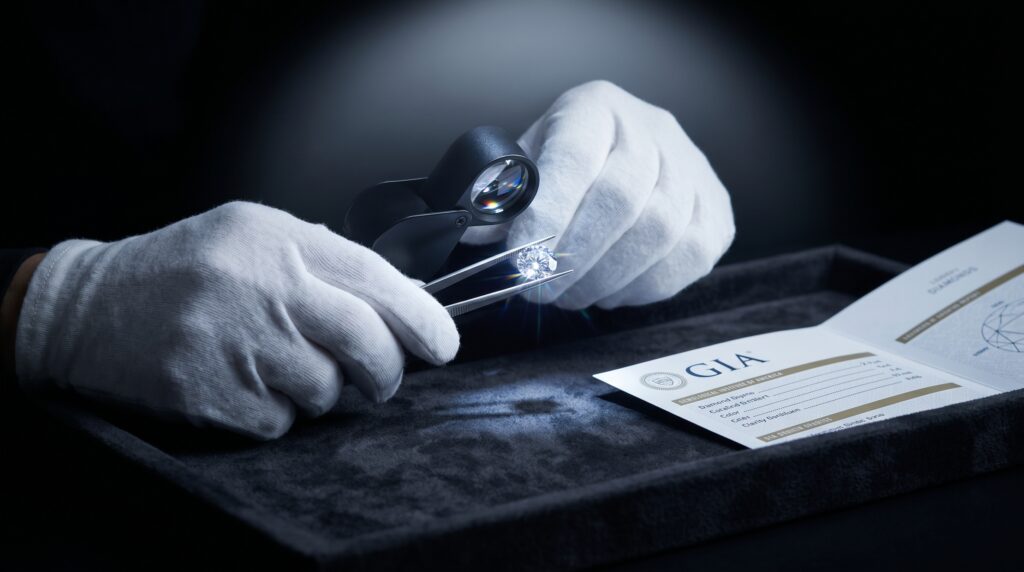
When I assess a diamond, the first thing I check is not the certificate. I look at the stone under a standard lighting environment and evaluate how it behaves visually. Then I go to the paperwork to confirm what I am seeing.
Here are four expert evaluation tips every buyer should apply:
- Prioritize cut above all other grades. Brilliance, fire, and scintillation are entirely products of cut quality. A VS1 diamond with a Poor cut is less beautiful than an SI1 diamond with an Excellent cut. Cut grade is the single most impactful quality factor.
- Check table percentage and depth percentage. For round brilliants, an ideal table falls between 54 and 57 percent. Depth should sit between 59 and 62.5 percent. Stones outside these ranges sacrifice light return through the pavilion. These numbers are on every GIA report.
- Evaluate clarity in context of the shape. Step cuts like emerald and asscher require VS2 or better clarity because their open facets make inclusions visible to the naked eye. Brilliant cuts like round and oval are much more forgiving, with many SI1 stones appearing eye-clean in person.
- Assess color against the setting metal. A D, E, or F color grade is most meaningful in white gold or platinum. In yellow gold, the setting itself introduces warmth, making G through I color grades appear nearly identical to higher grades at meaningfully lower prices.
- View fancy shapes for bowtie effect. Oval, pear, and marquise diamonds are prone to a dark bowtie shadow across the center when proportions are off. No certificate captures this. You must view the stone in person or via HD video before purchase. When buying through a certified diamond source like Lepdo Diamonds, always request a video to verify light performance on fancy shapes before committing.
Buying Diamonds the Right Way: What You Should Take Away
Three things should stay with you after reading this diamond buying guide. Cut quality is non-negotiable, no matter what shape or origin you choose. Certification from GIA or IGI is the minimum standard for any serious purchase, not a premium add-on. And knowing the types of diamonds by name and character before you walk into a buying decision is the single fastest way to protect your money and your confidence.
Whether you are an individual buying a once-in-a-lifetime engagement diamond or a retailer building out a new inventory season, the same fundamentals apply. The stones that deliver the most value are not always the most expensive ones. They are the ones sourced from the right place, cut with precision, and verified by a grading report you can trust.
You will want to explore the full range of certified natural and lab-grown diamonds available through Lepdo Diamonds, a manufacturer-direct source with transparent pricing and complete grading documentation across all major shapes and quality tiers. If you have sourcing questions or want guidance on a specific diamond buying decision, the team is available for direct consultation.
The best diamond purchase you ever make is the one where you knew exactly what you were looking for and found it without compromise. That is what a real diamond buying guide makes possible.
Frequently Asked Questions About Diamond Buying
1. What is a diamond buying guide?
A diamond buying guide is a structured framework that helps buyers evaluate diamonds using the 4Cs: cut, color, clarity, and carat weight. It covers diamond types, grading standards from labs like GIA and IGI, pricing factors, and quality benchmarks. It is essential for anyone purchasing diamonds for engagement rings, fine jewelry, or investment purposes.
2. Is buying a lab-grown diamond cheaper than a natural diamond?
Yes, lab-grown diamonds typically cost 50 to 80 percent less than natural diamonds of comparable quality. They carry the same physical and optical properties as mined stones and are certified by the same grading labs. For buyers prioritizing size and brilliance on a budget, lab-grown diamonds offer significant value without compromising on appearance or diamond purity.
3. Which diamond shape looks the biggest or most impressive?
Oval, marquise, and pear-shaped diamonds tend to look largest for their carat weight because of their elongated outlines and shallow depth. Among all shapes, the oval cut has become especially popular for this reason. Round brilliants, while visually brilliant, carry more weight in the pavilion, making them appear slightly smaller face-up at the same carat weight.
4. Does a diamond buying guide apply to GIA-certified stones only?
No. A diamond buying guide applies to all certified diamonds, whether graded by GIA, IGI, HRD, or other recognized labs. GIA is widely considered the most stringent for natural diamonds, while IGI is the leading certification body for lab-grown diamonds. Always use a guide alongside a grading report to ensure you are evaluating quality accurately and paying a fair price.
5. What is the biggest quality risk when buying diamonds?
The biggest quality risk is prioritizing carat weight over cut quality. A heavy but poorly cut diamond will appear dull, lifeless, and visually smaller than a well-cut stone of lower carat weight. Cut determines how light travels through the stone, affecting brilliance, fire, and scintillation. Always prioritize cut grade before stretching your budget on size.
6. Are lab-grown diamonds as good as natural diamonds in quality?
Yes. Lab-grown diamonds are chemically, physically, and optically identical to natural diamonds. They score the same on the Mohs hardness scale, are graded by the same 4Cs standards, and certified by IGI and GIA. The only real difference is origin. For buyers who prioritize beauty and diamond quality over geological rarity, lab-grown stones are an excellent and ethical choice.
7. Which diamond type is best for an engagement ring?
Round brilliant diamonds remain the most popular choice for engagement rings because of their superior light return and timeless appearance. That said, oval and cushion cuts are trending strongly. The best choice depends on the wearer’s style, finger shape, and setting preference. For elongating fingers, oval or marquise shapes are highly flattering and offer excellent visual impact per dollar spent.
8. How do I choose a reliable diamond manufacturer or supplier?
Look for suppliers who provide GIA or IGI-certified diamonds, offer transparent Rapaport-referenced pricing, and have a verifiable track record in the industry. Ask for cut grading consistency across their inventory. Lepdo Diamonds operates as a certified, manufacturer-direct source with full grading documentation, making it a trusted option for both B2B buyers and individual consumers.