Diamond Sourcing From India: 12 Checks Before a US Retailer Places Its First Order
 by lepdogroup@gmail.com
0 comments
by lepdogroup@gmail.com
0 comments
Diamond sourcing from India should begin with supplier verification, stone specifications, grading consistency, origin documentation, US compliance, landed-cost analysis, and a controlled sample order. US retailers should evaluate the factory, reports, parcel consistency, payment terms, shipping responsibility, rejection policy, and repeat-order capability before committing meaningful inventory capital.
Diamond sourcing from India can allow a US jewelry retailer to source diamonds from one of the world’s most established diamond manufacturing ecosystems. However, the first purchase should not be made with the main focus on the lowest price per carat.
In business, there are numerous ways to lose money, and the quoted diamond price is only one part of the risk.
Sometimes brokers quote attractive prices, and a sample looks good, but the production parcel may contain a much wider distribution of color, clarity, millimeter measurements, and cut quality. A retailer may receive a grading report, but the retailer still needs to confirm that the report belongs to the physical stone being purchased. Duties, transportation, insurance, sanctions screening, rejected merchandise, and inventory carrying costs can also increase the real cost of the order.
The key to good diamond sourcing is to put controls in place from the beginning.
A US retailer needs to understand what the supply chain of the diamonds being purchased actually looks like, how quality is measured, what documents accompany the shipment, and how exceptions are handled. The retailer should also ask a simple but important question: can the supplier deliver the same quality again on the next order?
India has a strong manufacturing ecosystem for cutting and polishing, sorting and grading, lab-grown diamonds, calibrated goods, fancy shapes, melee, and larger diamonds. Retailers therefore need a specific buying specification for diamond sourcing rather than a broad request for “good quality diamonds.”
For a broader diamond sourcing overview, Lepdo’s guide on source diamonds explains the basic international procurement process. This checklist goes into more detail and focuses specifically on the first diamond sourcing experience of a US retailer.
What Diamond Sourcing From India Gets Wrong When Using Supplier Quotes
A supplier quote provides the price a supplier is willing to accept for a particular order. It does not provide enough information to complete proper supplier or supply-chain due diligence.
A quote alone does not establish:
- Factory capability
- Grading consistency
- Stone identity
- Origin
- Report authenticity
- Repeatability
- Export capability
- Commercial dependability
- Replacement support
- US compliance
There is no reliable way to determine the full risk of diamond sourcing from a quotation alone.
For example, a retailer buying 10 individually selected center stones faces a different risk profile from a retailer sourcing 1,000 melee stones.
The retailer sourcing center stones is highly sensitive to stone quality, grading-report accuracy, eye cleanliness, proportions, and the amount of inventory capital tied to individual stones.
The retailer sourcing melee stones is more sensitive to color range, clarity distribution, millimeter consistency, matching, replacement, and the consistency of goods supplied after breakage or during repeat production.
In either case, the retailer’s sensitivity to different quality factors should determine how the diamond sourcing program is designed.
Because diamonds can appear similar on a spreadsheet while performing differently in actual inventory, buying decisions should rely on evidence rather than sales presentations.
Check 1: Verify Who the Supplier Actually Is

The first diamond sourcing check is to understand the business behind the quotation diamond sourcing.
A supplier may be:
- A direct manufacturer
- A cutting and polishing company
- A laboratory-grown diamond producer
- A wholesaler
- A stockist
- An exporter
- A trader
- A broker
- A company operating several of these models
A manufacturer may provide stronger control over repeat production, sorting standards, calibration, and replacement matching.
A trader may provide access to a wider inventory base and may be able to source varied specifications quickly.
Neither model is automatically better. The retailer needs to know which type of business it is dealing with.
A trusted diamond supplier evaluation should include the supplier’s:
- Legal business name
- Billing or invoicing name
- Export entity
- Operating address
- Business registration details
- Location where goods are manufactured
- Location where goods are sorted
- Banking identity
- Export capability
If a supplier says it manufactures diamonds, ask which processes are performed internally and which are outsourced.
For lab-grown stones, ask whether the company grows the material, cuts the stones, polishes them, sorts them, or simply buys and resells finished inventory.
Diamond sourcing becomes safer when the retailer can map the supply chain and understand exactly which functions are controlled by the supplier.
Check 2: Define Natural and Lab-Grown Goods Precisely
The first purchase order should clearly state whether the retailer is buying natural diamonds, laboratory-grown diamonds, or both.
That description should remain consistent across:
- Purchase orders
- Commercial invoices
- Packing lists
- Inventory records
- Product descriptions
- Internal product databases
- Retail disclosures
For retailers in the United States, this is not simply internal terminology.
The Federal Trade Commission requires laboratory-created diamonds to be described in a manner that clearly communicates that they are not mined diamonds. Terms such as laboratory-grown or laboratory-created can be used for this purpose.
Disclosure language should therefore form part of the diamond sourcing specification before the order is placed.
For laboratory-grown stones, determine whether the supplier uses CVD, HPHT, or both within its inventory.
Not every diamond manufacturer uses the same growth, treatment, cutting, polishing, sorting, or grading process.
Lepdo Diamonds is a B2B laboratory-grown diamond manufacturer located in Surat, India, using CVD and HPHT production.
The commercial question is not which acronym sounds more advanced. The real question is whether the supplier can consistently meet the specifications the retailer actually sells.
Check 3: Define the Required Grading Documentation
Diamond sourcing requirements should clearly indicate which stones require independent grading documentation and which stones will be purchased according to parcel specifications.
For center stones and higher-value individual diamonds, many retailers prefer separately documented goods.
The requirements may include:
- Laboratory name
- Report number
- Stone measurements
- Carat weight
- Color or quality assessment
- Clarity
- Cut or finish
- Fluorescence
- Laser inscription
- Online report verification
When individually documented goods are required, Certified Diamonds can form part of the retailer’s buying strategy.
Terminology also matters.
Beginning October 1, 2025, GIA changed its evaluation service for D-to-Z laboratory-grown diamonds. Its Laboratory-Grown Diamond Quality Assessment uses Premium and Standard descriptions rather than the traditional natural-diamond color and clarity nomenclature.
A retailer comparing different documents should therefore not assume that every laboratory report uses identical terminology or grading presentation.
Before accepting inventory, the retailer should reconcile the physical diamond with the grading report.
The report number, measurements, weight, inscription where applicable, and physical characteristics should correspond with the actual stone.
Diamond sourcing controls should treat documentation as something to verify, not simply something to receive.
Check 4: Verify Origin and Sanctions Exposure
One of the major control points in diamond sourcing for the United States is origin verification.
Just because a diamond was cut and polished in one country does not necessarily mean it was mined in that country.
The country of manufacture and the country of mined origin may be different.
This matters because certain United States restrictions apply to Russian-origin diamonds even when the diamonds have been processed in another country.
Current US restrictions prohibit the importation of certain Russian-origin non-industrial diamonds of 0.5 carats or greater even when the diamonds have undergone cutting, faceting, polishing, or other substantial transformation outside Russia.
A natural diamond sourcing program should therefore ask what origin information the supplier can provide and what screening process is used.
A statement such as “we do not sell Russian diamonds” should not be treated as the entire control process.
Ask:
- What documentation supports the origin declaration?
- Who collected the information?
- How is the information attached to the parcel or stone?
- Does the information survive trading between parties?
- What screening occurs before export?
- What records can be retained by the buyer?
For retailers interested in broader responsible purchasing practices, Ethical Diamond Sourcing is relevant to the wider due-diligence framework.
Diamond sourcing should distinguish between manufacturing location, exporting country, and origin of the underlying diamond material where the distinction is commercially or legally relevant.
Check 5: Write a Real Product Specification
An example of weak diamond sourcing is:
“Send me VS quality white diamonds.”
That specification is incomplete.
For individually selected stones, the purchasing specification may need to include:
- Shape
- Carat range
- Color
- Clarity
- Cut
- Polish
- Symmetry
- Fluorescence
- Measurements
- Ratio
- Depth
- Table
- Eye-clean requirements
- Inclusion restrictions
- Certification requirements
For calibrated goods, the specification may include:
- Diameter
- Size range
- Millimeter tolerance
- Weight range
- Color range
- Clarity range
- Matching requirement
- Make consistency
- Quantity
- Total carat weight
- Sieve range
- Maximum acceptable percentage outside the target tolerance
This is where diamond sourcing becomes operational.
A retailer purchasing Loose Diamonds needs a measurable acceptance standard.
If the retailer sells ovals, cushions, pears, emerald cuts, marquises, radiants, or other Fancy Shape Diamonds, ratio and outline preferences should also be documented.
The same carat, color, and clarity combination can still produce noticeably different visual results.
The more precisely the retailer describes the expected product, the easier it becomes to determine whether the delivered order actually meets the agreement.
Check 6: Approve a Reference Sample Before Scaling

A sample becomes useful only when it functions as a reference standard.
If five stones are approved and the retailer later orders 500 stones, the supplier needs to understand exactly which characteristics made the original stones acceptable.
Record the relevant characteristics, including:
- Measurements
- Color
- Clarity
- Make
- Finish
- Inclusion appearance
- Matching
- Visual standard
A photograph or video can support the reference, but it should not replace measurable specifications.
For unusual facet patterns or Unique Cut Diamonds, visual references can become especially useful because outline, facet arrangement, proportions, and repeatability may all affect whether the reordered stone matches the original concept.
For a first transaction, the retailer can use a controlled sample order to test the supplier’s interpretation of the specification.
The retailer can then decide whether a larger production order is justified.
An excellent sample does not automatically prove that the supplier is a reliable production partner.
Diamond sourcing should test repeatability, not just first-sample quality.
Check 7: Test Parcel Consistency, Not Just the Best Stone
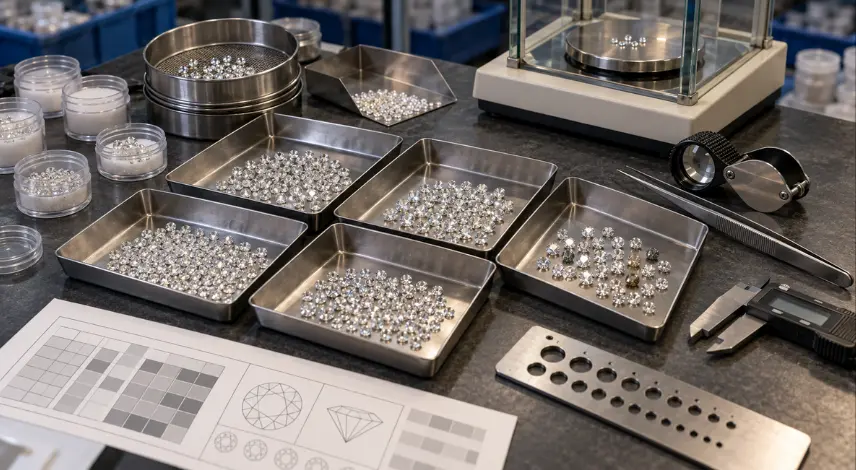
One excellent diamond does not prove that the entire parcel meets the requirement.
Wholesale purchasing is about distribution.
If a retailer orders a parcel described as meeting a particular color and clarity specification, the commercial question is not whether one stone fits that description.
The question is whether the parcel as a whole fits the agreed standard.
Diamond sourcing therefore requires a sampling method.
Check whether stones throughout the parcel are:
- Within the agreed color range
- Within the agreed clarity range
- Uniform in size
- Consistent in shape
- Consistent in make
- Within agreed fluorescence limits where relevant
- Free from unacceptable chips or abrasions
- Properly matched
- Free from significant outliers
A diamond parcel buying guide can help document these requirements before parcel buying begins.
This becomes especially important when buying loose diamonds wholesale.
A small inconsistency may look insignificant when examining a single stone. Multiplied across hundreds or thousands of stones, however, the same inconsistency can create bench-setting issues, matching problems, rework, inconsistent finished jewelry, and inventory complications.
The quality of diamond sourcing should therefore be judged across the parcel, not by the supplier’s best sample stone.
Check 8: Calculate the Real Landed Cost
The buyer needs to consider more than the supplier’s quoted stone value.
A diamond sourcing cost calculation may include:
- Stone value
- Shipping
- Insurance
- Brokerage
- Import processing
- Duties
- Additional tariffs
- Banking fees
- Currency conversion
- Inspection
- Rejected goods
- Return freight
- Inventory carrying cost
Tariff treatment deserves special attention because import treatment can change.
A retailer should not base current diamond sourcing economics on an old article, historic duty assumption, or a headline tariff quoted without the actual HTS classification and entry conditions.
Before a meaningful shipment, verify:
- HTS classification
- Country of origin
- Applicable Chapter 99 treatment where relevant
- Entry date
- Current tariff treatment
The internal guide on US india diamond tariff provides relevant context, but actual entry treatment should still be confirmed with a qualified customs broker at the time of import.
The best supplier price is not always the lowest landed cost.
A slightly higher stone price may produce a better commercial result when quality consistency, rejection rates, shipping, replacement, and inventory turnover are considered together.
Check 9: Clarify MOQ, Payment Terms, and First-Order Exposure
MOQ is not simply a condition imposed by the supplier.
It is an inventory-risk decision for the retailer.
A low price can become commercially expensive if the retailer is required to buy more inventory than it can reasonably sell.
Before placing the first order, determine:
- Minimum order quantity
- Minimum order value
- Whether MOQ is carat based
- Whether MOQ is quantity based
- Whether MOQ varies by size
- Whether multiple specifications can be combined
- Deposit amount
- Deposit due date
- Balance payment timing
- Currency
- Bank fees
- Payment method
- Whether repeat-order terms change
The moq diamond wholesale decision should be based on realistic sell-through rather than simply accepting the supplier’s minimum.
Aggressive negotiation for the lowest possible price per carat may not be worthwhile on a first order.
Buying more inventory to qualify for a small price reduction can weaken cash flow if the extra stock remains unsold.
Good diamond sourcing should improve inventory efficiency, not merely reduce the number printed on the supplier invoice.
Check 10: Put Incoterms, Shipping, and Insurance in Writing
A supplier saying “shipping included” is not sufficient.
The purchase order should clearly state the agreed Incoterm or equivalent commercial responsibilities.
FOB, CIF, and other shipping structures affect responsibility for freight, insurance, risk transfer, and parts of the transportation process.
Retailers unfamiliar with those terms should understand fob vs cif diamond export before authorizing the shipment.
For each diamond sourcing order, answer these questions before the parcel leaves India:
- Who books the carrier?
- Who pays the freight?
- Who is responsible for insurance?
- What value is insured?
- When does risk transfer?
- Who prepares the export documents?
- Who is the importer of record?
- Who handles the customs entry?
- What happens if the shipment is delayed?
- What happens if the shipment is damaged?
- What happens if the shipment is lost?
Assumptions about ordinary parcel shipping can create problems when applied to high-value goods.
The retailer should understand whether the shipping method, insurance coverage, declared value, and claims procedure are appropriate for the value of the diamonds being transported.
Check 11: Prepare the US Import File Before the Goods Leave India
It is better to identify missing documentation before the shipment reaches US customs.
The retailer and customs broker should ideally review the expected commercial paperwork before the goods leave India.
The file may include:
- Commercial invoice
- Detailed goods description
- Goods quantity
- Total carat weight
- Declared value
- Country of origin
- HTS classification
- Shipping documents
- Insurance documents
- Importer information
- Natural versus laboratory-grown description
- Supporting origin records where relevant
- Supporting compliance records where relevant
For retailers unfamiliar with the process, import diamonds from india to usa provides a useful internal reference.
The customs broker should still confirm the live classification and entry treatment for the shipment.
For natural rough diamonds, Kimberley Process requirements may apply. Those requirements are different from the ordinary process for polished loose stones.
Diamond sourcing becomes easier to manage when the commercial, logistics, compliance, and merchandising teams use the same product description from the supplier quotation through the retail inventory system.
Conflicting descriptions across documents can create unnecessary questions and delays.
Check 12: Agree on Rejections, Replacements, and Repeat Orders
The first order should not be judged only by whether it ships successfully.
A more useful test is how the supplier responds when something goes wrong.
Before placing the order, determine what happens if:
- A stone falls outside specification
- A grading report does not match the stone
- A stone arrives chipped
- The parcel has inconsistent color
- Measurements exceed agreed tolerances
- The shipment contains the wrong quantity
- A matching stone is required later
- A customer return requires replacement
- The retailer wants to reorder the same specification
Establish an inspection window.
Establish who pays the return freight.
Establish whether rejected stones are replaced, credited, or refunded.
Establish how replacement value is determined.
For calibrated programs and repeat orders, verify whether the supplier can reproduce the original specification.
This is one of the strongest ways to distinguish transactional diamond sourcing from a long-term supplier relationship.
A supplier that handles exceptions clearly and consistently may provide more commercial value than a supplier offering a slightly lower initial quotation but no reliable process when problems occur.
What Should the First Purchase Order Include?
The first purchase order should contain enough information for an independent person to compare the delivered shipment with the agreed requirements.
| Control Area | What the Purchase Order Should Include |
|---|---|
| Product | Natural or laboratory-grown diamond, shape, category |
| Quality | Color, clarity, finish, matching, and agreed limits |
| Size | Carat or millimeter range and tolerance |
| Documentation | Required report or supporting analysis |
| Quantity | Stone quantity and total carat requirement |
| Commercial | Unit basis, total value, currency, payment terms |
| Logistics | Incoterm, shipping responsibility, insurance responsibility |
| Acceptance | Inspection window and rejection criteria |
| Remedy | Replacement, credit, refund, or agreed corrective action |
The goal is to eliminate assumptions.
Setting diamond specifications before production or sorting gives both buyer and supplier a measurable standard.
A clear purchase order also makes diamond sourcing easier to audit because the retailer can compare what was ordered, what was shipped, and what was accepted.
Direct Manufacturer vs Trader or Stockist: Which Is Better for a First Order?
There is no single preferred business model for every retailer.
| Factor | Direct Manufacturer | Trader or Stockist |
|---|---|---|
| Production control | Potentially stronger | Depends on upstream partners |
| Inventory breadth | May focus on core production | Often broader |
| Calibration repeatability | Can be strong for factory-controlled goods | Depends on sourcing consistency |
| Immediate stock access | Depends on inventory | Often stronger |
| Custom specifications | Potentially easier | May require upstream coordination |
A retailer may prefer a direct diamond manufacturer when production consistency, calibration, repeatability, and transparency are priorities.
A retailer may choose a trader when it has confidence in the trader’s sourcing controls, supplier network, traceability, inventory access, and inspection discipline.
US retailers should choose the model according to their buying program.
For a repeated calibrated melee program, direct production control may offer significant advantages.
For one-off, varied, or highly customized inventory, a trader with a strong supplier network may provide useful flexibility.
The right diamond sourcing model is the one that can repeatedly meet the retailer’s actual commercial requirements.
Sample Order Limitations
Diamond sourcing should increase in scale only after the supplier has demonstrated four things.
First, the stones match the written specification.
Second, the paperwork matches the goods.
Third, delivery and communication function effectively under real commercial conditions.
Fourth, exceptions are resolved professionally.
After these conditions have been demonstrated, the next order can test repeatability.
A retailer should not move immediately from a small successful sample to the maximum possible order volume.
Increase the order size in stages and measure:
- Acceptance rate
- Rejection rate
- Delivery accuracy
- Matching quality
- Report accuracy
- Specification consistency
- Replacement speed
- Communication quality
This creates evidence.
It also gives the supplier an opportunity to understand the retailer’s expectations without exposing either party to an unnecessarily large first transaction.
For broader perspective, Lepdo’s Medium discussion on diamond sourcing from India examines the international sourcing environment and additional challenges faced by global buyers. The Medium reference should supplement the primary Lepdo article rather than replace the retailer’s own supplier-verification process.
Frequently Asked Questions
1. Is India a Good Country for Diamond Sourcing for US Retailers?
Yes, but US retailers still need supplier and product due diligence.
India has extensive cutting, polishing, sorting, export, and laboratory-grown diamond manufacturing capabilities. The main commercial advantage is manufacturing depth and supplier availability. A retailer should still evaluate grading, origin, parcel consistency, logistics, landed cost, replacement procedures, and repeatability before increasing order volume.
2. How Do I Verify a Diamond Supplier in India?
Ask for the company’s legal name, operating address, banking details, export information, product specialization, and whether it manufactures or trades the goods.
Then test the supplier through a controlled order.
A supplier’s ability to provide accurate documentation, communicate clearly, meet specifications, and resolve commercial exceptions is usually more informative than claims made in brochures or sales presentations.
3. Should My First Diamond Sourcing Order Be Small?
Usually, a controlled first order is sensible.
It allows the retailer to test product quality, documentation, logistics, inspection results, and supplier communication while limiting unnecessary exposure.
The goal is not to make the first order unrealistically small. The order size should reflect the amount of evidence the retailer currently has about the supplier’s ability to perform.
4. Do I Need Certified Diamonds for Every Wholesale Order?
No.
Individual grading reports are more commonly relevant for larger, higher-value, or center stones. Smaller calibrated goods may be purchased using parcel specifications and the retailer’s own quality-control procedures.
The need for individual documentation depends on stone size, value, product type, customer expectations, merchandising requirements, and the retailer’s quality-control standards.
5. What Should I Check in Loose Diamonds Wholesale Parcels?
Check the parcel as a whole rather than evaluating only a few attractive stones.
Review color distribution, clarity distribution, measurements, matching, make, quantity, carat weight, chips, abrasions, and obvious outliers.
In production jewelry, consistency can be commercially as important as the nominal grade because inconsistent stones can create setting, matching, replacement, and finished-product problems.
6. How Important Is a Supplier’s MOQ?
MOQ is important because it directly affects working capital, inventory turnover, and cash flow.
A low price per carat may not be attractive if the MOQ forces the retailer to buy excessive inventory.
Compare the MOQ with realistic sell-through, reorder frequency, available cash, product demand, and storage requirements before accepting a volume discount.
7. What Is the Biggest Compliance Risk When Importing Natural Diamonds From India?
A major risk is assuming that cutting or polishing in India automatically proves acceptable mined origin.
Certain US sanctions apply to Russian-origin diamonds even when the diamonds are processed through another country.
Buyers should perform origin due diligence, review current sanctions requirements, maintain appropriate supporting records, and consult customs or compliance professionals where necessary.
8. What Should I Ask Before Reordering From the Same Supplier?
Ask whether the supplier’s specification, calibration range, reference standards, grading expectations, packaging method, and rejection rules have changed.
Then compare the second shipment with the first.
Consistent results are what make a diamond sourcing program successful. A supplier that delivers one excellent parcel but cannot reproduce the same standard reliably is not yet a dependable long-term inventory partner.
Strategic Takeaways for US Retail Buyers
Diamond sourcing from India should be treated as a repeatable sourcing program rather than a one-time purchasing event.
Price is important, but long-term commercial value also depends on quality, grading consistency, traceability, landed cost, documentation, parcel distribution, communication, and remediation when something goes wrong.
The second principle is to transform subjective expectations into objective standards.
Terms such as “good VS,” “white stones,” or “premium make” are open to interpretation. Grade ranges, millimeter tolerances, report requirements, matching standards, acceptable variation, and rejection rules provide measurable expectations.
The third principle is to measure the supplier’s ability to repeat the result.
The US retailer should determine whether the supplier consistently meets the agreed standard and should track the outcome of each shipment. Only after that evidence exists should purchasing volume increase.
A controlled diamond sourcing system therefore combines supplier verification, precise specifications, documented inspection, compliance checks, landed-cost analysis, and measured repeatability.
When these controls are in place, US retailers can approach diamond sourcing from India with a clearer understanding of quality and commercial risk, rather than allowing price to become the only factor controlling the purchase.
For in-depth market reports, trade sourcing guides, interactive Q&As, and expert gemological perspectives, join the discussion on Lepdo Diamonds on Quora.