

Lab grown diamond supplier scorecards compare vendors on measurable procurement outcomes, not price alone. A practical 15-metric assessment tracks rejection rates, grading consistency, report-to-stone matching, on-time-in-full delivery, substitutions, documentation, response speed, traceability, and claims handling. Retailers and wholesalers can use weighted scores, sample orders, and written evidence to identify avoidable supply risks.
Lab grown diamond supplier decisions tend to look simple during the first round of shipments. However, inconsistencies in the subsequent shipments tend to undermine the competitiveness of the quotes provided. Some of these might be unexpected substitutions, shipment delays, or inconsistencies in the stone grades. Dependability needs to be substantiated.
A lab grown diamond supplier should be analyzed based on the characteristics of the diamond that the business in consideration actually sells. It is important to track the shipments against the orders placed, and determine if the problems are resolved. This should be done prior to committing to large orders.
Why a Lab Grown Diamond Supplier Needs More Than a Price Check
Two lab grown diamond supplier candidates might quote the same specifications, but tend to produce different outcomes. For example, one supplier tends to deliver stone shipments that are matched pairs along with completed paperwork, and the other tends to consistently deliver stone shipments that require corrections and/or tend to miss the deadline. The lowest quote for saleable inventory is not always the lowest cost.
A diamond supplier’s due diligence process for first time sourcing policy can utilize the Diamond Supplier guide and utilize the scorecard to measure the performance after actual orders are made.
Rapaport Trade says its Primary Suppliers meet enhanced verification and compliance requirements. That status can be used in a buyer’s due diligence process, but shouldn’t replace it.
How the 15-Metric Scorecard Works
Each lab grown diamond supplier is rated on product accuracy, delivery, documentation, commercial transparency, and problem resolution. The individual metrics are scored (0-5) based on orders, inspections, correspondence, or policies, and are weighted. The total weights are 100.
For each lab grown diamond supplier, a zero means no credible evidence or failure to meet the minimum requirement. A one or two indicates a serious or recurring gap. A three indicates the supplier meets the minimum requirement. A four indicates the supplier has executed well. A five indicates strong performance over the review period. These are scoring rules, not industry benchmarks.
Compare each lab grown diamond supplier using the same evaluation checklist, product mix, defined commitment and review period. Separate center stones from calibrated melee and request evidence rather than score assurances.
The 15 Metrics to Evaluate Every Lab Grown Diamond Supplier
1. Incoming Diamond Rejection Rate (Weight: 10)
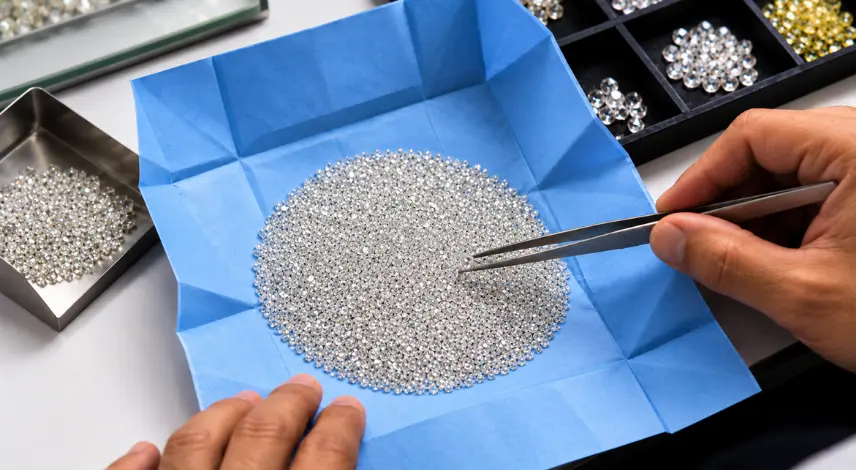
The rejection rate measures how often received stones fail the purchasing specification. Divide rejected stones by all inspected stones during the same period, then multiply by 100. Track rejection reasons against the agreed inspection criteria.
A lab grown diamond supplier should be evaluated using consistent inspection standards across comparable parcels. Record whether a rejected stone was replaced, credited, or accepted under an approved exception.
2. On-Time, In-Full Delivery (OTIF) (Weight: 10)
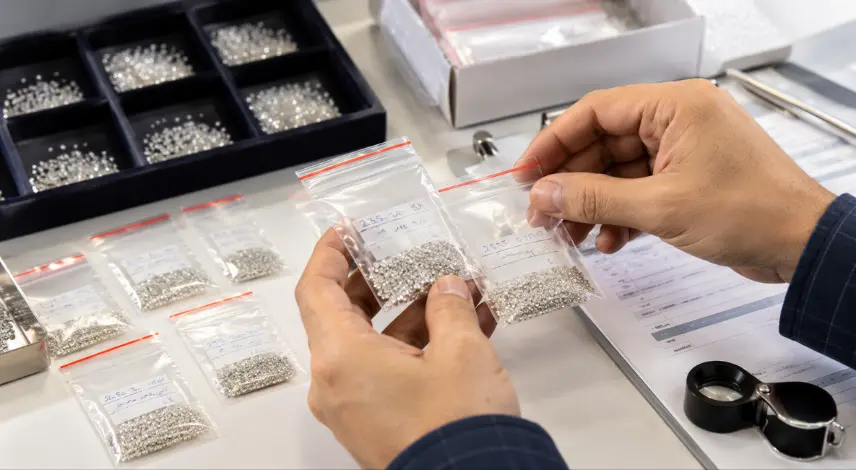
OTIF measures orders received by the agreed date with every required order line and quantity complete. A timely parcel with missing stones does not qualify as in full, and a complete parcel delivered late does not qualify as on time. The following order-stage checks support the delivery review.
Performance Targets Met
Did the lab grown diamond supplier meet the buyer’s pre-determined performance targets? Review all parcel traceability and order documentation. If a performance target was not met, document why, e.g., insufficient supply, extreme weather, operational constraints, etc.
Order Acknowledgement
Was the buyer notified of an order via acknowledgment from the lab grown diamond supplier? Note if the buyer provided documentation with insufficient detail.
Order Confirmation
Did the supplier confirm an order via documentation? Note if the documentation was provided with insufficient detail.
Order Release
Was the order released by the supplier? Note if there is no order release documentation or if the documentation was provided with insufficient detail.
A lab grown diamond supplier may give dispatch dates instead of arrival dates. Agree on which event counts, how to address delays at customs, and which of the supplier’s original dates to consider. This helps to avoid attractive delivery statistics that do not reflect the replenishment experience of the retailer.
3. Report-to-Stone Verification (Weight: 9)
For individually reported stones, verify the report against the physical stone by reviewing the grading report (if available), stated identity, measurements, carat weight, and any girdle inscription. Obtain verification of the report by the issuing laboratory, if available. Track verified matches as a percentage of report-bearing stones examined.
It is useful to work with a lab grown diamond supplier to establish a consistent process to reconcile stone IDs and accompanying paperwork. Diamond Report Verification provides a useful starting reference. Not all small diamonds are accompanied with individual reports, and the appropriate checks will vary based on the agreed product category.
4. Grading and Visual Consistency (Weight: 9)
Inspect diamonds against the agreed reference examples. Photograph borderline examples as to not rely on subjective terms like “excellent”. A report describes a stone, but it cannot prove that an entire shipment looks consistent.
Evaluate a lab grown diamond supplier through multiple batches, not through a sample that has been hand-selected. Review lab diamond quality grades for more buying criteria. For report terminology differences between laboratories and reporting systems, compare the actual fields and report issue dates.
5. Cut, Shape, and Millimeter Tolerance (Weight: 8)
It is possible for a parcel to be within its stated carat range and still create issues during production. Check the shape, length-to-width ratio, physical measurements, girdle considerations, and the visual Finish stated in the purchase order. For setting programs, even slight dimensional variations may require remaking or resizing the mounting.
Ask a lab grown diamond supplier to confirm the agreed tolerance before cutting, sorting, and dispatching. Companies purchasing matched stones can review the meaning of a calibrated diamond stones supplier and apply a stated pass/fail inspection to each parcel.
6. Unauthorized Substitution Rate (Weight: 8)
Track each order line that was changed without written approval and include substitutions in shape, report laboratory, clarity range, growth method (if specified in the contract), or delivery lot. Divide the number of unauthorized substitutions by the total number of order lines. State the original request and the proposed replacement. Obtain final approval from the buyer.
A lab grown diamond supplier may need to use alternatives if their inventory is moving quickly. This is not automatically a failure. Failure occurs when the supplier conceals the change or dispatches it without approval. A written substitution procedure prevents account managers and the warehouse team from reinterpreting the buyer’s specification.
7. Documentation Completeness (Weight: 7)
Review to see if each shipment contained the required commercial invoice and packing list. Verify each shipment contains the required product identification, laboratory report, and product origin disclosures. Lack of paperwork can slow down the receiving process, and complicate the custom’s and/or the customer’s review of the shipment.
Judging only by the number of files supplied could give this lab grown diamond supplier a higher score than it deserves. In this case, a crowded folder does not help the case when report numbers, quantities, and/or invoice description don’t support each other. For businesses sourcing internationally, the operational steps in import diamonds from india provide helpful context to plan shipment documentation.
8. Inventory Depth and Replenishment Reliability (Weight: 6)
A sample order forms a baseline to assess the supplier’s capability. Replenishment history reveals the supplier’s ability to repeat that capability based on the changing demand. Evaluate how often the supplier is able to re-stock agreed upon shapes, size bands, color ranges and quantities without lead time changes or alternates.
A lab grown diamond supplier should be able to separate available inventory from expected inventory from a production run or from a trading partner. Request available to promise (ATP) snapshots. A manufacturer and trader can both perform well, but their stocking and fulfillment risks can differ.
9. First Useful Response Time (Weight: 5)
Determine the time from a buyer’s request to the first response that answers the question or provides a next step. An automatic response should not be counted. Responses to quotations should be differentiated from responses to report requests and updates. Responses to urgent requests should be measured separate from the rest.
Unhelpful answers to urgent requests should be scored lower than useful, timely responses. Determine if the team identifies correct contact, communicates the issue clearly and provides updates to the buyer. Fast, but incorrect responses should be scored lower than accurate, useful responses.
10. Claims and Corrective-Action Resolution (Weight: 6)
Although procurement is complex and defects happen, the main concern for a buyer is how the defect is dealt with. This includes how the problem is contained and investigated and how the corrective action is executed. Keep track of the percentage of claims closed within the agreed time frame, how long it takes to effect a corrective action, and the occurrence of the same defect.
A lab grown diamond supplier should be willing to capture the affected stone IDs and the reason for the defect and ensure the remedy is captured and provided in writing. Buyers can exercise their rights to a replacement or credit based on the terms of their contract, or request a re-inspection or a change to the handling method. An apology does not close a claim.
11. Quote and Pricing Transparency (Weight: 5)
There are many assumptions when quotes are provided. Written quotes may not be clear and must be interpreted, for example, the shape, carat weight, color, clarity, cut, etc. Check the validity of the quote. Compare terms on which fulfillment will be made.
A lab grown diamond supplier should be clear on the reasons for any changes in the quoted price, as well as when a price change will occur. The lab diamond wholesale price discussion is a good reference when constructing similar buying requests. Relying on unsupported promises for fixed prices or price advantages for factory direct sourcing is ill advised.
12. Total Landed Cost Disclosure (Weight: 5)
The total cost of procurement includes several components. This includes the cost of inspection, freight, insurance, customs, brokerage fees, duties, taxes, and costs incurred due to return and replacements. What costs are relevant depend on the route taken, the structure of the transaction and the agreed responsibilities.
Regarding the lab-grown diamond quotations:
Ask the lab grown diamond supplier to define the delivery term and which party pays for each component. Provide a comparable landed cost view rather than viewing all quotes delivered to the same location.
13. Production and Origin Traceability (Weight: 5)
Ask the lab grown diamond supplier to provide detailed information about the provenance of the rough, where the cutting and polishing was done, and what records connect the final parcel to the seller’s disclosures.
CVD and HPHT are methods of diamond growth, and do not substitute a documented chain of supply or stone identification. A supplier that claims direct control over the manufacture of lab-grown diamonds should be able to articulate its production process without overstating what a certificate proves. A background reference is cvd diamond manufacturing process. Treat environmental and ethical claims separately, and request evidence prior to communicating them to customers.
14. Business Verification and Claims Substantiation (Weight: 4)
Review the contracting entity, business registration, bank account, and other information. Evaluate what the seller states, represents, or claims against what is verifiable, sub-contracting, or outsourcing. Consider claims, representations, and statements in a holistic manner, even if they appear in separate documents. Seek documentation for claims regarding certifications, sole sourcing, exclusivity, and/or guarantee of capacity or availability.
15. Returns and Replacement Terms (Weight: 3)
Understand written policies regarding inspection windows, nonconforming stones, shipping responsibility, credits, replacements, and accepted exemptions. Discern difference between specification defects and buyer preference. Indicate on the trial order remedy delivery.
Flexible return policies allow buyers to mitigate the cash trapped in payment disputes. Repeated defects, false reports, and unauthorized substitutions can not be reconciled by flexible return policies. The scorecard places more weight on the delivery of the original order than solving problems after the fact.
How to Score and Compare Supplier Candidates
For each lab grown diamond supplier, use a common five-point scale and multiply each score by its metric weight divided by five. Sum the 15 weighted results for a maximum score of 100. The workbook automatically computes the total score when all metrics have scores entered.
| Score band | Suggested buyer interpretation | Procurement action |
|---|---|---|
| 85 to 100 | Strong candidate | Agree to commercial terms, confirm capacity |
| 70 to 84 | Conditional candidate | Agree to documented corrective action plan |
| Below 70 | Elevated performance risk | Reassess before volume commitment |
| Missing evidence | Not yet comparable | Continue the assessment rather than estimate the score |
| Critical integrity concern | Hold orders | Investigate independently |
Score bands are illustrative rather than industry benchmarks. A lab grown diamond supplier scoring 90 can not pass a due diligence review by hiding a report mismatch or misrepresenting origin. Integrity failures require separate escalation.
Why Two Suppliers With Similar Quotes Can Score Differently
Visualize two suppliers providing similar parcel specs. Vendor A quotes less per stone, but requires continual manual corrections and cannot demonstrate or document changes to the original order. Vendor B quotes more per stone, but provides consistent grading, and complete and verifiable paperwork and reports. The scorecard demonstrates the difference.
Include inspection hours, late deliveries, replacement freight, stock outs, and returned goods. A lab grown diamond supplier becomes an attractive source when the total buying process is predictable and repeatable, as opposed to when the initial quote looks the most inexpensive.
A Realistic Five Step Trial Prior to Signing a Supply Agreement
1. Fix the Buying Specification
Document categories, quantities, types and acceptable ranges of reports, grading, delivery terms, inspection criteria, etc. Do not ask competing suppliers to interpret an incomplete request for proposal (RFP) and give differing bids. The clearest quotation for a lab grown diamond supplier begins with the clearest purchase order.
2. Representative Order
A purchaser should not always request the largest, most premium sample. For an inspector of diamond parcels, the sample size is determined by the value of the order, and there is no firm number of stones that guarantee reliability of the supplier.
3. Inspect and Reconcile Parcel
Upon delivery, log inspection, measurements, and conditions. Observe and document report discrepancies, and approved substitutions. If applicable, check individual certified diamonds against the documentation. Based on the purchase agreement, use sample and batch identification procedures to test a broader assortment of loose diamonds.
The above scenario gives a potential buyer an opportunity to refine a buying specification, document procedure for sampling, and establish criteria and means to evaluate a diamond parcel, prior to committing to a supply agreement.
4. Test Response and Resolution
Use actual buyer inquiries to see how claims are resolved. A lab grown diamond supplier should be evaluated based on actual performance, not a false emergency manufactured to test the staff.
5. Review Again After Repeat Orders
The first order from a lab grown diamond supplier establishes a baseline, not a final judgment. Adjust the corresponding metrics for similar products and categories in subsequent purchases and compare them. Some purchasers may find the diamond supplier selection discussion useful in differentiating an impressive factory presentation from operational evidence.
Risk Signals that Should Lead to a Low Score
Temporarily stop purchases with a supplier for misrepresenting the source, altering reports, undisclosed substitutions, inconsistencies in contract terms, or failing to substantiate key claims.
Explain the reason for stopping purchases, and provide evidence to corroborate it, for the lab grown diamond supplier in question. Hold the affected transaction if warranted. Good procurement is about integrating numerical scoring with judgment on the severity of the issues.
Frequently Asked Questions
1. What is a lab grown diamond supplier scorecard?
A lab grown diamond supplier scorecard is a tool that lets buyers of lab-grown diamonds quantitatively compare suppliers. It contains measurable criteria such as how well a supplier accepts a diamond, how well a supplier delivers a diamond, a supplier’s documentation, how consistent a supplier is in diamond grading, how quickly a supplier responds to buyer inquiries, and how well a supplier investigates a buyer’s claim. A scorecard supports consistent buying conversations, and keeps the discussions grounded in actual orders.
2. What is a good supplier score out of 100?
Generally, in the diamond industry, there is no pass/fail score for a supplier using this framework. I have illustrated examples of buyer thresholds in the excel sheet. An score of 85-100 is a strong supplier candidate, 70-84 is an approval with conditions, and less than 70 is an insufficient supplier and requires further reassessment. Your organization should set thresholds based on your tolerance for financial exposure and rigid requirements.
3. How do retailers calculate diamond rejection rate?
Divide the total number of rejected stones by the total number of stones inspected and multiply by 100. Classify rejection reasons, and compare parcels against a fixed written specification. A lab grown diamond supplier cannot be judged fairly when one shipment receives a full inspection, and another receives a casual, quick inspection.
4. What does OTIF mean in wholesale diamond buying?
OTIF means on time, in full. An order is only fully successful if it is delivered on time and the entire order quantity is delivered. Before collecting data, determine if you mean delivery to the recipient or if you mean the supplier’s dispatch. If a parcel arrives on time, but is missing one or more of the items in the order, it should not be considered a fully successful order.
5. Are IGI and GIA reports interchangeable for procurement?
No. IGI and GIA use different report formats to communicate assessment terminologies and findings. IGI documents quality characteristics by virtue of their applicable report system. On the other hand, GIA uses an overall assessment of Premium or Standard for eligible colorless to near colorless lab-grown stones as part of their recent update to their service. Consider the type of report issued, the date the report was issued and the purchaser’s requirements.
6. Should a buyer go with a manufacturer instead of a trader?
Choose the lab grown diamond supplier business model that gives the vendor the most control of the supply that they agree to provide. A manufacturer may give insight into how they make their products while a good trader may give access to an assortment of products and be flexible to changing customer demands. The question that you should ask of your lab grown diamond supplier is: can they consistently meet your requirements, provide a clear and verifiable supply chain and address problems that you may have?
7. How often should a supplier be rescored?
Rescore after a significant or material number of comparable orders. Rescore after a major quality or logistics problem. Rescore before a significant increase in purchase orders. Consider rescored on a monthly or quarterly basis if you feel that would help you determine how your suppliers perform consistently.
8. Can a high score replace legal and technical due diligence?
No. Weighted scores help a buyer compare how suppliers performed against the criteria for which the scores were established. However, weighted scores by themselves cannot authenticate reports or guarantee that a supplier’s product meets the legal and technical requirements. It is important that a buyer verify the lab grown diamond supplier’s business and product through appropriate legal and technical checks and terms. Concerns of illegal, unethical or foul play should be researched regardless of the total points that a supplier gets.
Strategy Briefing for Retailers
Purchasing teams evaluate lab grown diamond suppliers using a scorecard to gauge each supplier’s ability to meet demand. Price promises and successful sample order experience should not determine the scorecard on their own.
There are three principles guiding the final decision:
First, although the most-favored-nation (MFN) approach is desirable, consistency should be valued more than the best price. If a supplier creates operational costs by causing repeated supply chain disruptions, that supplier should not be favored.
Second, for each claim made by the supplier, provide evidence. Favorability should be determined by supplier agreements, grading reports, traceability documents, delivery agreements, and replacement policies as opposed to seller presentations.
Third, continually assess suppliers. A strong start for a lab grown diamond supplier should not guarantee a long-term relationship. Meaningfully change purchasing patterns to discover the root causes of issues impacting suppliers, and adjust supplier approval decisions based on new evidence.
Increased order volume should not be the only determinant of the supplier of quality lab-grown diamonds. Quality, documentation, communication, and commercial execution should remain reliable.
For in-depth market reports, trade sourcing guides, interactive Q&As, and expert gemological perspectives, join the discussion on Lepdo Diamonds on Quora.