Lab Grown Diamond Certification for B2B Buyers: What to Verify Before Buying in Volume
 by lepdogroup@gmail.com
0 comments
by lepdogroup@gmail.com
0 comments
Lab grown diamond certification gives B2B buyers a documented reference for a stone’s identity and reported quality, but volume procurement requires more. Buyers should verify report authenticity, report-to-stone matching, inscriptions, measurements, grading consistency, relevant treatment disclosures, and batch-level conformity before accepting or paying for a large order.
Lab grown diamond certification should be treated as a procurement control, not as a document attached to each stone and forgotten. A grading report can identify and describe an individual diamond. Still, a wholesale order introduces a second problem: hundreds or thousands of stones must match the reports, the agreed specifications, and the commercial expectations of the buyer.
For a retailer, wholesaler, sourcing team, or jewelry manufacturer, the real question is not simply whether a parcel contains graded stones. The stronger question is whether the report data can be verified, reconciled to the physical diamonds, and checked consistently across the whole order. That is where lab grown diamond certification becomes part of quality control.
A disciplined B2B process should check report authenticity, report numbers, girdle inscriptions where present, laboratory identity, carat and measurement matching, color and clarity distribution, cut information, growth or treatment disclosures when reported, and parcel-level consistency. This approach reduces substitution risk, grading mismatch, inventory surprises, and avoidable disputes after shipment. Pasted markdown
What Lab Grown Diamond Certification Means in B2B Buying
Lab grown diamond certification is the commercial shorthand buyers often use for an independent diamond grading report or quality assessment issued by a gemological laboratory. The document generally records identifying and quality information for the submitted stone according to the laboratory’s own service and reporting format.
For volume procurement, the report has two jobs. First, it provides stone-level information. Second, it creates a reference point that can be checked against the physical inventory supplied. Buyers should understand both roles.
A report does not automatically prove that an entire shipment is consistent. If 300 stones are ordered, 300 individually graded stones can still vary within an agreed grade range, cut profile, measurement tolerance, or visual appearance. This is why lab grown diamond certification must sit inside a broader batch inspection process rather than replace it.
For a technical foundation, buyers can review Lab Diamond Certification before building a procurement checklist.
Why Stone-by-Stone Reports Are Not Enough for Volume Orders
Consumer certification content usually asks whether one diamond has a report. B2B sourcing needs a different framework. The buyer must ask whether every report belongs to the correct stone, whether the batch matches the purchase order, and whether the quality distribution is commercially usable.
A parcel can create operational problems even when every stone has documentation. One shipment may contain too wide a spread of measurements. Another may technically meet a clarity range but include a higher concentration of visible inclusions than expected. A third may contain mixed cutting styles that complicate matching for jewelry production.
Lab grown diamond certification helps establish identity and reported quality, but a volume buyer should also define acceptable tolerance before the order is confirmed. The specification can cover size, millimeter range, color, clarity, cut or make, fluorescence where relevant, shape consistency, and any treatment or growth information that matters to the buyer’s product program.
This distinction becomes especially important when sourcing Loose Diamonds for repeated production rather than one-off retail sales.
1. Verify the Report Before You Verify the Grade
The first lab grown diamond certification check is authenticity. Do not begin by debating whether a VS1 should have been a VS2. First confirm that the report itself can be verified through the issuing laboratory’s official verification system or report-check function.
The report number, stone description, measurements, carat weight, shape, and other identifying data should correspond with the physical diamond. A buyer should also check whether the report format is appropriate for the service represented.
A practical workflow is to create a reconciliation sheet containing the supplier’s stone ID, laboratory name, report number, carat weight, measurements, color, clarity, and order-line reference. This creates traceability between the purchase order and the received parcel.
The concept is explained further under Diamond Report Verification. For B2B orders, report verification should be performed systematically rather than only when a problem appears.
2. Match the Report Number to the Physical Stone
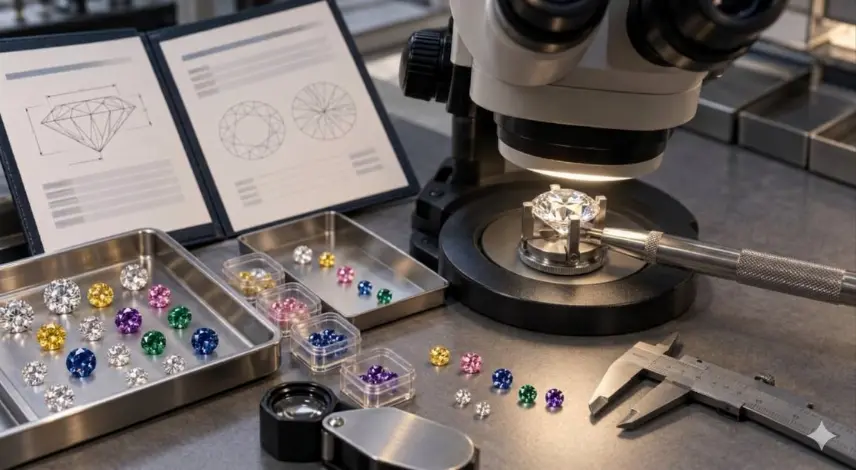
Lab grown diamond certification becomes much more useful when the buyer can match a report to a physical stone without relying only on a supplier label.
Many graded diamonds may carry a laser inscription on the girdle that identifies a report number or laboratory-grown status, depending on the laboratory and service. Where an inscription is present, inspect it under appropriate magnification and compare it with the documentation.
The presence of an inscription should not become a shortcut for every other check. A buyer should still compare carat weight, measurements, shape, and other identifiers because the objective is full reconciliation.
The internal process can use Diamond Laser Inscription as the technical reference for understanding what girdle marking is and how it is used.
When the order includes stones with no practical inscription check, the buyer can rely more heavily on measurement, weight, report data, controlled parcel separation, and supplier traceability.
3. Check Whether the Report Data Matches the Purchase Order
A report may be valid and still not match what was ordered. The third lab grown diamond certification control is therefore purchase-order conformity.
If the order calls for round stones in a defined carat range, color range, clarity range, and measurement tolerance, the receiving team should test the supplied report data against those specifications. Do not assume that a parcel marked “EF VS” means every stone fits the exact agreed distribution.
For larger orders, use a structured exception list. Flag stones that fall outside the purchase specification, stones with missing report details, duplicate report numbers, measurements outside tolerance, or mismatched supplier IDs.
Diamond certification numbers are useful identifiers, but the commercial control comes from linking those numbers to the purchase order and physical inventory.
A clean reconciliation process makes lab grown diamond certification actionable for inventory intake rather than merely archival.
4. Evaluate Grading Consistency Across the Batch
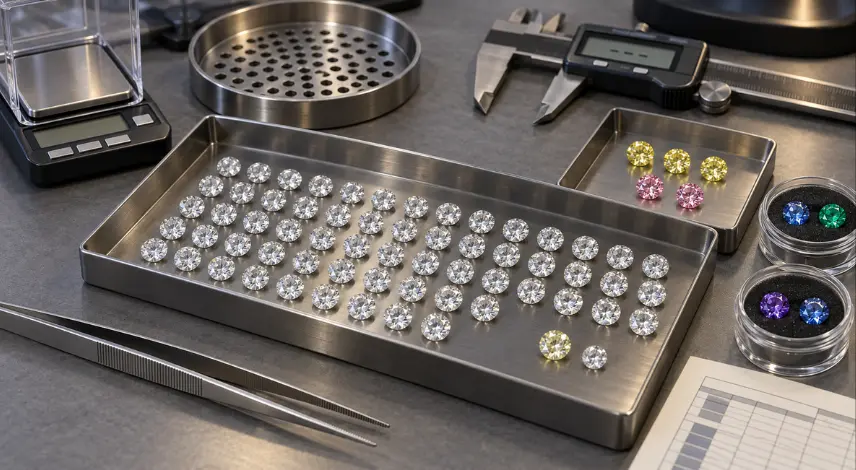
The most common B2B mistake is treating the grade printed on each report as the end of quality control. Lab grown diamond certification gives the buyer reported grades, but the buyer still needs to assess whether the batch is consistent enough for the intended product.
Imagine a jewelry program that requires matched pairs, calibrated halo stones, or repeatable center-stone inventory. Two diamonds can share the same broad color and clarity grades while differing in measurements, inclusion visibility, cut appearance, or face-up character.
For this reason, batch QC should review the distribution, not only individual pass or fail. Group stones by shape, size, color, clarity, and make. Compare outliers against reference stones or approved master samples where appropriate.
Buyers using Diamond Grading Standards can separate the concept of formal grading from the additional commercial tolerances required for production.
The strongest lab grown diamond certification workflow therefore connects laboratory data with incoming QC, visual matching, and manufacturing requirements.
5. Understand What the Laboratory Is Actually Reporting
Not every lab grown diamond certification format contains identical fields, terminology, or grading presentation. Buyers should review the actual report rather than assume that every laboratory uses the same document structure.
The most commercially relevant fields can include identification as laboratory-grown, shape and cutting style, measurements, carat weight, color information, clarity information, cut-related information where applicable, polish, symmetry, fluorescence, comments, growth method or treatment disclosure when provided, and inscription details.
For buyers working heavily with IGI reports, Lab Diamond IGI Report provides a focused reference for reading report components.
The buyer should understand what data is present, what data is absent, and how that reporting format connects to the order specification.
This is particularly relevant for Certified Diamonds purchased in volume, where report consistency affects both procurement and downstream retail communication.
6. Verify Treatment and Growth Information Where It Matters
Lab grown diamond certification should be reviewed for any disclosure that affects the buyer’s product description, merchandising, internal standards, or customer communication.
Laboratory-grown diamonds can be produced using CVD or HPHT methods, and some stones may undergo post-growth treatment. Buyers should not infer the production method or treatment history from appearance alone. Use the information stated on the relevant report or documentation where the chosen laboratory service provides it.
For a B2B buyer, the main issue is consistency with the purchase agreement. If the order requires a defined production method, treatment status, or disclosure standard, the supplier and buyer should agree on that requirement before shipment.
This prevents a common problem: treating lab grown diamond certification as a generic yes-or-no document while ignoring fields that may affect the commercial specification.
When mixed production methods are acceptable, the buyer can focus more heavily on the final quality and reporting consistency. When they are not acceptable, the requirement should be explicit in the purchase order.
For Fancy Color Diamonds, buyers should also review color-related descriptions and any relevant treatment disclosure contained in the selected laboratory report.
7. Build Batch-Level QC Around Certification
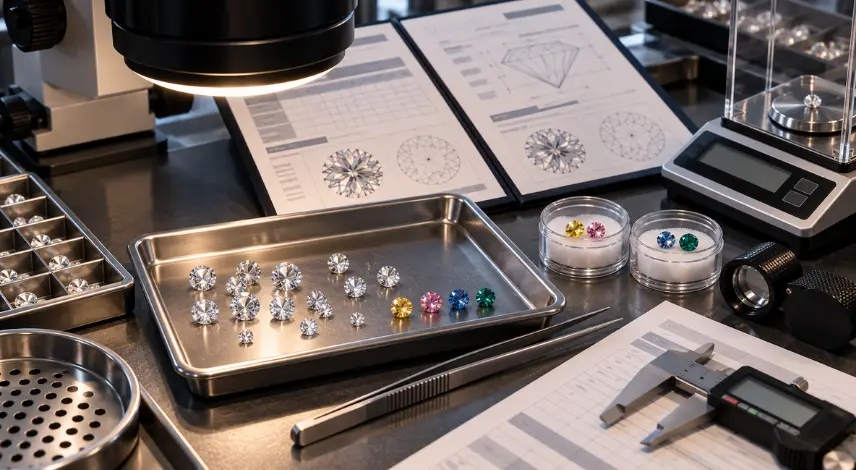
The best lab grown diamond certification process does not end with report verification. It connects report data to the physical batch.
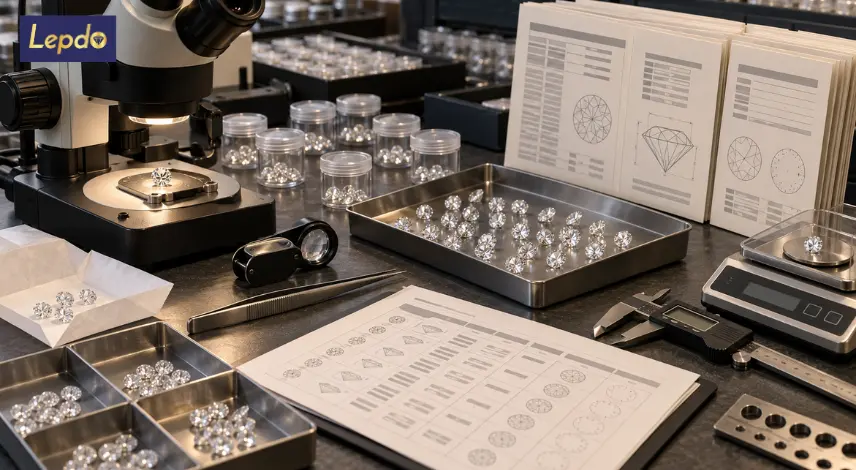
A useful incoming-QC sequence is:
- Count the stones and reports against the packing list.
- Confirm report numbers and supplier IDs.
- Match carat weights and measurements.
- Inspect girdle inscriptions where applicable.
- Sort by shape, size, color, clarity, and make.
- Identify outliers and missing documentation.
- Record exceptions before stones enter production or inventory.
This process is especially important for Fancy Shape Diamonds, where two stones carrying similar grades can still differ visibly in outline, length-to-width ratio, bow-tie appearance, facet pattern, or spread.
For special faceting programs, Unique Cut Diamonds may require an even tighter link between report identity and physical visual matching because standard grade fields do not fully describe every design characteristic.
Lab Grown Diamond Certification vs Batch-Level B2B Verification
| Factor | Stone-Level Certification | Batch-Level B2B Verification |
|---|---|---|
| Primary purpose | Describe and identify one submitted diamond | Confirm the shipment matches the commercial order |
| Main reference | Laboratory report | Reports, purchase order, packing list, physical stones |
| Key checks | Identity, measurements, 4Cs, comments | Reconciliation, consistency, tolerance, outliers |
| Main risk controlled | Misunderstanding one stone’s reported quality | Mismatch across many stones |
| Buyer outcome | Stone-level documentation | Production-ready, traceable inventory |
The two processes are complementary. Lab grown diamond certification provides the documented stone-level reference, while batch verification determines whether the entire order is suitable for the buyer’s operational requirements.
IGI Lab Grown Diamond Certification in B2B Procurement
The secondary search term igi lab grown diamond certification is commercially relevant because IGI reports are commonly encountered in laboratory-grown diamond trading. A B2B buyer should still apply the same controls used with any grading document: verify the report, reconcile the report number to the correct stone, inspect report fields, and test the full parcel against the agreed specifications.
IGI certification can help procurement teams understand the laboratory-specific context without turning the supplier decision into a brand-name shortcut.
For buyers who specifically source Indian inventory, IGI-certified lab-grown diamonds in India can form part of a broader sourcing specification.
A laboratory report can strengthen traceability, but lab grown diamond certification does not remove the need for supplier QC. The stone that reaches the buyer must still match the report and the order.
What to Verify Before Paying for a Large Order
Before final payment or release of a large shipment, use lab grown diamond certification as one part of a broader document-control package.
At minimum, the procurement record should be able to connect the commercial invoice, packing list, stone or parcel IDs, report numbers, quantity, weight, and agreed quality specification. When individual stones are certified, the mapping between each physical stone and report should remain clear.
This is where choose a diamond supplier becomes relevant. Certification is useful evidence, but supplier controls determine how exceptions are handled.
Avoid These Certification Mistakes in Volume Procurement
Accepting a PDF Without Verifying the Report
A PDF file should not be treated as lab grown diamond certification verification by itself. The report number and stone details should be checked against the issuing laboratory’s official verification process where available.
Checking Only a Sample of Reports Without a Sampling Plan
Random checking can be useful for some commercial QC tasks, but certified-stone identity is different. If every stone is sold and inventoried as individually graded, the buyer should establish a reconciliation method that prevents report-to-stone mix-ups.
Ignoring Millimeter Measurements
Carat weight alone does not guarantee matching dimensions. This matters for calibrated jewelry manufacturing, replacement inventory, and matched sets.
Treating Color and Clarity Ranges as Uniform Appearance
A grade range is not the same as visual uniformity. Lab grown diamond certification should be paired with parcel-level visual QC where appearance consistency matters.
Forgetting Treatment or Growth Disclosures
If the buyer’s product positioning depends on a specified production method or treatment disclosure, that information must be checked against the agreed documentation.
Assuming Certification Replaces Supplier Due Diligence
A laboratory evaluates submitted stones. It does not manage the supplier’s parcel assembly, packing, order accuracy, replacement policy, or production consistency. Those remain procurement responsibilities.
A Practical Volume-Order Verification Framework
A scalable lab grown diamond certification workflow can be divided into three checkpoints.
Before the Purchase Order
Define acceptable laboratories or report services, grade ranges, sizes, shapes, tolerances, treatment or growth requirements where relevant, inscription expectations, and the format in which report data must be delivered.
Before Shipment
Ask for the report list and map it to stone IDs or parcel IDs. Check obvious duplicates, missing report numbers, out-of-range grades, and mismatched quantities before the goods leave the supplier.
On Receipt
Reconcile the physical shipment against the report list. Inspect a controlled combination of identity markers, measurements, weights, visual quality, and batch consistency. Escalate exceptions before inventory is mixed into normal stock.
This three-stage approach turns lab grown diamond certification into an operational control rather than an after-the-fact document review.
For additional B2B perspective, this Medium discussion of lab grown diamond certification explains why certification becomes more significant when buyers move beyond a single retail transaction into repeat purchasing and volume procurement.
Frequently Asked Questions
1. What Should B2B Buyers Verify First in Lab Grown Diamond Certification?
Start with report authenticity and stone identity. Confirm that the report number can be verified, then match the report to the physical diamond using available identifiers such as inscription, weight, measurements, shape, and supplier stone ID. Only after identity is secure should the buyer move to grade distribution and batch consistency.
2. Is Lab Diamond Certification Enough for a Wholesale Order?
No. Lab diamond certification can document individual stones, but wholesale acceptance also requires order-level checks. Buyers should reconcile quantities, report numbers, measurements, grades, and physical stones against the purchase order. Batch consistency, visual matching, and tolerance control remain separate procurement responsibilities.
3. Why Is Diamond Certification Important for Volume Buyers?
Diamond certification creates a documented reference for identity and quality. For B2B buyers, its value increases when report data is integrated into receiving, inventory control, matching, and exception management. The report supports traceability, but lab grown diamond certification still requires the procurement team to verify that the entire shipment conforms to the commercial agreement.
4. Should Buyers Accept Only One Grading Laboratory?
Not necessarily. The correct policy depends on the buyer’s market, customer expectations, product program, and internal controls. What matters is that the buyer understands the chosen laboratory’s report format and applies a consistent verification process. Lab grown diamond certification should be evaluated by what is reported and how reliably it supports the purchase specification.
5. How Should Report Numbers Be Checked in a Large Parcel?
Create a digital list that links each report number to the supplier stone ID, carat weight, measurements, grade information, and purchase-order line. Check for duplicates, missing numbers, and mismatches before inventory is accepted. A structured list makes lab grown diamond certification easier to audit than a folder of unrelated PDFs, and lab grown diamond certification data can then be reconciled before stock is released.
6. Does a Laser Inscription Prove the Full Quality of a Diamond?
No. An inscription is an identity aid, not a replacement for grading or physical inspection. It can help connect the stone to a report, but buyers should still compare report data, weight, measurements, and physical quality. Lab grown diamond certification is strongest when multiple identifying checks agree.
7. How Can a Buyer Check Grading Consistency Across Hundreds of Stones?
Segment the order by shape, size, color, clarity, and make, then compare each group against the approved specification. Review outliers separately and use reference stones or calibrated standards where appropriate. Lab grown diamond certification supplies report data, while parcel QC determines whether the batch is commercially consistent.
For deeper grade-level evaluation, diamond quality grades provide a practical B2B framework.
8. What Is the Biggest Certification Mistake in B2B Sourcing?
The biggest mistake is assuming that valid reports automatically mean a shipment is correct. A buyer can receive genuine reports and still face report-to-stone mismatches, out-of-range measurements, inconsistent appearance, or order errors. Lab grown diamond certification must therefore be connected to receiving inspection and supplier accountability.
Strategic Takeaways for B2B Buyers
Lab grown diamond certification should function as part of the purchasing system, not as a decorative attachment to inventory. The report establishes a stone-level reference, but the buyer creates commercial confidence by verifying that reference against the physical diamond and the purchase order.
The second priority is consistency. A certified parcel can still be unsuitable for a production program if measurements, visual make, color distribution, clarity appearance, or report mapping vary too widely. Volume buyers should therefore combine lab grown diamond certification with batch-level sorting and exception control.
The third priority is supplier process. Reliable B2B sourcing depends on how accurately the supplier maintains stone identity, report records, packing, QC, and replacement handling. For Lepdo Diamonds and any other B2B supplier, lab grown diamond certification should be assessed together with repeatable quality control, transparent documentation, and clear acceptance standards.