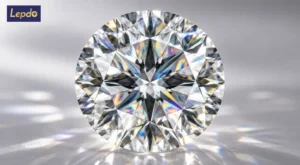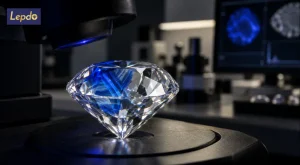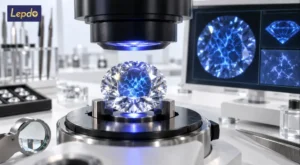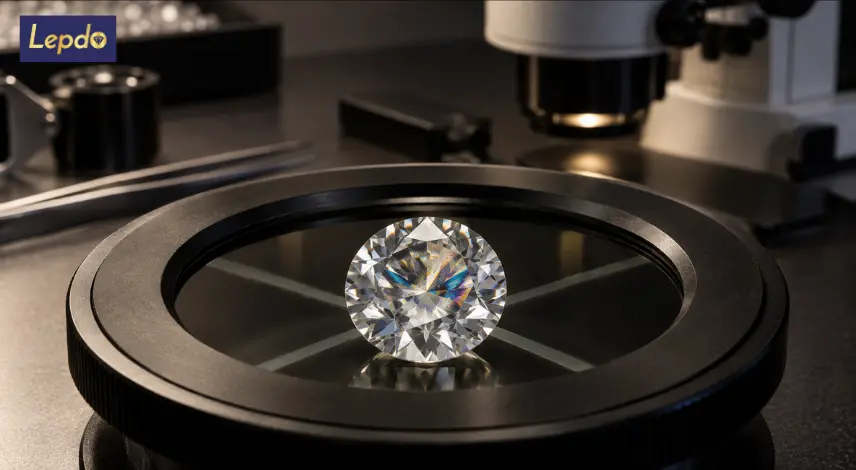

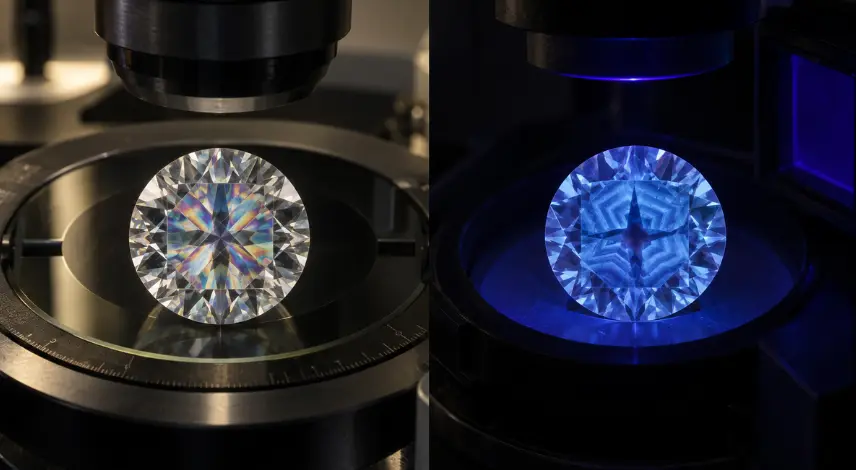
Diamond strain imaging reveals internal stress patterns by viewing a diamond between crossed polarizers. Natural diamonds often show crosshatched or mosaic strain, many CVD diamonds show banded patterns, and most HPHT diamonds show weak strain. Because exceptions exist, strain imaging is a screening tool, not a standalone proof of diamond origin.
A diamond can appear perfectly ordinary in neutral white light and then reveal a network of vivid internal colors when it is rotated between crossed polarizers. For manufacturers, graders, wholesalers, and retailers, diamond strain imaging can expose growth-related stress patterns that the 4Cs do not describe.
Diamond strain imaging is a non-destructive optical screening method for observing anomalous birefringence caused by lattice distortion. It can reveal clues associated with natural, CVD, and HPHT growth, but Gemological Institute of America research cautions that no single identifying feature should be used alone.
Here is what matters in practice: use strain as evidence, not as a verdict. Natural diamonds often show internal strain, CVD-grown diamonds commonly show banding, and HPHT-grown diamonds usually show weak strain or none.
What Diamond Strain Imaging Is
Diamond strain imaging is the controlled viewing of a diamond between polarizing filters positioned at roughly 90 degrees to one another so internal stress becomes visible as interference colors.
Quick Info Box
Definition: A non-destructive optical method that reveals stress-related anomalous birefringence inside a diamond.
Key Types or Varieties: Crosshatched strain, mosaic strain, banded strain, columnar strain, localized inclusion strain, low-strain fields.
Best For: Loose-diamond screening, manufacturing quality control, growth-method investigation, laboratory triage, and diamond trade education.
Key Difference or Advantage: It visualizes internal lattice distortion that normal face-up inspection usually cannot reveal.
For buyers building a broader sourcing checklist, Lepdo Diamonds provides access to laboratory-grown diamond inventory and educational resources.
Crossed Polarizers and Anomalous Birefringence
Diamond is normally singly refractive. Internal distortion changes polarized light locally, creating anomalous birefringence.
Think of it this way: crossed polarizers create a dark field, while strained areas return colored interference patterns. GIA commonly associates crosshatched or mosaic strain with natural diamonds, banding with CVD growth, and weak strain with most HPHT-grown diamonds.
A strain pattern is therefore a growth-history clue. It is not a clarity grade, cut grade, beauty score, or price grade.
What Strain Patterns Can and Cannot Tell You
The truth is that a typical-looking image can still mislead an inexperienced observer. GIA has documented HPHT-grown diamonds with visible strain even though most colorless HPHT-grown diamonds show very little anomalous birefringence.
A reliable conclusion may require microscopy, ultraviolet fluorescence imaging, spectroscopy, inscription verification, and a recognized laboratory report.
Most buyers should treat strain as a screening layer. Unusual strain should trigger more testing, not an unsupported origin claim.
Most Popular Diamond Strain Pattern Types and Who They Are For
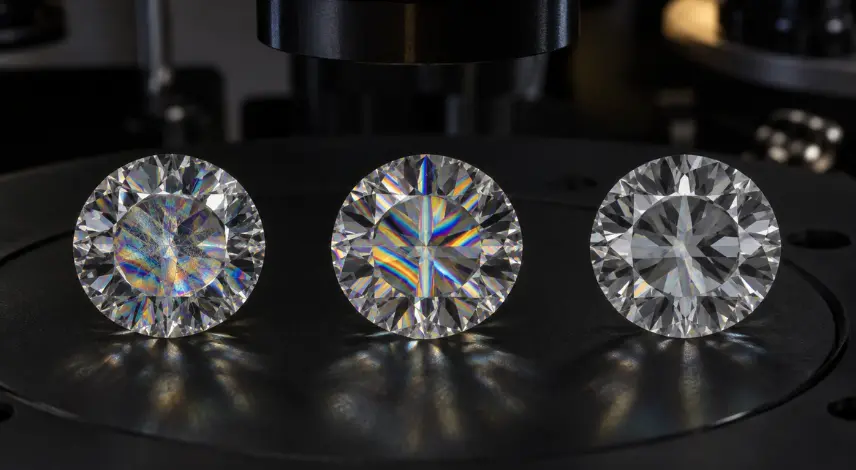
The most useful pattern categories are crosshatched or mosaic strain, banded or columnar strain, low-strain fields, localized inclusion strain, sector-related strain, and mixed or treatment-influenced patterns.
For Loose Diamonds, inspection is easier because the stone can be freely rotated. Fancy Shape Diamonds and Unique Cut Diamonds may require extra orientations because facet layout changes how the pattern appears.
Crosshatched and Mosaic Strain in Natural Diamonds
Many natural diamonds show crosshatched, tatami-like, or mosaic interference colors created by lattice distortion during their geological history.
GIA states that a clear majority of natural diamonds display some degree of internal strain under cross-polarized filters. Type II natural diamonds can show weaker tatami patterns, so pattern intensity alone should never be treated as an authenticity scale.
A brighter strain image is not automatically a lower-quality diamond. Scientific interest and commercial quality are different judgments.
Banded and Columnar Strain in CVD-Grown Diamonds
Chemical vapor deposition, or CVD, grows diamond layer by layer. Growth-related defects can produce banded or columnar interference patterns under crossed polarizers.
GIA describes banded anomalous birefringence as a useful CVD clue, but not a standalone identifier. Modern growth and post-growth treatment can also change expected appearances.
The better trade question is this: does the pattern agree with the report, fluorescence behavior, microscopic features, and other tests?
Low-Strain Fields in HPHT-Grown Diamonds
HPHT growth takes place under high pressure and high temperature in a comparatively uniform growth environment. Many colorless HPHT-grown stones therefore show little or almost no strain except around inclusions, fractures, or localized defects.
GIA’s 2024 research described five HPHT-grown stones with unusual strain. That said, low strain remains useful when it agrees with fluorescence, inclusions, spectroscopy, and laboratory disclosure.
Diamond Strain Imaging vs DiamondView Fluorescence Imaging: The Real Difference
Diamond strain imaging and DiamondView-type fluorescence imaging answer different questions. The first visualizes stress-related birefringence, while the second uses deep ultraviolet excitation to reveal fluorescence and growth zoning.
| Factor | Diamond Strain Imaging | DiamondView Fluorescence Imaging |
|---|---|---|
| Primary signal | Internal stress and anomalous birefringence | Fluorescence and growth structures |
| Typical equipment | Polariscope or microscope with crossed polarizers | Specialized deep-UV imaging system |
| Best use | Rapid structural screening and pattern comparison | Advanced growth-pattern and origin investigation |
| Main limitation | Natural, CVD, and HPHT exceptions can overlap | Requires specialized equipment and trained interpretation |
| Standalone proof of origin | No | No, strongest when combined with spectroscopy and other evidence |
GIA uses DiamondView imaging to reveal characteristic growth structures. The two methods complement each other, but neither replaces a full identification workflow.
Critical Differentiator: Performance and Aesthetics
Strain patterns do not directly measure brilliance, fire, or scintillation. Those visual properties are primarily controlled by cut geometry, facet alignment, transparency, pavilion depth, table percentage, and how the stone interacts with its environment.
A customer should not prefer a diamond simply because its strain image looks cleaner. Separate gemological identification from visual performance.
Critical Differentiator: Cost Structure and Sourcing Economics
Cross-polarized screening is relatively accessible, while advanced fluorescence imaging and spectroscopy require more specialized equipment. That makes strain useful for triage.
Rapaport’s price list remains an industry benchmark for natural diamonds and is updated weekly. Rapaport describes its list as a natural-diamond pricing benchmark, not a laboratory-grown diamond price sheet.
For lab-grown inventory, compare replacement cost, grading documentation, make quality, shape demand, and batch consistency. Misidentification risk matters more than screening cost.
How to Choose the Right Diamond Strain Imaging Method for Your Inventory
The right diamond strain imaging workflow depends on whether you are checking individual center stones, parcels, mounted jewelry, or a report mismatch.
- Start with the physical format. Loose stones offer the widest range of viewing angles. Mounted stones may be partly blocked by prongs, bezels, halos, or gallery metal.
- Match the holder to shape and size. Pear, marquise, oval, emerald, radiant, and custom shapes may require different orientations to expose the table and pavilion without confusing facet extinction with strain.
- Rotate the stone. A single static image can hide or exaggerate patterns. Record more than one position whenever possible.
- Separate light performance from strain. The 5Cs of diamonds still determine the core commercial discussion around cut, color, clarity, carat weight, and certification.
- Escalate ambiguous stones. If the observed pattern conflicts with documentation or other tests, stop the commercial decision and seek laboratory confirmation.
- Account for growth method. Lab-grown diamonds can be CVD or HPHT, and growth method changes the kinds of strain, fluorescence, inclusions, and spectral features a gemologist may expect.
Before you finalize your choice, define the job. Do you need receiving QC, education, or evidence strong enough for an origin decision?
Balancing Proportions, Orientation, and Setting Security
Length-to-width ratio, pavilion depth, and table percentage affect how easily a stone can be positioned for observation. Elongated shapes can produce very different views through the table, pavilion, and long axis.
Metal can obscure the optical path. The prong vs bezel vs pave setting guide retailers reference explains why prongs generally expose more of the diamond than full bezels.
Before you rotate a pointed fancy shape, protect vulnerable tips and thin girdles.
Finding the Right Price Tier Without Paying for Invisible Premiums
A strain image should not be sold as a premium beauty feature. Consumers should still allocate budget primarily to visible cut performance, color preference, eye cleanliness, carat weight, setting, and trusted documentation.
For B2B users, screening has operational value because it identifies stones that deserve further testing before mounting or delivery.
To be fair, advanced instruments cost more, but their value rises with transaction size and origin risk.
What B2B Buyers and Diamond Manufacturers Should Know
For retailers, wholesalers, exporters, and every fancy cut diamond manufacturer, diamond strain imaging is most useful when it is integrated into receiving inspection instead of treated as an isolated laboratory curiosity.
Since October 1, 2025, GIA has used Premium or Standard quality assessments for qualifying D-to-Z laboratory-grown diamonds. International Gemological Institute, or IGI, continues detailed 4Cs grading for laboratory-grown diamonds and also provides a cut-grading option for fancy shapes.
Manufacturers comparing Surat supply can review Cvd Diamond Manufacturers India for additional production context. Lepdo Diamonds operates from Surat, India, and focuses on laboratory-grown CVD and HPHT inventory.
My trade tip: never approve a large parcel from one sample. Pull stones from different sizes, shapes, and growth batches, then compare measurements, reports, inscriptions, strain behavior, and available fluorescence results.
Wholesale Procurement Models: Memo Programs vs Direct Sourcing
Memo programs reduce upfront inventory cost but give buyers less control over availability, returns, and replacement. Direct sourcing uses more capital but improves control over calibrated stock and replenishment.
Either way, record stone identity before inventory is split, mounted, or transferred to another buyer.
Most buyers should also keep natural and lab-grown price logic separate. Rapaport pricing is designed around natural diamonds, while laboratory-grown replacement pricing can behave differently across size, shape, color, and production cycles.
Batch Consistency, Calibration, and Tolerance Standards
A high-volume parcel should be consistent in millimeter dimensions, carat brackets, color, clarity, polish, symmetry, outline, length-to-width ratio, and visible light return.
IGI grades fancy-shape cut from Excellent to Poor using polish, symmetry, proportions, shape-specific requirements, and light return.
Strain images add QC value when one stone behaves differently from a supposedly consistent batch. The goal is exception detection, not a made-up “strain grade.”
Diamond Strain Imaging Jewelry Trends for 2026 to 2027
Diamond strain imaging is becoming more relevant to retail operations because laboratory-grown center stones now occupy a large share of the US engagement-ring market.
The Knot’s 2026 Real Weddings Study reports that laboratory-grown center stones accounted for 61% of engagement-ring purchases among surveyed 2025 couples, representing a 239% increase compared with 2020. The same study reported an average center-stone weight of 1.9 carats.
Larger stones and personalized settings increase the need for reliable receiving checks. Vogue’s 2026 engagement-ring coverage also highlights bezel settings, elongated cushions, sculptural gold, antique-inspired cuts, and east-west orientations.
For Fancy Color Diamonds, growth method and treatment disclosure deserve especially careful attention because color origin and post-growth treatment may require laboratory-level analysis.
Contemporary Settings and Architectural Mountings
Bezel settings, east-west orientations, three-stone compositions, chunky gold bands, and distinctive antique-inspired silhouettes are all visible in current design coverage.
These designs also change how much of the diamond remains accessible after mounting.
The Knot reports round at 26% and oval at 25% among engagement-ring shapes in its 2026 study, while yellow gold represented 39% of ring metals.
Here is what retailers should do: complete identity-sensitive checks before complex mounting, when inspection angles are still open.
Shifting Consumer Demographics and Purchasing Drivers
The Knot’s 2026 study also reports that 88% of proposers made custom edits or designed a custom ring, while average engagement-ring spend was approximately $4,600.
For laboratory-grown goods, transparency matters because customers may ask why one report uses traditional 4Cs terminology while another uses Premium or Standard terminology.
Educational resources on the Lepdo Diamonds Medium Account and the Lepdo Diamonds Quora Profile can support early research, but origin decisions should always be grounded in appropriate laboratory evidence.
How to Evaluate Quality in Diamond Strain Imaging
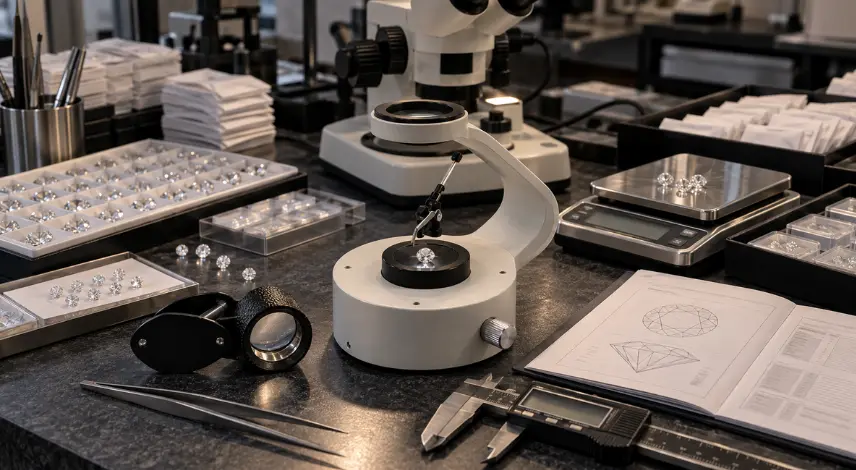
When I assess a diamond strain image, the first thing I check is whether the optical setup is clean enough to trust what I am seeing. Dust, reflections, poor focus, metal obstruction, and a bad viewing angle can distort interpretation.
- Confirm crossed-polarizer alignment. Rotate the stone rather than judging one fixed view.
- Separate strain from facet effects. Dark areas may come from extinction or geometry rather than internal stress.
- Compare pattern and growth method carefully. Typical natural, CVD, and HPHT tendencies are useful, but exceptions must remain part of the decision.
- Inspect clarity features at 10x. Feathers, fractures, crystals, flux inclusions, and other features can create localized strain or influence interpretation.
- Verify the report. For Certified Diamonds, match the physical stone with report measurements, report number, inscription where applicable, growth-method disclosure, and treatment information.
IGI continues established color and clarity scales for laboratory-grown reports, while GIA uses Premium and Standard for qualifying D-to-Z laboratory-grown stones.
Analyzing Light Return: Bowties, Windows, and Extinction
A diamond strain imaging result cannot tell you whether an oval has an unattractive bowtie or whether an emerald cut has severe windowing. These are light-performance questions linked to facet geometry, viewing environment, and cut precision.
Brilliance is white-light return. Fire is the separation of white light into spectral colors. Scintillation is the pattern of bright and dark flashes seen as the diamond, light, or viewer moves.
Pavilion depth and table percentage influence those visual effects far more directly than strain intensity.
Evaluate light return separately in neutral and diffused lighting. Strain should never distract from obvious face-up performance problems.
Assessing Diamond Reports and Grading Discrepancies
A grading report records laboratory conclusions, while a strain image is one observation from one screening method.
GIA’s 2025 change matters here. Qualifying D-to-Z laboratory-grown diamonds submitted under its current service receive Premium or Standard assessments rather than the natural-diamond color and clarity terms previously used for that category.
IGI, by contrast, reaffirmed in 2025 that it continues using the 4Cs of Diamonds for both natural and laboratory-grown diamonds.
If documentation and screening conflict, isolate the stone for verification. Do not average the two results or force an interpretation that protects a sale.
Strategic Takeaways for Buyers and Jewelers
Diamond strain imaging is most valuable when it answers a specific operational question. It can reveal internal stress architecture, support natural versus laboratory-grown screening, and flag stones that require advanced testing. It cannot replace spectroscopy, fluorescence imaging, expert microscopy, or a recognized laboratory conclusion when origin is commercially important.
For consumers, keep identification separate from beauty. Cut precision, brilliance, fire, scintillation, color, clarity, carat weight, and setting design determine what you actually experience when wearing the gemstone.
For manufacturers and retailers, build diamond strain imaging into incoming QC before mounting or parcel splitting. Lepdo Diamonds can serve B2B buyers seeking certified CVD and HPHT laboratory-grown inventory from Surat, India. For additional sourcing context, review GIA Certified Diamonds Surat and verify every stone against its report and agreed commercial specifications before final acceptance.
Frequently Asked Questions About Diamond Strain Imaging.
1. What Is Diamond Strain Imaging?
Diamond strain imaging is a non-destructive optical method that reveals lattice distortion under crossed polarizers. In diamond strain imaging, natural diamonds commonly show crosshatched or mosaic colors, CVD-grown diamonds often show banding, and most HPHT-grown diamonds show weak strain. While diamond strain imaging supports gemological identification, it does not independently prove origin.
2. Is Diamond Strain Imaging Cheaper Than DiamondView Imaging?
Basic diamond strain imaging is generally more accessible and cost-effective because a polariscope or crossed-polarizer microscope used for diamond strain imaging is far simpler than deep-ultraviolet fluorescence equipment. Conducting diamond strain imaging works well for preliminary screening, while high-value cases may justify fluorescence imaging, spectroscopy, and full laboratory testing.
3. Which Type Looks Biggest or Most Impressive on the Hand in Diamond Strain Imaging?
Results from diamond strain imaging do not determine apparent size on the finger. When evaluating diamonds examined under diamond strain imaging, face-up spread depends on carat weight, dimensions, shape, depth, length-to-width ratio, and setting. Elongated shapes provide strong finger coverage, but cut quality controls visual appeal, whereas patterns seen in diamond strain imaging remain invisible during everyday wear.
4. Does Diamond Strain Imaging Have an Official GIA Cut Grade?
No, diamond strain imaging does not receive an official GIA cut grade. Diamond strain imaging focuses strictly on internal lattice distortion, while formal cut evaluation concerns proportions, polish, symmetry, and light return. For laboratory-grown diamonds analyzed alongside diamond strain imaging, GIA provides Premium and Standard assessments, while IGI offers dedicated cut grading.
5. What Is the Biggest Quality Risk or Defect to Watch for in Diamond Strain Imaging?
The biggest risk in diamond strain imaging is analytical interpretation error. In diamond strain imaging, a typical pattern can be overread as definitive proof of origin, while strain surrounding an inclusion can be mistaken for a growth signature. When anomalous patterns appear during diamond strain imaging, gemologists rely on multi-instrument testing rather than conclusive assumptions.
6. Are Lab-Grown Diamonds Evaluated Under Diamond Strain Imaging Identical to Natural Ones?
Lab-grown diamonds tested through diamond strain imaging share the same cubic crystal structure and optical properties as natural stones. However, variations in growth history reveal distinctive markers during diamond strain imaging, allowing advanced laboratories to differentiate natural, CVD, and HPHT materials by combining diamond strain imaging with spectroscopy.
7. Does Diamond Strain Imaging Indicate Durability for an Everyday Engagement Ring?
A diamond strain imaging evaluation does not directly dictate ring durability. Long-term durability depends far more on physical cut proportions, girdle thickness, inclusion placement, and protective settings than on features noted in diamond strain imaging. Regardless of observations from diamond strain imaging, setting vulnerable points securely protects the stone for daily wear.
8. How Do I Choose a Diamond Manufacturer Skilled in Diamond Strain Imaging?
When selecting a supplier familiar with diamond strain imaging, choose a manufacturer that clearly discloses growth methods, maintains rigorous quality control, and pairs diamond strain imaging with verifiable laboratory reports. Working directly with primary producers like Lepdo Diamonds ensures transparent grading, reliable screening, and calibrated consistency across loose stones and finished jewelry.