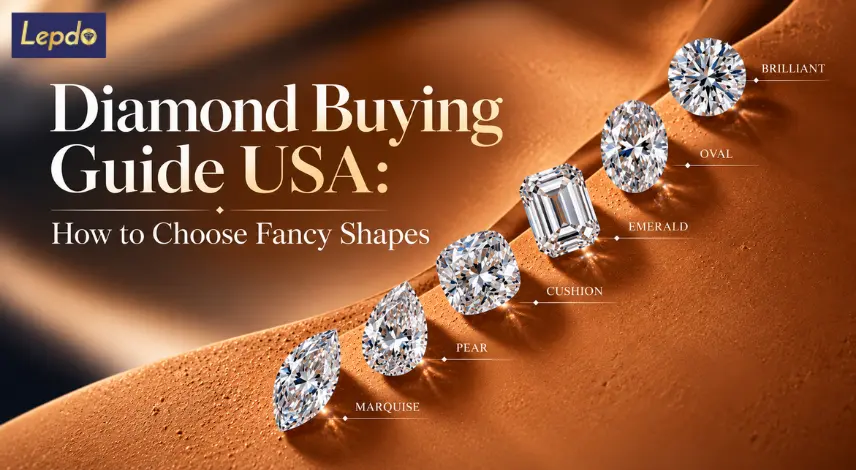

Diamond buying guide USA helps American jewelry buyers, retailers, and sourcing professionals compare fancy-shaped diamonds using the 4Cs, proportions, brilliance, grading information, setting requirements, and pricing. Oval, cushion, emerald, pear, and princess diamonds can look very different at the same carat weight, making individual stone evaluation essential before purchasing.
This diamond buying guide USA is designed for people that buy, sell, or source fancy shaped diamonds in the USA. The guide provides an organized way to review fancy shaped diamonds according to the 4Cs, measurements, proportions, grading, brilliance, settings, and prices. Comparing different diamonds at the same carat weight can be difficult, especially when selecting shaped diamonds. To make an educated purchase, it is recommended to review the individual stones prior to purchasing.
Diamond buying guide USA searches typically begin with an attractive photo, but that is not enough information for the average buyer to make a purchase. Two oval diamonds can be of the same carat weight and clarity grade and still look very different. A grading report is helpful, but that doesn’t always describe every detail that your eye can visually recognize.
The diamond buying guide USA provides fancy shaped diamond buying information and helps determine when to consider a fancy shape over a classic round brilliant. It explains diamond issues and their solutions and provides examples to assist in the communication of requests to suppliers.
What does a Diamond Buying Guide USA cover for Fancy Shapes?
A diamond buying guide USA for fancy shapes explains how to review and compare non-round diamonds. This includes but is not limited to: oval, pear, cushion, princess, radiant, emerald, marquise, Asscher, heart, and other shapes. Fancy shapes are not to be confused with fancy colored diamonds. Fancy colored describes body color that is outside of the normal colorless range.
A good diamond buying guide USA wants to begin with shape name, not end with it. To tell the difference, take a look at Diamond Shape vs Cut. While related, the two are different. Some diamond outlines are more commercial than others. For a commercial view of available outlines, take a look at Fancy Shape Diamonds and narrow down your choices.
Understanding Different Shapes of Diamonds Before Buying
| Diamond shape | Appearance and faceting | Main inspection consideration |
|---|---|---|
| Oval | Long and slim, usually brilliant | Bow-tie contrast and balanced end |
| Pear | Teardrop with point | Symmetry, tip protection and contrast |
| Elongated Cushion Cut Diamonds | Square or elongated with rounded corners | Length to width balance |
| Emerald | Rectangular with step cutting | Parallel lines, inclusions |
| Princess | Square with pointed corners | Corner protection, brightness |
| Radiant | Rectangular or square, trimmed corners | Brightness and distribution of Facets |
| Marquise | Long with pointed ends | Tip contrast and center balance |
| Asscher | Square with clipped corners and step cutting | Center and symmetry |
| Heart | Curved lobes with central cleft | Outline and symmetry |
There are a couple other diamond buying guide USA resources that focus on shapes and don’t always promise that one shape will always look bigger or larger than others. These resources, however, focus on the actual dimensions and Faceting of each shape. Compare a few shapes at a similar weight to determine true value rather than assuming outline is the biggest determining factor of worth.
Diamond Buying Guide USA and the 4Cs of Fancy Shapes
The 4Cs are carat weight, color, clarity, and cut. While these characteristics can be used to compare diamonds, their visible effects depend on the shape and arrangement of the facets. Diamond buying guides USA typically rely on a single ideal grade for each fancy shape. This guide uses many characteristics of fancy shapes, in addition to a face-up evaluation.
Carat Weight and Face-Up Dimensions

A single carat diamond can be many different shapes and sizes. Two diamonds that weigh 1.00 carat may not occupy the same surface area. Diamond buying guides USA often resort to carat weight to compare shapes, but those guides should consider face-up dimensions. Carat weight provides very limited information regarding the surface area of a diamond. Face-up dimensions, especially length, should be requested when comparing shapes.
When using a diamond buying guide USA checklist to compare fancy shapes, evaluate face-up measurements to determine if a larger carat weight indicates better value.
Color and How a Shape Presents It
Color is also evaluated independently from shape. Open step facets allow color to be visible, as in the case of emerald and Asscher cuts. Brilliant-cut diamonds, on the other hand, would be expected to show less color in the same situation. Identical color grades do not ensure equal appearance of whiteness.
This diamond buying guide USA suggests you base color choice on the visible setting and not pay for a grade that has no difference in your design. The Diamond Color terminology is helpful for interpreting laboratory reports.
Clarity and Position of Inclusions
Clarity grades do not give any indication as to the visual effect of inclusions at normal viewing distances. Features located near tips or corners can become more prominent when the diamond is cut too shallow. Ask for a closer inspection.
According to this diamond buying guide USA, a combination of diamond clarity and face-up view, along with a video or professional inspection, is the best way to assess a diamond. A higher clarity grade gives reassurance, but shouldn’t replace a visual inspection of the diamond and consideration of any structural weaknesses.
Cut, Symmetry, Polish and Light Performance
Facet relationships give the diamond its brilliance, liveliness, and vibrancy. Poor relationships create darkness and dullness.
Following this diamond buying guide USA, a diamond isn’t guaranteed the best looking diamond to you just because it has the strongest specs. Overall cut grading by the GIA is applicable only to round brilliant cuts, and to other shape cuts, additional considerations and judgement have to be made.
Diamond Buying Guide USA: 7 Steps to Assess Fancy Shapes
The easiest method in the Diamond Buying Guide USA for assessing fancy shapes is creating a consistent inspection routine. Develop a set of core questions and ask the same of each candidate, so an eye-appealing photo or single grading doesn’t influence your decision.
1. Start with the Design of the Set Jewelry
There are different ways to determine the shape of the jewel you want to set. The design of the setting can influence shape. Ovals and cushions are good to use in classic settings. Emerald and princess cuts can work well with geometric settings. A diamond buying guide USA is useful when determining shape and certain proportions to help your supplier target your requests.
2. Review the Proportions
While considering shape, compare length, width, and depth, as well as the overall contour of the stone. Look for balance; something as subtle as an off-center tip on a pear can detract from the symmetry and overall appeal of the stone. Different proportions are often a matter of preference and can vary across different settings. What works in a wide setting may not look good in a narrow setting, such as a diamond bracelet.
These are just a couple of ways to help you decipher a diamond buying guide USA to help assist your supplier in providing stones that fit your request. Diamond shapes and settings can get complex and preferences are subjective, so it can be difficult to help others interpret what they want. Using measurements, pictures, and your stated preferences, your diamond buying guide USA can help reduce the subjectivity in interpreting your requests, giving your supplier a better chance at hitting your target.
3. Observe the Diamond Under More than One Light

Diamonds can be showcased in a variety of ways using spot lights. Look for diamonds with dark bands that are not centered in the diamond or diamonds with very low brightness.
This diamond buying guide USA assessment takes movement into account. Controlled rotation of a diamond provides evidence of changing brightness and contrast. Diamonds should not be bought based on marketing pictures. Make comparisons of diamonds under the same kind of lighting.
4. Check Symmetry and Other Issues Unique to Shape
Bow-ties are a normal contrast feature in oval and pear shapes and may be disregarded. Emerald cuts should reflect order and symmetry. Hearts in hearts should be centered.
In this diamond buying guide USA checklist, issues that are unique to shape, should be treated separately from actual defects. A diamond may be out of shape preference but may still be attractive. Read Diamond Symmetry in conjunction with a face-up inspection.
5. Examine Visible Inclusions and Surrounding Supporting Structure
Pointed and sharp tips should be protected by surrounding prongs or bezels. Broad step-cut facets reveal clarity features better than a brilliant pattern. Ask for a durability assessment if an inclusion is located near an exposed tip.
Based on your diamond buying guide USA checklist, if there are issues located near an exposed tip, you should ask how it impacts durability. An attractive clarity grade does not guarantee that a diamond is structurally sound.
6. Compare Two or Three Specific Stones
Buyers should compare stones of similar weight and quality. The measurement, report, video, price and setting suitability for each candidate should be documented. For online purchase, one should check the return and inspection conditions prior to making a payment.
A diamond buying guide USA resource provides a repeatable process for assessing aesthetics, documentations, craftsmanship and price.
7. Confirm the Full U.S. Purchase Terms
Prior to making payment, the buyer should verify if the terms of the purchase include a mount, tax, shipment, inspection and return conditions. It is the buyer’s responsibility to confirm if the stone is laboratory grown. The diamond buying guide USA resource provides a repeatable process to evaluate the stone prior to mounting, along with purchase conditions and final price verification.
Common Mistakes that Lead to Disappointing Purchases
Several mistakes made during the purchase process can undermine the buyers confidence. The diamond buying guide USA resource addresses them prior to mounting or delivery.
- Buying only by carat. Weight does not equate to the face-up dimensions buyers expect.
- Assuming all cushion and ovals are the same. Faceting can vary.
- Not considering vulnerable points. A setting must be designed to accommodate the shape of a pear or marquise.
- Relying on a single picture. Lighting and magnification can conceal differences between stones.
- Choosing CL1 and not looking. Where a stone includes an inclusion, it’s often more important for the inclusion to be in a position where it will not be easily visible.
- Evaluating two quotes and assuming they are the same. There must be understanding of the origin, measurements, characteristics, report, conditions of sale and price to compare quotes.
A smart diamond buying guide USA advises slowing down at the six key decision points. It advocates against buying the highest available grade. The goal is to purchase a diamond whose visible qualities match the intended end-use.
Diamond Buying Guide USA: Pricing and Value for USA Buyers
Fancy shape prices are a function of many variables such as the cut, the use of material, demand and availability, and the individual stone. There is no set discount for fancy shapes versus rounds. Other costs such as setting and retail also affect the total price.
This diamond buying guide USA suggests to ask for quotes that include the same origin, weight and color. Look for comparable clarity and the absence of visible inclusions, as well as the same documentation. See if taxes, shipping, and/or inspection fees are included in the quoted price. Also ask if the buyer can return the stone if the specifications don’t match what was ordered.
Laboratory grown diamonds should also be identified. While natural and laboratory-grown diamonds share common physical properties, their origins and disclosure requirements are different. The same is true for their market prices. Lepdo Diamonds, based in Surat, India, is a B2B supplier of laboratory-grown loose diamonds.
Wholesale Diamonds USA: What Professional Buyers Should Verify

The term ‘Wholesale Diamonds USA’ describes various routes for supply, from buying inventory in the USA to direct buying from the USA for overseas retailers. A B2B diamond buying guide USA would need to cover numerous aspects beyond an ideal shape list, such as a parcel of stones of varying quality, consistency of batches, matching tolerances, and documentation. It should also include replacement policies. The diamond parcel buying guide addresses the related process of evaluating wholesale parcels.
Establish criteria for dimensions, ratios, grade distributions, finish, and inspection for repeat orders. Agree on allowed substitutions. For matched sets and multi-stone jewelry, consistency may be more important than the quote, especially for repeat orders.
A diamond buying guide USA sourcing checklist should ask if the supplier can ID individual stones/parcels versus their docs and explain how discrepancies are handled. The Diamond Grading Report is part of the supplier’s process for controlling the diamond(s) and should not be construed as proof of future performance.
Fancy Shapes vs Round Brilliants
It isn’t “Are fancy shapes better than rounds?” Rather “For what visual character priorities and inspection do the intended jewelry pieces call?” This diamond buying guide USA will cover the most important variations of the shapes versus rounds and will not promise a universal winner.
Buyer considerations: Round brilliant versus fancy shapes
| Buying factor | Source guidance |
|---|---|
| Shape outline | Face-up shapes may be circular, oval, square, rectangular, pointed, or OEDF. |
| Light Performance | Balanced brilliant-style light performance may produce lively reflections and broad step-cut flashes. |
| Assessment | GIA’s overall cut grade is available for a select group of round brilliant diamonds. More emphasis is placed on finish data and visual assessments for other shapes. |
| Setting | Variety of options. Some shapes require special consideration for tip protection. |
| Appearance | More compact face-up area than fancy shapes. Some outlines create apparent finger coverage. |
| Price | Often acts as a benchmark. Depending on the stone, price can be lower or higher. |
Something comparing the best shape for sparkle might prefer a well-cut round, but an attractive oval or radiant can produce lively reflections. For buyers who prefer broad flashes and sharp edges, an emerald or Asscher might be more appealing. A diamond buying guide USA should provide details for preferences beyond a best to worst list.
For another look at the purchase of non-round stones, check out Lepdo Group’s Medium post on fancy shape diamond buying, which looks at outline and buyer priorities for the US market.
Expert Selection Tips for Jewelry Brands and Retailers
Approve a reference stone and document its outline, dimensions, ratio, grade range, and other visual characteristics. Give the information to the setting team, especially prong and seat requirements. Treat the approved stone as a target, not a promise of exact copy.
During repeated orders, a diamond buying guide USA workflow should include a sample check process as well as rules for matched pairs. Also include a process for reporting stones outside tolerance. Discuss how grading reports are reconciled with physical samples. For additional purchasing checks, evaluate certified diamonds with the understanding that a report is only a part of the evaluation.
Variety in designs may be worth exploring unique cut diamonds, but unique outlines may complicate calibration and make future replacement difficult. Keep records of the original dimensions and setting details. If the collection consists of colored stones, compare fancy color diamonds and fancy shapes separately, so that the discussion of body color and outline do not get confused.
For US retailers, a diamond buying guide USA resource also covers customer education. During your diamond purchasing process, select a shape of your choice and compare it with a round stone, and speak about differences honestly. Explain the reason for the setting of your choice without giving unsubstantiated claims about future value and demand.
Frequently Asked Questions
1. What should a diamond buying guide USA explain to me before I purchase?
A diamond buying guide USA checklist should explain how to evaluate shape, cut artistry, carat weight, color, clarity, grading documentation, setting suitability, and total price. For fancy shapes, ask for millimeter dimensions and a video, and consult a report if available. Instead of claiming one grade or outlining guarantees of beauty, the most useful guidance should give you a process to consistently compare diamonds.
2. What is the best shape for an engagement ring diamond?
What constitutes the “best shape” is largely relative to preference and style. Some prefer round stones for their traditional appeal, while others favor a graceful silhouette created by an oval shape. Emerald cuts can offer broad, clean and structured reflections. Like with preferences in style, the wearer’s preference should ultimately weigh more than a particular shape trend.
3. Is choosing a diamond shape more important than its clarity grade?
They both serve differing, but equally important functions. Choosing a shape is more of a design function, while a clarity grade describes a diamond’s internal and/or external characteristics. A Visible inclusion in a diamond with a step cut might be more concerning than a diamond with a brilliant cut. Compare individual stones. The documentation should be reviewed along with the diamond to make an educated decision.
4. Can a diamond shape finder help with my purchase decision?
A diamond shape finder can help with outlining preferences and serve to narrow options. However, it cannot analyze every stone’s optical performance, inclusion placement, and construction risks. Once you have options, look at the actual dimensions and rotating videos, compare grading reports, and review the design of the setting. The former is to be used to initiate the purchase process, and not to validate the quality of diamonds.
5. Are different shapes of diamonds priced differently?
Yes. The market price of various shapes is influenced by a number of factors like availability, cutting requirements, material utilization and market conditions. Beyond that, diamond’s price is determined by many other factors like its characteristics, weight, origin, and seller terms. Many assume that a fancy shape diamond would be cheaper as compared to a round shape diamond; however, that’s not always the case. It is better to get quotes for a similar kind of jewelry and consider the full cost before making your purchase.
6. How do I evaluate an oval, pear or marquise diamond?
A balanced outline is preferable. Look for symmetrical shoulders or tips, and attractive brightness. Check the Length to Width Ratio of the stone, and make sure the bow-tie effect is not too dominating. Get a report card on the stone’s performance and movement, and make sure the points of the stone are protected by the setting. Remember, no single ratio is universally preferred.
7. Is a laboratory grading report enough to confirm fancy-shape quality?
A report typically includes information on characteristics and, based on the laboratory and service, measurements and finish. A report may not include a cut grade for a non-round shape, and, in fact, cannot assess every detail captured by the human eye. Reliable images or videos can be helpful, as can reviewing the report in person. A stone can also be inspected to assess its clarity, durability, and the presence of defects. If any concerns exist, an independent review by a professional is recommended.
8. What should US wholesale buyers ask a diamond supplier?
Buyers should ask about shape availability, measurements, grade ranges, matching tolerances, report practices, minimum order requirements, substitutions, and remedies for discrepancies. Other areas to consider are how stones are sorted and matched to a production brief, and checks made on stones prior to acceptance.
Strategic Takeaways for Buyers and Jewelers
Buyers should be able to integrate their personal preference into an industry standard for assessing diamond quality.
Retailers and manufacturers should also be able to define their target standards and tolerances, and review matched stones prior to placing an order. A diamond buying guide USA approach to fancy shapes is most useful when it leads to an informed decision about an actual stone and not just a favorite shape name.
Lepdo Diamonds takes part in B2B discussions for laboratory-grown diamonds. To start a relevant conversation, add a clear brief with your intended designs, outlines, measurements, and the qualities expected.