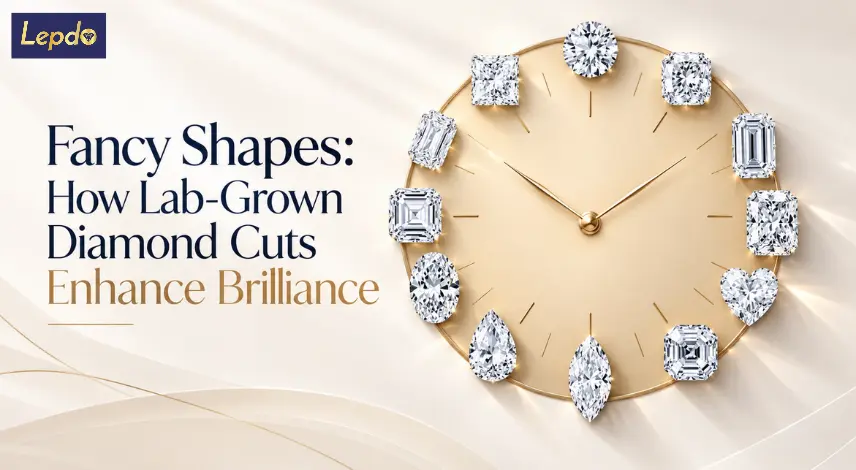

Fancy shapes give lab-grown diamonds more than just another outline. An oval might look bigger on the finger, a radiant might emit lively flashes across its surface, and an emerald cut might produce broad, orderly reflections rather than the sparkle of a round brilliant. The difference matters to U.S. jewelers and wholesale buyers for both visual and sourcing reasons.
Good cutting cannot be replaced by the right shape. If the facets reflect the light differently, two otherwise identical diamonds can appear very different. Understanding fancy shapes helps customers explain and make buying decisions.
What Are Fancy Shapes?
Fancy shapes in jewelry usually mean diamond outlines other than the standard round brilliant. Some common examples are oval, cushion, radiant, emerald, princess, pear, marquise, Asscher and heart. Some diamond fancy shapes have rounded edges, some have pointed ends or cropped corners, and each interacts with the light in a different way.
A fancy shaped diamond is not a separate material. Natural and lab-grown stones can have the same outlines. Diamond shoppers interested in fancy shape diamonds need to check the proportions and light performance of each diamond.
Diamond Shape List: What Are the Choices?
Common U.S. retail and wholesale offerings include oval, cushion, emerald, princess, pear, marquise, radiant, Asscher, heart, elongated cushion and elongated radiant. There are three cutting approaches that can be used to understand these fancy shapes:
- Brilliant or modified-brilliant styles emphasize lively reflections. There are many ovals, pears, marquises, cushions and radiants.
- Emerald and Asscher cuts, for example, are step-cut styles that use parallel rows of facets to create larger flashes and strong geometric patterns.
- Mixed and proprietary styles are a combination of different approaches to faceting. Names and appearance vary from cutter to cutter.
A fancy cut diamond shapes guide shows outlines; videos help you evaluate individual stones.
Search Language Versus Product Language
“Shape fancy,” “shapes fancy,” and “fancy diamond shape style jewelry” are not gemological grades. Instead, catalogs have to define clear outlines and cutting styles. The same distinction applies to the words fancy shape and fancy shaped.
The Influence of Fancy Shapes on Brilliance
Brilliance is white light turned back on the observer. Fire means spectral color flashes, scintillation means the bright and dark flashes that vary with the movement of the diamond, the observer, or the light. The effects are related but not the same. The cutter alters the outline, the arrangement of facets, the crown and the pavilion. Different patterns are created by fancy shapes.
Structure of Facets and Light Return
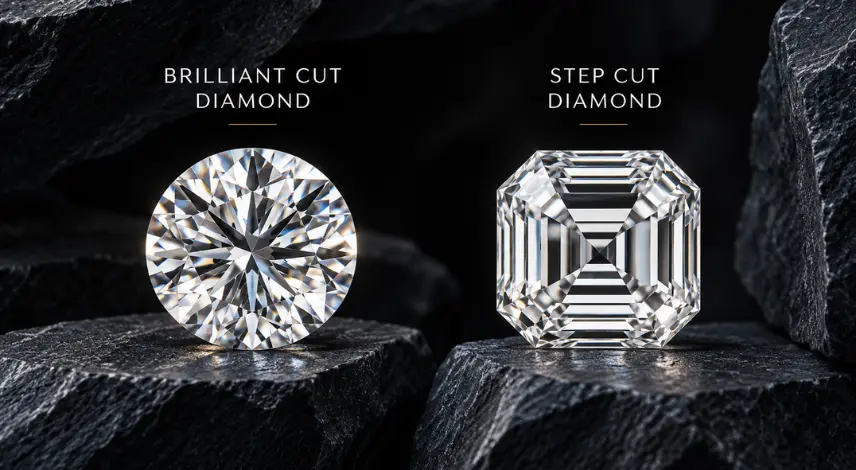
The oval shape and rounded outline, along with the modified-brilliant faceting, could give great general brilliance. A radiant tends to have smaller flashes that are busy. A cushion can be crisp or softly patterned, depending on the facet pattern. Emerald cuts replace that busy look with wider, alternating reflections. No look is better than the other; they are for different tastes.
This is why a stone may appear bright when not in motion but less lively when in motion. It is the difference between diamond brilliance vs scintillation. Judge fancy shapes under consistent lighting.
Length-to-Width Ratio and Perceived Size
The ratio of length to width is the length of a stone divided by its width. An elongated shape covers more of the finger and creates the illusion of size for the same carat weight. It doesn’t automatically return more light. It may also affect where darker regions can be seen.
| Shape | Common visual preference range | What buyers should look for |
|---|---|---|
| Oval | Approximately 1.35 to 1.50 | Shoulder balance and center bow tie |
| Cushion | Approx. 1.00 to 1.10 for square; 1.15 or higher for elongated | Corner symmetry and facet pattern |
| Emerald | 1.30 to 1.50 | Broad flashes, windowing, visibility of clarity |
| Radiant | 1.00 for square, 1.15 to 1.35 for elongated | Crushed-ice pattern, even brightness |
These are style references, not universal cut standards. One well-cut stone can perform better than another in the same numerical range. A buyer might prefer a wider oval or a longer radiant. For fancy shapes, appearance and accuracy of measurements are more important than following one ideal ratio.
Bow Ties, Windowing and Dark Areas
Some ovals, pears and marquises also have a darker pattern in the center called a bow tie. The contrast is usually moderate; wide persistent darkness can be unattractive. Windowing makes an area look transparent because light does not reflect back correctly. Rock the stone and look at both of them.
Lab-Grown Diamonds and Fancy Cuts Are a Great Match
Real diamond crystal material is produced by CVD and HPHT growth. Cutters set the orientation and polish the rough for yield and quality. Fancy shapes are alternatives to round, but no shape is guaranteed to recover better from every crystal.
Benefits for Manufacturers
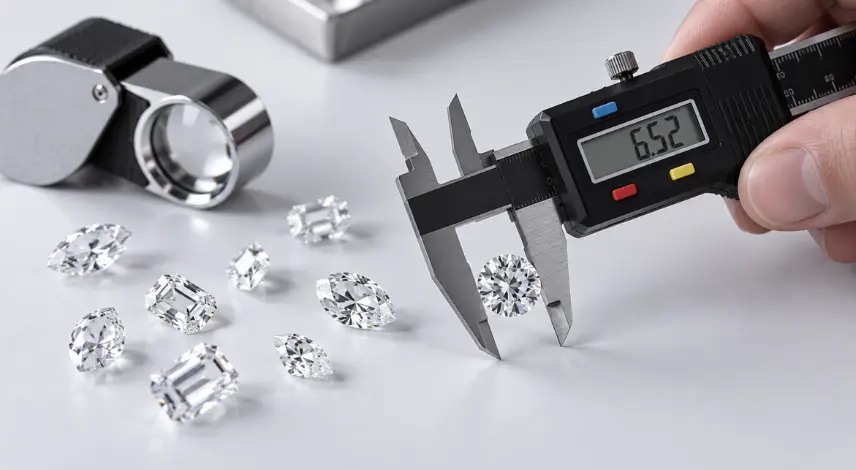
Manufacturers design to the crystal geometry, inclusions and target dimensions. Retained weight must be balanced against optical quality, especially with fancy shapes. A lot of depth can make a stone look smaller or darker.
For consistent production, defined tolerances for symmetry, table and depth measurements, girdle thickness and polishing are also required. Even lab-grown fancy shapes are not immune to poor cutting.
Implications for U.S. Wholesale Buyers
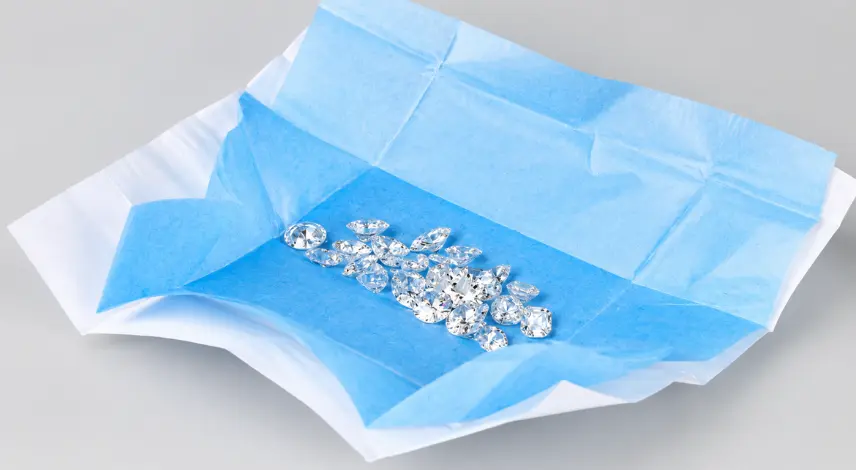
Buy fancy shapes based on the specs and not just the labels. An “elongated cushion” parcel may have different ratios or faceting. Ask for color and clarity requirements and millimeter ranges, and consistent imaging or inspection evidence.
A practical diamond parcel buying guide can help with sorting, matching and acceptance checks when many stones must look identical in a finished jewelry line.
Types of Diamond Shapes and Their Brilliance Profiles
There are many fancy shapes, and they have their own visual signatures. But the individual cut still determines appearance.
Oval Shape
Ovals have a soft outline with lively reflections, and can appear to be elongated on the finger. Look for symmetrical shoulders, central bow ties and brightness on the ends. They are suitable for buyers who want a larger-looking silhouette without increasing carat weight.
Cushion Cut
The cushions are square or rectangular and have rounded corners. Reflections come in broad flashes and fine crushed ice. Cushions among fancy shapes in vintage jewelry have a softer appearance. Specify square or elongated proportions and facet style for repeat orders.
Radiant Cut
The radiants have truncated corners and a bright faceting style. Their lively pattern can hide inclusions better than an open step cut, but dull areas can still happen. Look at the whole face, not just assuming more facets mean more sparkle.
Emerald Cut
Emerald cuts have long step facets for a hall-of-mirrors effect. Open centers can display inclusions or body color, but the clean reflections work well for minimalist designs and three-stone jewelry.
Princess, Asscher and Heart Cuts
Princess cuts are brilliant, but need to be protected at the pointy corners. Asscher cuts are square step cuts that expose inclusions. Heart cuts need well-balanced lobes and a well-defined cleft.
Pear and Marquise Cuts
Pears require a rounded end that’s balanced and a centered point; marquises require even sides and aligned tips. Both can have bow ties. Guard the points, and carefully sort pairs for matching earrings.
Price of Diamond Shapes vs. Fancy Shapes
Fixed discounts don’t accurately summarize diamond shapes by price. The price of a quote at any point in time is a function of carat weight, quality, cut execution, availability, manufacturing economics and supplier terms. In many similar listings, round stones are often more expensive, but an elongated or unusual cut that is desirable may be more expensive than a less attractive round diamond.
| Purchasing factor | Round brilliant-cut diamond | Fancy-shaped alternatives |
|---|---|---|
| Optical pattern | Well-known, highly standardized sparkle | Shape-specific contrast, flashes and patterns |
| Silhouette face up | Circular outline, symmetrical | Elongated, square, rectangular or pointed options |
| Production economics | Various yield and cutting considerations | Range widely by rough and selected outline |
| Price comparison | A useful reference, not a fixed ceiling | Must be quoted stone by stone |
| Inventory planning | Broad classic demand | Permits differentiation but needs finer segmentation |
Check matched weight, quality, reports and appearance. Knowing the current lab diamond wholesale price is more useful than knowing permanent percentage discounts. Fancy shapes mean more choice, not guaranteed margins.
What Buyers Need to Know About the Cheapest Shape of Diamond
There’s no permanently cheapest lab-grown outline. Emerald, cushion or Asscher stones can be reasonably priced but supply, quality and proportions vary the comparison. Cheap is never a bargain when the finishing is poor.
Compare quotes and videos for entry-level fancy shapes. Check for order minimums, substitutions, return policies and real face-up dimensions. It’s better to go for good looks than the cheapest price per carat.
Diamond Cut vs. Diamond Shape
For fancy shapes, shape means the outline as viewed from above: oval, heart, pear, or some other profile. Cut style is the arrangement of facets and the fashioning of the rough. Cut quality is how well those choices achieve desired light performance and visual balance. These differences are especially critical for fancy shapes, because two stones can have the same outline but are faceted differently.
For example, a long cushion with broad distinct reflections is not visually the same as a cushion with fine crushed ice. The distinction between shape and cut helps buyers understand the craftsmanship that makes it look how it does. So the term diamond fancy cut is not as useful as a complete product specification as is an actual shape, facet style and dimensions.
Diamond Fancy Color Chart and Fancy Cuts
A fancy color diamond chart is about intensity and hue, not outline. Yellow, pink and blue lab-created diamonds are examples of colored diamonds that can be created and analyzed. Colorless and near-colorless diamonds are described with different descriptors. Here we have two different meanings for the word “fancy”. Being precise with these avoids confusion on supplier quotations.
Some fancy shapes can make color seem more concentrated by changing the way light travels through the stone. Yellow color may be enhanced by a radiant or other modified cut, or uneven color may result from a shallow or poorly proportioned cut. Shape choice should be considered together with hue, tone, saturation and any disclosed treatment.
Color and shape specifications can be collected separately, allowing brands to compare fancy color diamonds.
Commercial Advantages for U.S. Companies
Fancy shapes mean collections can compete on appearance but stocking should follow the actual demand of customers rather than promises of fast turnover.
For Producers
Different outlines can support different design requirements and rough planning options. For production contracts, specify allowable dimensions and shape tolerances, edge protection requirements, and acceptable face appearance. These details make reorders more predictable and reduce bench adjustments.
For Wholesalers
Rather than combining different stones into one large SKU, group fancy shapes by outline, ratio, grading details and appearance. A consistent parcel inspection process helps buyers to identify stones that do not conform to the agreed visual standard before onward sale when mixed lots are supplied by suppliers.
For Jewelry Brands
Elongated, geometric, or vintage styles are complemented by fancy-shaped engagement rings. Show stones on hand, and check availability of matching side stones before custom production.
For Retailers
Loose diamonds displayed together allow you to compare broad flashes to finer sparkle. The customer’s preference is the guide; a larger stone does not always mean a better cut.
Unique Cuts and Market Segmentation
The standard oval, radiant, cushion and emerald designs do not cover all the preferences of all customers. Extended cushions, altered radiants and more uncommon geometric outlines can underpin a recognizable jewelry collection. However, special shapes may have longer sourcing cycles, more complicated replacement matching or additional setting design work.
Availability is just as important as novelty when sourcing unusual diamond shapes in bulk. Limited collections can use unique cut diamonds, but repeatable specs are essential for long-term lines. Pick out elaborate fancy shapes that suppliers can describe and substitute in a consistent way.
Technical Aspects of Brilliance Optimization
For the technical evaluation, consider table percentage, total depth percentage, crown and pavilion geometry, girdle thickness, facet alignment, polish and symmetry as a whole. But none of these measurements alone passes a verdict. Two stones with the same percentages can have a different distribution of brightness and contrast because they do not have the same arrangement of facets.
Grading reports must be read with caution too. Most fancy-shaped diamonds also do not receive GIA’s traditional overall cut grade. The current lab-grown quality assessment utilizes overall Premium or Standard descriptions for eligible colorless to near-colorless stones. IGI publishes a fancy-shape cut-grading methodology that includes polish, symmetry, proportions, craftsmanship and light performance. Not all labs use the same criteria, so always check what each individual report is really testing.
Please request the report for verification, measurement consistency, face-up video and controlled lighting comparisons. Checking certified diamonds can help, but a report is no replacement for looking at the stone yourself.
Quality Control Checks for Reorders
When ordering fancy shapes in bulk, confirm the allowable range of length-to-width ratios in millimeters, allowable bow tie, color distribution, clarity range, polish and symmetry. See if the supplier’s images are of representative stones or just selected examples. Establish a process to accept, reject or replace outliers prior to production approval.
U.S. Market Trends in the Real World
Current U.S. engagement ring research supports demand for non-round silhouettes, without saying round has disappeared. According to The Knot’s 2026 Real Weddings Study, which surveyed couples married in 2025, round was the most popular shape, with 26% of couples choosing it, and oval was almost as popular, with 25% of couples opting for it. In the same survey, couples surveyed bought lab-grown center stones 61 percent of the time for their engagement rings.
These findings support stocking fancy shapes, especially ovals, but are not a wholesale forecast. Bridal rings could differ in demand from earrings and fashion jewelry.
Purchase Strategy: B2B and B2C Perspectives
For Buyers (B2B)
Begin with the customer’s order history and create a manageable assortment based on shape, dimensions and visual style. Ask for comparable quotations, verified grading information and actual videos for representative goods. Set sample approval and replacement terms before placing a large order. For procurement teams in the lab grown diamond wholesale usa segment, it is important to consider the replenishment rate of consistent shapes and not only the price.
For fancy shapes, keep optional design choices separate from variation within a matched line. For repeat orders, record reference stones, tolerances and parcel IDs.
For B2C Shoppers
Start with the look you really like. Compare an oval, radiant, cushion and emerald cut in directional and diffuse light. Check the stone face-up, at a slight angle, in a setting similar to the one you will wear. For longer designs, check the overall shape and comfort of the fit with your chosen ring proportions.
Decide on your budget first before you conclude that a certain shape is more value for money. Ask for exact dimensions, grading report available, close-up media, clear return terms. A good choice of a stone is one that you like the sparkle, proportions and setting of, under normal conditions, not just under showroom spotlights.
The Bottom Line
Fancy shapes allow for more design possibilities in lab-grown diamonds, as each silhouette interacts with light, size and contrast in its own unique way. Oval and radiant cuts are popular with buyers who like a lot of sparkle; emerald and Asscher cuts are popular with buyers who prefer architectural flashes; cushions and other modified cuts are in between. Good cutting is still important in all categories.
For U.S. diamond businesses, the opportunity is to combine good inventory decisions with clear product education. Lepdo Diamonds, a lab-grown diamond manufacturer from Surat, can be judged like any other B2B supplier by the stone specifications, sample quality, documentation and consistency, not by promotional promises. Another perspective is Medium’s overview of diamond fancy shapes.
FAQs
1. Do Fancy Shapes Sparkle Like Round Diamonds?
Some oval, radiant, pear and cushion cuts can have a strong white light return and lively sparkle. Round brilliants have a more uniform performance profile, but appearance depends on individual cut. Compare the stones in the same light and look for dark zones or windowing. But the outline does not tell us if a diamond will sparkle in a ring.
2. What Is the Least Expensive Lab-Grown Diamond Shape?
No single outline will always be the cheapest. A quote is based upon supplier inventory, finished quality, weight, market demand and cut complexity. For emerald, Asscher and cushion cuts, some options may have competitive pricing. Buyers should compare stones of similar quality and look at face-up appearance rather than a permanent shape ranking.
3. Are Fancy-Shaped Lab-Grown Diamonds Good for Resale Value?
The actual resale value is determined by the secondary market, demand by buyers, condition, documentation and prevailing wholesale prices. A trendy shape does not guarantee strong resale value, and you may receive substantially less than what you paid for a lab-grown diamond on the resale market. Pick primarily for beauty and intended use.
4. How Do I Decide Between Different Diamond Shapes?
Choose your desired sparkle type and then consider face-up size, length-to-width ratio, setting design, comfort and budget. Look at moving stones. Read their reports. Elongated ovals and marquises create a different visual impression than square cushions or step-cut emeralds, even if the carat weights are the same.
5. Are Lab-Grown Fancy Shapes Not as Good Quality as Natural Diamonds?
No. Lab-grown diamonds are essentially the same as natural diamonds in terms of crystal structure and optical properties. Their look depends on the quality of the individual material and cutting. A lab-grown stone can appear dull if it is poorly proportioned, just as a natural stone can be if it is poorly proportioned. Brilliance or craftsmanship isn’t just about where something comes from.
6. Does Diamond Shape Affect Grading?
Yes, the shape does influence how cut performance is judged, and grading procedures are not consistent from one lab to the next. GIA’s traditional overall cut grade is for standard round brilliants, but IGI has a methodology to grade fancy-shape cutting. Don’t assume that one grade means the same thing for all stones; check the current report format and the specific characteristics that are being graded.
7. What Are the Most Beautiful Fancy Shapes?
Pear, oval and marquise diamonds can provide a lot of finger coverage for their carat weight, whereas radiant and cushion cuts can create unique patterns of sparkle. Buyers who want clean lines like emerald cuts. The visual value is in an attractive individual diamond at a sensible price, not one outline being the universal winner.
8. Can Fancy Shapes Add to Fancy-Colored Lab-Grown Diamonds?
Yes. The shape and depth of the facets can affect how concentrated or even a diamond’s color looks face-up. Some yellow hues can be improved with radiant and other modified brilliant cuts but results are stone specific. Buyers should view color under consistent lighting and look for any disclosures on treatments. Fancy color grading is about hue and intensity, not about the diamond’s shape.
Strategic Lessons for U.S. Diamond Buyers
First choose the reflection pattern and silhouette. Then check proportions, durability, light performance and reports. Finally, prepare repeatable specifications and compare actual quotations.
Fancy shapes are most valuable when the appearance sold to a customer can be delivered again. That’s the standard for stocking, custom jewelry development and wholesale relationships.
For in-depth market reports, trade sourcing guides, interactive Q&As, and expert gemological perspectives, join the discussion on Lepdo Diamonds on Quora.