
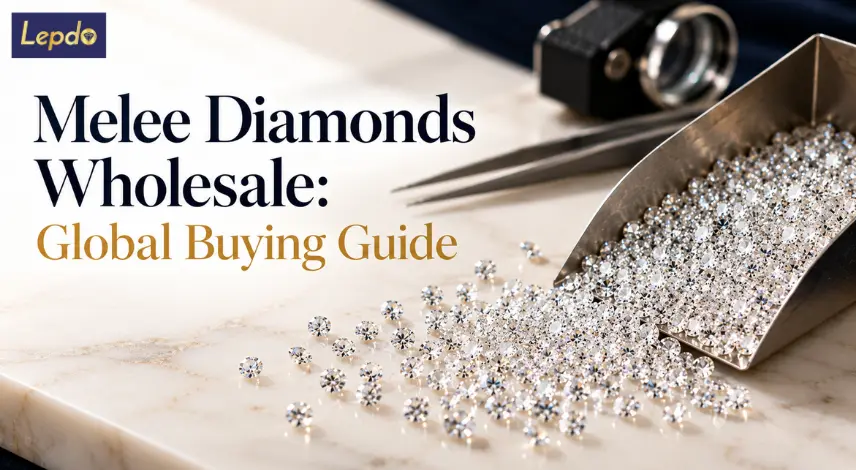

Melee diamonds wholesale involves sourcing small natural and lab-grown diamonds in bulk for pavé settings, halo rings, eternity bands, and fine jewelry manufacturing. Global buyers compare melee diamond prices per carat based on cut, color, clarity, size, and parcel consistency. India, particularly Surat, is a major sourcing hub, supplying calibrated diamonds to jewelry manufacturers, retailers, and wholesalers worldwide.
Melee diamonds wholesale is the global market for small diamonds (generally 0.008 to 0.03 carats) that are mostly used as accent stones and sold in sorted lots. India, especially Surat, is the main cutting and sorting center for this market. The challenge for gem buyers in the USA, Europe, Middle East, and Asia is the same: how to find consistent stones at reasonable prices. To source reliable melee diamonds, one has to look at a number of factors, including the diamond cuts, calibration and verification of origin, and the reliability of supply.
An eternity band, for example, may require in excess of thirty individual stones, and if just three of them are off in terms of color or cut, the rest of the stones appear uneven to the eye in the store lighting. It is a dilemma that jewelry manufacturers face every day, and this is the reason that selecting the right melee diamonds wholesale supplier is important to jewelry brands worldwide. For international buyers looking at India, the declared price may look attractive, but so may the price look attractive in other jurisdictions, where the parcel may actually be more consistent.
Surat polishes a major part of the world’s small diamonds for the melee diamonds wholesale trade, and various factories there sort and calibrate stones to various manufacturing needs. Previously, diamond trade in this region was unorganized. Now, this part of the trade has specialized parcel sorting and supply ready for export. But, buyers in the melee diamonds market should look into the specifics of each lot and not make assumptions based on where the parcel is from.
For manufacturers using melee diamonds wholesale supply chains and selling to different countries, specialized sorting provides more options when setting sizes and grading ranges for orders. Economies of scale can be realized for melee diamond planning; however, any savings would depend on the supplier maintaining the agreed upon quality and a full evaluation of the total cost of delivery.
This melee diamonds wholesale guide will cover what melee diamonds are, how Indian and international suppliers categorize them, how natural melee compares to lab-grown, as well as what B2B buyers should look into before making a bulk purchase. If you design or manufacture jewelry in the USA, EU or source retail inventory in the Middle East, the aim is always consistent quality at a price protecting your margins.
What Are Melee Diamonds?
Melee diamonds are small diamonds, usually below 0.18 carats, used as accent stones in pavé settings, among other things. While the strict definition for melee is less than 0.20 carats, the broader definition is less than 0.18 carats. As the name melee implies, they are sold in bulk lots. When considering what melee diamonds are, buyers should know they are repeatable, reliable sources of stone supply for intricate multi-stone jewelry designs.
Unlike center stones, melee diamonds wholesale parcels aren’t typically graded one stone at a time. In a parcel, the cut of the stones needs to be consistent and uniform. The color of the stones should also be tightly held by the range promised. The same holds true for the clarity of the stones.
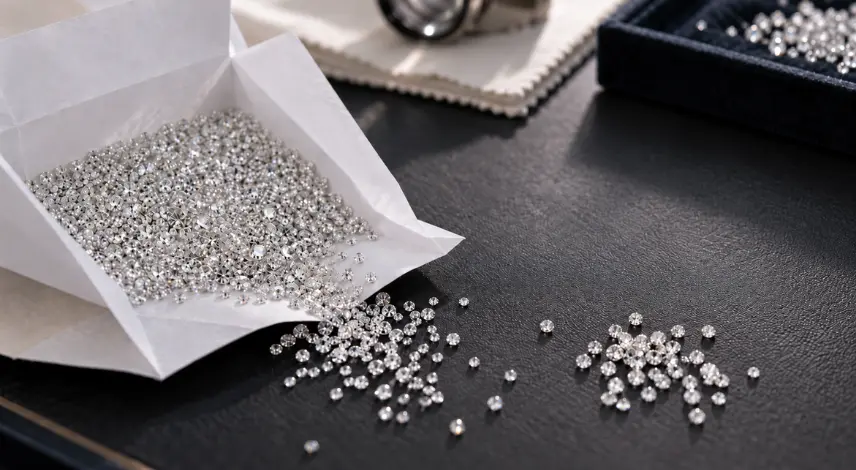
Melee diamonds are small round, fancy-shaped diamonds, often purchased in parcels to be used in accents and other pieces of jewelry.
Types and Varieties: Natural melee, lab-grown melee, single-cut melee, full-cut melee, and fancy-shape melee.
Best Used For: Eternity bands, halo settings, pave, side stones and other accent work.
In melee diamonds wholesale, stones are typically sold by parcel weight. Due to this, they can be purchased in large quantities for production.
A more in-depth look into the grading and definitions associated with melee diamonds can be found on Lepdo’s Melee Diamonds.
Melee Diamonds Wholesale Prices: Global Buying Guide and LEPDO Reference Ranges
Other factors that affect melee diamonds wholesale prices aside from weight, are color, clarity, individual stone size, order quantity, cut, and stone origin. In melee diamonds wholesale, finely matched round stones cannot be quoted the same as a commercial, mixed size parcel, even if they both weigh 10 carats.
Melee Diamonds Price Per Carat: Published USA Market Reference
“Level” quality ranges given in Lepdo Diamonds’ published melee diamonds glossary are reference figures to discuss melee diamonds prices, and are not confirmed Lepdo selling prices, or guaranteed global wholesale quotations.
| Quality level in LEPDO’s published guide | Indicative price per carat (USD) | What buyers should verify |
|---|---|---|
| Low | $300–$800/ct | Actual color and clarity, usable yield and origin |
| Mid | $800–$1,500/ct | Whether stones are calibrated and consistently sorted |
| High | $1,500–$3,000+/ct | Consistency of cut, grading range and supporting documentation |
This is more of a general overview based on an educational guide, not an exact trade definition for melee diamonds wholesale purchasing. The source does not specify which, if any, of these ranges, are assigned to a natural or lab-grown parcel. Actual prices may fall outside the ranges discussed, and may vary based on the market, exchange rates, supply and conditions of the purchase.
Comparison of Wholesale Quotes by Diamond Type
| Diamond category | Specification required for a reliable quote | Price status |
|---|---|---|
| Natural full-cut round melee | Size (in points), color, clarity, cut, total carats | $370 to $900+ USD per carat |
| Lab-grown full-cut round melee | Size (in points), color, clarity, origin, total carats | $100 to $220 USD per carat |
| Single-cut melee | Diameter, facet style, range (in points) | $60 to $200 USD per carat |
| Princess, baguette, marquise melee | Shape, dimensions, ratios, tolerance (in points) | $9.45 to $12.60 USD per stone |
| Calibrated or mixed-size parcels | Distribution of sizes, tolerance (in points), grading mix | $300 to $500 USD per carat |
Buyers calculating melee diamond price per carat for melee diamonds wholesale should be clear about the currency, whether USD/ct or total parcel, and if freight, insurance, duties and screening are included. This is important for both international and domestic sourcing. Low listed rates do not necessarily mean better prices, if stones require re-sorting or replacement during production.
Pricing Tip for International Buyers: Compare equivalent specs, determine landed cost per usable stone and see if parcel size affects quoted price for larger orders. Ask for a sample to be retained for future orders. A melee diamonds wholesale price quote should be as transparent as possible for repeat business.
Popular Types of Melee Diamonds for Global Manufacturers
Not every parcel in melee diamonds wholesale is produced the same way, and distinctions are relevant when filling production orders. Like for like product categories in Indian manufacturing have also evolved, and the same buying distinctions are true when reviewing melee diamonds wholesale parcels traded through other international centers. A melee diamonds wholesale order should always begin with the desired finished product and the tolerances, and not with price.
1. Full-Cut Round Melee (D to J, VS to SI)
The major player of the industry. Full-cut rounds of melee diamonds have between 57-58 facets like larger round brilliants, and deliver sparkle in pavé bands and halos. For retailers focused on bridal, this category is very important. When evaluating melee diamonds wholesale parcels, it is very important to ensure that the stones are being produced as agreed, and not to simply review the first few stones in a parcel.
2. Single-Cut Melee
Single-cuts have between 17-18 facets, and are typically cut to smaller sizes than 0.01ct. For manufacturing of antique or vintage styled jewelry, single cuts are used since they are in line with the older cutting traditions. When sourcing through melee diamonds wholesale suppliers for a given design, it is important to compare single cuts against full cuts, and not simply presume that full cuts are superior.
3. Lab-Grown Melee Diamonds
Reports show that both CVD and HPHT methods are being used to produce larger quantities of lab-grown melee diamonds. Commercial jewelry lines are using them and they can be purchased at a lower cost than natural melee. However, the costs are quote based and depend on many factors. When natural and lab-grown melee diamonds are compared by manufacturers, the important checks remain cut, visible matching, disclosure of origin, and consistency from one order to the next.
Comparable designs using natural or lab-grown diamonds are offered at different price points by many manufacturers. Lepdo’s comparison of Lab Diamond vs Natural Diamond discusses the material and origin. For melee diamonds wholesale orders, make sure the supplier specifically identifies the origin and explains how mixing is prevented.
4. Fancy Shape Melee
While channel-set bands can use round melee, baguette or marquise melee shapes can also be used for channels in Art Deco designs that employ geometric lines. Round shapes can also be used for channel-set designs; however, with other melee shapes, size and dimension variations can impact the design. In melee diamonds wholesale, fancy-shape stones should be ordered specifying size tolerances.
5. Calibrated Parcels
Manufacturers using melee diamonds wholesale parcels in repeatable, automated setting processes use calibrated stones. The tolerances can vary depending on the manufacturer; however, tight tolerances can impact the finish of the design. When tolerances are given for a sample, the sample may not represent the entire parcel.
6. Trade Tiers for Melee
In Surat and other diamond trading centers, melee is classified into trade tiers such as commercial grade, fine white, and top white. Commercial grade melee may be set in fashion jewelry, while fine white melee may be used in bridal jewelry. Melee diamonds wholesale comparisons may be based on tier names, but these tier names do not reflect any uniform standard. Therefore, buyers should request the actual color and clarity range agreed upon before comparing melee diamonds wholesale quotes.
7. Mixed Carat Run Parcels
In melee diamonds wholesale, parcels that encompass a wide range of sizes, from as little as 0.005 to 0.18 carats, may enable manufacturers to produce a variety of jewelry designs without having to place several orders. This, however, may require additional internal sorting. A jewelry manufacturer with predictable setting sizes may benefit from a tightly calibrated parcel as opposed to a mixed run parcel, especially if the mixed run parcel provides better production efficiency.
Global Melee Diamonds Wholesale Sourcing Considerations
For melee diamonds wholesale buyers, key differences between suppliers are more commercial than technical. These include the range of assortments, currencies quoted, minimum orders, import procedures and shipping, and return terms. Buyers in the USA, Europe, Middle East, and Asia should request similar essential sample specifications and then compare suppliers.
In melee diamonds wholesale, a supplier in another country isn’t automatically more expensive or more reliable. When importing, check the current applicable requirements and total landed cost in the country of destination. For the context of the Diamond Export, see Lepdo. It is usually easy to tell the origin of a parcel, especially if it is mined or cut, but disclosing origin and country of shipment should be kept separate, as a parcel shipped from one trading center may have been grown, mined or cut elsewhere.
Melee Diamonds vs. Larger Center Stones: The Real Difference
Most buyers comparing melee diamonds wholesale and center stones think the rules for center stones are similar. Treating the two similarly is one of the most common mistakes novice manufacturers make.
| Factor | Melee diamonds | Larger center stones |
|---|---|---|
| Selling unit | Parcels sold by weight, usually in carats, for multiple stones | Stones sold individually |
| Documentation | Parcel descriptions and origin screening used; individual grading reports are rare | Reports for individual stones are common for high-value stones |
| Grading | Consistency within a parcel and verified origin | Cut, clarity and color for individual stones |
| Price comparison | Parcel size, origin, grade range, and usable yield | Stone characteristics and individual reports |
| Sourcing volume | Bulk purchases for production | Stones selected for specific pieces in a jewelry design |
The major takeaway point is that melee diamonds wholesale sourcing is more about consistency than it is about evaluating stones individually. A manufacturer who approaches a melee parcel the same way they would approach a single diamond purchase is the one who is going to have surprises. The real risk in melee purchasing is variation among stones in the same parcel. Suppliers in Surat who sort by size and color in a melee parcel reduce that variation, and in many cases that is the only thing that sets a supplier apart and keeps them from getting dropped.
Center stone sourcing requires more individual evaluation, but melee mistakes do compound. For parcel procurement, a buyer should consider usable matching yield rather than just total carat weight.
How to Choose the Right Melee Diamonds for Your Production Line
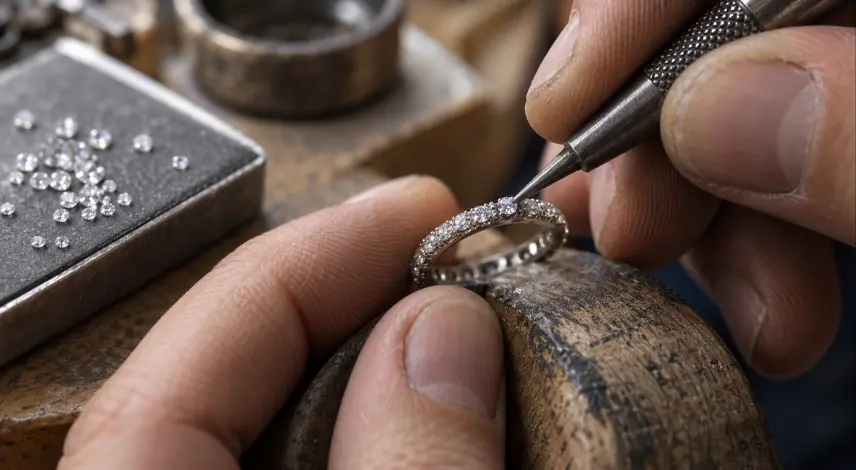
An analysis of your desired shapes: In melee diamonds wholesale, each design has a unique shape signature. Decide which shapes you need (rounds, baguettes, etc.) and procure parcels matched to that signature.
Proportions and tolerances: In melee diamonds wholesale, the tolerances required for various melee shapes and settings differs. A design may require a specific proportion for a baguette to be set in a channel.
Color consideration: Invisible settings don’t require color matching, but a halo surrounding a center stone does. Have a supplier sort parcels by color for you. The color of the metal also comes into play.
Distance and relatedness: Nail down the optimum thickness of your design and the tolerances for melee for that design and your supplier will help you find the best melee diamonds for your production.
Budget Advantage: Melee diamonds wholesale pricing from India can be competitive for high volume orders, but buyers need to compare like for like qualities and full landed costs to determine if importing them is actually saving them money.
Occasion and Product Line: Diamond matching in bridal jewelry generally requires a tighter match than fashion jewelry, and a higher specification for initial melee diamonds wholesale orders is justifiable for signature lines.
Lab-Grown vs Natural Melee: The different demands and needs of the marketplace allows a jewelry manufacturer to offer the same design using either natural or lab-grown melee in two price points. This should also be consistent with what the customer is looking for.
In melee diamonds wholesale, it is best practice to check samples in person prior to approving a production order. This is especially useful if you need to define a specification for melee. Photos will often obscure inconsistencies. A lab sample will not mislead you about the qualities of the diamonds. If you find yourself purchasing melee regularly, have an approved sample for future reference.
What B2B Buyers and Diamond Manufacturers Should Know
For melee diamonds wholesale sourcing, the main concern is consistency. If a sample contains a consistent grade, it’s often acceptable to purchase the entire parcel. Consistency is much more important than the top layers appearing attractive. This is often where a sampling of the lower layers of a parcel comes into play. If it is consistent for the most part, purchasing the entire parcel is often justifiable.
Cut consistency is critical in melee diamonds wholesale, especially when the melee is set in a visible way. The GIA Melee Analysis Service sorts qualifying diamonds by origin. This is different from a full individual cut, color, and clarity report. Price lists for natural diamonds can inform market comparisons, and melee parcel quotes reflect cutting, sorting, origin screening, size calibration, and order requirements. Transparent melee diamond suppliers should be able to explain price changes for different size and quality tiers. In melee diamond wholesale buying, the lowest quote is not necessarily the best value, and a number of factors should be taken into account, including rework and replacement costs.
To evaluate potential melee diamonds wholesale suppliers, read Lepdo’s explanation of diamond wholesale and his guide to minimum order quantities. Some design choices can also impact costs. The Medium guide on engagement ring settings explains the setting should be considered with the finished ring in mind.
A consistent reorder is critical for suppliers in the melee diamonds wholesale business. A recurring issue in this industry is inconsistent orders. If a supplier is unable to produce consistent orders, the differences will be seen in the final product (i.e. jewelry) by the retailer. For us, the main factors that define an acceptance level for color, clarity, cut, measurements, and replacement terms before next production run are the foundation of a strong partnership.
Melee Diamond Jewelry Applications Across Global Markets (2026–2027)
Eternity bands and stackable rings will continue to be the main applications for melee diamonds and small matching sets. Designs that incorporate melee, like the ‘halo effect,’ where melee is set around the center stone, require a carefully balanced order. For manufacturers that supply different markets, it is best to account for the actual orders placed by customers rather than relying on what’s in vogue for each region. Sustaining consistent sizes is more valuable than trying to follow every single regional trend.
Two-tone designs of melee set in either yellow gold or white metal pairings require attention for matching as do designs that incorporate melee set in yellow gold.
Tennis bracelets, huggies, and accent designs offer plenty of opportunities for manufacturers to add small diamonds to their pieces. Geometric and minimalist designs can include baguette and trapezoid accents. The opportunity in melee diamonds wholesale is the ability to source similar stones to replenish inventory without having to redesign the settings.
How to Evaluate Quality in Melee Diamonds
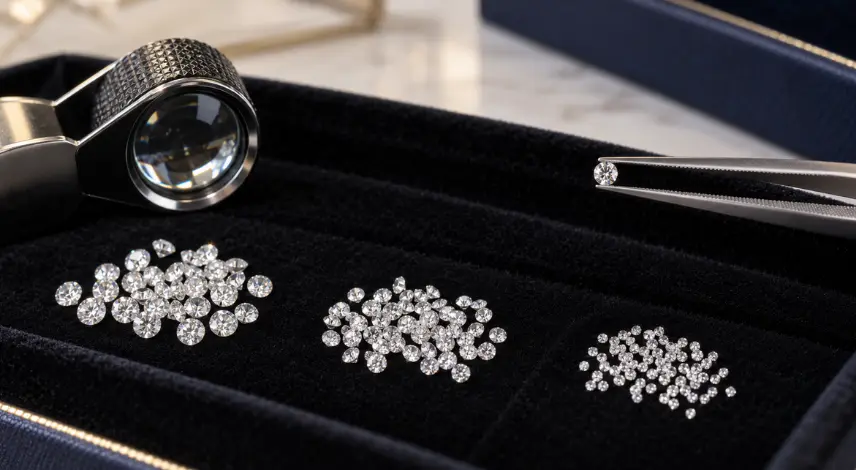
When analyzing a parcel for melee diamonds wholesale, the first thing that is evaluated is not whether one stone is exceptional. The first thing evaluated is whether the parcel is a consistent group and holds together under magnification and in a controlled lighting environment.
Cut quality and light return: Even small stones can reflect light and be brilliant and display “fire” and “scintillation.” Poorly proportioned melee diamonds can look “dull” compared to a well-proportioned center stone.
Color consistency across the parcel: Pull stones from different areas of the lot and compare them to each other. A parcel described as G-H should be compared to make sure there are not stones that are visibly outside the range described.
Clarity grade: Representative samples should be pulled to confirm they are within the range described and do not have inclusions that create an unintended variation in the finished product.
Calibration: For fancy shapes such as baguettes, the length to width ratio is important. For pavé and channel settings, precise millimeter sizing is important.
Origin Screening: There are different screening process that separates natural, laboratory grown, treated, and imitation stones. Verify the laboratory documents through the issuing laboratory. Lepdo’s Diamond Certification Check explains how to evaluate the documents.
Inspecting melee diamonds requires evaluating a parcel under various types of lighting. Some color differences become evident with one type of lighting but not with others. A parcel that looks nice under cool lighting may look different under warm lighting. This depends on the design of the setting and how the jewelry is displayed.
For repeat melee diamonds wholesale purchases, create a quality control checklist. Effective quality control of melee diamonds requires a retained sample, accepted measurement range, and minimum requirements for color and clarity. Other components include the use of an origin-screening method, sample inspection, and a rejection policy. Effective quality control provides buyers and sellers a shared standard.
Conclusion
There are three primary concepts for understanding melee diamonds wholesale sourcing. First, consistency across a parcel is the greatest concern for quality control, and this alters how a buyer evaluates a parcel relative to center stone purchases. Second, cost advantages in alternative markets hold up only if parcels are properly graded, calibrated, and described. Finally, repeatability is a main concern in sourcing. This offers manufacturers the opportunity to stabilize their production schedules and ensure finished jewelry meets quality standards.
For melee diamonds wholesale buyers and retailers, start with a specification and verify your Lepdo quote before considering alternative, lower, quoted prices. Consider Loose Diamonds Wholesale sourcing from Surat and compare shipping, screening, and import terms for your market.
Purchasing a large center stone attracts a lot of attention. Clients and retailers ask for things like clarity, color, and shape. But purchasing smaller stones, or melee, takes more focus and attention. When purchasing thousands of tiny melee stones, it is unlikely that clients and retailers will notice a few poor quality stones among the bunch. It is easier to manufacture melee stones at scale, so long as the sorting is consistent and inspected thoroughly. In melee diamonds wholesale, clients care about the details like the precise weight of each parcel, specifications, and the terms of the trade. All of those factors help predictable procurement as a product line grows.
Frequently Asked Questions About Melee Diamonds Wholesale
1. What is melee diamonds wholesale India?
Melee diamonds wholesale India refers to small diamonds, typically less than 0.18 carats, in bulk, that are sourced in India and sold to manufacturers in the US and other countries for pavé, halo and eternity band jewelry. These diamonds are weighed and sold in commercial lots, and price is determined by factors such as size, color, clarity, cut, calibration, and quantity ordered.
2. Is melee diamonds wholesale in India cheaper than sourcing in the US?
It could be, depending on how close the comparison is to the manufacturing and sorting operations. But melee diamonds wholesale price comparisons should be made on a like-for-like basis. Total landed cost depends on many factors including shipping and insurance, duties, minimum order quantity, and stones that are rejected by the buyer. It is possible a quote for a lower price per carat actually results in a higher total cost for useable stones.
3. Which melee diamond type looks the biggest or most impressive?
Full-cut round melee can be attractive when well-proportioned, and larger stones can be noticeable in a piece. However, several other factors can effect a stone’s visual impact, including the cut quality and setting, how the accents are arranged, lighting, and how well the accents compliment the center stone. More of that is up to chance.
4. Do melee diamonds in wholesale parcels come with a GIA cut grade?
Melee parcels are not individually assessed by the GIA like eligible larger round brilliant diamonds. GIA does provide a melee analysis service where eligible parcels can be assessed, sorted, and/or screened by origin with some color sorting. When considering a wholesale melee order, buyers should aware of the differences between an origin-screening documentation and a full per-stone evaluation.
5. What is the biggest quality risk with melee diamonds in wholesale?
The biggest risk in a wholesale parcel is internal inconsistency where stones vary from the other stones in the parcel beyond the tolerance agreed upon. Another risk is lack of clear disclosure of origin. Request representative samples and appropriate screening before committing to a large wholesale order of melee diamonds.
6. Are natural melee diamonds better than lab-grown?
Naturally and lab-grown diamonds have the same essential optical properties. Well or poorly cut stones can be found with either. In the case of melee diamonds, don’t assume one origin means the melee will be of a better quality. Check for yourself.
7. Which melee diamond type is best for an engagement ring?
A full-cut round melee diamond will usually provide the most sparkle. Baguettes and trapezoids are best used for accents and in more geometric designs. The choice ultimately depends on the design of the setting, the dimensions required, and the level of visual matching.
8. How do I find a good melee diamond wholesale supplier?
Look for a supplier who clearly outlines their parcel specifications, discloses their origin, has consistent reorders, allows you to inspect their diamonds, has documented their tolerance ranges, and explains their pricing. Ask about their policy for screening and replacement before increasing your orders. A good supplier will be able to provide all of this information, and explain what will be provided, not just give you a price.
For in-depth market reports, trade sourcing guides, interactive Q&As, and expert gemological perspectives, join the discussion on Lepdo Diamonds on Quora.