Lab Grown Diamond Certification: Why It’s Becoming Non-Negotiable for Buyers in 2026
 by lepdogroup@gmail.com
1 comment
by lepdogroup@gmail.com
1 comment
Lab grown diamond certification importance refers to why independent reports from GIA or IGI matter when buying a lab-grown diamond, confirming carat weight, clarity grade, and cut quality. Buyers rely on these reports to avoid overpaying or receiving misrepresented stones. Lepdo Diamonds issues IGI and GIA certified stock as standard practice for retailers and consumers alike.
A Texas retailer recently returned a parcel of loose stones to its supplier after discovering the paperwork did not match what was inside the box. No GIA number, no IGI report, just a vague trade invoice. That single mismatch cost the retailer a customer relationship worth six figures a year.
Stories like this are becoming more common, and they explain why lab grown diamond certification importance has moved from a nice-to-have talking point to a deal-breaker for serious buyers. Whether you are sourcing melee for a jewelry line or shopping for a two-carat engagement ring center stone, the paperwork now carries as much weight as the 4Cs themselves.
Here is what this guide covers: what certification actually verifies, which labs matter most in 2026, how certified and uncertified lab-grown diamonds compare, and what both retail shoppers and B2B buyers should check before any purchase. You will also find practical guidance on reading a report correctly, plus the questions worth asking any lab-grown diamonds supplier before you wire a deposit.
What Lab Grown Diamond Certification Actually Means
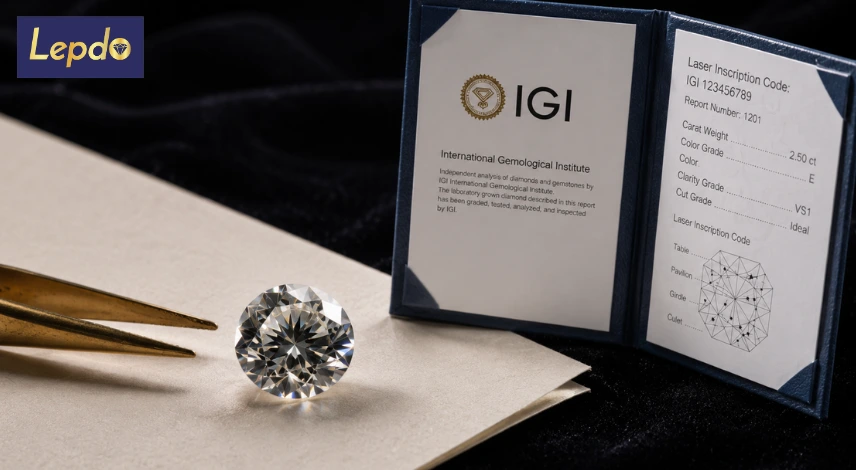
Lab grown diamond certification is the independent verification of a diamond’s origin, carat weight, color, clarity, and cut by a recognized gemological laboratory. It confirms the stone was grown, not mined, and it grades the diamond against the same 4Cs framework used for natural stones.
The report itself is not the diamond. It is a third-party record that protects the buyer’s investment and gives the seller credibility. This is why lab grown diamond certification importance keeps surfacing in buyer surveys, trade publications, and retailer training materials throughout 2026.
Manufacturers like Lepdo Diamonds, based in Surat’s diamond manufacturing hub, issue IGI and GIA certified stock as standard practice, not as a premium upcharge reserved for select orders.
Quick Info Box
- Definition: A gemological lab’s independent grading report confirming a lab-grown diamond’s origin, carat weight, color, clarity, and cut.
- Key Types or Varieties: GIA lab-grown reports, IGI lab-grown reports, GCAL reports, SGL reports, laser-inscribed certificates.
- Best For: Retail buyers, wholesalers, manufacturers, and appraisers who need verifiable proof of quality.
- Key Difference or Advantage: Certified stones carry documented, lab-verified value, which is the practical core of lab grown diamond certification importance, while uncertified stones rely on the seller’s word alone.
Retailers building a catalog of Lab Grown Diamonds Certified stock typically standardize on one or two labs to keep grading language consistent across their inventory.
Types of Lab Grown Diamond Certification Buyers Should Know
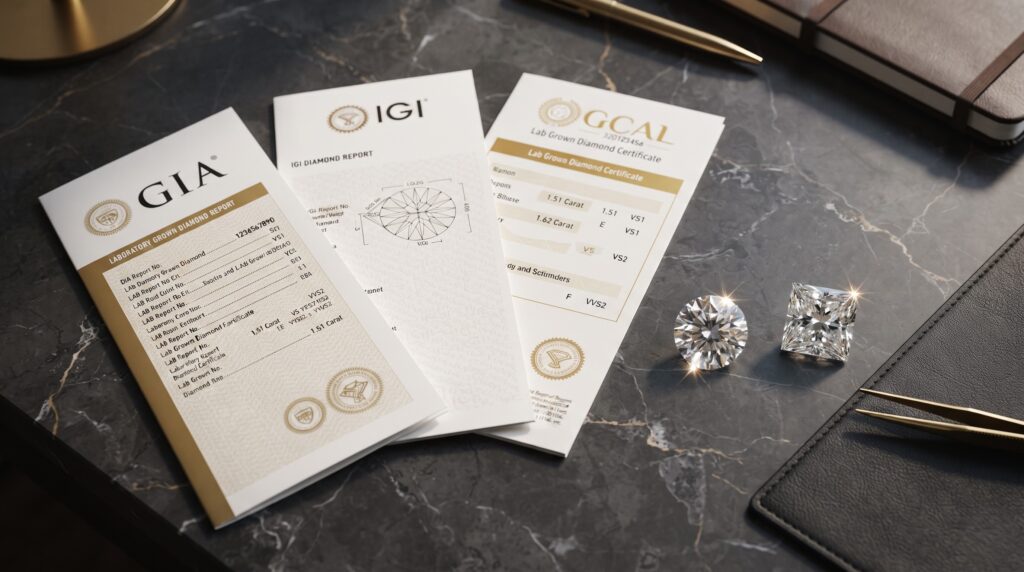
Not all certificates carry equal weight in the US market. Understanding the different flavors of Lab Diamond Certification helps you spot outliers before they end up in your inventory.
GIA Lab-Grown Diamond Reports
GIA remains the most recognized name among American consumers, even for lab-grown stones. Its reports use grading terminology nearly identical to natural diamond reports, which builds trust with shoppers who already know the 4Cs. GIA grading tends to run slightly conservative on color and clarity compared to other labs.
IGI Lab-Grown Diamond Reports
IGI issues more lab-grown diamond certificates globally than any other laboratory, and its reports are standard across most Lab Grown Diamonds sold through Surat and Mumbai manufacturing hubs. IGI reports often include a digital verification feature that retailers use for online listings.
GCAL Reports
GCAL is known for strict cut grading and a laser-inscribed hologram feature. Buyers focused heavily on light performance sometimes prefer GCAL for its detailed light-return analysis.
Other formats worth recognizing include SGL reports, which circulate in some wholesale markets but carry less brand recognition with US consumers, and laser inscriptions, which etch a report number directly onto the diamond’s girdle so the stone and paperwork can never be separated.
Digital or blockchain-linked certificates are gaining traction too, letting buyers scan a QR code for instant verification. Finally, watch for in-house or self-issued grading reports written by the seller rather than an independent lab. These are not certification in any meaningful sense, and their presence is one of the clearest uncertified lab diamonds risk signals a buyer can encounter. Recognizing these differences is part of understanding lab grown diamond certification importance at a practical level, not just a theoretical one.
Certified vs Uncertified Lab Grown Diamonds: The Real Difference
| Factor | Certified Lab-Grown Diamonds | Uncertified Lab-Grown Diamonds |
|---|---|---|
| Price Transparency | Priced against documented grading, easier to benchmark with Rapaport lab-grown price lists | Priced on the seller’s claim alone, harder to verify |
| Resale Value | Retains value tied to a lab report, accepted by appraisers and other retailers | Often discounted heavily or refused outright by resale buyers |
| Buyer Confidence | High, backed by third-party grading | Low, relies entirely on trust in one seller |
| Return/Warranty Terms | Typically clearer, since grading disputes can be checked against the report | Vague, since there is no independent standard to reference |
| Verification Method | Lab report number, laser inscription, or digital certificate | Seller invoice or verbal description only |
The gap here is not cosmetic. A certified stone can be checked against Lab Diamond Price benchmarks the way a car’s value gets checked against a blue book. An uncertified stone has no such reference point, which means the buyer is trusting a number pulled from thin air. This comparison itself illustrates lab grown diamond certification importance in dollar terms, not abstract ones.
To be fair, some small independent jewelers built loyal followings for decades without formal lab reports. That model still works in a handful of legacy shops. It rarely survives online scrutiny, though, where a shopper can compare five listings in the time it takes to finish a cup of coffee.
How to Choose the Right Certification for Your Lab Grown Diamond Purchase
Choosing the right certification is not just about picking a famous name. Match the report to how you plan to use the diamond.
- Match the lab to your priority. If color and clarity language matter most to your customers, GIA’s conservative grading builds trust. If you need volume and consistency across a large parcel, IGI is the industry default for a reason.
- Consider the report format you need. Loose stone dealers often want a physical or digital IGI report tied to a laser inscription, while finished jewelry brands sometimes prefer a simplified certificate sized for a smaller mounting.
- Match certification to your use case. Bridal centerpieces deserve full 4Cs grading, while smaller melee stones in pave settings are often certified as a batch rather than individually.
- Weigh the budget advantage. Certification adds a modest cost per stone, but it protects Lab Diamond Price positioning and prevents disputes that cost far more later.
- Think about the occasion. Engagement rings, investment purchases, and high-value commercial orders all warrant full independent grading. Fashion pieces under a certain price point sometimes move without it, though that gap is closing fast.
- Decide between lab-grown and natural. If you are weighing certified lab diamonds trend 2026 data against natural stone sourcing, note that Lab Diamond Quality standards for lab-grown diamonds now mirror natural diamond grading almost exactly, which makes the certified lab-grown route far easier to defend to a skeptical buyer.
Every factor above ties back to lab grown diamond certification importance, since a mismatched report undermines all the other choices you make.
Before you finalize your choice, ask your supplier for a sample report and check it against the physical stone yourself. A five-minute comparison at the counter beats a returned parcel three weeks later.
What B2B Buyers and Diamond Manufacturers Should Know
For manufacturers and wholesalers, lab grown diamond certification importance shows up directly on the balance sheet. Buyers expect diamond certification 2026 standards as a baseline requirement before they will even review a price list, not as a premium add-on.
Bulk sourcing decisions hinge on consistent cut grading across a parcel. A batch where cut grades swing from Excellent to Good under the same lab creates pricing headaches and customer complaints down the line. Manufacturers serious about consistency lean on IGI’s high-volume grading infrastructure, since it processes lab-grown parcels at a scale most other labs cannot match.
Rapaport pricing for lab-grown diamonds is still maturing compared to natural stone benchmarks, but certified stock trades closer to published guidance than uncertified goods, which often get priced on negotiation alone. Lab diamond certification statistics from recent trade reporting show certified inventory turning over faster at wholesale, since retailers can list it online with confidence. This is exactly where lab grown diamond certification importance turns into measurable ROI for manufacturers, not just a compliance checkbox.
In my experience working alongside cut-focused manufacturers, the parcels that move fastest are the ones where every stone’s report number is logged before it ships, not after a buyer asks for it. That single habit prevents most disputes before they start.
Lab Diamond Market Growth data supports this shift too, showing certified lab-grown supply expanding faster than uncertified trade channels across US import figures.
Lab Grown Diamond Certification Trends in the USA (2026 to 2027)
American engagement ring shoppers increasingly ask for the report before they ask for the ring size. That shift alone signals where the market is heading through 2027.
Fancy shapes and colored stones are driving much of this demand. Lab Grown Fancy Color Diamonds have moved from a niche request to a regular line item for retailers stocking anything beyond classic round and princess cuts. Certification for fancy colors is more nuanced than for colorless stones, since color origin and stability both need independent confirmation.
Cultural visibility around lab-grown jewelry on red carpets and social media has normalized the category for younger buyers, without a single celebrity endorsement doing the heavy lifting alone. Industry trade data points to certified lab-grown diamond jewelry sales growing at a faster rate than uncertified fashion jewelry segments through the current reporting period. Growing certified lab diamonds trend 2026 numbers reflect broader lab grown diamond certification importance across the entire US jewelry market.
Retailers report that customers under 35 rarely complete a purchase without seeing a report number first. That trend is unlikely to reverse. If anything, expect QR-linked digital certificates to become the default rather than the exception by 2027, especially for online-first jewelry brands competing on transparency as much as price.
How to Evaluate Quality Using Certification Reports
Understanding lab grown diamond certification importance also means knowing how to read the report correctly, not just requesting one. When I assess a lab-grown diamond’s report, the first thing I check is the cut grade, not the carat weight. Carat weight is fixed the moment the stone is polished, but cut quality determines brilliance, fire, and scintillation, which is what a customer actually sees under normal lighting.
- Check the pavilion depth and table percentage against the lab’s ideal ranges. Numbers far outside standard proportions often signal a stone cut to save weight rather than maximize light return.
- Compare clarity grade against the plotted inclusion diagram, not just the letter grade. A VS2 with inclusions near the culet behaves differently than one near the girdle.
- Confirm the color grade matches visual inspection under neutral lighting, since color can shift subtly under warm bulbs.
- Review Lab Grown Diamond Durability notes if the report includes fluorescence or treatment data, since some lab-grown stones undergo post-growth treatment that affects long-term stability.
- Cross-check Lab Diamond Quality indicators like length-to-width ratio for fancy shapes, where an uneven ratio can create a bowtie effect that dulls brilliance across the center of the stone.
Is a summary grade enough on its own? Rarely. A report is only useful if you actually read past the headline number.
Conclusion
Three things matter most here. Lab grown diamond certification importance comes down to verified origin, defensible pricing, and long-term buyer trust, three things no invoice alone can provide. Certified stones protect resale value and simplify disputes, while uncertified stones leave both retailers and consumers exposed to guesswork. The market has shifted decisively, and buyers expect diamond certification 2026 standards as a baseline rather than a bonus feature.
The truth is, certification is no longer a marketing checkbox. It is the foundation buyers, wholesalers, and manufacturers now build every transaction around, and that foundation only gets more important as fancy shapes and colored stones grow in popularity.
Retailers sourcing certified lab-grown diamonds can explore Lepdo Diamond for current IGI and GIA certified stock, where lab grown diamond certification importance is treated as standard practice rather than a premium option. Whether you are placing a first wholesale order or choosing a center stone for an engagement ring, ask for the report before you ask about price. The paperwork tells you more than the seller ever will.
Frequently Asked Questions About Lab Grown Diamond Certification
1. What is lab grown diamond certification importance?
Lab grown diamond certification importance comes from the independent verification a report provides for origin, carat weight, color, clarity, and cut. Without it, buyers rely solely on a seller’s claims. GIA and IGI reports give retailers, wholesalers, and consumers a shared reference point for pricing, resale, and trust, which is why so many purchase decisions now start with the paperwork.
2. Is a certified lab-grown diamond cheaper than a natural diamond?
Yes, certified lab-grown diamonds typically cost significantly less than comparable natural diamonds of the same carat weight, color, and clarity grade. The certification process itself adds only a modest cost per stone. The larger price gap comes from production method, not from grading, since both lab-grown and natural stones use the same 4Cs standards.
3. Which lab-grown diamond certification looks most impressive to buyers?
GIA reports carry the most recognition among US retail buyers, largely because shoppers already trust GIA from natural diamond shopping. IGI reports are equally rigorous and dominate global lab-grown volume. Neither report makes a diamond physically more brilliant, but GIA often reassures first-time buyers faster, while IGI satisfies buyers focused on scale and consistency.
4. Does a lab-grown diamond have a GIA cut grade?
Yes, GIA assigns cut grades to lab-grown diamonds using the same scale as natural stones, ranging from Excellent to Poor. The grade considers proportions like pavilion depth and table percentage, along with polish and symmetry. This is one reason lab grown diamond certification importance keeps growing, since buyers can compare cut quality directly against natural benchmarks.
5. What is the biggest quality risk with uncertified lab-grown diamonds?
The biggest uncertified lab diamonds risk is misrepresented grading, where a stone is sold as a higher color or clarity than it actually is. Without independent verification, buyers have no way to confirm carat weight, treatment history, or cut quality. This risk compounds at resale, when appraisers or other buyers refuse stones lacking any lab report entirely.
6. Are lab-grown diamonds certified to the same standard as natural diamonds?
Yes, GIA and IGI grade lab-grown diamonds against the same 4Cs framework used for natural stones, including cut, color, clarity, and carat weight. The only structural difference is that lab-grown reports clearly state the diamond’s grown origin. Grading rigor has not been reduced, which is why certified lab diamonds trend 2026 data shows growing buyer confidence.
7. Which certification is best for an engagement ring center stone?
For an engagement ring center stone, IGI or GIA certification is strongly recommended, with GIA often preferred for stones one carat and above due to its brand recognition. Laser inscription adds an extra layer of security, linking the report permanently to the physical stone. This combination protects both the purchase and any future insurance or resale needs.
8. How do I choose a reliable lab-grown diamond certification manufacturer or supplier?
Choose a supplier that issues IGI or GIA certified stock as standard practice, not as a special request. Ask for sample reports before committing to a bulk order, and confirm laser inscription matches report numbers. Reputable manufacturers, including Lepdo Diamonds, provide certified stock with transparent sourcing details so buyers can verify every claim independently.