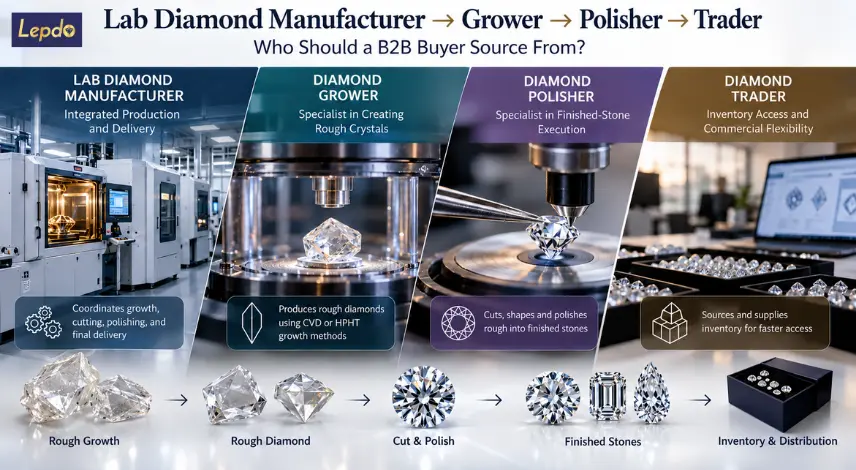

lab diamond manufacturer, grower, polisher, and trader describe different roles in laboratory-grown diamond supply. A manufacturer may coordinate growth through finished delivery, a grower makes rough crystals, a polisher cuts stones, and a trader sources inventory. B2B buyers should choose based on order complexity, quality controls, availability, documentation, and accountability.
A lab diamond manufacturer, a grower, a polisher, and a trader play different roles in the lab-grown diamond supply chain. A manufacturer can also mean someone who coordinates growth through finished delivery. A grower is someone who makes rough crystals. A polisher is someone who cuts stones, and a trader means someone who sources inventory. When considering lab diamond manufacturers, B2B buyers should look at order complexity, quality controls, availability, documentation and accountability.
A lab diamond manufacturer may also be a grower or polisher, while a trader generally operates in a different part of the supply chain. When a retailer orders replacement center stones, it may not matter whether a manufacturer makes the stones vs. a grower or polisher. For a wholesaler who is replenishing a collection of hundreds of stones, it may matter if the manufacturer integrates multiple operations or a trader gives quick access to inventory.
It is not simply whether a supplier calls itself a lab diamond manufacturer. It is which functions they perform vs. outsource and what they guarantee. A manufacturer who integrates multiple operations may not give the best value. A trader may give quick access to inventory. Neither term assures quality and value.
What Does a Lab Diamond Manufacturer Really Do?
Stones take a long journey before reaching the commercial stage. They involve crystal growth, planning, cutting, polishing, inspection, laboratory assessment when needed, sorting and distribution. For a lab diamond manufacturer, an important distinction is a company that performs an activity (e.g. polishing) and a company that oversees a subcontractor that performs the activity.
Related terms, such as diamond dealers and manufacturers, help create a framework for the distinction, but the key question is who owns the equipment, work instructions, inventory and risk for a rejected shipment. For a lab diamond manufacturer, a process map usually provides a better description compared to a website.
Lab Diamond Manufacturer, Grower, Polisher and Trader Explained
1. Lab Diamond Manufacturer: Integrated Production and Delivery
While an integrated lab diamond manufacturer controls the diamond’s growth and polishing, other parts of the process can also be performed in-house. Integration may give the manufacturer better control of a batch and assist with repeatability. This helps the buyer understand the production process, the expected delays and gives assurance of consolidated documentation.
Choosing a lab diamond manufacturer with integrated operations does not guarantee higher quality stones, or the lowest price. Even established lab diamond manufacturers outsource certain activities like diamond cutting, grading, and shaping to subcontractors. The relationship between the manufacturers is based on trust, control, and tolerances. The integrated manufacturer may outsource activities but is responsible for the end product.
2. Diamond Grower: Specialist in Creating Rough Crystals
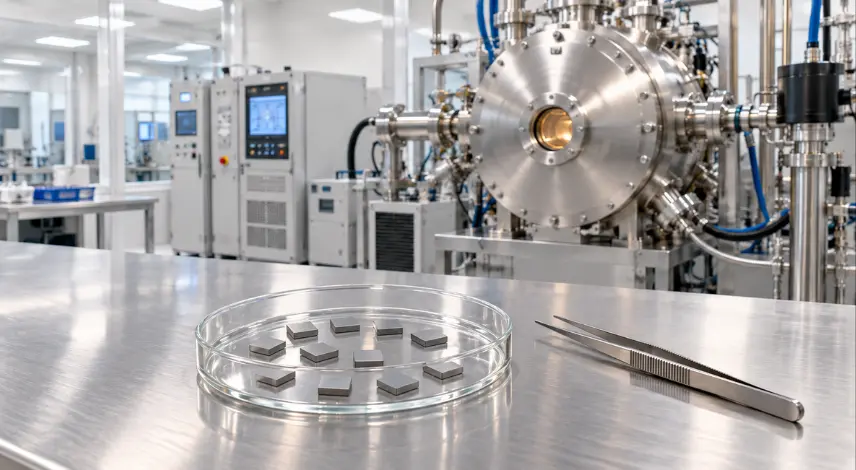
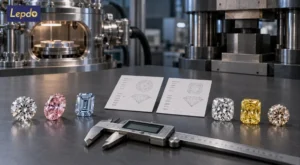
A diamond grower creates rough diamond material in a lab. Two methods of doing this are chemical vapor deposition (CVD) and high-pressure, high-temperature (HPHT) growth. In CVD, diamond material is deposited onto a prepared substrate in a chamber and grows via a vapor deposit. In HPHT, diamond crystals grow from a carbon source in a high-temperature and high-pressure environment. Other treatment may be used on the material to impart different physical and chemical properties.
For those considering the technical aspects, the cvd diamond manufacturing illustrates the growth aspect of diamond production. A diamond grower may be the right partner for a cutting house looking for rough diamond material. Retailers considering a grower must assess if the grower is able to arrange other services for the stone such as matching and grading.
A diamond grower’s capability to polish does not ensure polished stones will be supplied. Final characteristics and the yield of rough material also depend on subsequent decisions made and the intrinsic properties of individual crystals. A lab diamond manufacturer that offers finished diamonds may manage this uncertainty for the buyer, but only if the supply terms allow for it.
3. Diamond Polisher: Specialist in Finished-Stone Execution
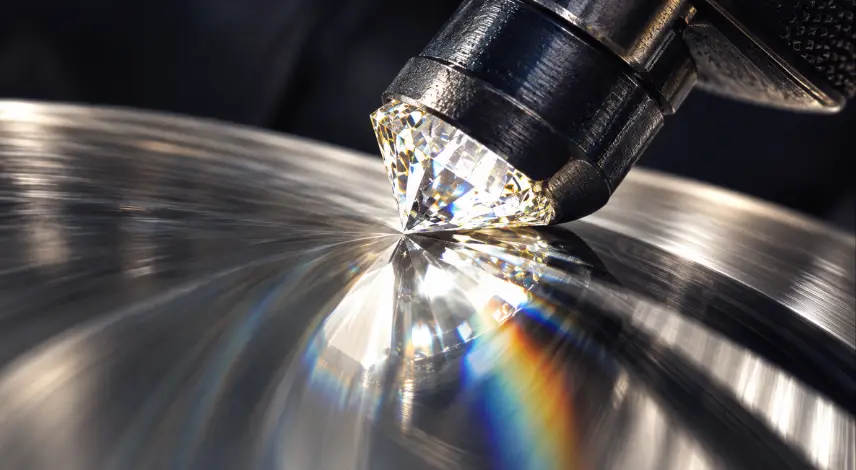
A diamond polisher plans, saws or lasers, bruits, facets, and polishes diamond or other materials to create faceted stones. The various cutting choices impact the weight, shape, symmetry, and performance of the stones and determine their fitness for different jewelry settings. There are polishing houses that specialize in certain fancy shapes or precision cuts.
Custom shapes require particular consideration of the diamond polishing process. Reviewing examples of finished diamonds provides insight into various aspects such as proportion, facet alignment, girdle finish, and size repeatability. For a lab diamond manufacturer or specialist polisher, determine who, if anyone, approves finished stones and is responsible for recutting.
Polishing is a process that can be outsourced to a different facility and still be overseen by the manufacturer. Some polishers work best with brands that own rough and require specialized finishing. This process can be more challenging to retailers who expect stock-ready inventory. Polishing can be less convenient if the polisher is requiring extensive lead times on certain diamonds.
4. Diamond Trader: Inventory Access and Commercial Flexibility
A trader may own equipment, but equipment ownership is generally not a distinguishing factor.
The equipment adds little value to a trader’s offerings unless specialized or rare equipment is employed. A trader’s core value is usually in sourcing and inventory access. The exception may occur if the trading operation supports an owned factory and the operation of the factory is presented as a trading service. These factors should be transparent in the trading operation to protect the reputation of the source.
Compare a Lab Diamond Manufacturer, Grower, Polisher, and Trader Before Requesting Quotes
| B2B Factor | Manufacturer | Grower | Polisher | Trader |
|---|---|---|---|---|
| Primary Strength | Coordinated finished supply | Rough crystal production | Control over cutting and finish | Broad stock |
| Typical Starting Material | Rough or integrated growth output | Diamond seeds and growth inputs | Rough diamonds | Purchased polished inventory |
| Customization | Potentially broad (subject to capability) | Rough specification focus | Cut and shape focus | Depends on upstream partners |
| Speed Advantage | Repeat programs with planned capacity | Rough production (and planning) | Defined cutting programs | Mixed and ready-stock orders |
| Main Buyer Check | Actual owned versus outsourced stages | Rough yield and downstream services | Finished tolerances and rework | Stock proof and replacement terms |
This table compares operating models, not guaranteed results. Meaningful quote comparisons require the same delivered specifications, services and remedies to be included.
Which Supplier Should You Choose for Your Order Type?
Standard Replenishment and Ongoing Wholesale Orders
What type of supply do retailers replenishing repeat selling sizes need? Available, consistent, predictable supply more than complete control over the growth process. For planned, repeat production, a lab diamond manufacturer with the capability to plan and produce repeat rough diamond growth programs over a long time horizon may be the best option. For shorter time horizons, a diamond trader is a better choice.
Diameter, color and clarity, and other factors can be set to a range of tolerances. Define your requirements for reports and certificates, and in the case of loose diamonds, select a sample parcel for approval. A lab diamond manufacturer or trader can replicate previous results and be relied upon, but not always produce the best samples.
Custom Shapes, Matching Sets, and Branded Collections
There are several key components to custom programming, ranging from design to execution. These components include but are not limited to: target face-up dimensions, outline symmetry, facet shape, acceptable face-up spread (size relative to carat weight), minimum yield (assumptions on retained weight), and an agreed-upon approval process. A specialist polisher or a lab diamond manufacturer that employs skilled polishers may be a better alternative, particularly for difficult designs.
When looking at fancy shape diamonds, a buyer needs to assess actual millimeter measurements and the appearance of the diamonds, rather than relying on carat weight to be a complete specification. Pair and layout matching should also be clearly defined. A trader can help coordinate the request, but the buyer should also ask, “who signs off on the final result?”
Urgent Assortment Gaps and Mixed Small Orders
In the case of an urgent order consisting of one oval shaped diamond, two radiant shaped diamonds, and a few small round diamonds of a specified color, and a replacement, the trader may be more helpful based on the strength of their inventory verification. A lab diamond manufacturer may be able to do the same, assuming they have the inventory and it is allocated.
Check minimum order quantities, available to promise (A-T-P) status, dispatch cutoffs, and substitutions. Never assume an item on the supplier’s inventory list is reserved, this should be confirmed by the order acknowledgement. A low quote is of no use if the stones can’t be delivered together.
Where Are the Real Cost Differences?
Despite a lab diamond manufacturer cutting out some middlemen, there are still costs associated with direct sourcing that must be taken into consideration. These costs include a trader’s premium for aggregation and immediate availability, financing, transportation, return, and unsold inventory.
Rather than looking at an average cost per carat, look at total landed and usable cost. In addition, consider the price of distribution and sorting. Look at context clues provided by the diamond wholesale price guide. You should request quotes based on your specifications.
When looking at a lab diamond manufacturer versus a trader, you should evaluate financing, credit for nonconforming goods, transport and shipment, grading and inscription, terms of payment, lead time, inspection, and packaging. Also, ask if price changes with the final size mix.
A good lab diamond manufacturer will be able to explain the rationale behind their quoted price without attempting to conceal costs behind the process of crystal growth. A good trader will do the same. Assumptions about markups will provide little insight.
Quality Consistency Is Key
Records of consistency checks are what ensure quality consistency. For each order you need to specify the stone shape, number of stones, total weight, size spread, color and clarity distribution, visible characteristics, finish, and what difference from a reference sample would be acceptable. A lab diamond manufacturer that supplies calibrated melee diamonds could potentially be more interested in millimeter sizing than in providing individualized reports.
For larger center stones, confirm whether independent reports are required. IGI provides reports on laboratory-grown diamonds. Effective October 1, 2025, GIA changed how it assesses eligible colorless to near-colorless laboratory-grown diamonds. Rather than using the natural diamond color and clarity grading nomenclature, GIA now assigns an overall Premium or Standard quality assessment when the stone meets the applicable criteria. If a buyer is purchasing a report thinking it would contain a particular piece of information, and then finds that information to be absent, they should not impute incorrect or inaccurate information to the report.
When purchasing certified diamonds, always verify measurements and identifiers on the certificates. Reports describe individual stones, not a supplier’s business practices. It is imperative for the supplier to verify traceability, particularly when dealing with intermediaries. Neither a laser inscription nor a supplier statement verifies traceability.
Traceability must also be included on commercial documents for laboratory-grown diamonds, which states the stone was lab-grown. The lab diamond manufacturer or intermediary must identify information that is verified versus information that was declared by the upstream supplier. Neither a laser inscription nor supplier statement verifies a complete chain of custody.
Seven Checks Before Choosing a Lab Diamond Manufacturer or Other Supply Partner
Before finalizing the choice of supply partner, you should run these checks.
- Review the workflow and identify owned growth machines, in-house cutting, outsourced work, grading, storage, and dispatch arrangements. Ask for evidence relevant to the actual order.
- Verify the sample. Ensure stones conform to the specified parameters rather than accepting an attractive sample outside the range.
- Define tolerances. State the millimeter limits and proportions, grade distributions, finish, and matching rules for sets or parcels.
- Test repeatability. Evaluate if separate samples or lots, or deliveries, show consistency.
- Check stock and capacity claims. Determine what is available for shipment from finished goods inventory, what is scheduled for production, and what is available from a third party.
- Audit documentation. Ensure the relevant numbers, identifiers, and quantities match.
- Agree on exceptions. Agree on acceptable remedies and a timeframe for exceptions, like breakage, the absence of stones, replacement, supply shortages, and rework.
Add this to your choose diamond supplier checklist and adapt as needed to your selected model. A lab diamond manufacturer should have more documentation available showing process control than a trader. However, both should deliver accurately to the terms of the contract.
Larger mixed parcels can be reviewed using a documented diamond parcel buying guide, which includes receiving inspections and exception logs. A complementary diamond manufacturer selection guide on Medium discusses the limitations of relying on a factory tour, alone, to make a diamond manufacturer selection. Agreed rejection thresholds should be documented before shipment, not after a disagreement has begun.
Questions to Add to Your RFQ and Supply Agreement
An RFQ to a lab diamond manufacturer should require the seller to disclose how they will fulfill the order, not simply offer a price. Send each diamond manufacturer or intermediary the same specification sheet, estimated quantity, delivery location, and acceptance terms. Request prices, quotes, or bids for items or parcels, using the same currency and trade terms to ensure comparability.
Verify the following: disclosure of growth origin, polished size range, color and clarity range, shape, drawings or reference images, grading standards, inventory on hand and availability, lead time, minimum order quantity, inspection window, terms and conditions, and policy for damaged or mismatched stones. Separate a pilot order from a planned repeat order to ensure supplier quotes are realistic.
Determine who makes the acceptance decision. In the event a batch is measured or inspected and found to be deficient, according to agreed terms, determine the seller’s obligation, if any, and who bears the freight cost. A lab diamond manufacturer may be in a better position to manufacture replacement items, while a trader may be able to offer substitute inventory more quickly.
Implement change control procedures for deviations to specified requirements. Define what the word manufacturer promised to avoid disagreement on contract terms.
What to Look for When a Supplier Claims to Be a Manufacturer
A lab diamond manufacturer should be able to explain its operations. Look for inconsistencies in where stones are grown vs. polished. Be suspicious of unsubstantiated claims of in-house processing. Also, avoid suppliers that do not disclose who addresses quality complaints. There are legitimate trade secrets that do not need to be disclosed. However, core aspects of a manufacturer’s operation that contribute to order fulfillment should be understandable.
There are other red flags that apply to all supplier models. Expect inconsistent quotations, samples that deviate significantly from specifications, misaligned grading, and promises made without order-level terms. Avoidance is not the best strategy. Try verifying adequately.
The same idea applies to trade. A lab diamond manufacturer that is able to meet the needs of a given order is valuable. The same is true of diamond growers and polishers. Choose evidence and execution over labels.
Frequently Asked Questions
1. Is a lab diamond manufacturer the same thing as a grower?
Not always. A lab diamond manufacturer can be a grower, cutter, polisher, grader or supplier of finished stones. Some companies do all of these. Ask which of these tasks are performed directly by the company and which are done by third parties. Also ask if the quote is for rough stones or finished stones and what guarantees the company has on the quality of the stones.
2. Is it always cheaper to purchase from a diamond grower?
Not always. Purchasing rough stones can mean taking on risk associated with the variation in cutting yield, polishing costs and the quality of the stones. The relevant comparison is the total cost of the finished stones that meet the requirements of the purchase specification. It is often the case that a jewelry retailer does not have the downstream arrangements for cutting and grading so purchasing directly from a diamond grower often does not make sense.
3. Is it always possible for a trader to provide the same quality as a manufacturer?
Yes, if the trader purchases the appropriate goods, verifies the specifications and stands behind the purchase. Manufacturing ownership does not always ensure that a company performs these tasks properly. Buyers should assess the quality of the stones and the documentation. The trader may be best for small and mixed orders.
4. Which supplier is best for custom-cut lab-grown diamonds?
A diamond polisher who specializes in custom cuts is the first choice when a lab diamond manufacturer does not have proven custom-cutting capacity. In addition to this, an integrated lab diamond manufacturer with proven custom cutting capabilities can be considered. While assessing custom cutting examples, consider dimension and outline tolerances, matching, approval samples, and recut policies. A trader can also manage custom cutting through a partner, provided responsibility for final acceptance and corrective actions is defined clearly.
5. What documents should accompany a wholesale lab-grown diamond order?
Documents from a lab diamond manufacturer or trader should correspond with the transaction and satisfy applicable requirements. Items commonly include an invoice labeling the diamonds as lab-grown, a packing list, order specs, parcel and/or stone identifiers, and independent lab reports, if any. Buyers should reconcile quantities and verify measurements upon receipt. Where applicable, buyers should evaluate and record origin/treatment disclosures for marketing and product claims.
6. Should all lab-grown diamonds have individual grading reports?
Not always. Grading reports for center stones are prudent; for larger parcels of smaller stones, it may be unworkable. Ultimately, buyers should agree on the proper documentation and testing for their product category.
7. Will knowing about CVD or HPHT growth help determine the better supplier?
Knowledge of either CVD or HPHT growth alone will not point to the better commercial supplier. CVD and HPHT are well-established routes for laboratory grown diamonds and stones from these processes still require evaluation. Match the method and the finished characteristics to the order, confirm any relevant disclosure of post-growth treatments, and assess the finished appearance, grading, documentation, repeatability and the contractual service.
8. How can a B2B buyer evaluate a new supplier before making a large order?
Diamonds made in a laboratory can be manufactured by a variety of methods. Test a lab diamond manufacturer using the specifications you intend to use for the continuing purchases. Record dimensional measurements, appearance, and report matching. Assess the quality and consistency of communications and response to any exceptions.
Insights for B2B Diamond Buyers
To begin, a lab diamond manufacturer isn’t necessarily the best one just because they happen to have the longest list of services. It is more important to confirm which of the steps in the process they actually perform and what assurances they provide in the event that a finished stone fails to meet the agreed-upon specification.
Second, match your supply model to your order. For expertise in rough: contact a grower. For skill in the cut: contact a polisher. For flexibility in inventory: contact a trader. For integration across repeat supply: contact an integrated provider.
Third, judge partners based on what they actually bring to the table. All else being equal, which partner is more willing to improve their inventory, processes, and/or documentation to better suit your needs? A small, verified trial followed by a supply agreement is a stronger starting point than any supplier label.
For in-depth market reports, trade sourcing guides, interactive Q&As, and expert gemological perspectives, join the discussion on Lepdo Diamonds on Quora.