Diamond Certification IGI vs GIA for Wholesale Purchasing: A Procurement Comparison
 by lepdogroup@gmail.com
0 comments
by lepdogroup@gmail.com
0 comments
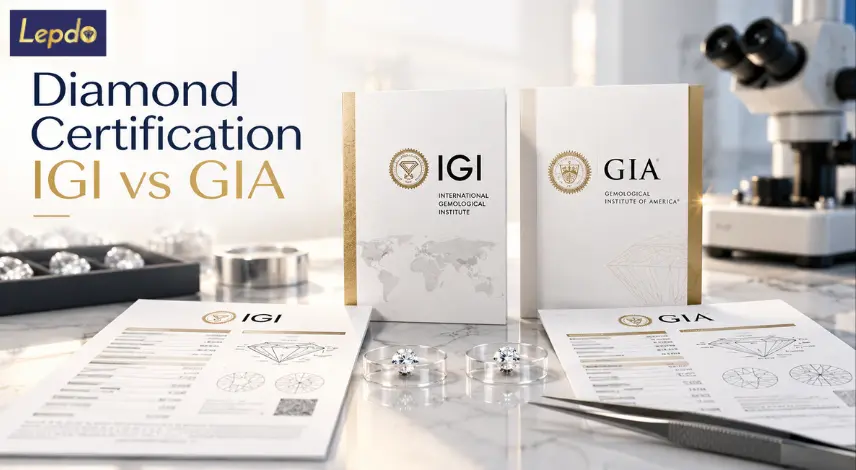
Diamond certification IGI vs GIA is a procurement decision about report compatibility, not simply laboratory reputation. IGI provides detailed 4Cs reporting for laboratory-grown diamonds, while GIA uses Premium or Standard assessments for eligible colorless to near-colorless lab-grown stones. Wholesale buyers should verify reports, match stones to records, and define acceptance rules before ordering.
Diamond certification IGI vs GIA decisions can delay a wholesale order even when the stones appear identical on a supplier’s inventory list. A buyer may approve a carat range, color, clarity, and target price, only to discover that the proposed grading documents do not express those characteristics in the same way. The consequence is not simply confusion about two laboratories. It can affect quotation comparisons, product listings, receiving checks, and the way a retailer explains a diamond to its customer.
The question is whether each report delivers the information required by the buyer and sales channel. For diamond certification IGI vs GIA comparisons, natural diamonds and laboratory-grown diamonds must be evaluated separately. A report also needs to be matched to the physical stone and the supplier’s invoice, not treated as an automatic guarantee of quality or commercial value.
What Diamond Certification Actually Establishes
A diamond grading report is an independent laboratory’s record of a stone’s identification and assessed characteristics. Depending on the service, it may state the diamond’s origin, measurements, carat weight, color, clarity, cut-related details, finish, and other observations. The familiar word certification is used throughout the trade, but a grading report is not a price appraisal, proof of ethical sourcing, or a manufacturer’s warranty.
For procurement, Diamond Certification provides a common basis for describing individual stones. It does not establish that every diamond in a bulk parcel matches one documented example. A sound diamond certification IGI vs GIA decision therefore begins with the intended inventory unit: a single report-linked center stone, several separately documented diamonds, or a calibrated group requiring agreed inspection standards.
Natural and Lab-Grown Identity Must Be Explicit
Natural and laboratory-grown diamonds are both diamonds, but their origins and commercial descriptions must not be mixed. Independent testing and correct disclosure matter before any discussion of an attractive grade. For diamond certification IGI vs GIA sourcing, the first acceptance field should identify whether each stone is natural or laboratory-grown. If the order includes both, the supplier should maintain distinct stock records, parcel identifiers, and customer-facing descriptions.
Diamond Certification IGI vs GIA: The Procurement Comparison
The Gemological Institute of America, GIA, established the modern 4Cs framework and issues detailed reports for natural diamonds. The International Gemological Institute, IGI, also issues reports for natural and laboratory-grown diamonds and offers services for finished jewelry. Their current laboratory-grown documentation differs in a way that matters much more than simplistic claims about one laboratory being strict and the other being lenient.
In diamond certification IGI vs GIA procurement, document type must be compared before the reported values. A natural diamond grading report and a laboratory-grown quality assessment are not interchangeable documents, even when both are issued by a respected organization.
| Procurement factor | GIA | IGI |
|---|---|---|
| Natural diamonds | Detailed 4Cs-based reports, depending on service | Natural diamond reports with 4Cs information |
| Colorless to near-colorless lab-grown diamonds | Premium or Standard quality assessment for eligible loose stones | Detailed laboratory-grown diamond reporting using 4Cs grades |
| Colored lab-grown diamonds | Separate colored-diamond report services | Fancy-color and lab-grown report options, according to service |
| Verification | Official GIA Report Check and eligible professional data services | Official IGI report verification |
| Wholesale fit | Useful when a buyer specifically requires the available GIA document | Useful when individual 4Cs fields are needed for lab-grown stock specifications |
The meaningful distinction is data compatibility. Diamond certification IGI vs GIA should be assessed against the purchase order’s exact information requirements, not by assuming that labels on two different report types are equivalent.
The 2025 GIA Change That Wholesale Buyers Must Understand
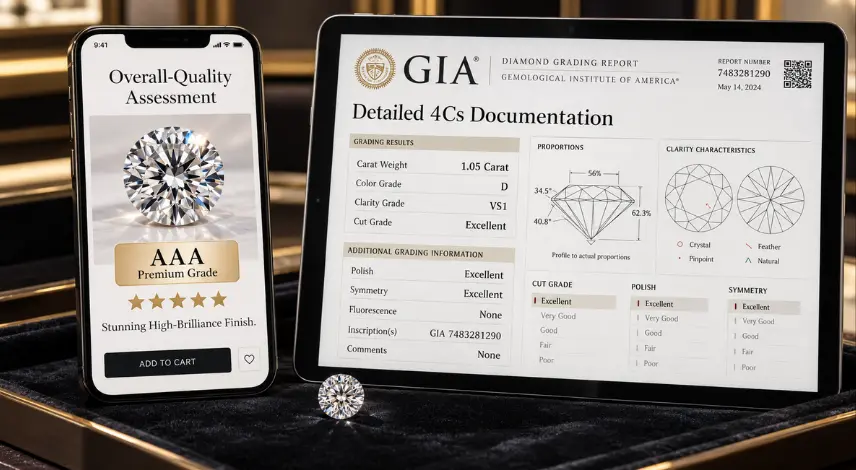
On October 1, 2025, GIA introduced revised services for eligible D-to-Z laboratory-grown diamonds. Its Laboratory-Grown Diamond Quality Assessment uses the overall descriptions Premium and Standard instead of the individual natural-diamond-style color and clarity nomenclature formerly used for this service. GIA states that the assessment applies to loose colorless to near-colorless laboratory-grown diamonds weighing at least 0.15 carats. Stones outside its specified quality criteria may not receive a quality designation.
That policy changes diamond certification IGI vs GIA decisions for purchasing teams that require individual color and clarity grades in their sales feeds. A Premium assessment should not be translated into an invented D/VVS1 combination. Likewise, a Standard assessment is not a substitute for the exact E, F, G, VS1, or VS2 fields required by a customer’s specification.
How GIA’s Colored Lab-Grown Services Differ
GIA separately offers laboratory-grown colored diamond reports, including services addressing color, growth type, and evidence of post-growth treatment. Buyers should not extend the Premium/Standard description to every laboratory-grown stone or every report service. In diamond certification IGI vs GIA comparisons involving Fancy Color Diamonds, request the actual report format and review the stated hue, color characteristics, and disclosure fields before quoting a matching product.
Older GIA laboratory-grown reports can also remain in circulation. Therefore, the report issue date, report title, and applicable service are essential. The age of a document alone does not prove it invalid, but its terminology must be interpreted in the context of the service under which it was issued.
What IGI Laboratory-Grown Reports Provide
IGI publishes laboratory-grown diamond report information using individual color and clarity grading scales, along with measurements and cut-related assessments. Its report services can document the 4Cs and provide a standardized product description that suppliers and retailers can reference during inventory matching. Report content still varies with stone type, report format, and whether a stone is loose or mounted.
For diamond certification IGI vs GIA decisions where an e-commerce listing requires a specific color and clarity pair, IGI’s documented fields may fit that workflow more directly. The buyer must still check every field rather than assuming that the presence of an IGI report confirms a target specification. The separate resource on IGI Certified Lab Grown Diamonds India gives more context for sourcing individually graded stones.
Diamond Certification IGI vs GIA: Report Detail and Appearance
Grading reports cannot replace examining actual appearance. Stones with similar grades may differ in proportions, transparency, or face-up appeal. Diamond certification IGI vs GIA comparisons become stronger when suppliers provide standardized photographs, usable video, and measurements with a clear reference to the report number.
For fancy shapes, seek consistent face-up and side-view footage. Evaluate outline, bow-tie appearance, and apparent size without trusting a single number.
Natural Diamonds: Buyer Requirements Come First
For natural diamonds, both GIA and IGI provide grading reports, but procurement acceptance depends on the customer’s contract and sales-channel expectations. Some buyers specify a particular laboratory for certain price points or categories. Others accept either laboratory if report information, visual inspection, and agreed commercial terms satisfy their standards.
A diamond certification IGI vs GIA purchasing policy should state the accepted laboratory and report type before suppliers prepare quotations. Avoid treating a GIA report as an automatic resale premium or an IGI report as an automatic discount. Market price depends on the stone, grading characteristics, report details, actual demand, and commercial conditions. The supplier should quote against a clearly defined specification rather than an assumed percentage difference.
The same principle applies when reviewing GIA Certified Diamonds: the geographic sourcing point does not remove the need for stone-specific verification, transparent descriptions, and an agreed replacement procedure.
Report Verification: Match the Record to the Physical Diamond
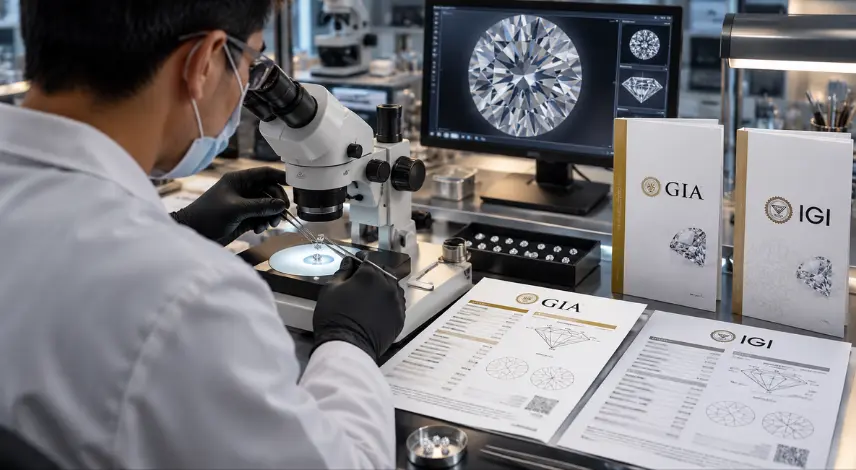
An online report lookup does not, by itself, prove that a supplier has delivered the corresponding stone. In diamond certification IGI vs GIA transactions, verification must connect three records: the laboratory report, the supplier’s stock identifier, and the physical stone delivered.
A Five-Check Receiving Procedure
- Verify the report number. Search the issuing laboratory’s official verification system and compare its available fields with the document supplied by the seller.
- Compare the physical stone. Where present, examine the girdle inscription under appropriate magnification and reconcile it with the report. Do not assume every report service guarantees the same inscription arrangement.
- Reconcile identifying details. Check carat weight, shape, measurements, origin, and any available diagrams or report comments against the purchase order.
- Resolve discrepancies. Quarantine an unmatched stone or document rather than treating a plausible report number as sufficient proof.
- Record acceptance. Preserve a report reference, inspection result, parcel ID, and decision trail so replacements can be traced.
For diamond certification IGI vs GIA teams with recurring deliveries, Diamond Certification Check is a useful reference for the verification stage. Stronger systems also record the inspector, date, discrepancy reason, and action taken. Verification is a workflow, not a one-time website search.
Why Laser Inscriptions Need Careful Interpretation
A legible laser inscription is useful, but it is not a substitute for identity screening or quality checks. Inscriptions can be difficult to read when a stone is mounted or oriented poorly, and buyers should not infer that every document includes identical laser marking rules. Diamond certification IGI vs GIA instructions should specify what evidence is required when an inscription is unavailable, damaged, or inconsistent with the paperwork.
Turnaround, Report Fees, and Inventory Planning
Procurement timing depends on laboratory location, available service, stone eligibility, submission volume, shipping, and current processing queues. No reliable universal rule says that one laboratory is always faster or cheaper for every order. A buyer comparing diamond certification IGI vs GIA should request an actual service quotation and current estimated return window for the precise report type.
The true unit cost includes more than the laboratory invoice. Account for shipping, insurance, inscription if applicable, handling, inventory holding time, and the cost of a rejected or delayed stone. A useful view of Diamond Certification Cost begins with these components, especially when a supplier is submitting stones for grading only after receiving a purchase order.
Confirm the Timeline Before Paying a Deposit
Ask the manufacturer whether the proposed stones are already graded, presently awaiting laboratory results, or merely eligible for a future submission. For diamond certification IGI vs GIA orders, those three statuses create very different delivery risks. Require separate dates for inspection, grading submission when necessary, report availability, parcel dispatch, and expected receipt. An estimated lab return is not the same as a confirmed shipping commitment.
For multi-store launches, samples and replacement availability can matter more than small fee differences.
Wholesale Orders Need Report-to-Inventory Reconciliation
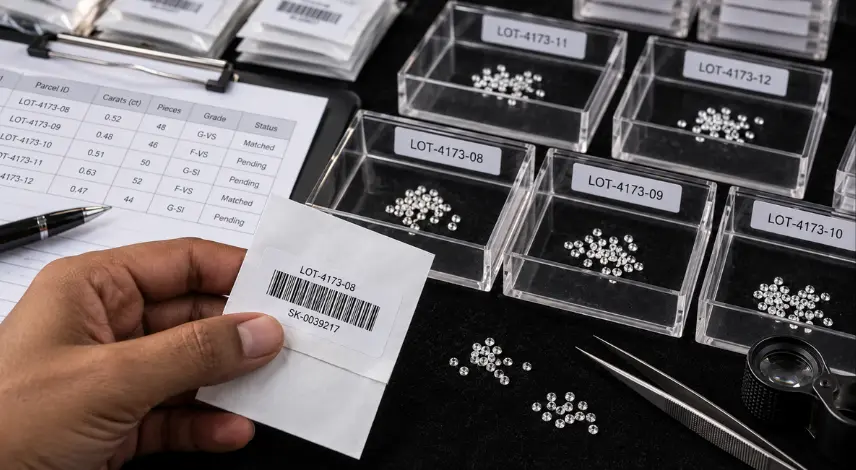
One verified report is not a substitute for controlling the rest of an order. Each individually certified diamond should have a unique link between the stock number, grading report, invoice line, and delivery container. If the shipment includes uncertified small stones, their acceptance needs a separate grading and sampling specification.
The diamond certification IGI vs GIA policy should distinguish separately report-linked stones from parcels sold by aggregate quality range. For individually certified stones, reject substituted report numbers unless the buyer approves the change. For grouped merchandise, define allowable variation, sample size, rejection thresholds, and price adjustment rules before shipment.
Batch Consistency for Jewelry Manufacturing
A retail collection may require consistent millimeter spread, matching pairs, near-identical shapes, or specific clarity distributions. Even correctly reported diamonds can cause production problems when assembled into earrings or repeated designs. Diamond certification IGI vs GIA reviews should sit alongside practical lab diamond quality grades controls, including shape symmetry, face-up matching, polish, setting suitability, and agreed tolerances.
For mixed parcels, the diamond parcel buying guide offers a separate framework for examining assortment risk. A report on one center stone cannot validate the grade distribution of every smaller diamond shipped with it.
Buyer Expectations Across Wholesale and Retail Channels
A U.S. jewelry retailer may need individual 4Cs fields for product filters, a manufacturer may prioritize matching physical dimensions, and a distributor may have strict document requirements written into a purchase order. The best diamond certification IGI vs GIA choice follows those needs. Customer familiarity cannot replace contractual clarity.
Before accepting a quotation, check that exact grades can be displayed, the marketplace accepts the report, and origin and treatment information is correctly disclosed. Diamond certification IGI vs GIA approvals should answer these questions before a product is listed or a consumer price is published.
Lepdo Diamonds operates as a Surat-based B2B laboratory-grown diamond manufacturer. When working with a supplier, buyers can request report-linked Certified Diamonds and compare individual Loose Diamonds against a written quotation. The operational standard should remain the same regardless of vendor: verify the supplied documents and physical merchandise against the agreed order. The diamond certification IGI vs GIA choice should never weaken that control.
A Practical Supplier Approval Workflow
The following workflow turns diamond certification IGI vs GIA evaluation into a procurement control rather than a debate about brand reputation.
Before quotation: Specify natural or laboratory-grown origin, accepted lab and report service, exact grades or quality description, shapes, size range, quantity, and target use. Make the required report fields explicit.
Before purchase order: Request sample report formats and stone-level identifiers. Confirm whether grading is already complete, how replacements will be approved, and which party bears resubmission costs.
Before dispatch: Require a final inventory schedule containing the report number, supplier SKU, carat weight, measurements, invoice line, and parcel reference for each individually documented stone.
At receiving: Cross-check online laboratory records, physically inspect selected or all stones according to contract, and isolate exceptions. Preserve the agreed photographic and inspection evidence.
After acceptance: Track recurring report mismatches, visual rejects, delayed documents, and credit notes by supplier. Diamond certification IGI vs GIA records become useful management information when they help explain avoidable operating costs.
A further perspective on the buyer’s need to connect a GIA report with physical and commercial verification appears in this GIA wholesale documentation discussion.
Common Procurement Mistakes That Create Avoidable Risk
Comparing unlike documents is a mistake: GIA Premium is not a numerical counterpart to IGI D/VS1. Other mistakes include trusting a report lookup without matching the stone or treating a grading estimate as a delivery commitment.
The fourth mistake is writing diamond certification IGI vs GIA into a purchase policy without defining what the final customer needs. The fifth is using certification as a substitute for inspection of cut appearance, parcel consistency, and manufacturing fit. These mistakes are preventable through a written checklist and explicit acceptance rules.
Frequently Asked Questions
1. Which is better for wholesale purchasing, IGI or GIA?
Neither laboratory is the automatic winner for every purchase. Diamond certification IGI vs GIA decisions should depend on diamond origin, specific service, required report fields, and the customer’s acceptance rules. GIA offers established natural-diamond reports and a newer quality-assessment model for eligible colorless lab-grown diamonds. IGI offers detailed laboratory-grown reports suited to buyers requiring individual 4Cs information.
2. Does GIA still grade laboratory-grown diamonds in 2026?
Yes. GIA offers Laboratory-Grown Diamond Quality Assessments with Premium or Standard classifications for eligible colorless to near-colorless Loose Diamonds. It also offers separate colored laboratory-grown report services. For diamond certification IGI vs GIA comparisons, buyers should establish the precise GIA service and report issue date, because older documentation may use a different reporting approach.
3. Does IGI provide color and clarity grades for lab-grown diamonds?
IGI’s laboratory-grown diamond reporting includes individual 4Cs assessments, including color and clarity, as applicable to the relevant report. Verify the actual document rather than assuming every jewelry or loose-stone service contains identical details. Diamond certification IGI vs GIA decisions become easier when suppliers send genuine sample reports with the fields required for listing, pricing, and receipt.
4. Can a GIA Premium assessment be converted into an IGI grade?
No direct one-to-one conversion should be assumed. GIA’s Premium and Standard terms describe its overall assessment criteria, while IGI provides individual grade information in its laboratory-grown reports. In a diamond certification IGI vs GIA comparison, a buyer requiring exact color and clarity fields should request suitable supporting documentation, not assign unsupported grades to a GIA quality assessment.
5. How should wholesalers verify grading reports?
Use the issuing laboratory’s official lookup, compare the returned details with the report, and then match those details to the actual stone. Check girdle inscription where available, carat weight, dimensions, shape, origin, and applicable comments. A proper diamond certification IGI vs GIA receiving process records discrepancies, supplier references, and approval decisions rather than stopping at a successful online search.
6. Is IGI always faster and less expensive than GIA?
No universal claim is reliable across report types, countries, service queues, and shipping arrangements. Diamond certification IGI vs GIA cost comparisons should be requested for specific services and current laboratory conditions. Buyers should include grading fees, inscription, transit, insurance, stockholding, and resubmission risk. The cheapest line-item report fee is not necessarily the lowest total procurement cost.
7. Should every diamond in a wholesale parcel have a report?
Not necessarily. Separately sold center stones often benefit from individual documentation, while small calibrated stones may be purchased against agreed parcel-grade specifications and inspection methods. Diamond certification IGI vs GIA requirements should reflect transaction value, customer demand, and risk. Contractually define sampling, tolerance, replacement, and disclosure rules for merchandise without individual grading documents.
8. What should a supplier provide before shipment?
For individual report-linked stones, request the laboratory name, report type, report number, stock identifier, carat weight, shape, measurements, and invoice reconciliation. Confirm origin, any necessary treatment disclosures, and the agreed substitution policy. Diamond certification IGI vs GIA documentation should arrive in a form that procurement, quality control, and the sales team can use without translating or guessing at grades.
Strategic Takeaways for B2B Buyers
First, choose a laboratory service around the data and disclosure requirements of the actual product, not an unqualified ranking of institutions. Second, build a chain connecting each report to its stone, supplier SKU, quotation, and receiving decision. Third, calculate total procurement cost, including delays and rejected merchandise, rather than focusing only on certification charges.
The strongest diamond certification IGI vs GIA framework combines independent reporting with physical inspection, buyer-specific acceptance standards, and consistent supplier documentation. It makes quotations more comparable and prevents a respected laboratory’s name from becoming a substitute for the verification that every wholesale order still requires.