
Two polished diamonds can appear almost identical under normal jewelry lighting. They may have comparable carat weight, color, clarity, and brilliance, yet their internal growth histories can be completely different.
That hidden history is what makes cathodoluminescence in diamonds so interesting.
Instead of evaluating only the visible 4Cs, gemologists can examine how microscopic defects and impurities are distributed through the diamond crystal. Under specialized conditions, those features create luminescent patterns that may reveal how different areas of the crystal developed.
For a consumer, this sounds highly technical. For a diamond manufacturer Surat Gujarat, laboratory, wholesaler, or jewelry retailer, however, it can become another piece of evidence used to understand diamond origin.
Here is what makes the subject particularly relevant in 2026 and 2027: lab grown diamond india production is becoming increasingly sophisticated. Larger CVD and hpht lab grown diamond india, improved color, cleaner clarity, and advanced post-growth treatments mean that professional identification increasingly depends on several complementary tests rather than appearance alone.
What Cathodoluminescence in Diamonds Is
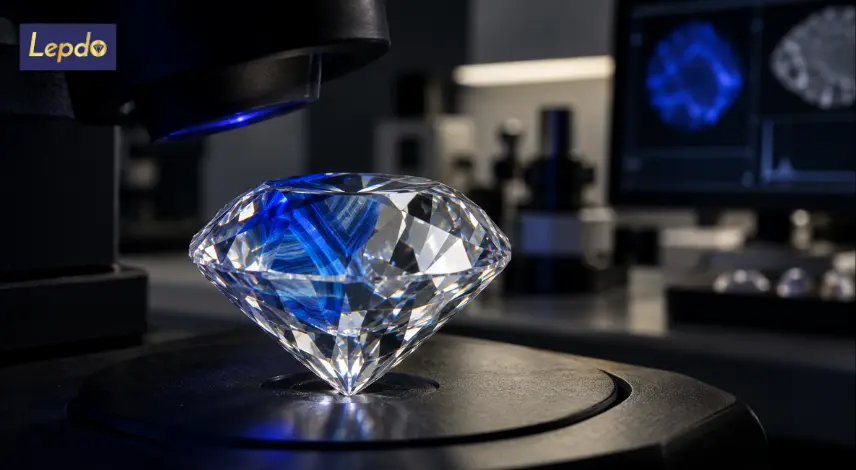
Cathodoluminescence in diamonds is the emission of light that occurs when a high-energy electron beam interacts with the diamond crystal. Certain defects, impurities, vacancies, and structural irregularities absorb this energy and subsequently release part of it as visible or near-visible light.
The resulting luminescence is not simply an attractive glow. Its position, intensity, geometry, and distribution can provide information about crystal growth and internal structure.
Quick Info Box
Definition: Cathodoluminescence is light emitted from specific defects or impurity-related centers in a diamond after excitation by high-energy electrons.
Key Types or Varieties: Growth-sector patterns, layered growth structures, defect-related emissions, interface patterns, strain-related features, and dislocation-associated structures.
Best For: Advanced diamond identification, growth-history analysis, CVD and HPHT research, difficult origin cases, and laboratory quality investigation.
Key Difference or Advantage: It can reveal structural patterns that may remain invisible during ordinary visual examination.
Buyers exploring Certified Diamonds can visit Lepdo Diamonds while comparing shapes, specifications, and grading requirements.
How Electron Excitation Reveals Hidden Diamond Structures
A diamond consists primarily of carbon atoms arranged in a highly organized crystal lattice. Real diamonds, however, are rarely structurally perfect at the atomic level.
Tiny concentrations of nitrogen, boron, vacancies, silicon-related defects, dislocations, and other imperfections can exist within that lattice. Some are introduced during growth, while others may relate to later treatment or structural change.
When an electron beam transfers energy into the diamond, certain defect centers become excited. As those centers return toward a lower-energy state, they can release energy as photons.
Think of it this way: polishing changes the external form of a diamond, but it cannot completely erase the microscopic history stored within its crystal.
Cathodoluminescence allows specialists to investigate parts of that history.
Why Cathodoluminescence Matters in Modern Diamond Identification
Cathodoluminescence in diamonds becomes especially useful when ordinary observation cannot provide enough information.
Natural diamonds form deep within Earth over geological timescales. CVD diamonds grow through chemical vapor deposition, while HPHT diamonds form under controlled high-pressure, high-temperature conditions. These different growth environments can create different structural characteristics.
Some of those characteristics can appear as sectors, lines, bands, layers, or other luminescent structures.
The truth is, one visible pattern should never be treated as absolute proof of origin. Modern production techniques continue to improve, and diagnostic features can overlap.
Professional identification therefore combines evidence.
Microscopy may reveal inclusions. Spectroscopy can detect defect-related absorption or emission. Fluorescence imaging can expose growth structures. Cathodoluminescence may provide another level of structural information when a case requires deeper investigation.
The takeaway is simple: CL is a diagnostic tool, not a one-image verdict.
Most Important Cathodoluminescence Patterns and Who They Matter To
The major variations in cathodoluminescence in diamonds are not traditional diamond shapes such as round, oval, pear, or emerald. They are patterns associated with the way a crystal grew and the defects incorporated during that process.
Six particularly useful categories include growth sectors, layered structures, interface patterns, linear striations, defect concentrations, and dislocation-related features.
Growth sectors can show that different crystallographic areas developed under different conditions. Layered structures may indicate repeated growth stages. Interfaces can reveal transitions between separate periods of crystal formation.
Linear striations can reflect directional growth behavior. Localized defect concentrations may identify areas where particular impurities accumulated. Dislocation-related luminescence can reveal structural disturbances within the lattice.
Most buyers will never inspect these patterns personally. Their importance lies behind the grading and identification process.
Growth Sectors and Crystal Architecture
Different regions of a diamond crystal do not always grow identically.
Certain crystallographic directions may incorporate impurities more readily than others. As a result, two neighboring regions inside the same crystal can produce different luminescence responses.
This creates what gemologists describe as growth-sector zoning.
Such zoning can be particularly informative when studying HPHT-grown material because controlled crystal growth may create recognizable relationships between sectors and defect concentrations.
Here is what buyers should understand: growth-sector information describes the crystal’s internal development. It does not automatically determine whether the polished stone has strong brilliance or attractive fire.
Those are separate questions.
Layered Growth and Interfaces in CVD Diamonds
CVD growth provides another fascinating example.
A CVD diamond develops through deposition of carbon onto a diamond seed. As growth continues, new material accumulates progressively.
If conditions change during this process, the resulting crystal can preserve interfaces between growth periods.
Those interfaces may differ in defect concentration, impurity distribution, or luminescence intensity.
Some CVD material therefore reveals parallel bands, layered structures, or fine growth-related lines under specialized imaging.
Most buyers might imagine laboratory-grown diamonds as perfectly uniform crystals produced in one uninterrupted process. The reality is more complex.
Growth conditions can change.
Temperature can vary. Gas chemistry can be adjusted. Growth can stop and restart. Post-growth treatment may also modify certain optical characteristics.
Each event can potentially leave microscopic evidence.
Continuous Growth and Subtle CVD Signatures
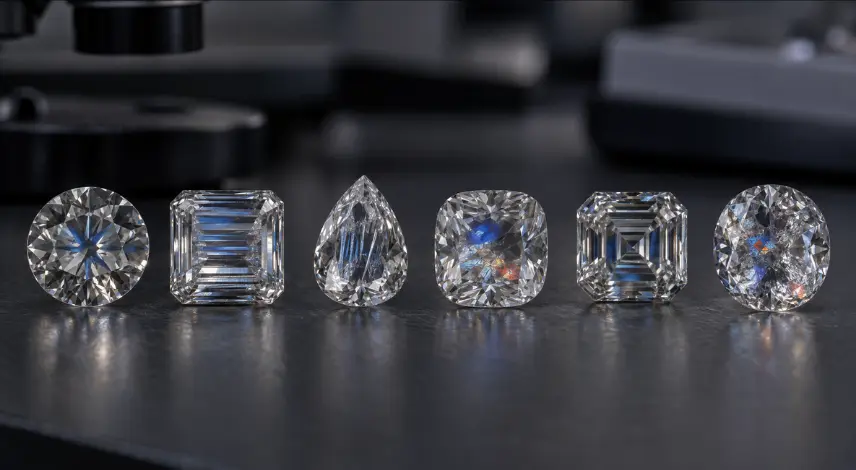
Not every CVD diamond displays obvious bands.
Modern growth systems can produce increasingly uniform material with subtler internal structures. Clear layer boundaries that might be visible in one CVD diamond may be weak or absent in another.
Fine linear striations can sometimes become more informative than dramatic growth bands.
That said, absence of a familiar feature does not automatically establish natural origin.
This is one reason cathodoluminescence in diamonds should be interpreted by specialists who understand how manufacturing technology changes over time.
The diagnostic question is rarely, “Does this stone have one particular pattern?”
A better question is, “Do all available observations tell a consistent story?”
Cathodoluminescence vs UV Fluorescence: The Real Difference
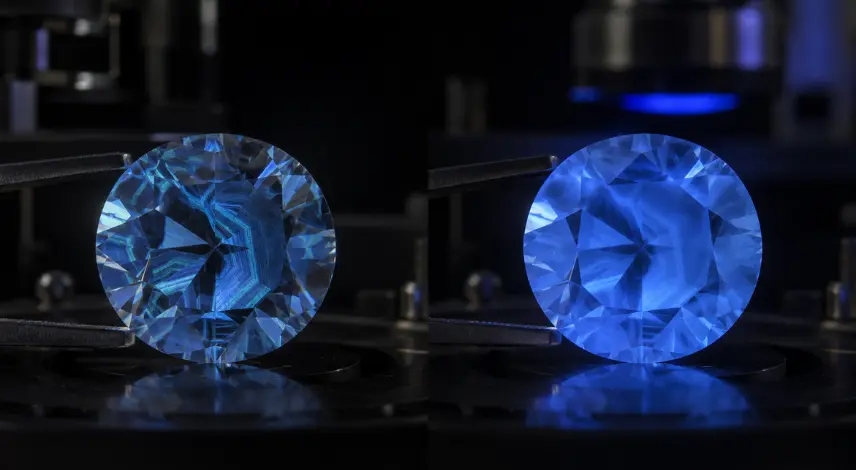
Cathodoluminescence and ultraviolet fluorescence both involve light emission, but they use different excitation sources and serve different analytical purposes.
| Factor | Cathodoluminescence | UV Fluorescence |
|---|---|---|
| Excitation Source | High-energy electrons | Ultraviolet photons |
| Main Purpose | Detailed structural investigation | Fluorescence observation and screening |
| Growth Information | Can reveal sectors, interfaces and fine structures | Can expose broader fluorescence and growth patterns |
| Equipment | Specialized laboratory instrumentation | More widely available gemological equipment |
| Typical Application | Advanced or difficult analysis | Screening and routine identification support |
Cathodoluminescence in diamonds can therefore provide a different view of the same crystal.
Neither method should automatically be considered superior. Their usefulness depends on what the gemologist is trying to determine.
Critical Differentiator: Performance and Aesthetics
A cathodoluminescence image may look dramatic, but it does not tell a consumer exactly how attractive the diamond will appear in an engagement ring.
Visible beauty depends strongly on cut quality.
Facet alignment influences light return. Crown and pavilion geometry affect brilliance and fire. Movement creates scintillation. Poorly coordinated angles can produce unwanted darkness or weak areas.
Most buyers should therefore separate laboratory identification from aesthetic evaluation.
CL asks questions about the crystal.
Unique Cut Diamonds analysis asks questions about visible optical performance.
Confusing the two can lead buyers to pay attention to scientifically interesting information that has little relationship to how beautiful the finished jewelry actually looks.
Critical Differentiator: Cost Structure and Sourcing Economics
Cathodoluminescence in diamonds does not create a standardized retail premium.
A diamond should not become more expensive simply because someone can produce a CL image of it. The commercial value lies primarily in the identification process.
For wholesalers and retailers, correct origin disclosure protects inventory integrity.
Mixing natural and laboratory-grown goods can create serious commercial problems. Mixing different laboratory-grown categories without proper records can also complicate inventory management.
Here is what matters financially: reliable sourcing reduces uncertainty.
The cost of verification should therefore be viewed as part of quality control rather than a decorative product feature.
How to Choose the Right Diamond When Cathodoluminescence Matters
Understanding cathodoluminescence in diamonds can improve your buying knowledge, but it should never distract from the characteristics that determine whether the stone suits your actual jewelry requirement.
- Choose the visual personality first. Round, oval, emerald, pear, cushion, marquise, radiant, and other shapes create very different appearances even at similar carat weights.
- Match the diamond to the setting. Pointed shapes require thoughtful protection. Bezels, prongs, halos, and architectural mountings affect both security and appearance.
- Evaluate optical performance. Look at brilliance, fire, scintillation, symmetry, table percentage, pavilion geometry, and unwanted dark areas.
- Allocate your budget intelligently. A technically higher clarity grade may provide little visual return if the lower grade is already eye-clean.
- Consider the intended occasion. Everyday engagement jewelry demands different practical thinking from earrings, pendants, statement pieces, or bespoke collections.
- Confirm diamond origin. Natural and lab-grown diamonds require clear disclosure. CVD and HPHT laboratory-grown diamonds are genuine diamonds, but their manufacturing origin should be represented accurately.
Before you finalize your choice, ask yourself one simple question: am I paying for something I can appreciate, or merely for a specification on paper?
Balancing Proportions, Ratio, and Setting Security
Cathodoluminescence cannot rescue weak proportions.
For elongated diamonds, length-to-width ratio changes how narrow, broad, elegant, or substantial the stone appears. Table percentage and pavilion depth influence optical behavior, although ideal combinations vary according to shape and facet architecture.
Setting security deserves equal attention.
A marquise tip or pear point has different vulnerability from the curved outline of a round diamond. Appropriate prongs, V-prongs, or bezel protection may therefore matter more for everyday durability than any CL characteristic.
Before you buy, examine the diamond as jewelry rather than only as a laboratory specimen.
Navigating Price Tiers vs Visual Return
The best diamond cert for retailers value often exists where technical specifications and visible differences stop moving together.
For example, moving from an eye-clean clarity grade to an exceptionally high clarity grade can increase price without creating an obvious naked-eye improvement.
Color behaves similarly.
Metal choice, diamond size, shape, cut architecture, and personal Fancy Color Diamonds sensitivity can influence whether paying for a higher color grade creates enough visible return.
Most buyers should spend first on characteristics they can actually see.
What B2B Buyers and Diamond Manufacturers Should Know
For professional sourcing, cathodoluminescence in diamonds is primarily relevant to identification confidence and supply-chain transparency.
A retailer buying from a Fancy Shape Diamonds manufacturer needs more than attractive stones. Inventory should arrive with repeatable specifications, clear origin disclosure, appropriate diamond certification, and dependable sorting.
Gemological Institute of America (GIA) and International Gemological Institute (IGI) laboratory testing can play important roles in professional diamond verification and grading. Rapaport also remains a recognized reference within natural-diamond pricing discussions, although laboratory-grown diamond economics operate differently.
For CVD and HPHT procurement, buyers should keep laboratory-grown inventory clearly identified throughout purchasing, sorting, cataloging, sales, and customer communication.
Lepdo Diamonds operates from Surat, India, with certified CVD and HPHT laboratory-grown diamond inventory across multiple shapes, DEFG color ranges, and VVS to VS clarity ranges.
Here is my diamond trade india tip: never build an origin decision around one visual clue. A strong procurement system combines documentation, reliable grading, supplier transparency, and consistent inventory controls.
Wholesale Procurement Models: Memo Programs vs Direct Sourcing
Memo and direct purchasing solve different inventory problems.
A memo arrangement can reduce upfront capital exposure because selected diamonds remain subject to agreed return conditions. This can be useful when a retailer needs broader assortment without purchasing every stone immediately.
Direct sourcing places more inventory responsibility on the buyer but can provide stronger control over assortment, pricing negotiations, and replenishment.
The truth is, the lowest unit price is not automatically the best commercial decision.
Inventory turnover matters.
A slightly more expensive parcel that matches customer demand and moves consistently can outperform cheaper inventory that remains unsold.
Batch Consistency, Calibration, and Tolerance Standards
Consistency becomes critical when diamonds are purchased in volume.
Imagine producing 100 matching jewelry pieces. Tiny differences that seem insignificant in individual stones can become obvious when those stones appear side by side.
Parcels should therefore be sorted using defined tolerances for millimeter dimensions, carat weight, color, clarity, and visible appearance.
Calibrated diamonds used for tennis bracelets, eternity rings, halos, pavé layouts, and matched earrings require especially careful sorting.
Cathodoluminescence answers a different question.
It can help investigate growth characteristics, but it does not replace physical calibration or visual matching.
Cathodoluminescence in Diamond Jewelry Trends for 2026 to 2027
Cathodoluminescence in diamonds is becoming more relevant behind the scenes as laboratory-grown manufacturing becomes more advanced.
CVD producers can now create substantially larger rough crystals than were typical during the industry’s earlier commercial years. Improvements in growth control also allow manufacturers to produce cleaner material and increasingly consistent polished inventory.
The commercial consequence is straightforward.
Visual appearance alone becomes less useful for determining origin.
During 2026 and 2027, retailers should expect customers to ask increasingly detailed questions about CVD, HPHT, diamond certification, treatments, traceability, and value.
That creates an opportunity for knowledgeable jewelers.
Contemporary Setting Styles and Architectural Mountings
Modern jewelry is increasingly using the diamond’s silhouette as part of the design itself.
East-west elongated settings, protective bezels, asymmetric arrangements, three-stone layouts, mixed fancy shapes, and low-profile engagement rings can make familiar diamonds feel visually different.
Lab-grown diamonds also give some buyers greater freedom to experiment with larger center stones or multi-diamond arrangements within a defined budget.
That does not mean bigger always looks better.
Balance still matters.
A well-proportioned diamond that works naturally with its mounting can create stronger visual impact than a larger stone chosen primarily for carat weight.
Shifting Consumer Demographics and Purchasing Drivers
Today’s diamond customer can compare far more information before entering a jewelry store.
Natural origin, laboratory growth, CVD versus HPHT, grading laboratories, fluorescence, proportions, resale expectations, and pricing can all become part of the same buying conversation.
That transparency changes what good selling looks like.
Consumers increasingly expect retailers to explain why two visually similar diamonds may carry very different prices.
To be fair, natural diamonds continue to serve buyers who prioritize geological origin, rarity, and the traditional natural-diamond market. Laboratory-grown diamonds appeal to buyers with different priorities, including size, budget flexibility, design freedom, and technological origin.
Neither story should require confusing the customer.
How to Evaluate Quality in Cathodoluminescence in Diamonds
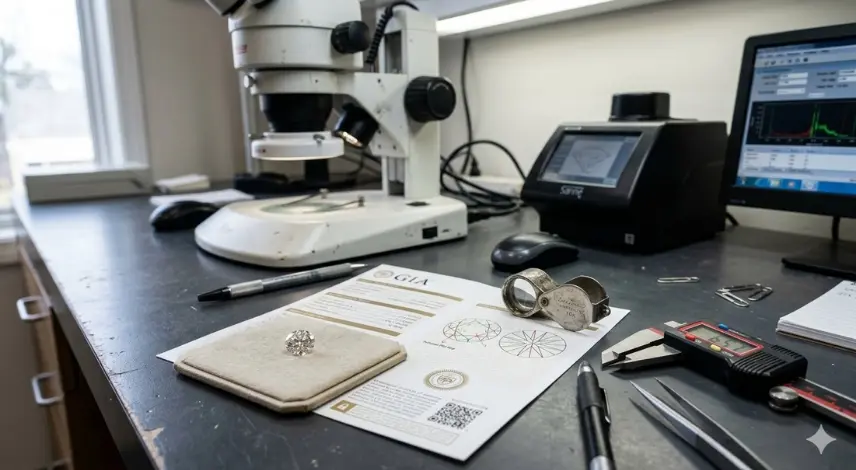
When I assess a diamond, the first thing I check is whether we are discussing visible quality or scientific identification. Cathodoluminescence in diamonds belongs primarily to the second category.
Use these five evaluation rules.
- Separate origin from appearance. Growth patterns may support identification, while brilliance, fire, and scintillation determine visible optical character.
- Examine cut precision. Pavilion depth, table percentage, crown geometry, symmetry, and facet relationships affect light return.
- Assess clarity intelligently. Inclusion type, size, position, relief, and potential durability impact matter alongside the clarity grade.
- Keep color and CL behavior separate. Luminescence color is not the same thing as conventional diamond color grading.
- Look for agreement between tests. Difficult identification should involve complementary evidence rather than dependence on one unusual pattern.
Here is what professional buyers should remember: a beautiful polished diamond and an accurately identified diamond are two separate requirements. Good sourcing demands both.
Analyzing Light Return: Spotting Bow-Ties, Windows, and Extinction
Cathodoluminescence in diamonds should never be confused with light-performance analysis.
A bowtie effect occurs when certain facet arrangements create a dark band across parts of elongated brilliant-cut diamonds. Ovals, pears, marquises, and some cushions can show it to varying degrees.
Windows create another issue. Instead of returning enough light toward the viewer, part of the stone can appear transparent or visually weak.
Extinction refers to dark areas that remain unresponsive under particular viewing conditions.
These characteristics influence beauty directly.
Cathodoluminescence generally does not.
Most buyers should therefore inspect a diamond under different lighting conditions and viewing angles rather than relying entirely on specifications.
Assessing Diamond Reports and Grading Discrepancies
A diamond grading report should answer specific questions, not replace judgment.
Check the carat weight, measurements, color grade, clarity grade, proportions, polish, symmetry, inscriptions, and relevant comments.
Where a clarity plot is provided, examine the type and location of inclusions. A feather close to a vulnerable edge deserves different consideration from a tiny internal characteristic positioned safely inside the stone.
Diamond grading can also involve professional judgment within established standards.
Before you compare two reports, confirm that you are actually comparing equivalent specifications and grading contexts.
Strategic Takeaways for Buyers and Jewelers
Cathodoluminescence in diamonds gives gemologists a view of diamond structure that ordinary jewelry lighting cannot provide. Growth sectors, microscopic interfaces, defect distributions, and other patterns evaluated through cathodoluminescence in diamonds preserve vital information about crystal formation.
Its second lesson is equally important: one diagnostic feature from cathodoluminescence in diamonds is rarely enough. Modern identification and screening increasingly depend on multiple observations supporting cathodoluminescence in diamonds.
For the consumer, scientific findings from cathodoluminescence in diamonds should remain separate from beauty. Brilliance, fire, scintillation, cut quality, carat weight, clarity, color, proportions, and setting compatibility determine visual appeal far more than cathodoluminescence in diamonds.
For jewelers and B2B buyers, the priority is connected: accurate origin disclosure confirmed by methods like cathodoluminescence in diamonds, dependable certification, consistent specifications, and controlled sourcing protect inventory and customer trust.
Lepdo Diamonds supplies certified CVD and HPHT laboratory-grown diamonds from Surat, India for professional buyers seeking clearly specified inventory across shapes, color ranges, and clarity requirements. Before you make the final sourcing decision, remember the simplest lesson hidden inside cathodoluminescence in diamonds: two stones may look remarkably similar on the surface while telling completely different internal stories.
Frequently Asked Questions About Cathodoluminescence in Diamonds.
1. What Is Cathodoluminescence in Diamonds?
Cathodoluminescence in diamonds is light emitted when high-energy electrons excite specific defects and impurities within a diamond crystal. Gemologists can study cathodoluminescence in diamonds to investigate growth sectors, layers, interfaces, and structural irregularities. Cathodoluminescence in diamonds is primarily an advanced analytical technique rather than a visible quality characteristic used by consumers when selecting jewelry.
2. Is Cathodoluminescence in Diamonds Cheaper Than UV Fluorescence?
There is no standard consumer price comparison because cathodoluminescence in diamonds and UV fluorescence testing serve different analytical purposes. UV-based examination is more accessible in routine gemological environments, while cathodoluminescence in diamonds generally requires specialized equipment. Buyers should focus on whether appropriate testing like cathodoluminescence in diamonds has established diamond identity and origin rather than choosing a stone based on the cost of one test.
3. Which Cathodoluminescence in Diamonds Pattern Looks Biggest or Most Impressive?
No pattern revealed by cathodoluminescence in diamonds makes a diamond appear larger on the hand. Cathodoluminescence in diamonds describes microscopic crystal characteristics rather than normal jewelry appearance. Visual spread depends mainly on carat weight, shape, dimensions, proportions, and setting rather than patterns found in cathodoluminescence in diamonds.
4. Does Cathodoluminescence in Diamonds Have an Official GIA Cut Grade?
No. Cathodoluminescence in diamonds is not a cut grade. Cathodoluminescence in diamonds is a laboratory phenomenon used to investigate structural and growth characteristics. Cut assessment concerns how a polished diamond’s proportions, facets, symmetry, and optical behavior influence appearance, which remains completely separate from cathodoluminescence in diamonds.
5. What Is the Biggest Quality Risk to Watch for in Cathodoluminescence in Diamonds?
The greatest analytical risk is assuming that one feature in cathodoluminescence in diamonds definitively proves diamond origin. Natural, CVD, and HPHT stones can exhibit complex defect structures under cathodoluminescence in diamonds. Specialists therefore interpret cathodoluminescence in diamonds together with microscopy, fluorescence behavior, and spectroscopy rather than treating one pattern in cathodoluminescence in diamonds as definitive.
6. Are Lab-Grown Diamonds Chemically and Optically Identical to Natural Ones Under Cathodoluminescence in Diamonds?
Lab-grown diamonds share the fundamental carbon crystal structure of natural stones, but their growth histories differ when examined under cathodoluminescence in diamonds. CVD and HPHT manufacturing can leave microscopic structural and spectroscopic signatures detectable through cathodoluminescence in diamonds. Professional laboratories use cathodoluminescence in diamonds to help distinguish laboratory-grown material from mined diamonds.
7. Does Cathodoluminescence in Diamonds Affect Durability for an Everyday Engagement Ring?
No. Cathodoluminescence in diamonds does not influence everyday durability. Practical durability depends heavily on shape, inclusion condition, girdle integrity, and setting protection rather than features imaged via cathodoluminescence in diamonds. A properly secured, well-selected stone performs well in daily wear regardless of its internal patterns under cathodoluminescence in diamonds.
8. How Do I Choose a Reliable Supplier Using Cathodoluminescence in Diamonds?
Choose a manufacturer that clearly discloses origin, utilizes advanced screening such as cathodoluminescence in diamonds, supplies appropriate certification, and separates inventory correctly. B2B buyers should examine how cathodoluminescence in diamonds is applied alongside parcel calibration, repeatability, and quality control before stones enter retail inventory.
For in-depth market reports, trade sourcing guides, interactive Q&As, and expert gemological perspectives, explore the official Lepdo Group Medium platform and join the discussion on Lepdo Diamonds on Quora.