IGI Certified Lab Grown Diamonds in India: Why Certification Matters When Buying Lab Diamonds
 by lepdogroup@gmail.com
5 comments
by lepdogroup@gmail.com
5 comments
IGI certified lab grown diamonds from India are real diamonds graded by the International Gemological Institute for color, clarity, cut, and carat weight. Certification matters because it protects buyers from mislabeled or treated stones and gives retailers the documentation their customers expect. Lepdo Diamonds connects US buyers directly with India’s most trusted IGI-certified lab-grown diamond suppliers.
A US jewelry retailer once called me after receiving a shipment of lab-grown diamonds from a new Indian supplier. The stones looked beautiful in photographs. The price was compelling. But not a single one came with a verifiable certificate. When we finally had them independently graded, nearly a third of them were mis-stated by one full color grade. That experience cost the retailer tens of thousands of dollars and four months of delayed inventory. It also made a believer out of him: IGI certified lab grown diamonds India now sits at the top of his sourcing checklist, non-negotiable.
The lab-grown diamond market in India has grown at a pace few analysts predicted. India now accounts for roughly 70 percent of global lab-grown diamond production, and the International Gemological Institute, with its major grading lab in Surat, grades more lab-grown diamonds each year than any other certification body in the world. For US buyers, whether retail consumers searching for an engagement ring or B2B wholesalers placing five-figure orders, understanding the role of IGI certification is no longer optional. It is the baseline for doing business correctly.
This post covers everything you need to know: how IGI grading actually works for lab-grown stones, how it compares to GIA, what B2B buyers should demand before placing an order, how to verify a certificate independently, and which certification trends are reshaping the US market through 2026.
What Are IGI Certified Lab Grown Diamonds in India?
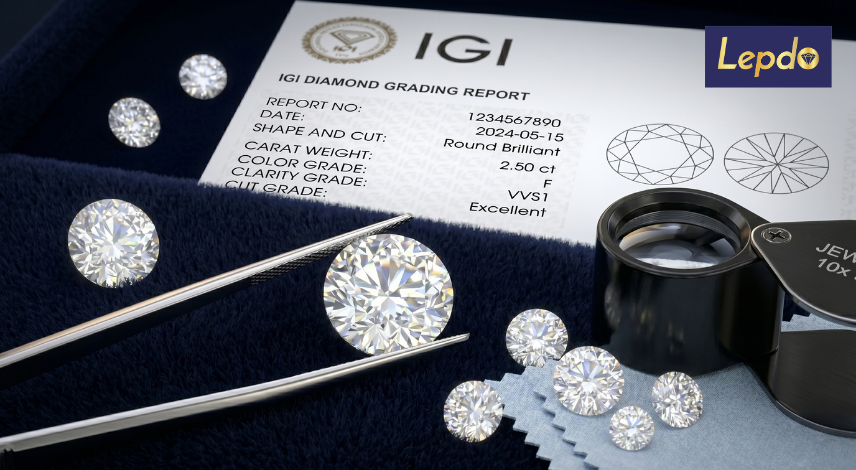
IGI certified lab grown diamonds are lab-created diamonds that have been independently evaluated by the International Gemological Institute and issued a grading report documenting the stone’s color, clarity, cut, and carat weight. The certificate also identifies the growth method (CVD or HPHT) and discloses any post-growth treatments such as HPHT color enhancement.
India’s position in this ecosystem is significant. IGI established a dedicated grading lab in Surat specifically because of the volume of lab-grown production concentrated there. That physical proximity gives Indian manufacturers faster turnaround times, lower per-stone certification costs, and a streamlined path to the US market compared to manufacturers in other countries who must ship stones internationally for grading.
| Definition: | IGI certified lab grown diamonds are independently graded real diamonds, grown in a lab and issued a formal report covering color, clarity, cut, and carat weight by the International Gemological Institute. |
| Key Types: | CVD white, HPHT-treated CVD, fancy color CVD, fancy shape CVD, HPHT-grown white, melee parcels |
| Best For: | Engagement rings, fine jewelry, wholesale B2B sourcing, investment-grade certified diamonds |
| Key Advantage: | IGI assigns cut grades to both round brilliants and popular fancy shapes, which GIA does not for fancy shapes |
To understand the full certification framework behind lab-grown stones, the Diamond Certification glossary at Lepdo Diamonds provides a clear technical breakdown of what grading labs actually evaluate and why each factor matters to the buyer.
Most Popular IGI Certified Lab Grown Diamond Types: And Who They Are For
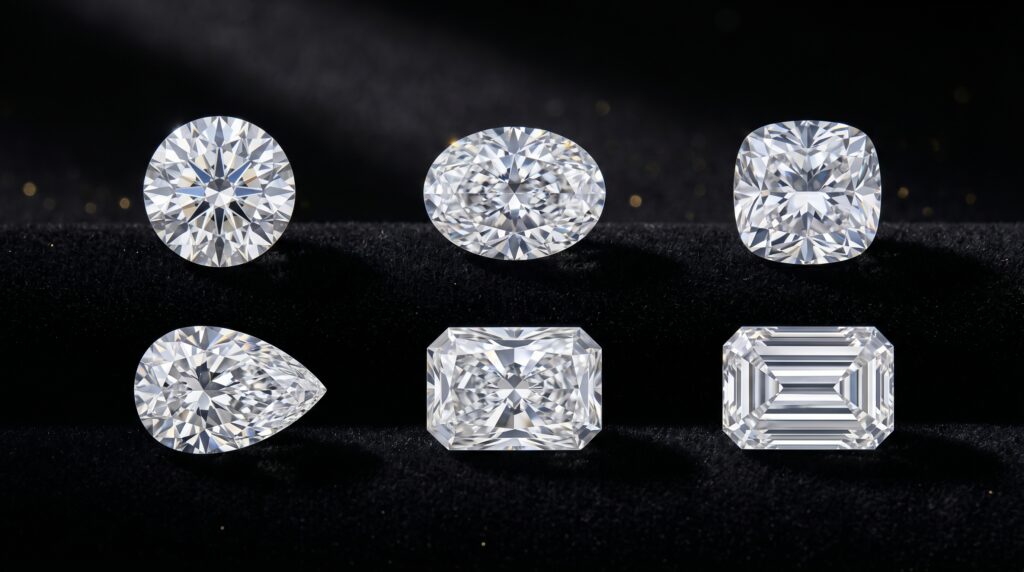
Not every IGI-certified lab-grown diamond serves the same buyer. The Indian production ecosystem generates several distinct categories, each with a different price point, buyer profile, and end use. Here is what the supply side actually looks like.
1. Standard White CVD Diamonds (D to J Color, VS to SI Clarity)
This is the core of Indian lab-grown production and the most commonly requested category by US retailers. These stones are grown by chemical vapor deposition, certified by IGI without post-growth treatment, and sold with full documentation of color and clarity. Most B2B buyers sourcing center stones in the 1.00 to 2.00 carat range shop heavily in this category. The IGI certificate gives their downstream retail customers the confidence to purchase.
2. HPHT-Treated CVD Diamonds (Color-Enhanced)
Some CVD rough grows with a brownish or grayish tint caused by trace elements absorbed during reactor growth. A secondary HPHT treatment cycle can shift the color grade toward D, E, or F. A legitimate IGI report will state clearly whether post-growth treatment was applied. This is not a defect if disclosed, but it is a non-starter if hidden. Buyers should always read this section of the IGI report before purchasing.
3. Fancy Shape IGI Certified Diamonds
Oval, cushion, elongated radiant, pear, and emerald cut lab-grown diamonds with IGI certification have seen a dramatic demand surge since 2023. IGI’s decision to assign formal cut grades to these shapes gives US buyers a quantifiable quality benchmark, something GIA does not provide for fancy shapes. This makes IGI reports especially valuable for B2B buyers sourcing fancy shapes at scale.
4. Fancy Color CVD Diamonds:
Vivid yellow, blue, and pink lab-grown diamonds certified by IGI serve the fashion jewelry and bespoke design markets. The IGI report identifies the color origin and any post-growth treatments used to achieve the final hue. These stones are significantly less expensive than natural fancy color equivalents.
5. Melee and Small Commercial IGI Parcels:
Stones under 0.30 carats certified in IGI lot reports are used for pave settings, halos, and eternity bands. Indian manufacturers have effectively replaced natural melee for many US wholesalers on both price and consistency.
6. Large IGI Certified CVD (3 Carats and Above):
The 3-plus carat segment is one of the fastest-growing categories in the US luxury lab-grown market. IGI-certified stones in this size range now routinely appear in fine jewelry collections at retail prices that mined equivalents cannot approach.
IGI Certified Lab Grown Diamonds vs GIA Certified: The Real Difference
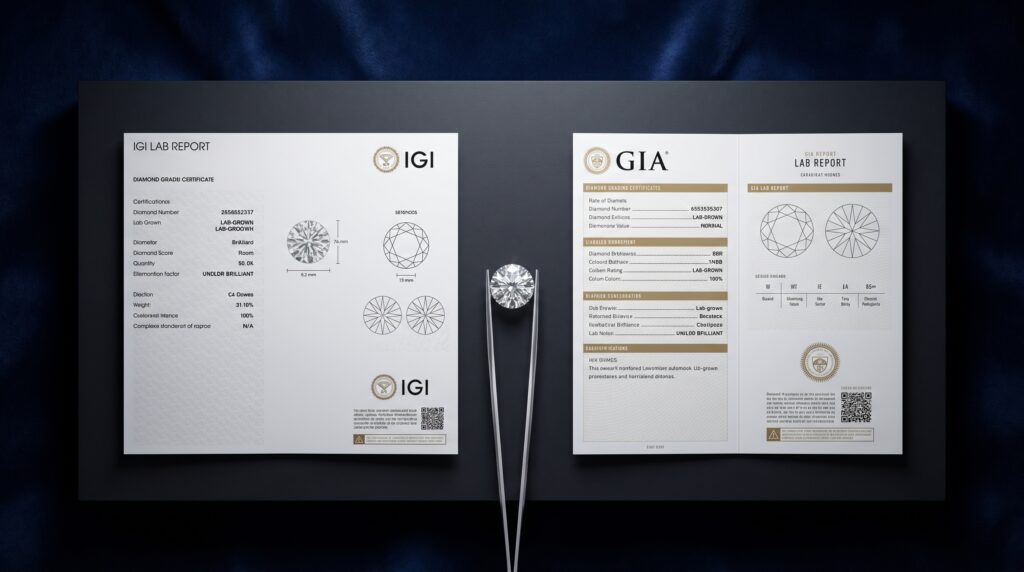
Most buyers approaching the lab-grown market ask this question early: should I buy IGI or GIA certified diamonds? The honest answer is that both are reputable grading standards with real differences in market positioning, turnaround, and specialty. Neither is universally superior for every buyer.
| Factor | IGI Certified Lab Grown Diamonds | GIA Certified Lab Grown Diamonds |
| Market Presence in India | Dominant over 80% of Indian lab-grown diamonds carry IGI reports | Growing, but still a smaller share of Indian-produced stones |
| Cut Grade for Fancy Shapes | Assigned for rounds, ovals, cushions, and most popular fancy shapes | Not assigned for fancy shapes; polish and symmetry only |
| Report Turnaround Time | Faster IGI has a major lab in Surat enabling quicker B2B cycles | Longer stones often shipped internationally for grading |
| Price Impact at Wholesale | IGI reports typically add less cost; widely accepted by US retailers | GIA commands a small premium; preferred by some luxury buyers |
| Consumer Recognition (USA) | Rapidly increasing; now accepted at all major retail tiers | Highest consumer trust; preferred for top-tier luxury positioning |
In practice, a well-graded IGI certified diamond and a well-graded GIA Certified Diamonds stone will look identical in a finished jewelry piece. The distinction matters more to B2B buyers managing inventory positioning than to end consumers. That said, for the US mid-market and wholesale segments, IGI’s Surat lab gives Indian manufacturers a genuine operational edge: faster grading cycles, lower certification cost per stone, and cut grades on fancy shapes that GIA does not provide. For luxury retail positioning at the highest price points, some US retailers still favor GIA for its consumer recognition advantage.
For a detailed side-by-side comparison of grading criteria, report formats, and market acceptance, the IGI vs GIA resource at Lepdo Diamonds covers both labs thoroughly.
How to Choose the Right IGI Certified Lab Grown Diamond for Your Style
Choosing an IGI certified lab grown diamond is not just about picking the best numbers on a report. It involves matching the stone to the wearer’s personality, the setting design, the occasion, and the real-world budget. Here is a decision framework that works for both retail consumers and B2B buyers selecting inventory.
- Personal style and visual personality: Round brilliant diamonds deliver the highest light return and suit traditional tastes. Oval and elongated radiant cuts create a modern elongating effect. Cushion cuts carry a vintage warmth that many buyers find compelling. Let the wearer’s aesthetic preference lead the shape decision, not just current trends.
- Finger and hand compatibility: Elongated shapes like oval, pear, and marquise visually lengthen shorter fingers. Wider shapes like cushion and Asscher read larger face-up. Always factor in the wearer’s hand proportion and finger size before recommending a shape to a retail customer.
- Setting compatibility: A CVD diamond in a prong solitaire needs strong cut grades and excellent symmetry because every facet is exposed to direct scrutiny. Bezel and channel settings are more forgiving and pair well with commercial-grade stones in the VS2 to SI1 clarity range.
- Budget advantage: IGI certified lab grown diamonds from India typically cost 60 to 80 percent less than equivalent mined diamonds. This opens up meaningful size upgrades. A buyer who might have purchased a 0.80-carat natural diamond can often afford a 1.75-carat IGI-certified lab-grown stone at the same price point.
- Occasion and use case: For engagement rings, prioritize IGI cut grade and certification documentation above all else. For fashion jewelry and stackable pieces, commercial-grade stones in SI clarity are perfectly appropriate. For investment or resale purposes, only buy stones with GIA or IGI certificates that are independently verifiable online.
- Lab-grown versus natural: The economics are clear, and consumer acceptance is accelerating. The lab grown diamonds glossary at Lepdo Diamonds outlines the key certification benchmarks you should insist on for any lab-grown purchase, whether you are buying one stone or a full parcel for your inventory. For detailed grading specs, the IGI Certified Diamonds resource covers everything from color nuances to report reading.
Before you finalize your choice, take the IGI certificate number and verify it directly on IGI’s online portal. Confirm the color grade, clarity grade, cut grade, and treatment disclosure match exactly what your supplier told you. A certificate that cannot be verified independently is not a certificate at all. For more context on what the verification process involves, visit the Diamond Certification Check glossary page.
What B2B Buyers and Diamond Manufacturers Should Know
The truth is, buying IGI certified lab grown diamonds at the B2B level requires a different evaluation mindset than consumer retail. Grading consistency across a full parcel, not just a single sample stone, is the first thing any wholesale buyer should assess. When you order 300 pieces of 0.50-carat round lab-grown diamonds from an Indian manufacturer, you are trusting that the IGI grades are consistent across the entire lot, not just the stones you were shown during negotiation.
Here is what separates a reliable Indian lab-grown supplier from one that will create downstream problems. First, insist on individual IGI certificates for every stone in a parcel, not a batch report covering the full lot. Batch reports protect the manufacturer, not the buyer. Individual certificates protect your downstream customers and give you recourse if grade misrepresentation becomes an issue. Second, understand how Rapaport pricing works for lab-grown diamonds: the Rapaport Lab-Grown Price List is updated regularly and is the standard reference for B2B negotiations in the US market. Indian CVD diamonds currently trade at significant discounts to natural diamond Rapaport values, and those discounts have been compressing margins at smaller carat sizes as supply continues to increase.
For a structured approach to qualifying new Indian suppliers, the Diamond Certification Labs resource covers the due-diligence steps experienced US buyers use when evaluating grading lab affiliations, reactor types, and treatment disclosure practices.
In my experience working directly with Surat manufacturers, the single most reliable indicator of a trustworthy supplier is not their price list. It is whether they proactively disclose HPHT post-growth treatment on CVD stones without being asked. Any supplier who hesitates or becomes defensive about treatment disclosure should be removed from your approved vendor list immediately. Transparency on this one issue tells you nearly everything you need to know about how they handle every other quality question.
IGI Certified Lab Grown Diamond Jewelry Trends in the USA (2026 to 2027)
The US lab-grown diamond jewelry market crossed 10 percent of total diamond jewelry sales by retail value in 2026, and IGI certified lab grown diamonds from India are driving the majority of that volume. The most significant shift heading into 2027 is the mainstream acceptance of lab-grown diamonds as engagement ring center stones, a transition that was still considered niche by many traditional retailers just three years ago.
Design trends are moving decisively toward East-West oval settings, hidden halo constructions, and split-shank solitaires that showcase larger lab-grown center stones. Yellow gold with colorless IGI-certified diamonds has surged sharply, driven by a broader industry shift away from white metal. Eternity bands and three-stone anniversary rings set with IGI-certified melee parcels from India are outperforming natural equivalents at every price point in the $3,000 to $8,000 retail bracket. Lab-grown diamond jewellery in these styles now accounts for a growing share of anniversary and milestone gift purchases, not just first-time engagement ring buyers.
Celebrity and cultural influence continues to accelerate demand for specific shapes. Elongated cushion and oval IGI lab diamond styles saw a significant demand spike in early 2026 following several high-profile ring reveals covered by major US fashion and lifestyle media. The appetite for larger, fancy-shape certified lab diamonds is not softening. It is growing with every engagement season.
How to Evaluate Quality in IGI Certified Lab Grown Diamonds
When I assess an IGI certified lab grown diamond, the first thing I check is not the report. It is the stone under magnification. The pavilion depth percentage and table percentage tell me immediately whether the cutter prioritized weight retention over light performance, and that trade-off is common in high-volume Indian production where carat weight drives wholesale pricing.
You will want to pay attention to these five evaluation points before committing to any significant purchase:
- Cut grade and proportions: For round brilliants, look for table percentages between 54 and 58 percent and depth percentages between 61 and 62.5 percent. Stones outside these ranges sacrifice fire and scintillation for carat weight. IGI’s cut grade for fancy shapes is also worth checking: an IGI Excellent or Ideal cut oval will deliver noticeably better light return than a VG-graded stone at the same clarity.
- Strain patterns and growth characteristics: CVD diamonds sometimes exhibit a distinct strain pattern visible under cross-polarized light. This is a growth characteristic, not a clarity flaw, but it can indicate rapid growth conditions, which sometimes correlate with less consistent optical performance across a parcel.
- Color nuances beyond the letter grade: Some IGI certified lab grown diamonds show a faint gray or brown modifier that does not appear in the certificate’s single color letter. Always view the stone face-up and face-down under neutral daylight-equivalent lighting before committing. A D-grade stone with a gray modifier will not face up like a true D.
- Clarity specifics in lab-grown stones: Pinpoint inclusions and small clouds are common in CVD rough. Feathers are rare. IGI uses the same clarity scale as natural diamonds, so a VS2 lab-grown stone will have inclusions not visible to the naked eye. At SI1, some inclusions may be visible under 10x magnification but not face-up in a ring setting.
- Certificate verification: Always cross-reference the IGI report number against the IGI online portal in real time. Confirm the growth method, color grade, clarity grade, cut grade, and treatment disclosure. Certified diamonds from a verified source will always pass this check instantly.
For detailed grading benchmarks by diamond type, the Lab Diamond Certification glossary covers the specific standards IGI applies to both CVD and HPHT lab-grown stones, including how treatment disclosure appears on the report.
Conclusion: Why IGI Certification Is Non-Negotiable When Buying Lab Grown Diamonds from India
Three things stand out after covering the full landscape of IGI certified lab grown diamonds in India. First, IGI certification has become the genuine standard for lab-grown diamond transactions in the US market, not because of marketing, but because it delivers what buyers actually need: an independently verified, publicly checkable record of color, clarity, cut, and treatment status. The infrastructure around that standard, particularly IGI’s Surat grading lab, has matured to the point where B2B buyers can source certified stones at scale with real confidence.
Second, the economics remain compelling. A well-graded IGI certified lab grown diamond from India represents 60 to 80 percent savings versus an equivalent natural stone without any sacrifice in the 4Cs or in light performance. That gap is what is driving US retail adoption across every price tier, from accessible fashion jewelry to luxury engagement ring collections.
Third, the quality ceiling keeps rising. Indian manufacturers have invested heavily in reactor technology, cutting equipment, and grading discipline, and the results are showing in the consistency of IGI reports coming out of Surat today. To explore Lepdo Certified Diamonds with full IGI documentation, transparent pricing, and direct access to India’s most trusted manufacturers, Lepdo Diamonds is the right starting point. The lab-grown diamond industry is not just growing. It is being built to last, and IGI certified lab grown diamonds from India are at the center of that story.
Frequently Asked Questions About IGI Certified Lab Grown Diamonds in India
1. What are IGI certified lab grown diamonds in India?
IGI certified lab grown diamonds in India are lab-created diamonds independently graded by the International Gemological Institute for the 4Cs: color, clarity, cut, and carat weight. India, especially Surat in Gujarat, is the world’s largest producer of lab-grown diamonds, and IGI’s Surat grading lab evaluates the majority of them. The resulting IGI diamond report gives buyers a documented, verifiable record of the stone’s characteristics and any post-growth treatments applied.
2. Are IGI certified lab grown diamonds cheaper than natural diamonds?
Yes. IGI certified lab grown diamonds from India typically cost 60 to 80 percent less than comparable natural diamonds. Prices have continued to fall as production volume in Surat and surrounding Gujarat has scaled. You can find well-graded D to F, VS1 to VS2 lab-grown stones today at prices that would have been unimaginable five years ago. For current benchmark pricing, the IGI Certification glossary at Lepdo Diamonds covers current wholesale market reference ranges.
3. Which IGI certified lab grown diamond looks most impressive?
An IGI certified lab grown diamond graded D to F in color, VS1 to VS2 in clarity, and cut to Excellent standards will look visually stunning in any setting. Cut quality is the most important variable: a well-proportioned stone in the VS range will consistently outperform a higher-clarity stone with poor cut grades in real-world light performance and face-up brilliance. Think of it this way: a dull D-color diamond is always less impressive than a sparkling G-color stone with ideal proportions.
4. Does an IGI certified lab grown diamond have a cut grade?
Yes. IGI assigns cut grades to round brilliants and to popular fancy shapes including oval, cushion, pear, and radiant cut lab-grown diamonds. GIA also grades cut for round brilliants, but does not assign a formal cut grade to fancy shapes, providing only polish and symmetry grades instead. For B2B buyers sourcing fancy shape lab diamonds, IGI’s cut grading is a meaningful practical advantage when evaluating consistent quality across large parcels.
5. What is the biggest quality risk with IGI certified lab grown diamonds from India?
The most common risk is undisclosed or misrepresented post-growth treatment. Some CVD lab-grown diamonds develop a brownish or grayish tint during reactor growth and undergo HPHT treatment afterward to improve color. A legitimate IGI diamond report will disclose whether any post-growth treatment was applied. Always verify your certificate number directly on IGI’s online portal before committing to a purchase. A supplier who cannot confirm treatment status should be disqualified.
6. Are IGI certified lab grown diamonds as good as natural diamonds?
Chemically and physically, yes. An IGI certified lab grown diamond is 100 percent carbon with the same crystal structure, hardness, brilliance, and fire as a mined diamond. The difference is origin. IGI grades lab-grown diamonds using the same 4Cs standards applied to natural stones, and their reports are accepted by leading US retailers, appraisers, and insurers. To be fair, natural diamonds retain a scarcity-based value that lab-grown stones do not, which matters for resale.
7. Which IGI certified lab grown diamond is best for an engagement ring?
A round brilliant lab grown diamond with an IGI grade of Excellent cut, D to F color, and VS1 to VS2 clarity is the most popular and safest choice for an engagement ring. Oval and cushion cuts with strong IGI cut grades are gaining ground quickly among buyers who want a distinctive look at a better price per carat. For any solitaire setting, prioritize cut quality above clarity, since light performance is what makes a diamond visually compelling in everyday wear.
8. How do I choose a reliable IGI certified lab grown diamond supplier in India?
Most buyers focus on price first. That is the wrong starting point. Look for a supplier that provides individually IGI-certified stones verifiable on IGI’s portal for every transaction, publishes transparent pricing benchmarked to Rapaport, maintains consistent grading across repeat orders, and has a documented track record with US-based B2B clients. Lepdo Diamonds is a verified trusted supplier in India with direct access to IGI-certified CVD and HPHT lab-grown diamonds for wholesale and retail channels serving the US market.