Diamond Parcel Buying Guide: How to Evaluate and Purchase Diamond Parcels Wholesale
 by lepdogroup@gmail.com
0 comments
by lepdogroup@gmail.com
0 comments
A diamond parcel buying guide is a structured resource that helps wholesalers, retailers, and manufacturers evaluate and purchase batches of loose diamonds efficiently. Understanding parcel grading, pricing benchmarks, and supplier vetting is critical to protecting margin and quality. Lepdo Diamonds, a certified loose diamond supplier from Surat, India, offers IGI and GIA certified parcels directly to verified B2B buyers in the USA and globally.
Over 70% of diamonds sold globally move through the supply chain not as individual certified stones, but as parcels, mixed or matched lots that travel from cutting centers in Surat and Antwerp to retailers and wholesalers before a single customer ever sees them. Yet most buyers, even experienced ones, enter parcel negotiations without a clear framework for evaluation. That is where this diamond parcel buying guide becomes essential.
Whether you are a jewelry retailer in the USA restocking your engagement ring inventory, a wholesaler sourcing for the holiday season, or a manufacturer looking to buy diamond parcels wholesale with consistent cut quality, the rules of smart parcel buying are the same. You need to understand what is inside the lot, how it is graded, what the price benchmarks should be, and which supplier relationships are worth building.
This guide covers all of it: from understanding the types of diamond parcels and how mixed diamond parcel buying works, to evaluating cut quality, clarity grades, and getting a fair price tied to Rapaport benchmarks.
What Is a Diamond Parcel?
A diamond parcel is a grouped lot of loose diamonds sold together as a unit rather than individually. Parcels can contain stones of a single specification , same carat weight, cut, color, and clarity, or they can be mixed, combining a range of qualities within agreed parameters.
Quick Info Box:
- Definition: A diamond parcel is a batch of loose diamonds sold as a single lot, typically by weight or stone count, at a negotiated price per carat.
- Key Types: Single-specification parcels, mixed-grade parcels, calibrated parcels, melee parcels, fancy shape parcels
- Best For: Wholesalers, jewelry manufacturers, diamond retailers, estate buyers, and B2B procurement teams
- Key Advantage: Parcels typically deliver better per-carat pricing than individually purchased stones of equivalent total weight
For buyers newer to B2B sourcing, the Diamond Buying Guide at Lepdo Diamonds is a strong starting point for understanding how individual stone grading translates into parcel-level decisions.
Parcels are the backbone of the wholesale diamond trade. They allow manufacturers to move inventory at volume, and they give buyers access to a range of stones for a fraction of what individual certified purchases would cost. The tradeoff is that due diligence falls heavily on the buyer.
Most Popular Types of Diamond Parcels
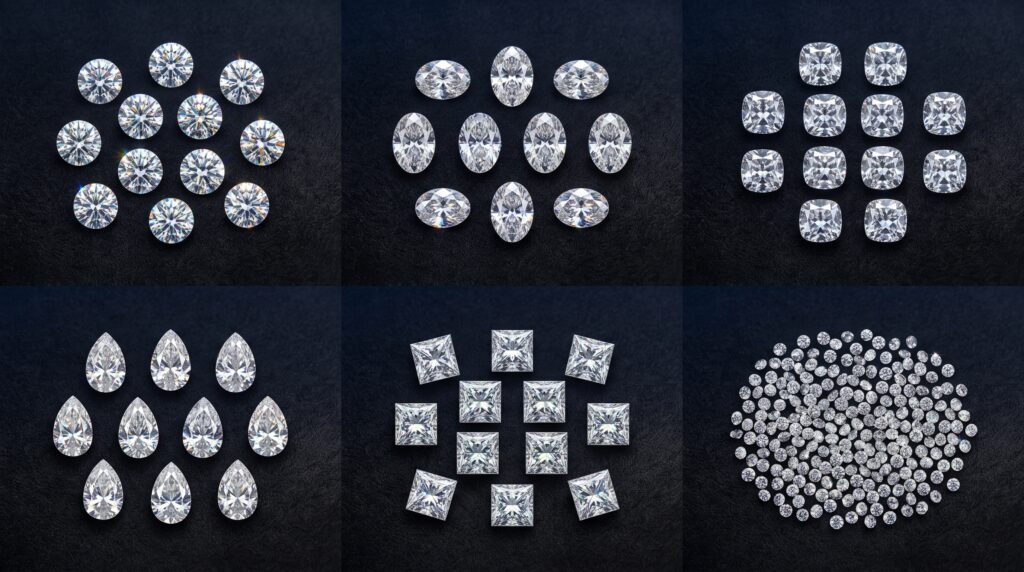
Not all parcels are the same. The type you buy should match your end-use, your customer base, and your quality tolerance.
1. Single-Specification (Matched) Parcels
These are the cleanest type to evaluate. Every stone in the lot shares the same agreed-upon parameters: carat weight range, color grade (for example, F-G), clarity grade (VS1-VS2), and cut grade. Matched parcels command a premium over mixed lots, but they dramatically reduce sorting time and quality inconsistency. Ideal for retailers who need uniform stones for a specific jewelry line, or for Diamond Manufacturers producing branded engagement ring settings at scale.
2. Mixed Diamond Parcels
Mixed diamond parcel buying is the most common form of B2B diamond procurement. These lots combine varying grades , say, D through J color and SI1 through I1 clarity, sold at a blended per-carat rate. The value proposition is price: mixed parcels are significantly cheaper per carat than matched lots. The risk is that without proper inspection, buyers can end up with a lot weighted toward the lower end of the grade range.
3. Melee Parcels (Small Stones, 0.01 to 0.18 ct)
Melee diamonds are the workhorses of fine jewelry production. These tiny polished diamonds are used as side stones, pave settings, and halo accents. Melee parcels are sold by total weight and are almost always mixed in terms of exact carat weight, though they are typically held to a tight color and clarity band. Jewelers and manufacturers are the primary buyers.
4. Calibrated Parcels
Calibrated parcels contain stones cut to precise millimeter dimensions. This is critical for mass-production jewelry settings where stones need to fit standard prong configurations without adjustment. Slight variations in calibrated lots can cause enormous production delays downstream.
5. Fancy Shape Parcels
These contain non-round brilliant diamonds , ovals, cushions, pears, radiants, emeralds, princess cuts. Fancy shape parcels require extra scrutiny because cut quality, length-to-width ratio, and optical symmetry vary more dramatically than in rounds. Loose Diamonds in fancy shapes sourced from a reputable supplier will come with declared ratios and cut grading information.
6. Estate and Recycled Parcels
Sourced from traded-in or reclaimed jewelry, these parcels are lower-cost but require the most due diligence. Grade claims may be informal, and consistency is unpredictable. Experienced buyers only.
7. Commercial Melee Parcels (SI-I Clarity Range)
Used by volume jewelry producers for fashion-priced pieces. These parcels are priced aggressively and are suitable when brilliance and fire take a backseat to price per piece.
Diamond Parcels vs. Individual Certified Stones: The Real Difference
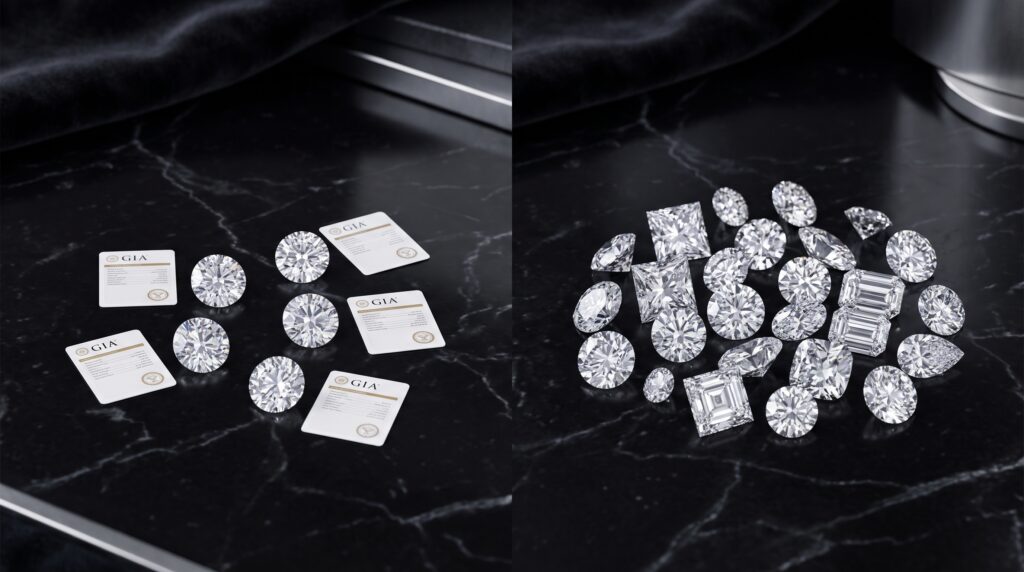
Here is what most buyers discover too late: purchasing individual GIA or IGI certified stones is not always the right model for B2B procurement. Understanding when to buy parcels versus individual certified stones is a core sourcing decision.
| Factor | Diamond Parcel | Individual Certified Stone |
|---|---|---|
| Price per carat | Lower (bulk discount) | Higher (certification premium) |
| Grade transparency | Supplier-declared or spot-checked | Full lab documentation per stone |
| Sorting time required | Significant for mixed lots | Minimal |
| Best for | High-volume production, restocking | Retail solitaires, bespoke design |
| Risk level | Moderate to high (grade inconsistency) | Low (lab-verified) |
The truth is, neither option is universally better. For a retailer sourcing center stones for engagement rings, individual certified diamonds deliver the documentation that American consumers expect. For a manufacturer producing a line of pave-set tennis bracelets or halo settings, buying melee in parcel form is the only economically viable approach.
Most buyers in the USA operate a hybrid model: certified singles for feature stones, parcel sourcing for accent and melee diamonds. That balance is where smart buyers protect both margin and quality reputation.
How to Choose the Right Diamond Parcel for Your Business
Choosing a parcel is not just about price. Six factors should drive every parcel buying decision:
- Define your end-use first. A parcel for pave jewelry needs different specifications than one for loose diamond resale. Know whether you need calibrated sizes, specific color ranges, or minimum cut grades before you ever look at a lot.
- Match the parcel type to your client profile. A retailer serving mid-market engagement ring buyers needs G-H, VS-SI stones. A volume fashion jeweler can work with I-J, SI-I material. Your customer’s expectations dictate your minimum acceptable grade, not the other way around.
- Check setting compatibility. If you are buying for a specific jewelry design or setting style, confirm the millimeter sizes in the parcel match your prong or bezel dimensions. This is especially important for calibrated melee parcels.
- Weigh the per-carat cost against sorting labor. A mixed parcel may be 20 to 30% cheaper per carat than a matched lot, but if your team spends significant time sorting and rejecting stones, the true cost advantage erodes quickly. Factor in sorting time honestly.
- Clarify the occasion or channel. Parcels sourced for bridal jewelry carry higher expectations for cut quality and optical performance than those for fashion or stackable pieces. Higher-margin retail channels justify the premium of tighter-spec parcels.
- Evaluate lab-grown versus natural for your category. Lab-grown diamonds have become a serious option in parcel buying, particularly for melee and accent stones where the cost savings are substantial without compromising visual quality. IGI certified Loose Diamonds Wholesale in lab-grown material from Surat suppliers is now a competitive and high-quality alternative for US retailers and manufacturers managing production costs.
Before you finalize your choice of parcel type or supplier, request a sample lot. Any reputable supplier will accommodate this for a verified B2B account. Evaluating an actual sample tells you more about a supplier’s grading standards than any price list ever will.
What B2B Buyers and Diamond Manufacturers Should Know
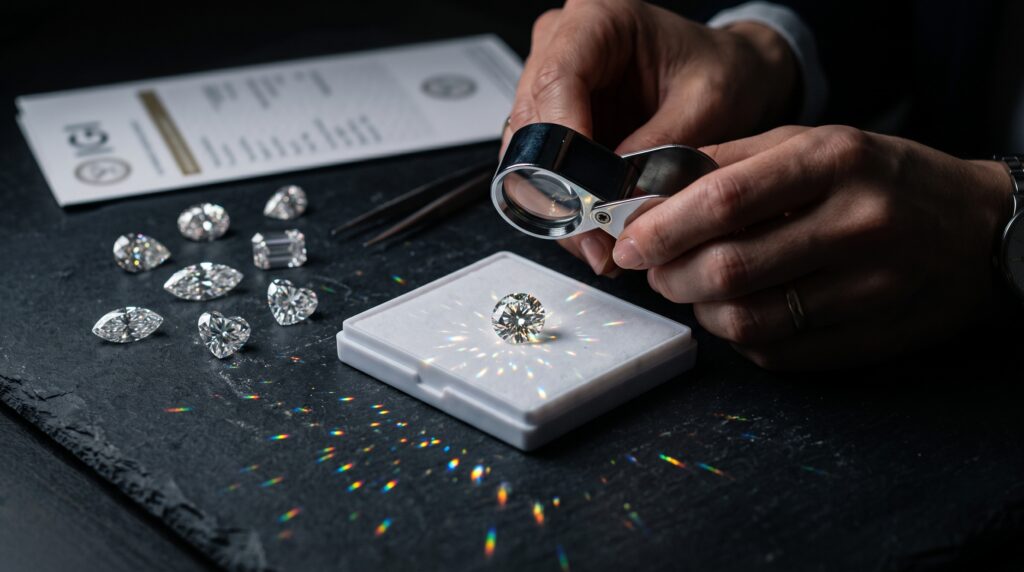
The wholesale side of parcel buying operates on a different logic than retail. Here is what matters at the B2B level that most guides skip over.
Diamond parcel price in India, particularly from Surat cutting centers, is typically quoted as a percentage plus or minus on the Rapaport Price List. Understanding where a parcel sits relative to Rap , whether it is quoted at “minus 40” or “minus 55” , tells you immediately how the supplier perceives the quality of the lot. Steeper discounts mean either more mixed grades, weaker cut quality, or slower-moving inventory. Tight discounts (closer to Rap or even at Rap) signal higher-quality matched material.
For bulk sourcing, cut grading consistency within a parcel is the most undervalued factor. A parcel declared as “Very Good cut” should not contain stones with table percentages above 65% or total depth percentages that kill light return. When I assess a parcel’s cut quality at the lot level, the first thing I check is a random sample of at least 10% of the stones for pavilion depth and table size using a leveridge gauge. One weak cluster of stones can indicate the entire lot was cut from lower-quality rough.
IGI and GIA certification standards differ in their parcel-level application. GIA typically does not offer parcel grading certificates , each GIA report covers an individual stone. IGI, by contrast, does offer parcel grading reports for melee and small rounds, which is why IGI is the dominant certification body in the B2B parcel market. Working with a Diamond Grading Lab that your supplier uses consistently is a strong indicator of their commitment to grade accuracy.
Manufacturers like Lepdo Diamonds, operating out of Surat’s diamond manufacturing hub, typically supply B2B parcels with full IGI certification on individual stones when requested, and parcel declarations for melee lots , giving buyers documented quality assurance rather than verbal grade claims. For retailers evaluating loose diamond parcel suppliers, that documentation standard matters enormously for downstream customer trust.
Industry insider tip: Always ask your supplier for the “make” of the stones in the parcel, this refers to the overall cut quality and production standard. A well-made stone with G color and VS2 clarity outperforms a poorly-made D/IF in actual brilliance and scintillation when worn. Grade alone does not tell the whole story.
Diamond Parcel Jewelry Trends in the USA (2026 to 2027)
The US jewelry market is in a distinctive phase right now. According to industry tracking data, demand for fancy shape diamonds in parcel form has grown steadily year-over-year, driven largely by consumer appetite for non-traditional engagement ring shapes and the rise of bespoke jewelry brands sourcing direct from wholesale.
Oval, elongated cushion, and pear shape parcels are commanding particular attention from independent jewelers and direct-to-consumer brands. These shapes photograph beautifully for social commerce, and their elongated silhouettes read larger than their actual carat weight, which makes them attractive to budget-conscious engaged couples who still want significant visual presence.
On the design side, multi-stone and cluster settings are driving melee and small-carat parcel demand. Toi et moi styles, sunburst halos, and vintage-inspired cluster rings all require substantial quantities of accent diamonds, pushing retailers to buy diamond parcels wholesale rather than piece together individual stones at retail premiums.
Lab-grown diamond parcel jewelry is also accelerating in the US market. A growing number of American fine jewelry retailers are moving to lab-grown for their pave and accent stone inventory, while reserving natural diamond sourcing for center stones where client expectation is naturals. A Diamond Wholesaler offering both natural and lab-grown parcel options gives retailers the flexibility to serve both buyer segments.
How to Evaluate Quality in a Diamond Parcel
When I assess a diamond parcel, the first thing I check is not the grade declaration. It is the light performance of a random sample pulled from the center of the lot, not the top, where suppliers sometimes place their best material.
Here are five expert evaluation steps every buyer should follow:
- Check brilliance and fire under a daylight-equivalent light source. A well-cut parcel should show consistent white light return (brilliance) and spectral color flashes (fire) across the sample. Dull or lifeless stones in the sample are a red flag for the whole lot.
- Measure table and depth percentages on a 10% random sample. Table percentages above 65% and total depth percentages outside the 58 to 63% range compromise light performance significantly in round brilliant cuts. For fancy shapes, check the length-to-width ratio against the declared specifications.
- Grade color under controlled conditions. Natural or D65 light source, white grading tray, stones face-down. If the supplier’s declared color range is G-H and you are seeing obvious yellow tints in the sample, the lot is graded loose. This is the most common form of misrepresentation in mixed diamond parcel buying.
- Examine clarity under 10x loupe. For SI-graded material, look at inclusion type and position, not just presence. Eye-visible inclusions in an “SI” declared parcel are a serious quality discrepancy.
- Request or cross-check with certified stones. Where individual stones carry IGI or GIA certification, cross-reference the physical stone against its certificate using the laser inscription. Reputable Trusted Diamond Supplier sources will encourage this verification rather than resist it.
You will want to pay attention to any supplier who discourages physical inspection or refuses to allow third-party verification before purchase. That resistance is a quality signal in itself.
Conclusion
Three things separate buyers who consistently get value from diamond parcels from those who get burned. First, they define their specifications before sourcing, not after receiving a price list. Second, they treat physical inspection as non-negotiable, regardless of how trusted the supplier relationship is. Third, they understand Rapaport pricing well enough to recognize when a quoted discount reflects genuine value versus a quality problem being priced in.
The diamond parcel buying guide framework in this article gives you the foundation for all three. Whether you are a US retailer building bridal inventory, a manufacturer sourcing melee for a jewelry line, or a wholesaler building a supplier network from Surat to your domestic market, the principles of smart parcel evaluation do not change.
Buyers evaluating suppliers for parcel sourcing often start by requesting a sample lot, something Lepdo Diamonds offers to verified B2B accounts, with full IGI certification available on individual stones and transparent Rapaport-referenced pricing. You can explore their current inventory of certified loose diamond parcels through Lepdo Diamonds directly.
The right parcel, from the right supplier, evaluated the right way, is still one of the most efficient ways to build a profitable diamond inventory. A solid diamond parcel buying guide is where every smart sourcing decision begins.
Frequently Asked Questions About Diamond Parcels
1. What is a diamond parcel buying guide?
A diamond parcel buying guide is a structured resource that helps wholesalers, retailers, and manufacturers evaluate, price, and purchase batches of loose diamonds efficiently. It covers parcel types, grading standards, pricing benchmarks relative to Rapaport, supplier vetting, and quality inspection steps specific to buying diamonds in bulk rather than as individual certified stones.
2. Are diamond parcels cheaper than buying individual certified stones?
Yes, typically. Diamond parcels deliver better per-carat pricing because the bulk quantity and reduced per-stone documentation cost are passed on to the buyer. That said, the savings depend on parcel type. A tight-spec matched parcel carries less discount than a wide-range mixed lot. Buyers need to factor in sorting labor costs when comparing true cost-per-usable-carat against individual certified purchases.
3. Which type of diamond parcel looks most impressive for finished jewelry?
Matched single-specification parcels with G-H color and VS-SI clarity in well-cut stones produce the most visually consistent and impressive finished jewelry. For statement pieces, fancy shape parcels in oval or elongated cushion cuts photograph and present exceptionally well, particularly in halo and multi-stone settings that are popular with US consumers right now.
4. Does a diamond parcel have a GIA cut grade?
Not typically. GIA cut grades are assigned to individual stones, not to parcels as a whole. GIA does not issue parcel grading reports. IGI, by contrast, does offer melee and small-stone parcel grading certificates, which is why IGI documentation is standard in the B2B wholesale parcel market. For individual stones within a parcel, GIA or IGI reports can be requested per stone at an additional cost.
5. What is the biggest quality risk with mixed diamond parcel buying?
Grade inflation is the most common risk. Suppliers may declare a parcel as “G-H / VS-SI” but weight the lot with stones toward the lower boundaries of those ranges, or include occasional stones that fall outside them. A physical inspection of a statistically meaningful sample, at least 10% of stones, under controlled conditions is the only reliable protection. Never accept grade declarations without verification for high-value parcel purchases.
6. Are lab-grown diamond parcels as good as natural diamond parcels?
For visual quality and optical performance, yes. Lab-grown diamonds have the same physical, chemical, and optical properties as natural diamonds. IGI certified lab-grown melee and fancy shape parcels from reputable Surat manufacturers meet the same grading standards as natural stone parcels. The key difference is price: lab-grown parcels are substantially cheaper per carat, making them increasingly attractive for US retailers managing production costs on pave and accent-heavy designs.
7. Which parcel type is best for engagement ring production?
For center stones, individual certified diamonds are the better choice for engagement ring retail because American consumers expect GIA or IGI documentation on the primary stone. For accent diamonds, halos, and side stones in engagement ring production, matched melee parcels in G-H, VS-SI offer the best balance of visual quality and per-carat cost. Fancy shape parcels in oval or cushion cuts work well for multi-stone bridal designs trending strongly in 2026.
8. How do I choose a reliable diamond parcel supplier?
Start with certification standards: a reliable loose diamond parcel supplier will provide IGI or GIA documentation on individual stones and parcel grading reports for melee lots. Ask about their grade tolerance policy, what happens if the delivered parcel falls outside declared specifications. Request a sample lot before committing to volume. Check whether they have an established B2B track record with US retailers or wholesalers. A Diamond Retailer or wholesaler reference from an existing client is a strong trust signal.