Lab Grown Diamond Wholesale Price Guide 2026: How Much Do Lab Diamonds Cost at B2B Level?
 by lepdogroup@gmail.com
0 comments
by lepdogroup@gmail.com
0 comments
A lab grown diamond wholesale price guide is a reference tool that helps B2B buyers, retailers, and manufacturers understand what certified lab diamonds actually cost at trade level, before retail markups are applied. Wholesale lab diamond prices in 2026 vary widely based on carat weight, cut, color, clarity, and growth method. Lepdo Diamonds offers transparent, IGI-certified pricing directly from the source.
Lab Grown Diamond Wholesale Price Guide 2026: How Much Do Lab Diamonds Cost at B2B Level?
A retail jeweler in Dallas recently told me he spent three months negotiating with five different suppliers before he finally understood what a fair price for a 2-carat, VS1, E-color CVD diamond actually looked like at the trade level. He had been overpaying by roughly 18 percent. That kind of information gap is exactly what this lab grown diamond wholesale price guide is designed to close.
Lab grown diamond wholesale prices have shifted dramatically over the past three years, and 2026 is no different. Buyers who rely on outdated price sheets or generic online estimates are either leaving money on the table or making purchasing decisions based on figures that no longer reflect the market.
Here is what you will find in this guide: a clear breakdown of current wholesale cost ranges by carat and quality, a comparison of CVD and HPHT pricing, key factors that drive price variation at the B2B level, and practical buying advice for retailers, manufacturers, and high-volume consumers alike. Whether you are sourcing a single 1-carat stone for an engagement ring or ordering a parcel of matched rounds for a jewelry line, the numbers and logic here will help you negotiate confidently.
What Is Lab Grown Diamond Wholesale Pricing?
Lab grown diamond wholesale pricing refers to the trade-level cost of lab-created diamonds sold directly by manufacturers, rough-to-polished processors, or certified wholesalers to buyers who are not the end consumer. These prices sit below retail by a meaningful margin, reflecting the removal of retail overhead, store markups, and brand premiums.
Quick Info Box:
- Definition: The per-carat or per-stone price at which lab grown diamonds change hands between trade partners, before any retail markup is applied.
- Key Types: CVD (Chemical Vapor Deposition) diamonds, HPHT (High Pressure High Temperature) diamonds, melee parcels, fancy shapes, calibrated rounds.
- Best For: Jewelry manufacturers, independent retailers, B2B procurement teams, high-volume online jewelers, and consumers purchasing directly from wholesalers.
- Key Advantage: Wholesale buyers typically save 30 to 60 percent compared to retail pricing on equivalent quality stones.
For a detailed reference on current trade pricing by origin, you can explore the Lab Grown Diamond Price breakdown at Lepdo Diamonds, which reflects live manufacturer-level pricing from Surat, India, one of the world’s primary lab diamond production centers.
Lab Grown Diamond Wholesale Prices by Type: What B2B Buyers Are Actually Paying in 2026
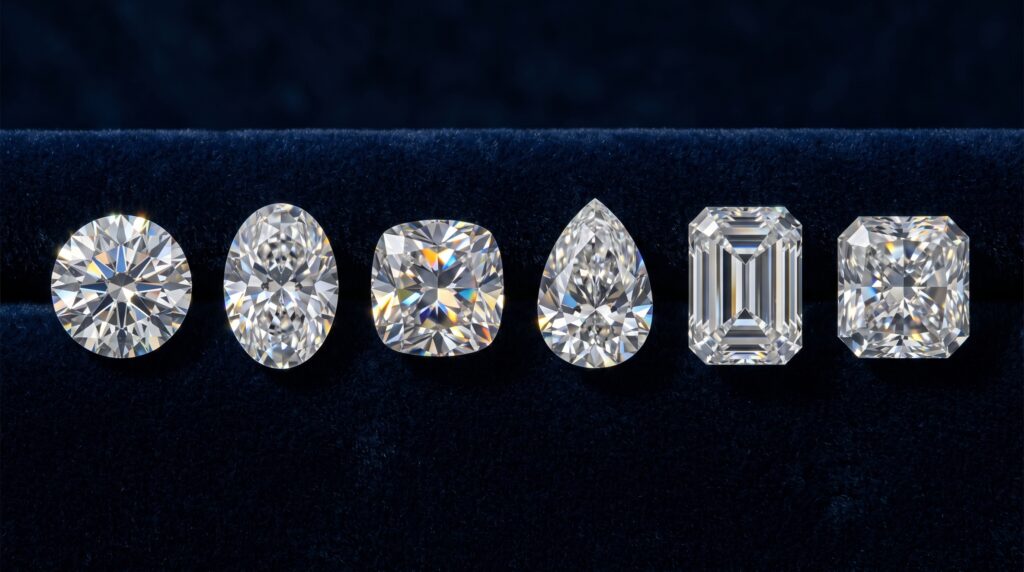
Pricing in the lab diamond market is not uniform. A 1-carat stone can range from under $200 to over $900 at wholesale depending on cut quality, color, clarity, growth method, and certification. Here is what the major categories look like right now.
1. CVD Rounds, 1 Carat (D-F, VS1-VS2, Excellent Cut)
This is the single most traded category in the lab diamond market. In 2026, expect wholesale pricing in the range of $350 to $600 per carat for IGI-certified CVD rounds at this quality tier. Stones graded D or E with VS1 clarity and triple excellent cut will sit at the higher end. F-color, VS2 stones from reputable manufacturers without known strain or graining issues typically land in the $380 to $480 range. This segment moves fast, and pricing shifts weekly based on Rapaport lab diamond sheets and manufacturer inventory cycles.
2. HPHT Rounds, 1 Carat (D-F, IF-VVS2)
HPHT stones at the top end of the color and clarity scale remain a premium segment at wholesale. A D-color, Internally Flawless HPHT round at 1 carat can still command $700 to $950 wholesale, primarily because HPHT production yields far fewer Type IIa stones at the D-IF level. That said, the gap between HPHT and CVD pricing has compressed significantly since 2022. HPHT Diamonds continue to be preferred by buyers who want that extra color assurance at the extreme top of the grading scale.
3. Fancy Shapes: Oval, Cushion, Pear (1 to 2 Carat Range)
Fancy shape lab diamonds at wholesale present a genuine value opportunity. Ovals and elongated cushions in the 1.50 to 2.00 carat range, graded G-H, SI1-VS2, typically wholesale between $280 and $550 per carat. The price variation here is driven heavily by length-to-width ratio, windowing, and extinction percentage. A well-cut oval with a 1.40 to 1.50 ratio and strong light return will hold value much better in a retail setting than a poorly proportioned stone at the same color and clarity grade.
4. Princess Cut (0.50 to 1.50 Carat)
Princess cuts remain a value-driven option at wholesale. In the 1-carat range, G-H color, VS1-VS2 clarity, expect $180 to $380 per carat, depending on corner integrity and table percentage. Retailers targeting mid-market engagement ring buyers find these stones offer strong margin room.
5. Emerald and Asscher Cuts (1 to 3 Carat)
Step-cut lab diamonds are a growing category. Emerald cuts in the 2-carat range, D-F color, VVS1-VS1 clarity, wholesale between $420 and $700 per carat. Clarity is paramount here. Unlike brilliant cuts, emerald-cut lab diamonds show inclusions readily, and buyers need to confirm that the IGI clarity grade matches visual inspection under magnification.
6 .Radiant Cut (1 to 2.5 Carat)
Radiants offer the brilliance of a round with the look of a fancy shape. In the 1.50 to 2.00 carat range, expect $300 to $520 per carat at wholesale for G-H, VS1-SI1 graded stones. CVD Diamonds dominate this category in most manufacturer offerings.
7. Lab Grown Diamond Melee Parcels (Under 0.30 Carat)
Melee is where volume purchasing becomes the defining factor. Lab grown melee parcels wholesale at $50 to $180 per carat depending on color range, matched quality, and parcel size. Buyers sourcing matched parcels for pavé or halo settings should expect tighter pricing for larger, consistently graded lots.
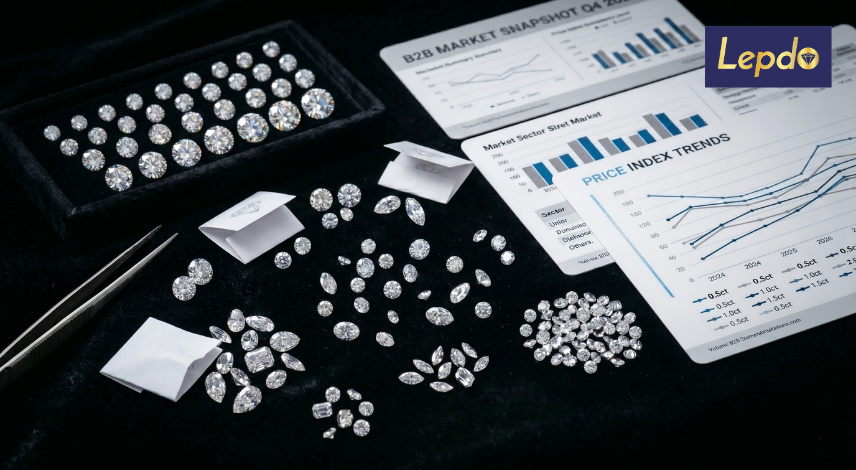
Lab Grown Diamond Wholesale Price Chart 2026 (Approximate Ranges, IGI Certified)
| Carat Weight | Color / Clarity | CVD Wholesale (per ct) | HPHT Wholesale (per ct) |
|---|---|---|---|
| 0.50 ct | F-G / VS1-VS2 | $90 to $160 | $110 to $200 |
| 1.00 ct | E-F / VS1-VS2 | $350 to $600 | $400 to $750 |
| 1.50 ct | F-G / VS1-SI1 | $280 to $480 | $320 to $550 |
| 2.00 ct | G-H / VS2-SI1 | $220 to $420 | $260 to $500 |
| 3.00 ct | G-H / VS2-SI1 | $180 to $350 | $210 to $400 |
Prices above reflect current trade-level ranges from Surat-based manufacturers. Retail pricing in the USA will typically be 2 to 4 times these figures depending on brand, channel, and setting.
CVD vs HPHT Wholesale Pricing: The Real Difference
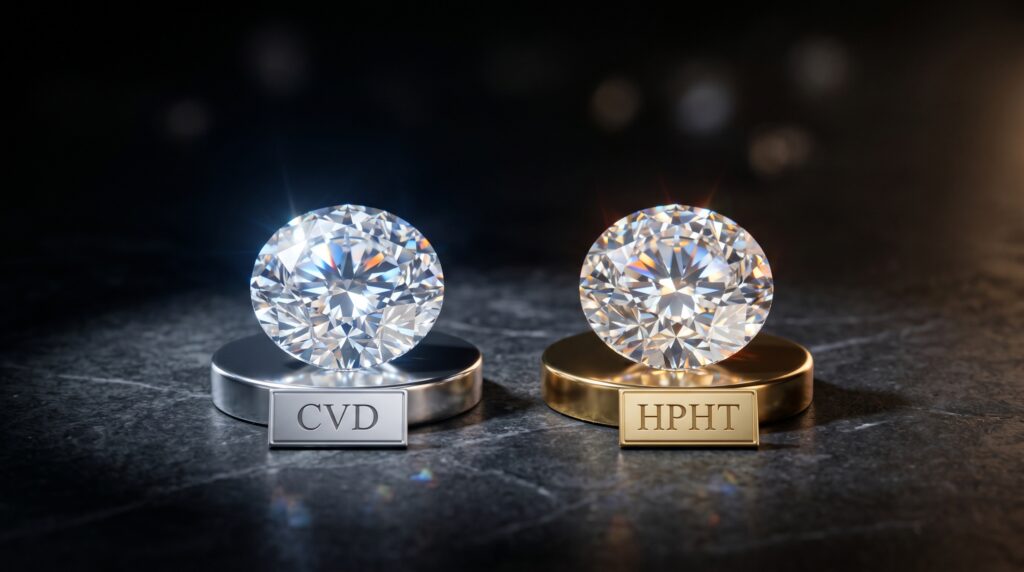
Both CVD and HPHT diamonds are chemically and optically identical to natural diamonds. The price difference at wholesale comes down to growth process efficiency, yield rates at top grades, and market perception.
| Factor | CVD Diamonds | HPHT Diamonds |
|---|---|---|
| 1 ct, D-F, VS1 Wholesale Price | $350 to $600 | $400 to $750 |
| Top Color (D-E) Yield Rate | Moderate | Higher at extreme top |
| Post-Growth Treatment | Often HPHT treated | Rarely needed |
| Strain / Graining Risk | Low to moderate | Very low |
| Preferred Buyer Profile | Volume buyers, retailers | Premium brands, top-grade buyers |
The truth is, for most engagement ring buyers and mid-market jewelry retailers, the difference in final light performance between a well-cut CVD and HPHT stone is invisible to the naked eye. The key decision factor for B2B buyers is usually grade consistency across a parcel rather than growth method alone.
Lab grown diamond wholesale cost for CVD has dropped more steeply than HPHT over the past 24 months, primarily because CVD reactor capacity has scaled faster globally. HPHT production remains more technically constrained, which supports a slight premium at the top of the quality scale.
Understanding how Diamond Wholesale works as a buying model is essential before committing to large CVD or HPHT purchases, especially if you are new to direct manufacturer sourcing.
How to Choose the Right Lab Diamond Grade for Your B2B or Retail Needs
Choosing the right lab grown diamond at the wholesale level is not just about finding the lowest price per carat. Here are six decision factors that experienced trade buyers use every time.
- Application and setting style. A pavé halo setting will perform beautifully with G-H, SI1 melee stones that would never pass muster in a solitaire. Match clarity grade to the setting before placing any order.
- Carat weight vs face-up size. In fancy shapes, a well-cut 1.80-carat oval can face up larger than a poorly proportioned 2.00-carat stone. Teach your retail customers to evaluate face-up diameter, not just carat weight on a certificate.
- Color grade for metal type. D-F color lab diamonds are ideal for platinum or white gold settings. G-H stones set in yellow or rose gold actually look whiter than their grade suggests. Buying G-H for yellow gold settings is one of the highest-leverage moves in wholesale buying.
- Budget efficiency by shape. Oval, pear, and marquise cuts offer the best face-up size per dollar at wholesale. Round brilliants command a premium due to polish waste during cutting.
- Occasion and end-customer profile. Engagement ring buyers prioritize cut and color. Fashion jewelry buyers are more forgiving of clarity. Investment-minded buyers still gravitate toward round brilliants in D-VS1 or better grades with IGI or GIA documentation.
- CVD vs HPHT for your product line. If your line targets premium bridal with D-F/VVS pricing, HPHT may offer better grade security at the top. For lab grown diamond price per carat efficiency across a broader color range, CVD parcels from established manufacturers deliver excellent value. Review the Diamond Buying Guide to align your selection criteria with your customer base.
Before you finalize your purchasing criteria, spend time defining exactly which grade combinations your end customers actually buy. Most retailers discover that 70 percent of their sales cluster in a narrow quality band, and optimizing your wholesale inventory around that band dramatically improves margin.
What B2B Buyers and Diamond Manufacturers Should Know
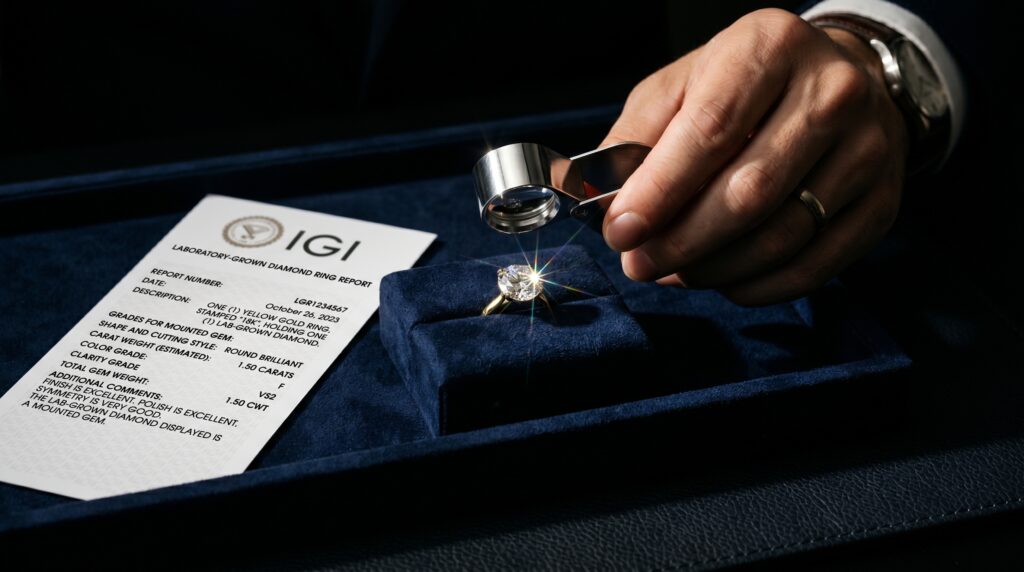
Sourcing lab grown diamonds at scale requires a different mindset than retail purchasing. Here is what matters most at the trade and manufacturing level.
Bulk lab diamond pricing from India, specifically from Surat, remains the most competitive in the world. A direct relationship with a Surat manufacturer for CVD rounds in the 1.00 to 1.50 carat range can yield savings of 15 to 25 percent compared to buying through a US-based distributor. The tradeoff is lead time, minimum order quantities, and the need to verify grading consistency independently before accepting parcels.
IGI (International Gemological Institute) remains the dominant certification body for lab grown diamonds at the B2B level. GIA has expanded its lab diamond grading program, but IGI reports remain more widely accepted in the lab diamond wholesale trade due to volume, turnaround speed, and global recognition among manufacturers. You will want to pay attention to which version of an IGI report a stone carries, as report formats and grading standards have been updated over recent years.
Rapaport publishes a lab grown diamond price sheet that functions as a trade reference point. Wholesale transactions typically happen at a percentage off Rap, much like the natural diamond market. Lab grown discounts off Rap have deepened significantly since 2021, with many categories now trading at 80 to 95 percent below Rap list.
When evaluating Certified Diamonds for a bulk order, always request a sample parcel before committing to volume. In my experience, the single most common mistake new B2B buyers make is purchasing based on certificate data alone, without physically inspecting a representative sample for light performance and any visible growth artifacts.
The difference between a Diamond Wholesaler vs Retailer relationship matters enormously here. Wholesalers operating with thin margins and high volume will often pass along manufacturer pricing with modest handling fees. Retailers marking up from that same wholesale cost add another layer that compounds quickly on higher-carat stones.
Lab Grown Diamond Jewelry Trends in the USA (2026 to 2027)
The US market for lab grown diamond jewelry has crossed a threshold in 2026. According to industry tracking data, lab grown diamonds now account for approximately 50 percent of all diamond engagement ring sales by unit volume in the United States, a figure that was under 10 percent just five years ago. That shift has fundamentally changed what retailers need to stock and how they price.
Elongated fancy shapes are leading consumer demand. Oval solitaires in the 1.50 to 2.50 carat range remain the most requested style at both the retail counter and through online channels. Elongated cushions and pear shapes are close behind, driven by strong visual presence at a lower price per carat compared to rounds of equivalent weight.
Think of it this way: a consumer who has a $5,000 engagement ring budget can either buy a 1.00-carat round in D-VS1, or they can buy a beautifully cut 1.80-carat oval in F-VS2. The oval looks dramatically larger on the finger, and lab grown diamond jewellery in fancy shapes is increasingly the choice for buyers who understand what they are doing. That consumer education is happening fast, and it is reshaping what moves in Diamond Retail channels.
Solitaire settings continue to dominate, but three-stone designs with tapered baguette or trillion accents are gaining ground, particularly among millennial buyers in the $4,000 to $8,000 retail range.
How to Evaluate Quality in Lab Grown Diamonds
When I assess a lab grown diamond, the first thing I check is not the certificate. It is the stone under a light source, looking for extinction zones, windowing in fancy shapes, and any visible growth graining or strain patterns that affect light return.
Here are the five evaluation steps I apply to every stone before recommending it at the trade level:
- Table and depth percentage. For round brilliants, ideal table falls between 54 and 58 percent, with total depth between 59 and 62.5 percent. Stones outside these ranges sacrifice either brilliance or scintillation, regardless of what a cut grade on the certificate says.
- Symmetry under magnification. Minor asymmetry in a fancy shape becomes visible when set. Check for crown-to-pavilion alignment and even facet distribution before approving any parcel.
- Color consistency. In CVD stones, check for color zoning or brown undertones under different lighting environments, particularly fluorescent light. A stone can grade E under daylight-equivalent light and show a noticeable warm cast in store lighting.
- Clarity under 10x loupe. Even a VS1 grade can house inclusions that are positioned directly under the table and become visible face-up. Always evaluate clarity in the context of face-up appearance, not just grade alone.
- Certification authenticity. Verify every IGI or GIA report number through the issuing lab’s online portal. Report cloning and certificate misrepresentation remain issues in the lab diamond supply chain at the lower end of the market.
For B2B buyers purchasing Certified Diamonds in volume, this five-step evaluation process should be part of every intake inspection, especially when working with new suppliers.
Conclusion
Three things stand out clearly for any buyer navigating the lab grown diamond market in 2026. First, the lab grown diamond wholesale price guide landscape has become more stable after years of rapid price compression, but it still rewards buyers who do their homework on grade-level pricing, growth method differences, and direct sourcing opportunities. Second, fancy shapes, especially ovals and elongated cushions, represent the strongest value proposition at wholesale right now, both for retailers building inventory and consumers purchasing directly. Third, certification and physical inspection remain non-negotiable, regardless of how competitive a price looks on paper.
Most buyers discover that the biggest savings in this market come not from chasing the lowest price but from understanding exactly which grade combinations deliver real value for their specific application. A G-H, VS2 oval in yellow gold will often outperform a D-color round at twice the cost in terms of customer satisfaction and sell-through.
If you are ready to explore current pricing, review available certified inventory, or discuss a custom sourcing arrangement, Lepdo Diamond offers direct access to manufacturer-level pricing with full IGI certification documentation. The lab grown diamond wholesale price guide is only the starting point. The right stone, at the right price, is the finish line.
Frequently Asked Questions About Lab Grown Diamond Wholesale Pricing
1. What is a lab grown diamond wholesale price guide?
A lab grown diamond wholesale price guide is a reference tool that outlines the trade-level cost of certified lab diamonds by carat weight, color, clarity, and growth method, before retail markups are added. It helps B2B buyers, retailers, and manufacturers understand fair market pricing and negotiate confidently with suppliers. In 2026, wholesale prices for lab grown diamonds have stabilized after years of decline, though they remain significantly below natural diamond equivalents.
2. Are lab grown diamonds cheaper than natural diamonds at wholesale?
Yes, lab grown diamonds are significantly less expensive than natural diamonds at wholesale, typically 70 to 85 percent lower for equivalent grades. A 1-carat, E-color, VS1, excellent-cut natural diamond might wholesale for $3,500 to $5,000, while a comparable lab grown stone trades at $350 to $600. The price gap exists because lab diamonds can be produced in weeks in a controlled environment, removing geological rarity from the equation entirely.
3. Which lab grown diamond shape looks biggest for the price?
Oval, marquise, and pear-shaped lab grown diamonds offer the best face-up size per carat at wholesale. An oval cut can appear 10 to 15 percent larger than a round of identical carat weight due to its elongated face-up profile. For consumers and retailers focused on visual impact per dollar, these elongated fancy shapes consistently outperform rounds. The key is selecting a stone with a strong length-to-width ratio and minimal extinction.
4. Does a lab grown diamond have a GIA cut grade?
GIA grades cut quality for round brilliant lab grown diamonds, issuing cut grades of Excellent, Very Good, Good, Fair, and Poor, the same scale used for natural diamonds. For fancy shapes, GIA does not issue an official cut grade, a limitation that also applies to natural fancy shapes. IGI grades cut for both rounds and some fancy shapes in their lab grown diamond reports, making IGI the more commonly used certification for fancy-cut lab diamond wholesale transactions.
5. What is the biggest quality risk when buying lab grown diamonds at wholesale?
The biggest risk is purchasing based solely on certificate data without physical inspection. CVD diamonds can carry brown undertones, strain graining, or color zoning that affects face-up appearance but may not fully register in a standard lab grade. For HPHT stones, metallic inclusions from the growth process can appear under magnification. Always request a sample parcel from any new supplier and inspect under multiple lighting conditions before committing to volume purchases.
6. Are lab grown diamonds as good as natural diamonds for jewelry?
Yes. Lab grown diamonds are chemically, physically, and optically identical to natural diamonds. They carry the same hardness of 10 on the Mohs scale, the same refractive index, and the same fire, brilliance, and scintillation when cut to equivalent standards. The only meaningful difference is their origin and rarity. For jewelry applications including engagement rings, fine jewelry, and fashion pieces, lab grown diamonds perform identically to natural stones and are indistinguishable without specialized testing equipment.
7. Which lab grown diamond type is best for an engagement ring?
For engagement rings, a round brilliant or oval in D-G color and VS2 or better clarity, cut to excellent or ideal proportions, is the most popular and commercially reliable choice. Round brilliants deliver maximum light performance and carry broad resale recognition. Ovals offer exceptional face-up size and a distinctive look that has grown significantly in popularity since 2022. Both shapes are available with IGI or GIA certification, which provides buyer confidence and retail documentation.
8. How do I choose a reliable lab grown diamond wholesale supplier?
Start by verifying that any supplier works with IGI or GIA-certified stones and can provide traceable report numbers you can verify independently. Request references from existing retail or manufacturing clients. Ask for a sample parcel before committing to volume. Evaluate turnaround time, minimum order quantities, and return policies for off-grade stones. Suppliers with direct manufacturing relationships in Surat, India, and transparent pricing tied to a published reference like Rapaport lab diamond sheets are generally the most reliable partners for consistent, scalable sourcing.