SGL Certificate Explained: Is SGL Certification Reliable for Lab Grown Diamonds?
 by lepdogroup@gmail.com
0 comments
by lepdogroup@gmail.com
0 comments
An SGL certificate guide helps buyers understand what the Solitaire Gemological Laboratories report covers, how it grades a diamond’s 4Cs, and whether it carries enough credibility for purchase decisions. For consumers and B2B buyers shopping lab grown diamonds in the USA, understanding SGL certification upfront prevents costly misjudgments. Lepdo Diamonds offers transparent certification guidance to help you buy with confidence.
Nearly 40% of diamond buyers in the USA admit they do not fully understand what a grading certificate actually measures before they make a purchase. That number jumps even higher when the stone in question is lab grown, where the certification landscape gets more complicated fast. Here is what you need to know about the SGL certificate guide before you spend a single dollar on a graded stone.
SGL, which stands for Solitaire Gemological Laboratories, has become a recognizable name in the Indian diamond market and is starting to appear more frequently on lab grown diamonds entering the US supply chain. But recognizable does not automatically mean reliable. Whether you are a retail consumer shopping for an engagement ring, a wholesaler building a lab grown diamond inventory, or a manufacturer sourcing certified polished diamonds, understanding what an SGL certification actually tells you will sharpen your buying decisions considerably.
This post covers what SGL certification is, how it compares to IGI, where it falls short, and what both B2B buyers and end consumers should watch carefully before accepting an SGL report as sufficient proof of quality.
What Is an SGL Certificate?
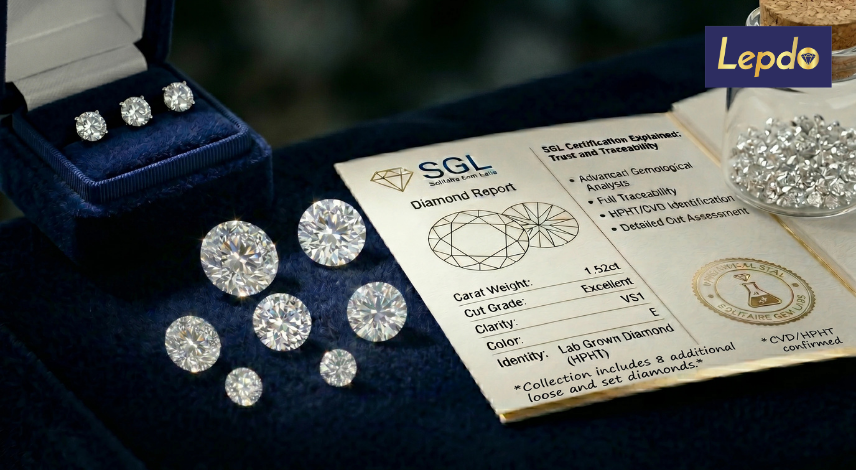
SGL, or Solitaire Gemological Laboratories, is a diamond grading laboratory headquartered in Mumbai, India, with a significant volume of certificates issued for diamonds manufactured and sold in the Indian market. An SGL certificate report documents a diamond’s 4Cs, which are cut, color, clarity, and carat weight, along with additional grading details such as fluorescence, polish, symmetry, and measurements.
Quick Info Box:
- Definition: An SGL certificate is an official grading report issued by Solitaire Gemological Laboratories that evaluates a polished diamond’s quality characteristics.
- Key Types: SGL Diamond Certificate, SGL Lab Grown Diamond Report, SGL Colored Stone Report
- Best For: Cost-conscious buyers, Indian market sourcing, entry-level lab grown diamond purchases
- Key Difference: SGL operates primarily in the Indian market and carries less global recognition than GIA or IGI in the USA luxury segment
For a deeper look at how diamond certification works across different labs, the Diamond Certification complete guide at Lepdo Diamonds is a solid starting point before you evaluate any specific laboratory’s report.
SGL Certificate Types and Who They Are For
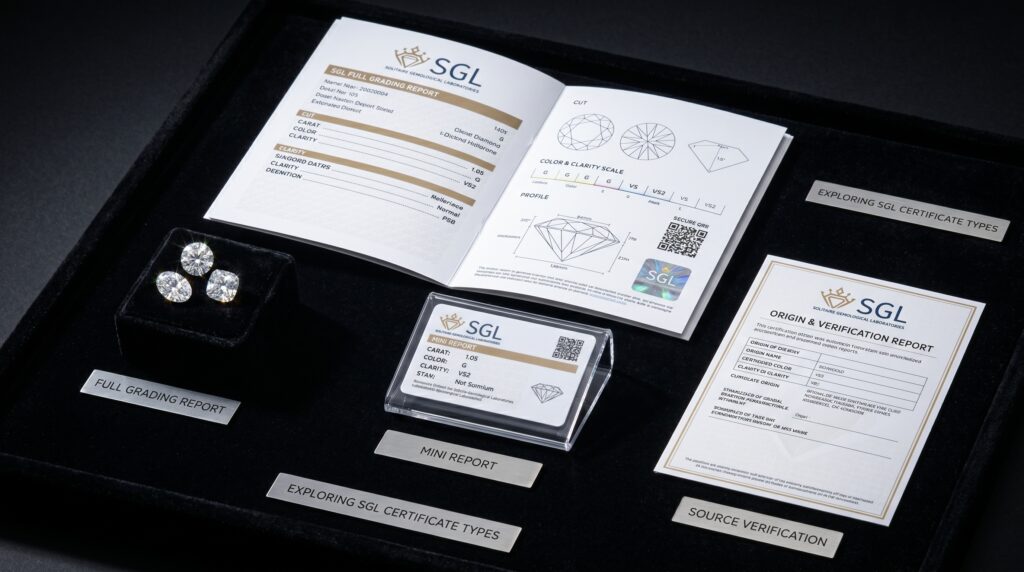
Not every SGL report is the same, and the type of certificate matters depending on what you are buying and where you intend to sell or use the stone.
SGL Diamond Certificate for Natural Stones
This is SGL’s standard report for earth-mined polished diamonds. It covers the 4Cs and provides grading details including table percentage, depth percentage, and symmetry grade. The grading on these reports tends to be more lenient than what you would expect from GIA or IGI, which is something the trade has acknowledged for years. Most experienced gemologists treat an SGL natural diamond report as a starting reference point rather than a definitive quality verdict.
SGL Lab Grown Diamond Certificate
As the lab grown diamond market has expanded, SGL has issued grading reports specifically for CVD and HPHT diamonds. These reports are structured similarly to natural stone certificates and cover the same 4Cs framework. The sgl certificate check process for lab grown stones includes identification of the growth method, which is genuinely useful data for buyers who need to document provenance.
SGL Colored Stone and Specialty Reports
SGL also issues reports for colored gemstones and treated diamonds. These are less commonly referenced in the US market and carry even less weight in international trade contexts than their diamond reports.
For independent retail jewelers buying smaller lab grown diamond parcels
SGL certification can make financial sense. The cost of SGL grading is lower than IGI, and for certain commercial price points, it does the job. That said, for anything above one carat or any stone being positioned as a premium purchase, you will want to reconsider.
For wholesalers and manufacturers
who need resalable inventory in the US market, understanding your customer base matters. If your retail clients or their end consumers are comparison-shopping certificates online, SGL-certified stones will often be discounted against IGI equivalents regardless of actual stone quality.
For consumers shopping engagement rings
an SGL certificate may be acceptable at budget-friendly price points, but it warrants extra scrutiny. The grading standards are not as tightly controlled as the leading labs, which means the actual quality of the stone may differ from what the certificate suggests.
For investment buyers
SGL certification is not recommended as a primary credential for any diamond being purchased as an investment asset.
SGL vs IGI Certificate: The Real Difference
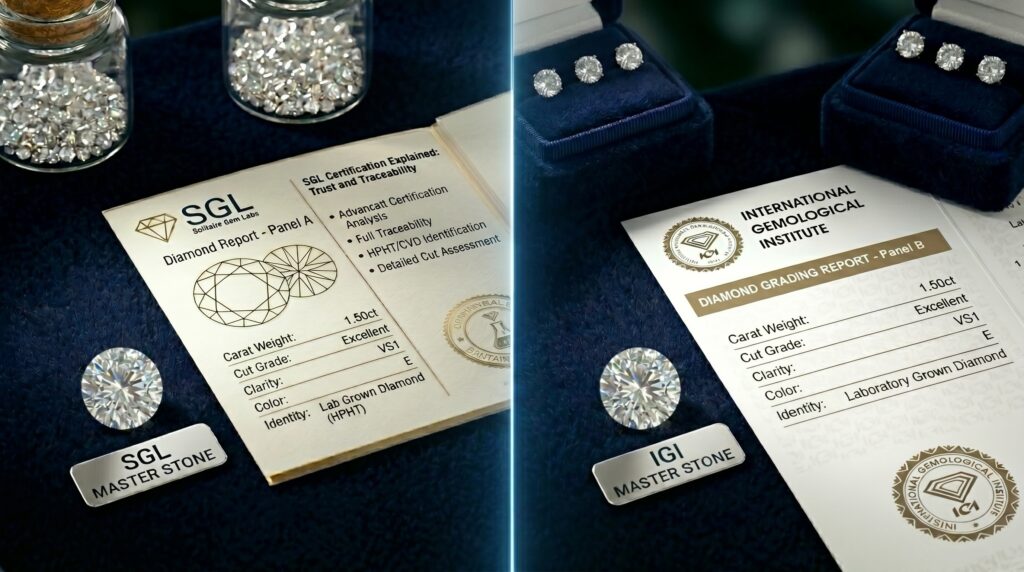
This is the comparison that matters most for the US lab grown diamond market right now. Here is how the two labs stack up across five key factors.
| Factor | SGL Certificate | IGI Certificate |
|---|---|---|
| Global Recognition | Limited, primarily India | Strong, widely accepted in USA and Europe |
| Grading Consistency | Moderate, known for lenient grading | High, tightly calibrated standards |
| Lab Grown Expertise | Developing capability | Established leader for lab grown diamonds |
| Report Verification | Available but less integrated | Robust online sgl report verification equivalent |
| Resale Value Impact | Lower consumer confidence | Higher resale marketability in US market |
The grading consistency gap is where this comparison really matters. IGI has invested heavily in standardizing its grading protocols specifically for lab grown diamonds, which is the fastest-growing segment of the polished diamond market. SGL has the infrastructure and volume, but its reputation for slightly more generous grading is well known among trade buyers.
The truth is, an IGI-certified lab grown diamond and an SGL-certified lab grown diamond that both grade as F VS1 may not represent identical quality in practice. That difference compounds as the carat weight increases. For buyers comparing sgl vs igi certificate options on any stone above 0.75 carats, the IGI report provides more reliable assurance. You can learn more about IGI Certification standards and what they cover through Lepdo Diamonds’ dedicated glossary resource.
How to Choose the Right Certification for Your Diamond Purchase
Here are six decision factors worth working through before you commit to a diamond carrying any certification, including SGL.
- Your personal buying purpose matters first. A consumer buying a lab grown diamond for everyday fashion jewelry has different certification needs than someone purchasing a 2-carat stone for an engagement ring or long-term value retention.
- Stone size changes the equation. For diamonds under 0.50 carats, certification costs eat into margin, and SGL may be entirely adequate. For stones one carat and above, the grading precision of a recognized lab makes a measurable difference to both purchase confidence and resale potential.
- Know the setting and retailer context. A stone destined for a private label jewelry collection sold at independent boutiques operates in a different credibility environment than a stone being sold through a national retailer that cross-references certificates online.
- Budget realities are legitimate. SGL-certified lab grown diamonds often trade at lower price points than IGI equivalents, and for buyers where budget is a real constraint, the cost advantage is worth acknowledging. That said, the savings need to be weighed against what you are giving up in grading assurance.
- Match certification to occasion. Engagement rings carry emotional and financial weight that justifies higher certification standards. Commercial jewelry production at volume may reasonably use SGL stones in the right price brackets.
- For lab grown diamonds specifically, the sgl certification diamonds landscape is still evolving. Lab grown stones certified by IGI or GIA carry significantly more secondary market recognition in the USA. If you are sourcing lab grown diamonds for resale, SGL Certification is worth understanding in detail before deciding whether it fits your product line.
Before you finalize your choice of certification, ask the seller directly whether the grading report can be verified independently online. A certificate that cannot be authenticated through the issuing laboratory’s own verification system should raise an immediate flag regardless of which lab issued it.
What B2B Buyers and Diamond Manufacturers Should Know
For wholesalers, manufacturers, and jewelry retailers sourcing lab grown diamonds at volume, the certification question is not just academic. It directly affects pricing, sell-through rates, and customer returns.
Here is what the trade understands that retail consumers often do not. Rapaport pricing structures, which are the industry’s primary price benchmarking tool, apply most cleanly to GIA and IGI certified stones. When SGL-certified diamonds enter a pricing negotiation, buyers routinely apply an informal discount to account for the perceived grading leniency. That discount can range from 5% to 15% depending on the stone and the buyer’s experience with SGL reports.
For manufacturers sourcing rough or polished lab grown diamonds in the Indian market, SGL certification is common because of the lab’s geographic presence and lower cost. But if your downstream market is the USA, that cost saving at origin can translate to a pricing disadvantage at the retail end.
My industry recommendation is this: if you are building a lab grown diamond product line for the US market and you are considering SGL as a certification path, test a small lot with your retail accounts before committing to volume. Their feedback will tell you quickly whether their end consumers are asking about certification lab names.
IGI and GIA grading standards for lab grown diamonds also include specific identification of the diamond growth method and post-growth treatments, which SGL reports handle with less consistency. For manufacturers positioning product in the Certified Diamonds premium segment, that documentation detail matters for consumer trust.
SGL Certificate and Lab Grown Diamond Trends in the USA (2026 to 2027)
The lab grown diamond market in the USA has moved through an interesting maturation phase. After a period of rapid price compression between 2022 and 2024, the market is now settling into tiered segments where certification quality is becoming a genuine differentiator rather than an afterthought.
Consumers in 2026 are better informed than at any previous point. They compare certificates before they compare prices, especially at higher carat weights and for engagement ring purchases. That shift in consumer sophistication is squeezing demand for less-recognized certifications in the upper price tiers. According to industry data from the Jewelers of America, consumer trust in diamond certification has become one of the top three purchase decision factors, ranking alongside price and design.
At the commercial and fashion jewelry level, SGL certified lab grown diamonds continue to hold a practical role. Designs where the certification detail is less central to the purchase decision, such as pavé accent stones, melee, or lower-price-point fashion pieces, can reasonably carry SGL reports without affecting consumer confidence or sell-through.
The trend moving into 2027 is clear though. For any lab grown diamond jewelry positioned above mid-market price points in the USA, IGI is the consumer-recognized standard and that preference is strengthening, not softening.
How to Evaluate Quality in an SGL-Certified Diamond
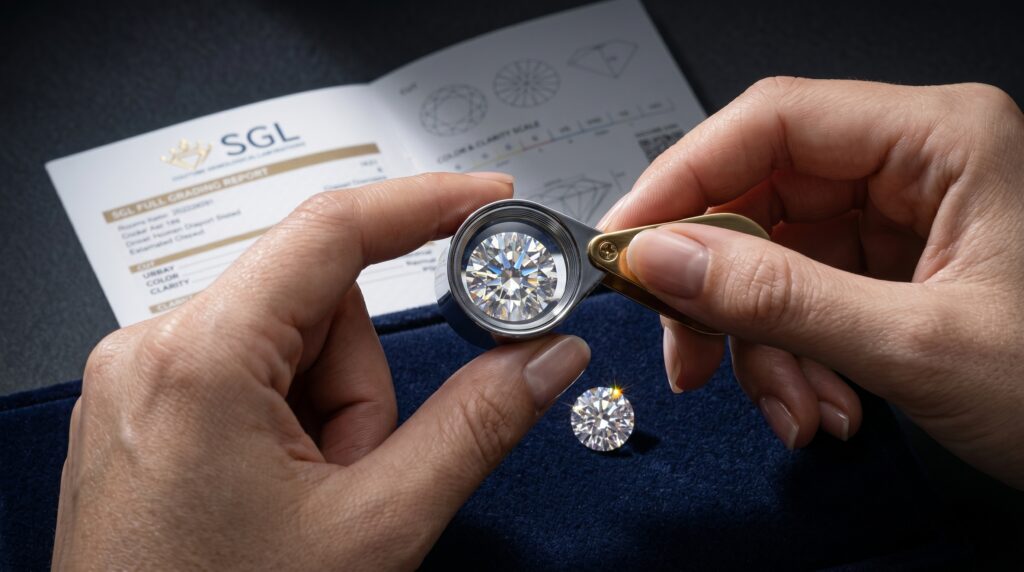
When I assess a diamond carrying an SGL certificate report, the first thing I check is not the grade itself. I check the grading details that are hardest to be generous with: table percentage, depth percentage, and the length-to-width ratio. These are mathematical measurements, and any lab that issues the report has to record them accurately. If those numbers look clean and consistent with what I see under the loupe, I have more confidence in the rest of the report.
Here are four expert evaluation steps for any SGL-certified stone:
- Verify the report independently. Always run an sgl report verification through SGL’s own online certificate check system before accepting the stone. A certificate without a verifiable digital record is a significant concern.
- Assess light performance directly. Brilliance, fire, and scintillation should be observable in person. An SGL certificate may grade cut as “Excellent,” but you will want to verify that the stone actually performs under different lighting conditions. A stone that looks flat or lifeless in diffuse lighting may have a cut issue the certificate does not fully reflect.
- Cross-check the clarity grade. SGL’s clarity grading for lab grown diamonds has been considered lenient in certain cases. Have the stone reviewed by an independent gemologist if the clarity grade is a key purchase factor, particularly for VS2 and SI1 grades where the boundaries are most subjective.
- Review the pavilion and table balance. A deep pavilion combined with a high table percentage can kill light return even on a stone that grades well on paper. These figures should align with accepted cut proportion standards.
For a broader understanding of how to read any diamond certificate, Lepdo Diamonds’ resource on How to Read a Diamond Certificate walks through each section in plain language.
Conclusion
Three things stand out from everything covered here. First, SGL certification is a legitimate grading credential but one that carries meaningful limitations in the US market, particularly for lab grown diamonds above one carat and stones being sold in premium retail or engagement ring contexts. Second, the comparison between sgl vs igi certificate is not just about prestige. It is about grading consistency, resale confidence, and the trust your end consumer places in the number on the report. Third, whether you are a manufacturer, a retailer, or a consumer, the most important step is verification. Any diamond certificate that cannot be confirmed through the issuing lab’s own database should not be the basis of a purchase decision.
The SGL certificate guide exists to help you make smarter choices, not to dismiss SGL outright. There are legitimate use cases for SGL-certified stones in the US market, particularly at commercial price points and in fashion jewelry categories. But knowing where those use cases end is just as important as knowing where they begin. Before you finalize your choice of certified stones, explore the full range of options available at Lepdo Diamonds and use the Diamond Certification Check resource to verify any report before you commit.
At Lepdo Diamonds, clarity about certification is as important as clarity in the stone itself.
Frequently Asked Questions About SGL Certification
1. What is an SGL certificate?
An SGL certificate is a diamond grading report issued by Solitaire Gemological Laboratories, an India-based laboratory that evaluates a diamond’s 4Cs, including cut, color, clarity, and carat weight. The sgl certificate guide covers natural diamonds, lab grown diamonds, and colored stones. It provides grading details such as polish, symmetry, fluorescence, and measurements, and can be verified through SGL’s online report database.
2. Is an SGL certificate cheaper than IGI certification?
Yes, SGL certification typically costs less than IGI certification, which is one reason it is common among manufacturers in the Indian diamond market. The lower cost makes it attractive for commercial-grade diamonds and smaller stones. However, in the US market, SGL-certified diamonds often trade at a discount relative to IGI equivalents, which can offset the savings when you factor in resale value and consumer confidence.
3. Which SGL-certified diamond looks biggest or most impressive?
A well-cut SGL-certified oval or elongated cushion lab grown diamond can appear larger than its carat weight suggests due to shape and cut proportions. Most buyers focused on visual impact per dollar gravitate toward elongated fancy shapes regardless of which lab issued the certificate. That said, cut quality matters far more than shape alone, and SGL’s cut grading should be cross-checked against actual light performance before purchase.
4. Does an SGL diamond certificate include a GIA-equivalent cut grade?
No. GIA cut grades apply exclusively to GIA-issued reports, and GIA is the originator of the modern cut grading system for round brilliant diamonds. SGL issues its own cut grade on its reports, but it does not carry the same standardization or global credibility as GIA or IGI cut grades. Buyers who need a cut grade with recognized international weight should look to IGI or GIA certified stones.
5. What is the biggest quality risk with an SGL certificate?
The most significant risk is grading leniency. SGL has a reputation among experienced trade buyers for grading on the more generous end of the scale, particularly for color and clarity. A stone graded F VS1 by SGL may realistically grade G or VS2 by IGI standards. This discrepancy increases with carat weight and makes accurate price comparison difficult if you are comparing SGL certificates against IGI or GIA reports.
6. Are lab grown diamonds with SGL certification as good as natural diamonds with SGL certification?
The physical quality of a lab grown diamond is not diminished by its certificate. Lab grown diamonds carry the same chemical and optical properties as natural diamonds. What matters is whether the SGL grading accurately reflects the stone’s quality in either case. SGL’s lab grown diamond certificates have improved in recent years, but for lab grown stones above one carat, IGI certification provides more precise grading and stronger US market recognition.
7. Which SGL-certified diamond is best for an engagement ring?
For an engagement ring, a round brilliant or oval lab grown diamond with a strong SGL cut grade is a reasonable starting point, but the certificate should be verified and the stone examined in person before purchase. Most gemologists recommend IGI or GIA certification for engagement ring purchases due to the emotional and financial significance of the occasion. If budget drives an SGL choice, prioritize a stone with verified light performance over grade numbers alone.
8. How do I choose a reliable SGL certificate supplier or diamond source?
Look for suppliers who provide full sgl report verification links alongside every stone, offer transparency about which laboratory graded the diamond and when, and are willing to have stones independently reviewed on request. A trustworthy supplier will not pressure you to skip verification. Reputable sources like Lepdo Diamonds provide certified diamonds with clearly documented grading credentials and support buyers through the verification process.