IGI vs GIA vs SGL Certificate: Which Diamond Certification Should You Trust?
 by lepdogroup@gmail.com
0 comments
by lepdogroup@gmail.com
0 comments
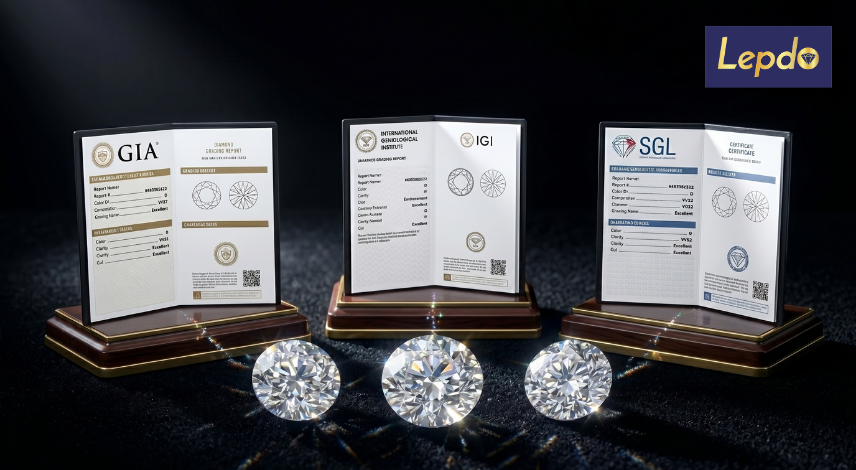
When comparing the IGI vs GIA vs SGL certificate, you are looking at three grading labs with very different levels of global recognition, grading consistency, and market trust. GIA sets the gold standard, IGI is the dominant force in lab-grown diamond grading, and SGL is a regional option common in South Asia. At Lepdo Diamonds, every certified diamond we offer is backed by documentation you can rely on.
A seasoned jewelry retailer in New York once told me she had lost a $28,000 sale because a customer walked in with a competing quote on a “VS1” diamond. Same carat weight, same color grade on paper, dramatically different price. When she examined the stone, she knew immediately: the cert was from a lab that had graded it at least one clarity grade above where GIA would have placed it. The customer had no idea. That one piece of paper had nearly cost them tens of thousands of dollars.
This is exactly why the IGI vs GIA vs SGL certificate debate matters, not just in theory, but every single day across showrooms, wholesale floors, and e-commerce checkouts across the United States. Which grading lab issued a diamond’s report will affect resale value, insurance coverage, pricing accuracy, and long-term buyer confidence.
In the sections that follow, you will get a clear, honest breakdown of what separates these three labs, who each one is right for, and what questions every B2B buyer and retail consumer should be asking before any money changes hands.
What Is a Diamond Certificate and Why Does the Issuing Lab Matter?
A diamond certificate, also called a grading report or diamond cert, is a document issued by an independent gemological laboratory that evaluates a polished diamond based on the 4Cs: cut, color, clarity, and carat weight. It is not an appraisal and does not assign a dollar value. Its job is to objectively describe what the stone is.
Quick Info Box:
- Definition: A grading report from an accredited lab that documents a diamond’s 4Cs and other physical characteristics.
- Key Types: GIA report, IGI report, SGL report, HRD report, AGS report.
- Best For: Buyers, retailers, insurers, and investors seeking third-party verification of a diamond’s quality.
- Key Difference: The issuing lab determines how consistent, conservative, and globally recognized the grading standards are.
Here is what most buyers do not realize until it is too late: two diamonds with identical reports from two different labs can differ by one or two full quality grades in real terms. Grading consistency is everything, and not all labs hold to the same standards. For a full overview of how the certification process works, visit our Diamond Certification guide, which walks through each step from submission to final report.
The Three Labs: What Each One Represents and Who It Serves
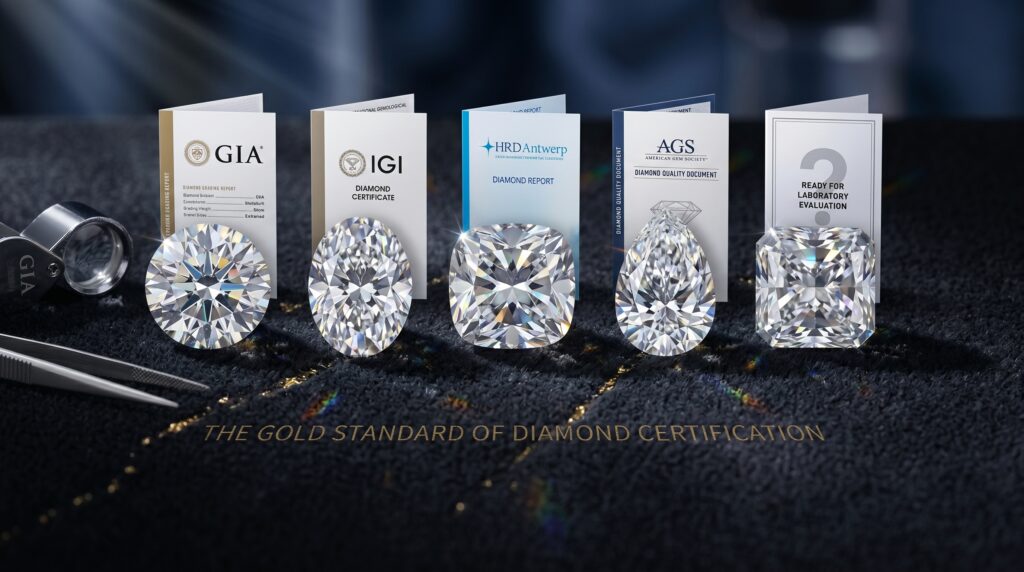
GIA: The Gemological Institute of America
GIA, or the Gemological Institute of America, is the most respected diamond grading organization in the world. Founded in 1931, it developed the 4Cs framework and the grading scales the entire industry uses today. When diamond professionals talk about a “clean cert,” they almost always mean GIA.
GIA’s graders are trained to be exceptionally conservative. A stone that lands at VS2 from GIA will sit at VS2 across multiple re-submissions with very little variance. That consistency is exactly what drives its premium positioning. In the U.S. market, GIA-certified diamonds command higher resale values, higher Rapaport-referenced prices, and stronger consumer confidence than any other lab.
GIA does not grade lab-grown diamonds with the same full report format it uses for natural stones, which is a meaningful distinction for retailers choosing between inventory types.
To explore what GIA certification covers in full detail, see our GIA Certification overview.
IGI: The International Gemological Institute
IGI has grown significantly over the past decade, driven almost entirely by the explosion of the lab-grown diamond market. For lab-grown stones, IGI has become the dominant grading authority worldwide. Their reports are detailed, widely accepted, and priced more accessibly than GIA, which makes them attractive to manufacturers and wholesalers working with high volume.
That said, IGI’s historical reputation on natural diamonds has been more nuanced. Earlier IGI reports had a known tendency to grade slightly more generously than GIA. The lab has worked to tighten standards in recent years, and current IGI reports are considerably more consistent than they were five years ago. Still, most experienced U.S. buyers price IGI-graded natural diamonds at a slight discount versus GIA equivalents.
For a deep look at what the IGI report covers, see our IGI Certification page. And for a direct comparison of the two leading labs, our IGI vs GIA resource covers the grading philosophy differences in detail.
SGL: The Solitaire Gemological Laboratories
SGL is a lesser-known lab that operates primarily in India, with particular reach in the Mumbai and Surat diamond trade corridors. SGL reports are common in South Asian domestic markets and among certain export-oriented Indian manufacturers selling to regional buyers in Southeast Asia and the Middle East.
In the U.S. market, SGL carries very limited recognition. Most American retailers and wholesale buyers will not accept SGL as a substitute for GIA or IGI. The grading standards have been inconsistent by the broader industry’s measure, and there is no established Rapaport pricing mechanism tied to SGL-graded stones the way there is for GIA and IGI diamonds.
SGL is best understood as a regional certification tool rather than a globally recognized grading authority. An SGL certificate on a diamond being sold in the U.S. should prompt additional independent evaluation before purchase.
Other Labs Worth Mentioning
Two additional labs frequently come up in U.S. market discussions: HRD Antwerp and AGS (American Gem Society). HRD is well-respected, especially in the European market, and carries solid credibility among U.S. professionals. AGS was known for its particularly detailed cut grading system before it merged its operations with GIA in 2022. For a broader comparison that includes EGL, see our IGI vs GIA vs EGL breakdown.
IGI vs GIA Certificate vs SGL: The Real Difference
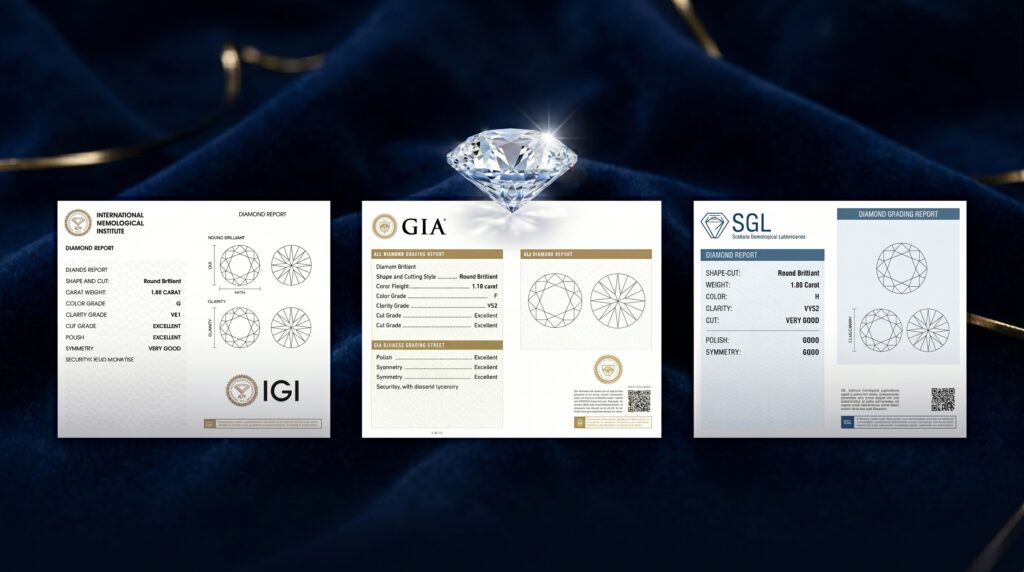
When retailers and manufacturers ask me to simplify this comparison into practical terms, I always come back to three things: grading consistency, market acceptance, and price impact. Here is how the three labs compare across the five factors that matter most.
| Factor | GIA | IGI | SGL |
|---|---|---|---|
| Grading Consistency | Extremely high, tightest standards globally | High for lab-grown; improving for natural | Low to moderate, inconsistent track record |
| U.S. Market Acceptance | Near-universal | High for lab-grown; moderate for natural | Very limited |
| Price Premium/Discount | Commands highest prices | Slight discount vs GIA for natural; standard for lab-grown | Significant discount required |
| Report Detail | Full 4Cs, cut grade, plot diagram | Full 4Cs, cut grade, plot diagram | Basic 4Cs, fewer supplementary details |
| Best Use Case | Natural diamonds, high-value purchases, investment | Lab-grown diamonds, B2B volume, retail mid-market | Regional South Asian trade only |
The most important takeaway here: the igi vs gia certificate gap is real, but it has narrowed in the lab-grown category where IGI has effectively become the industry standard. For natural diamonds at higher price points, GIA remains the cert buyers and sellers trust most, and the secondary market reflects that clearly. The sgl certificate vs igi gap is far wider and rarely closes regardless of the diamond involved.
How to Choose the Right Diamond Certification for Your Needs
Choosing a diamond certification standard is not a one-size-fits-all decision. Here are six factors that should guide every buyer, whether you are purchasing a single stone for an engagement ring or sourcing a thousand carats for a retail program.
- Budget and value alignment. If you want the strongest resale position and are buying a natural diamond, GIA is worth the premium. The price difference between a GIA cert and an IGI cert on the same natural stone typically ranges from 5 to 15 percent depending on the quality tier. On a $10,000 stone, that gap is meaningful, but so is the confidence that comes with it.
- Stone type: natural versus lab-grown. This is where the choice shifts dramatically. For lab-grown diamonds, IGI is not just acceptable, it is the market standard. Most buyers purchasing certified lab-grown diamonds expect an IGI report. GIA lab-grown reports exist but are less common in the retail pipeline.
- Resale and investment intent. Diamonds purchased as long-term investments or for estate planning should carry GIA grading. Auction houses, estate jewelers, and secondary market platforms apply the steepest discounts to non-GIA natural diamonds.
- Setting and end use. A diamond going into a fashion piece, a melee accent, or a trend-driven jewelry item does not need to carry the same cert weight as a 2.00-carat center stone in a solitaire engagement ring. Scale your certification standards to the end application.
- Retailer and consumer education. The diamond certification comparison that matters to a graduate gemologist differs from what a first-time buyer understands. If you are a retailer, your sales floor experience should be built around the cert your customer base trusts. In most U.S. markets, that means GIA for natural and IGI for lab-grown.
- Budget optimization for lab-grown selections. For consumers choosing lab-grown diamonds for engagement rings, IGI-certified stones offer excellent value. You get the same grading rigor that professionals rely on, at prices that free up budget for a better cut quality or larger carat weight.
Before you finalize your choice, ask the seller one direct question: “If I were to submit this stone to GIA independently, what grade do you expect it would receive?” How a manufacturer or retailer answers that question tells you everything you need to know about their confidence in their own certification standards.
What B2B Buyers and Diamond Manufacturers Should Know
For wholesalers, retailers ordering in volume, and diamond manufacturers building out a product line, the certification question is not just about quality signals. It is a commercial decision that touches pricing strategy, inventory turnover, and customer retention.
Here is what the B2B landscape actually looks like. GIA grading fees are higher, turnaround times are longer, and for natural diamonds in the mid-market range ($2,000 to $8,000 retail), the GIA premium is absolutely justified by the pricing power it delivers. For lab-grown programs operating at volume, IGI’s faster turnaround, lower grading fees, and high market acceptance make it the practical choice for most manufacturers.
The Rapaport price list, the benchmark that drives diamond pricing across the wholesale and retail trade, references GIA grading standards as its baseline. When you source an IGI natural diamond, experienced buyers will typically apply a discount to the Rapaport ask. Understanding that discount structure before you price your inventory protects your margins.
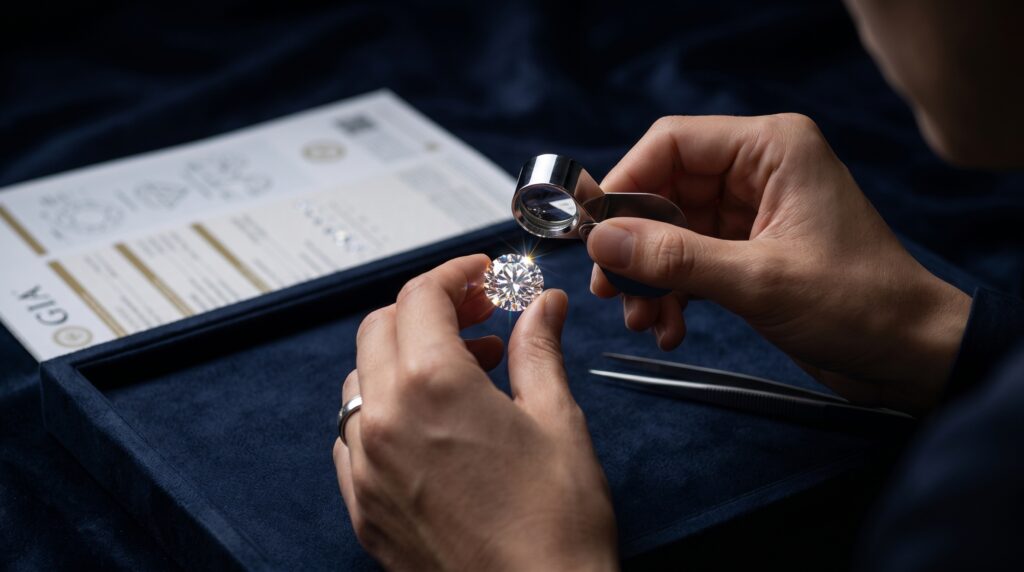
When I evaluate stones for B2B clients, the first thing I check is whether the cert matches what I see under the loupe. A certificate is only as good as the stone it describes. Any discrepancy between the report and the actual stone is a liability, not an asset.
For retailers building out a certified diamond program, the guidance is simple: lead with GIA for natural stones in your showcase, support it with IGI for lab-grown, and avoid SGL entirely for the U.S. market. Our team at Lepdo Diamonds works directly with manufacturers and wholesalers to source Certified Diamonds that meet these standards across both natural and lab-grown categories.
A note for any Diamond Retailer building out a lab-grown program: your customers are increasingly educated. They are comparing IGI reports across multiple vendors online before they ever walk into your store. Consistency in the certs you carry is as important as the stones themselves.
Diamond Certification Trends in the USA: 2026 to 2027
The U.S. diamond market is shifting in ways that make the certification conversation more important than it has ever been. Lab-grown diamond adoption has accelerated across every retail price point, with some estimates suggesting lab-grown diamonds now represent more than 50 percent of engagement ring center stone sales in certain market segments. IGI’s role in this category has made it far more visible to everyday consumers than it was even three years ago.
At the same time, GIA-certified natural diamonds are experiencing a kind of premium renaissance, driven in part by the desire to differentiate natural stones in a market where lab-grown alternatives are abundant. Retailers who position GIA-certified natural diamonds as the premium tier and IGI-certified lab-grown diamonds as the accessible tier are finding that narrative works extremely well on the sales floor.
From a trend perspective, digitally native consumers entering the engagement ring market are doing more pre-purchase research than any prior generation. They arrive knowing the difference between a GIA and an IGI report. That means the best diamond cert for retailers to carry is not a single answer but a curated range that speaks to different buyer motivations. The luxury customer wants GIA on natural. The value-conscious buyer going lab-grown is perfectly comfortable with IGI.
Fancy shape diamonds, such as ovals, cushions, and elongated radiant cuts, are driving significant interest in 2026, and most of these are arriving with IGI certs in the lab-grown category. GIA remains dominant for fancy shape natural diamonds at the high end.
How to Evaluate a Diamond Certification for Quality and Accuracy
When I assess a graded diamond presented with any certificate, the first thing I check is whether the plot diagram on the report matches the actual inclusions I see under a 10x loupe. Discrepancies here are a red flag regardless of which lab issued the report.
You will want to pay attention to these five evaluation points every single time:
- Verify the laser inscription. Most GIA and IGI reports include a laser-inscribed report number on the girdle of the diamond. This number should match the paper report exactly. If a seller cannot show you the inscription or the stone has no inscription, request an explanation before proceeding.
- Check the cut grade for round brilliants. Both GIA and IGI issue cut grades for round brilliant diamonds. GIA’s cut grading system for rounds is the most rigorous in the industry, evaluating brilliance, fire, and scintillation through specific pavilion angle and table percentage criteria. IGI has aligned closely with GIA on this. SGL cut grades should be independently verified.
- Examine the color and clarity grades against the stone. Pull the diamond under a daylight-equivalent light source and look at color face-down against a white background. Compare what you see against the graded color. For clarity, verify that the plot diagram matches the inclusion positions at 10x.
- Understand depth percentage and table percentage. For round brilliants, GIA research data shows that optimal light performance typically falls within specific depth and table ranges. These numbers are on every GIA and IGI report. A poorly cut stone may still carry an acceptable clarity and color grade, but the cut parameters will tell the real story about light return.
- Cross-reference the report on the lab’s verification portal. GIA, IGI, and most credible labs maintain online verification systems. Every GIA Certified Diamonds and IGI Certified Diamonds report should be verifiable by report number on the lab’s official website within seconds. If a certificate cannot be verified online, treat the stone as uncertified until proven otherwise.
Conclusion
Three labs, three very different value propositions. GIA remains the most trusted diamond certification in the world for natural stones, built on nearly a century of consistent, conservative grading and a global reputation that directly supports resale value and consumer confidence. IGI has earned its leadership position in the lab-grown diamond category, offering rigorous grading at accessible fees with strong U.S. market acceptance. SGL, while serviceable in its home markets, should not be relied upon for any diamond purchase intended for the American market, whether at retail or wholesale.
The IGI vs GIA vs SGL certificate comparison ultimately comes down to what your buyer needs from a piece of paper. GIA gives you the highest degree of trust and the strongest secondary market positioning. IGI gives you efficiency and an industry-standard cert for lab-grown. SGL gives you very little protection in the markets that matter most to U.S. buyers.
Whatever your sourcing needs, every stone in our inventory at Lepdo Diamonds comes with a certificate you can actually rely on. Browse our full range of Certified Diamonds to find GIA and IGI-graded natural and lab-grown diamonds sourced specifically for U.S. manufacturers, wholesalers, retailers, and end consumers.
The certificate is not just paperwork. It is the foundation of every diamond purchase you make. Choose the lab that your buyer trusts, and you will never have to explain a cert discrepancy again.
Frequently Asked Questions About IGI vs GIA vs SGL Certificate
1. What is the IGI vs GIA vs SGL certificate?
The IGI vs GIA vs SGL certificate comparison refers to three different diamond grading reports issued by three independent gemological labs: the International Gemological Institute (IGI), the Gemological Institute of America (GIA), and the Solitaire Gemological Laboratories (SGL). Each lab grades a diamond’s cut, color, clarity, and carat weight, but their consistency, global recognition, and market impact differ significantly. GIA is the global benchmark, IGI leads in lab-grown, and SGL is primarily a regional South Asian lab.
2. Is an IGI diamond certificate cheaper than GIA for buyers?
Yes, diamonds graded by IGI typically sell at a lower price than GIA-graded equivalents in the natural diamond category, often 5 to 15 percent less, because GIA commands a trust premium in the secondary market. For lab-grown diamonds, the pricing difference is minimal since IGI is the dominant cert in that category. The cost of submitting a stone to IGI for grading is also lower than GIA, which is why high-volume manufacturers often prefer IGI for lab-grown programs.
3. Which certificate makes a diamond look most impressive on paper?
Historically, SGL and some regional labs have been noted for more generous grading, meaning a stone might appear better on paper than GIA or IGI would grade it. IGI has also been known for grading slightly above GIA on natural diamonds, though this gap has narrowed in recent years. The truth is, an impressive-looking certificate from a less rigorous lab can mask real quality issues, which is exactly why GIA’s conservative standards protect buyers in the long run.
4. Does a GIA certificate include a cut grade for all diamond shapes?
GIA issues a formal cut grade only for standard round brilliant diamonds. For fancy shapes, such as ovals, pears, cushions, and marquises, GIA does not assign a cut grade and instead reports polish, symmetry, and other measurable parameters. IGI follows a similar approach for fancy shapes. This is a meaningful limitation because cut quality in fancy shapes can vary enormously, and buyers of fancy shape diamonds should rely on additional light performance analysis and expert evaluation beyond what any cert provides.
5. What is the biggest quality risk when buying an SGL-certified diamond?
The biggest risk is grading inflation. An SGL-graded diamond described as G/VS2 may realistically grade as H or I in color and SI1 in clarity under GIA or IGI standards. That gap represents real financial loss for the buyer. In the U.S. market, SGL certificates are not recognized by most major retailers, appraisers, or secondary market platforms, which makes resale extremely difficult and means the stone may need independent grading before any resale can occur.
6. Are lab-grown diamonds with IGI grading as good as natural diamonds with GIA grading?
The grading report type and the origin of the diamond are separate questions. IGI-graded lab-grown diamonds can be excellent stones with strong brilliance, fire, and scintillation, and IGI’s grading standards for lab-grown are well-established. The key difference is not in the cert, it is in the origin. Natural diamonds carry geological rarity and different long-term value characteristics compared to lab-grown stones. Both can be outstanding products. The right choice depends entirely on buyer priorities around value, origin, and sentiment.
7. Which certification is best for an engagement ring diamond?
For a natural diamond engagement ring center stone, GIA is the gold standard and the recommendation most professionals and experienced buyers stand behind. For a lab-grown diamond engagement ring, an IGI-certified stone is completely appropriate and represents exactly what the market expects. In both cases, the certificate confirms what you are actually buying. Avoid SGL-certified stones for engagement ring purposes in the U.S. market, where the cert carries no meaningful recognition or resale value support.
8. How do I choose a reliable diamond supplier that offers properly certified stones?
Look for suppliers who carry GIA and IGI reports as standard, who can verify every report number through the lab’s official online portal, and who are transparent about grading standards and pricing relative to Rapaport benchmarks. Ask directly whether they carry any SGL or non-industry-standard certs in their inventory and what their policy is on cert substitution. Suppliers with long-standing relationships in the U.S. wholesale and retail market, like those available through Lepdo Diamonds, will always be able to answer these questions clearly and without hesitation.