Unique Diamond Cuts That Are Trending in 2026: Kite, Hexagon, Shield, Rose & More
 by lepdogroup@gmail.com
1 comment
by lepdogroup@gmail.com
1 comment
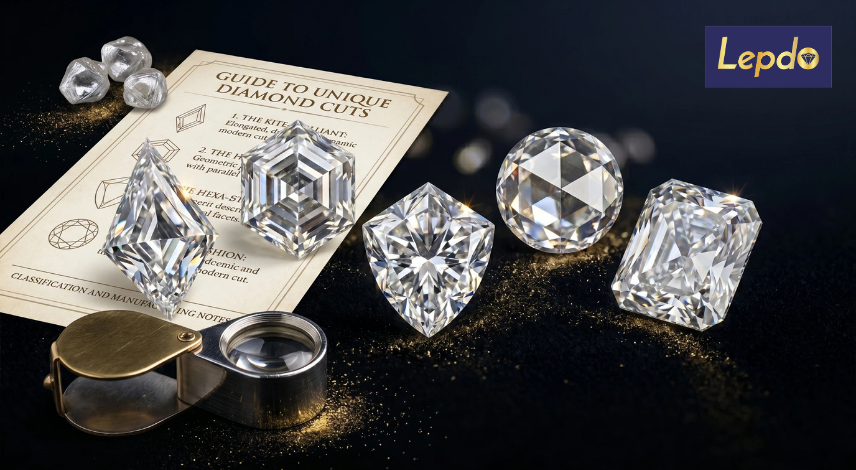
Unique diamond cuts trending in 2026 are specialty fancy shapes, including kite, hexagon, shield, rose, and portuguese cuts, that deviate from traditional round brilliants to deliver distinctive light performance and design character. For USA buyers, these cuts offer strong visual impact at lower per-carat costs, with growing availability from certified Surat manufacturers. Lepdo Diamonds supplies a full range of custom and unique cut diamonds to wholesalers, retailers, and jewelry brands across the United States.
Requests for non-round, non-oval diamonds have climbed by over 35% across USA specialty jewelry retailers since 2023, according to trade figures tracked by the Natural Diamond Council. If you work in this industry, you already feel it. Designers are asking for hexagons. Consumers are searching for shields. And buyers who once defaulted to the round brilliant are now walking in with a screenshot of a kite cut diamond and asking, “Can you source this?”
This is exactly where the conversation around unique diamond cuts trending in 2026 gets interesting. These shapes are not a niche curiosity anymore. They are a real and growing segment of the polished diamond market, and understanding them is essential whether you buy rough, trade polished stones, or sell finished jewelry to consumers.
Here is what this guide covers: the most significant specialty cuts gaining ground right now, who each shape is right for, how to evaluate quality without a GIA cut grade, and what USA-based wholesalers, retailers, and manufacturers need to know before sourcing these shapes at scale.
What Are Unique Diamond Cuts?
Unique diamond cuts are polished diamond shapes that fall outside the standard commercial categories of round, oval, pear, princess, cushion, and emerald. They are defined by unusual outlines, non-standard facet arrangements, or historically inspired cutting styles that produce a look you simply cannot replicate with a traditional brilliant cut.
Quick Info Box
- Definition: A polished diamond cut using a non-standard outline or facet pattern that produces a visually distinct shape outside mainstream commercial cuts
- Key Types: Kite, hexagon, shield, rose, flanders, half moon, portuguese, trapezoid, baguette variations, lozenge
- Best For: Custom engagement rings, designer fine jewelry, collector stones, bespoke bridal, east-west settings, halo alternatives
- Key Advantage: Higher face-up visual impact per carat weight at a lower Rapaport price point than round brilliants
Lepdo Diamonds is a Surat-based manufacturer that specializes in producing these specialty shapes for USA-based buyers, with consistent cut quality across both natural and lab-grown stones.
Most Popular Unique Diamond Cuts in 2026 and Who They Are Right For
Kite Cut Diamond
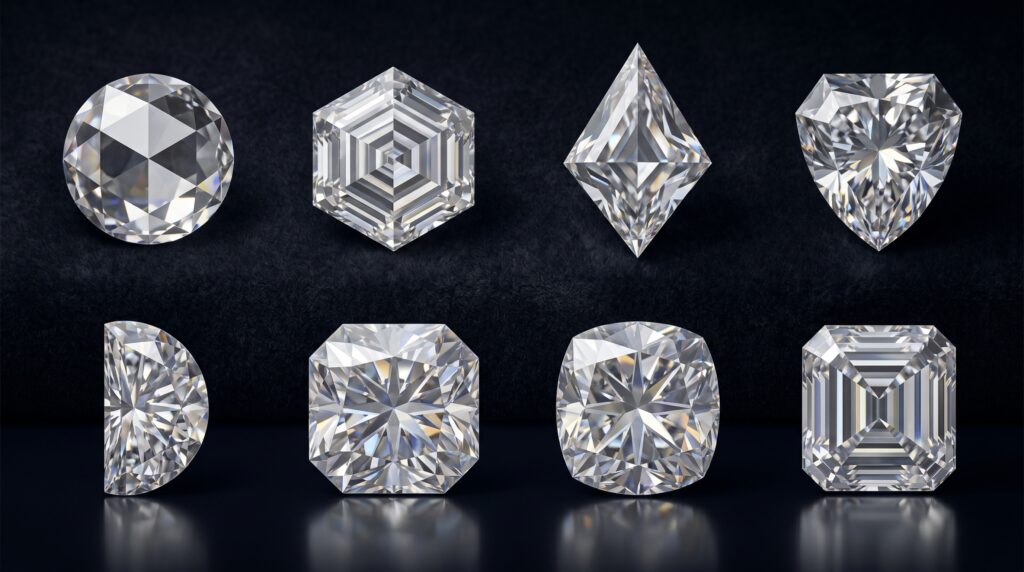
The Kite Cut Diamond is a four-sided geometric shape with two longer tapered sides and two shorter angled sides, forming a diamond-within-a-diamond silhouette. It reads as bold and architectural, which is exactly why avant-garde jewelry designers in New York and Los Angeles have been requesting it in volume. Kite cuts work beautifully as center stones in east-west settings and as side stones flanking an elongated oval or pear. The buyer profile is someone who rejects conventional shapes entirely and wants their ring to be a design statement.
Rose Cut Diamond
The Rose Cut Diamond is one of the oldest cutting styles in existence, originating in sixteenth-century Europe. It features a flat base, a domed crown, and anywhere from three to twenty-four triangular facets arranged to create a soft, diffused glow rather than the sharp scintillation of a modern brilliant. Rose cuts are extremely popular with the vintage bridal consumer and with designers working in the Victorian and art deco revival space. They face up very large for their carat weight because of the shallow pavilion. Among unusual diamond shapes for wholesale, the rose cut consistently ranks among the most requested shapes from USA jewelry brands right now.
Hexagon Cut Diamond
The Hexagon Cut Diamond has emerged as one of the defining shapes of the 2024 to 2026 fine jewelry cycle. Its six-sided outline pairs naturally with bezel settings, creates clean geometry in solitaire designs, and sits beautifully on a finger in east-west orientation. Step-cut hexagons deliver a hall-of-mirrors visual, while brilliant-faceted hexagons produce stronger light return. Hexagon diamonds from India, particularly from cutting centers in Surat, are among the highest-quality sources for consistent calibrated hexagons available to the USA wholesale market.
Shield Cut Diamond
The Shield Cut Diamond is a triangular shape with one flat or gently curved base and two longer sides that taper to a single point, resembling a heraldic shield. It carries a strong, assertive energy that appeals to the fashion-forward consumer. Shield cuts work well as solo center stones or as accent pieces alongside round or oval diamonds in custom multi-stone designs. The shape requires skilled cutting to prevent light leakage at the corners, which makes sourcing from an experienced custom diamond shape manufacturer critical.
Flanders Cut Diamond
The Flanders Cut Diamond is a square or slightly rectangular shape with eight faceted corners and a brilliant-cut crown structure. It was originally developed in Antwerp and produces strong brilliance with a softer outline than a princess cut. The Flanders is particularly appealing to buyers who want the sparkle of a round but the outline of a square, without the sharp corners of a princess. It is underutilized in the USA market right now, which means early adopters in retail have a clear differentiation opportunity.
Half Moon Cut Diamond
The Half Moon Cut Diamond is a semicircular shape with a flat edge and a curved outer arc. Primarily used as a matched pair flanking a center stone, half moon cuts are a staple of the three-stone engagement ring designer. Consistency of the flat edge and symmetry of the curve across a matched pair is critical for the finished ring to look balanced. This is where sourcing from a reliable kite cut diamond supplier or specialty cut house, one that calibrates matched shapes precisely, matters enormously.
Portuguese Cut Diamond
The Portuguese Cut Diamond is among the most complex and labor-intensive cuts on this list. It features an unusual double row of rhomboid and triangular facets on both the crown and the pavilion, producing extraordinary brilliance and fire that outperforms many modern brilliant cuts in scintillation. The portuguese cut is a collector’s stone and appeals to buyers who understand diamond cutting at a technical level. Retail price point is higher than most specialty shapes because the cutting labor is significant.
Step Cut Diamond
The Step Cut Diamond refers to any diamond cut with parallel rows of elongated rectangular facets running along the girdle on both crown and pavilion. In the unique cut category, step cutting is frequently applied to hexagons, shields, kites, and trapezoids to create a clean, architectural look with high clarity visibility. Step cut diamonds show inclusions more readily than brilliant cuts, so color and clarity grades matter more in this family.
Unique Diamond Cuts vs Round Brilliant Diamonds: The Real Difference
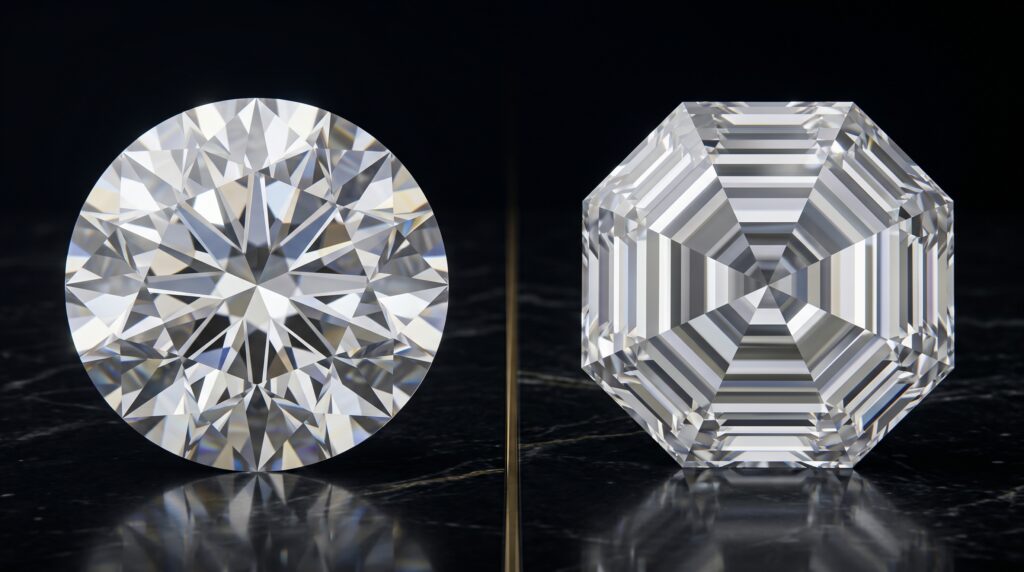
To be fair, round brilliant diamonds still dominate engagement ring sales in the USA, accounting for roughly 55% of all bridal diamond sales. But that number has been dropping steadily for four consecutive years. Here is the factual comparison buyers and retailers should understand.
| Factor | Unique Diamond Cuts | Round Brilliant |
|---|---|---|
| Price per Carat | 20% to 50% lower on Rapaport | Industry benchmark premium |
| GIA Cut Grade | Not available for fancy shapes | Available (Excellent to Poor) |
| Face-Up Size | Often larger for same carat weight | Smaller relative face-up area |
| Light Performance | Varies by shape and cutter | Highly standardized |
| Design Flexibility | Very high: geometric, vintage, bespoke | Limited to round-optimized settings |
The most important takeaway from that table is the price-per-carat advantage. A well-cut 1.50 carat hexagon or rose cut will typically cost 30% to 40% less than a comparable round brilliant at the same color and clarity grade. For the consumer, that means a visually larger, more distinctive stone for the same budget. For the retailer or unusual diamond shapes wholesale buyer, that means stronger margin on a product that is also differentiated.
That said, unique cuts demand more from the buyer in terms of evaluation skill, because the absence of a standardized GIA cut grade means you must assess light performance and proportion quality directly.
How to Choose the Right Unique Diamond Cut for Your Style
- Personal style and aesthetic personality. Geometric and architectural personalities gravitate toward hexagon and kite cuts. Romantic, vintage-leaning buyers consistently choose rose cuts. Bold and graphic design lovers tend to land on shield or flanders shapes. The shape should feel like a natural extension of how the wearer already dresses and accessorizes.
- Finger shape and hand compatibility. Elongated shapes like the shield and kite cut tend to flatter shorter fingers by creating a lengthening visual effect. Hexagons and flanders cuts work across finger sizes because of their balanced proportions. Rose cuts, with their low profile, are a strong choice for buyers with very active lifestyles who want minimal snag risk.
- Setting and mounting compatibility. Step cut hexagons and shields pair beautifully with bezel settings. Kite cuts often look best in minimal four-prong or tension-style mounts that do not interrupt the outline. Portuguese cuts deserve open, simple settings that let the complex faceting speak for itself. Always consider the setting before finalizing the shape.
- Budget advantage versus alternatives. Think of it this way: a natural 1.00 carat rose cut at VS2, G color, will typically be priced 35% to 45% below a round brilliant at the same grade. That savings can be redirected toward a better clarity or a more elaborate setting. For budget-conscious consumers, unique cuts are the single most effective way to get more stone for the money.
- Occasion and purpose. Hexagons, shields, and kites are strong center stone choices for engagement rings. Portuguese and rose cuts often appeal to anniversary pieces or right-hand fashion rings. Half moon and kite cuts see frequent use as accent stones in multi-stone designs. Flanders cuts work equally well across bridal and fashion jewelry.
- Lab-grown versus natural. Lab-grown diamonds in unique shapes are available across all the cuts listed here, with IGI certification and the same optical properties as natural stones. For buyers who want a 1.50 carat or larger hexagon or rose cut at an accessible price, lab-grown unique cut diamonds priced 50% to 70% below natural equivalents make that entirely realistic. You can explore the full range at Unique Cut Diamonds from Lepdo Diamonds.
Before you finalize your choice, spend time looking at the stone in person under different lighting conditions, natural daylight, LED overhead, and candlelight. Unique cuts behave differently across lighting environments, and that behavior is part of their character.
What B2B Buyers and Diamond Manufacturers Should Know
The unique cut segment is not just a consumer trend. It is a supply chain story, and the buyers who understand sourcing dynamics will be positioned to profit from it.
Here is what the wholesale and manufacturing side of this category actually looks like right now.
Consistency is the core challenge. Unlike rounds, where cutting standards are globally benchmarked, fancy shapes like hexagons and kite cuts have no universal proportion specification. That means cut quality can vary dramatically between manufacturers. When sourcing unusual diamond shapes wholesale, always request proportion details: table percentage, depth percentage, crown angle, and pavilion depth. These numbers tell you far more than a lab report alone.
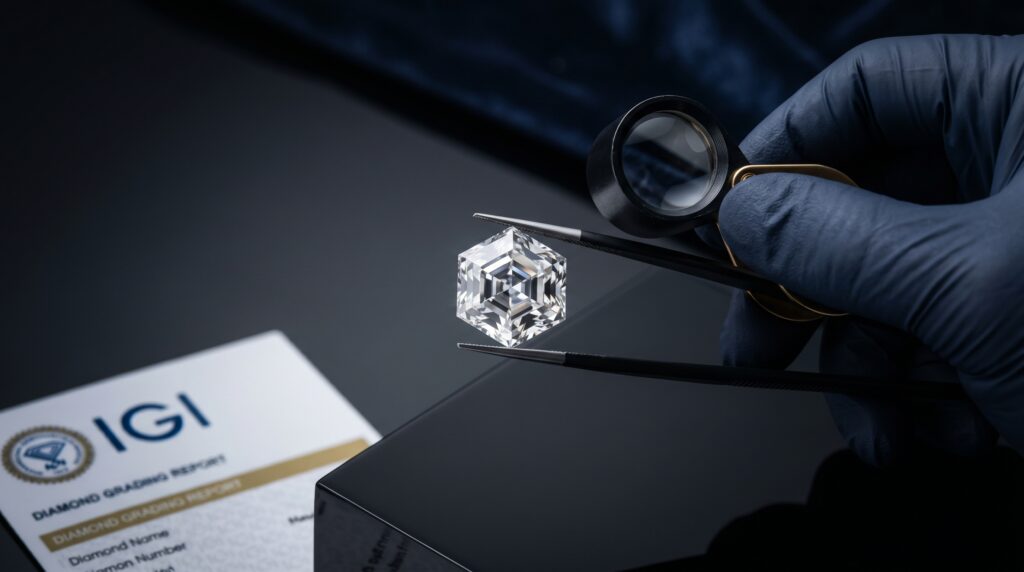
IGI currently grades polish and symmetry on fancy shapes, and while a GIA cut grade is not available for these stones, IGI’s light performance report (where offered) can provide useful comparative data. Rapaport pricing for unique shapes is based on the most comparable standard shape category, with adjustments for demand and cutting complexity. Kite cuts and shields typically price off the pear or marquise Rapaport list. Hexagons often reference the radiant or cushion list.
For bespoke diamond cuts from Surat, buyers should look for manufacturers with documented cutting consistency across matched pairs and calibrated parcels, not just single-stone samples. I have sourced from manufacturers who show exceptional sample stones but deliver inconsistent parcels. The production average is what matters, not the showcase stone.
Lepdo Diamonds operates as a Unique Cut Diamonds manufacturer and supplier from Surat with direct access to USA buyers, providing certified natural and lab-grown specialty shapes with full proportion documentation on request.
Industry insider tip: When evaluating a parcel of matched hexagons or half moons, always check the length-to-width ratio consistency across the entire lot, not just the top stones. A 0.05 variation in ratio across a matched pair is acceptable. Beyond 0.10, the finished ring will read as visually unbalanced.
Unique Diamond Jewelry Trends in the USA in 2026 and 2027
The USA fine jewelry market has entered what trade insiders are calling the “bespoke decade.” Consumers, particularly millennials and Gen Z buyers entering the bridal market, are actively rejecting the idea that a diamond engagement ring must look like every other diamond engagement ring. This has created a sustained pull toward unique diamond cuts trending in 2026 across every price tier.
Rose cuts are leading the vintage revival movement, appearing in everything from solitaire engagement rings to stacked fashion rings. The east-west setting trend, in which a stone is oriented horizontally across the finger rather than vertically, has made kite cuts and hexagons particularly relevant because their geometry reads as intentional and modern in that orientation. Bezel settings have returned to prominence partly because they showcase the geometric outline of hexagons and shields without interrupting the shape with prongs.
Influence from tastemakers in the fashion and editorial world has accelerated consumer awareness of these cuts significantly. When a shape appears in a widely shared editorial or on the finger of a cultural figure, wholesale inquiry volumes can shift within weeks. The hexagon diamond, in particular, saw a notable spike in USA retail interest beginning in late 2024 that has not subsided.
Market research from IDEX and other diamond industry publications confirms that the share of non-round, non-oval diamonds in USA engagement ring sales increased from approximately 38% in 2022 to over 45% in 2026. Unique cuts are a meaningful piece of that shift.
How to Evaluate Quality in Unique Diamond Cuts
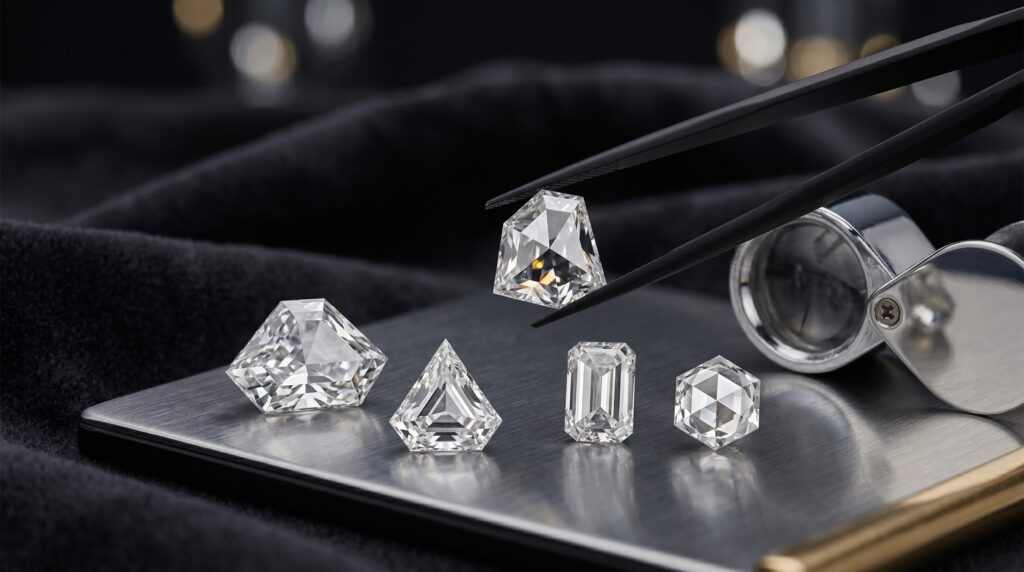
When I assess a unique cut diamond, the first thing I check is how the stone handles light in an uncontrolled environment. Not a loupe. Not a proportion sheet. I move it under a single light source and watch where the darkness falls. A well-cut hexagon or rose cut should show bright, even light return across the face with no large dark zones, particularly near the center.
Here are four expert evaluation criteria to apply to every unique cut you consider:
- Symmetry and outline regularity. In a hexagon, all six sides should be equal in length with consistent internal angles. In a kite cut, the two longer sides should mirror each other precisely. Any warping in the outline will be visible once the stone is set, and it cannot be corrected.
- Table percentage and depth. For step cut hexagons, a table percentage between 55% and 65% tends to produce clean clarity visibility with acceptable light return. Rose cuts by design have tables that are very small or absent, but the dome curvature should be smooth and even. Depth percentage that is too low will cause a shallow, glassy look; too deep, and the stone will face up dark.
- Pavilion facet alignment. The pavilion is where light return originates. In any step cut or modified brilliant unique shape, the pavilion facets should meet cleanly at the culet or at the center point with no misalignment. Misaligned pavilion facets in a shield or kite cause localized light leakage that no setting can fix.
- Color grading nuances. Unique cuts with larger open facets, such as step cut hexagons and rose cuts, show body color more readily than brilliant cuts. A stone graded J on the GIA color scale may read as warmer than expected in these shapes. For white or near-colorless looks in rose and step cuts, G or above is a safer color specification.
- Clarity considerations. Open, large-faceted shapes offer less optical coverage of inclusions than brilliant cuts. The brilliance and fire of a portuguese cut can mask some inclusions effectively, but a step cut shield at SI1 may show a visible feather or crystal. Review the clarity plot on the IGI or GIA report carefully before purchasing, and request an eye-clean confirmation from your supplier.
Conclusion
Three things stand out clearly from everything covered here. First, unique diamond cuts trending in 2026 are not a passing micro-trend. They represent a genuine, data-supported shift in how USA consumers and design professionals think about diamonds, and the market share numbers confirm this direction is accelerating. Second, the quality evaluation process for these shapes requires more direct expertise from buyers than standard commercial cuts,
because the absence of a GIA cut grade means you are assessing light performance and proportion integrity yourself, or relying on a supplier who does it consistently on your behalf. Third, the price advantage relative to round brilliants is real and meaningful, both as a consumer value proposition and as a margin opportunity for retailers who source these shapes early and well.
If you are a retailer, designer, or wholesaler building out your unique cut inventory for 2026, the right time to establish a reliable source relationship is before demand peaks, not after. Explore the collection at Unique Cut Diamonds from Lepdo Diamonds, where kite, hexagon, shield, rose, and a full range of custom diamond shapes are available for USA buyers in both natural and lab-grown options.
Unique diamond cuts trending in 2026 are becoming a major choice for jewelry brands, retailers, and custom designers looking for distinctive shapes beyond traditional round diamonds.
Frequently Asked Questions About Unique Diamond Cuts Trending in 2026
1. What are unique diamond cuts trending in 2026?
Unique diamond cuts trending in 2026 are specialty fancy shapes, including kite, hexagon, shield, rose, flanders, half moon, and portuguese cuts, that are gaining significant market share in USA fine jewelry. Growing consumer demand for personalized, non-traditional engagement rings and fashion jewelry is the primary driver. These cuts offer distinctive design character and strong visual impact compared to standard commercial shapes.
2. Are unique diamond cuts cheaper than round brilliant diamonds?
Yes, most unique diamond cuts are priced below round brilliant diamonds, often by 20% to 50% depending on shape and carat weight. Fancy shapes like kite, hexagon, and shield cuts carry lower Rapaport price premiums. This makes them attractive for budget-conscious buyers who want a larger, more distinctive stone for the same investment.
3. Which unique diamond cut looks the biggest or most impressive?
The rose cut and hexagon cut tend to look largest face-up relative to their carat weight because both feature shallow pavilions and wide table surfaces. The shield cut also has a bold face-up presence. For maximum visual impact per dollar, these three shapes consistently outperform round brilliants in how large they appear when set in a ring.
4. Do unique diamond cuts receive a GIA cut grade?
No. GIA issues cut grades only for standard round brilliant diamonds. Fancy shapes like kite, hexagon, shield, and rose cuts do not receive an official GIA cut grade. Instead, IGI and other labs may grade polish and symmetry. Buyers should evaluate light performance, facet alignment, and proportion quality directly when assessing specialty cuts.
5. What is the biggest quality risk with unique diamond cuts?
The biggest risk is inconsistent cutting standards, since there is no universal grading benchmark for fancy shapes. Poor pavilion depth or misaligned facets can cause dark centers, light leakage, or uneven brilliance. Buyers should always request detailed proportion specifications, view the stone under different lighting conditions, and source from certified diamond manufacturers with proven cut consistency.
6. Are lab-grown unique diamond cuts as good as natural ones?
Yes. Lab-grown diamonds in fancy shapes like hexagon, rose, and kite cuts are chemically and optically identical to natural diamonds. IGI-certified lab-grown unique cuts offer the same brilliance and fire at significantly lower price points, often 50% to 70% less than natural equivalents. For buyers prioritizing size, design flexibility, and value, lab-grown unique cuts are an excellent choice.
7. Which unique diamond cut is best for an engagement ring?
The rose cut and hexagon cut are top choices for engagement rings among unique shapes. Rose cuts have a romantic, antique softness that photographs beautifully. Hexagons pair perfectly with geometric bezel or east-west settings. The shield cut suits bold, modern designs. Your best choice depends on the wearer’s personal style and the ring setting you have planned.
8. How do I choose a reliable unique diamond cut manufacturer or supplier?
Look for manufacturers based in established cutting centers like Surat, India, with verifiable IGI or GIA certification processes, documented cut consistency across parcels, and transparent pricing against Rapaport benchmarks. Request sample stones before committing to bulk orders. Lepdo Diamonds, a Surat-based custom diamond shape manufacturer, provides certified unique cut diamonds to USA wholesalers, retailers, and jewelry brands.
9. What are the most popular unique diamond cuts trending in 2026?
Kite, hexagon, shield, rose, and Portuguese cuts are among the most popular unique diamond cuts trending in 2026 due to their modern appearance and custom jewelry appeal.