Diamond Certification: The Complete Guide for Buyers, Retailers & Wholesalers (2026 – 27)
 by Lepdo Diamonds
0 comments
by Lepdo Diamonds
0 comments
Introduction: The Document That Determines Everything
Imagine spending $8,000 on a diamond engagement ring, only to discover at the jeweler’s counter that the stone is two color grades lower than what the seller described. No refund. No recourse. Just an expensive lesson learned too late.
This scenario plays out more often than the industry would like to admit. And in nearly every case, the root cause is the same: the buyer didn’t fully understand diamond certification, or worse, they trusted a certificate they couldn’t evaluate.
Diamond certification is not just paperwork. It is the language of quality in the diamond industry. It protects consumers from misrepresentation. It gives retailers pricing confidence. It gives wholesalers a consistent trading vocabulary. And it gives manufacturers the ability to command fair market value for their product.
Whether you’re buying a diamond for the first time or sourcing inventory for a jewelry brand, understanding certification, what it is, which labs matter, and how to verify it, is not optional. It’s essential.
In short:
- Diamond certification is an independent quality report that grades a diamond’s 4Cs and other characteristics.
- Not all certifying labs are equal, the grading standards and industry acceptance vary significantly.
- Knowing how to read and verify a diamond certificate protects your investment at every level of the supply chain.
What Is Diamond Certification?
Diamond certification is an official grading report issued by an independent gemological laboratory that assesses and documents a diamond’s physical and optical characteristics, most importantly its Cut, Color, Clarity, and Carat weight (the 4Cs). The certificate provides an objective, standardized description of the diamond that buyers, sellers, insurers, and appraisers can rely on.
A diamond certification is not the same as an appraisal. An appraisal assigns monetary value; a certification grades quality. Both matter, but they serve different purposes.
For a deeper exploration of terminology, visit the Lepdo Diamonds Diamond Certification Glossary.
Why Does Diamond Certification Matter?
For Consumers (B2C)
Without a certificate, you are buying based on a seller’s word alone. Even experienced buyers cannot reliably assess color or clarity with the naked eye. A certificate from a respected lab removes subjectivity from the equation.
Key benefits for end consumers:
- Objective quality verification, not a salesperson’s opinion.
- Accurate comparison across multiple diamonds and sellers.
- Documentation for insurance, resale, and estate purposes.
- Protection against grade inflation or misrepresentation.
For Retailers and Jewelry Brands
Certification is the foundation of pricing integrity. A retailer who stocks only GIA or IGI certified diamonds can confidently communicate quality to customers and justify price points with documentation.
Key benefits for retailers:
- Standardized inventory pricing and communication.
- Reduced customer disputes and returns.
- Brand credibility and trust with discerning buyers.
- Easier staff training, the certificate tells the story.
For Wholesalers and Manufacturers
In the B2B diamond trade, certified stones trade at defined price points based on Rapaport price list benchmarks. Certification enables transparent negotiation and reduces the friction of in-person grading disputes.
Key benefits for the trade:
- Faster transactions with fewer disputes.
- Higher liquidity for certified vs. uncertified stones.
- Clearer inventory categorization across large lots.
- Stronger buyer confidence in remote and online transactions.
Explore certified diamond sourcing options at Lepdo Diamonds’ certified diamond collection.
In short:
- Diamond certification provides objective quality documentation that protects all parties in a transaction.
- Certified diamonds trade with more confidence, more speed, and at better-defined prices.
- The lab that issued the certificate matters as much as the certificate itself.
The Major Diamond Certification Labs: Who Are They?
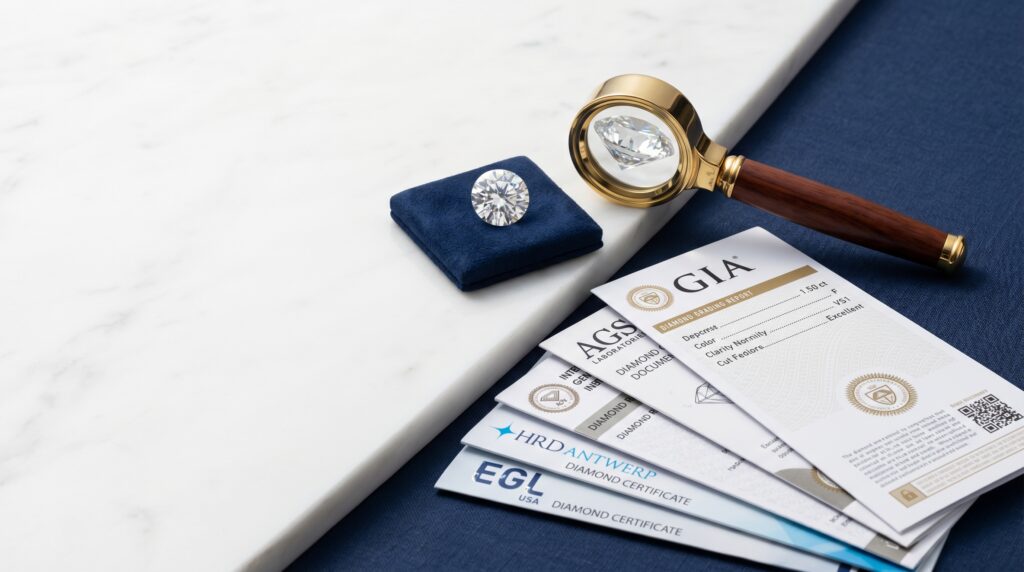
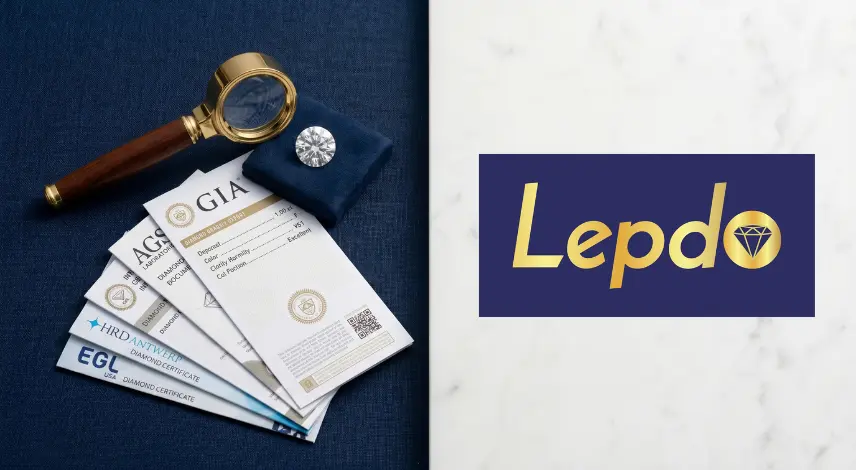
Not every certificate carries the same weight. The diamond industry recognizes several laboratories, each with different grading standards, international acceptance, and areas of strength.
| Lab | Founded | Industry Trust | Grading Strictness | Best For | Resale Acceptance |
|---|---|---|---|---|---|
| GIA | 1931 | Gold standard | Highest | Investment, bridal, high value | Universal |
| AGS | 1934 | Very high | Very high (cut focus) | Ideal cut precision buyers | Widely accepted |
| IGI | 1975 | High | High (lab-grown leader) | Lab-grown, fashion, retail | Broadly accepted |
| HRD | 1973 | Strong (Europe) | High | European market, wholesale | Strong in Europe |
| EGL | 1974 | Moderate / variable | More lenient | Budget, fashion, melee | Limited |
GIA – Gemological Institute of America
GIA is the most trusted name in diamond certification worldwide. Founded in 1931, it is a nonprofit organization that invented the modern 4Cs grading system. GIA certified diamonds are accepted by virtually every major retailer, estate buyer, appraiser, and international trader.
- Strictest, most consistent grading standards in the industry.
- Blind multi-grader consensus process, no single gemologist determines a grade.
- Universally accepted for resale, insurance, and financing.
- Best choice for high-value purchases, investment stones, and bridal diamonds.
Learn more at the GIA Certified Diamonds glossary page.
IGI – International Gemological Institute
Founded in 1975 in Antwerp, IGI has grown into the world’s largest independent gemological laboratory network, with offices in over 20 countries. IGI has become the dominant certification lab for lab-grown diamonds and is increasingly accepted for natural diamonds in the retail sector.
- Widely used in India, the USA, and Europe for both natural and lab-grown diamonds.
- Strong in fashion jewelry and accessible luxury retail.
- Grading standards considered slightly more lenient than GIA for natural diamonds, but highly consistent for lab-grown.
- Excellent choice for jewelry brands working with lab-grown inventory.
Explore IGI certification details in the IGI Certified Diamonds glossary.
HRD Antwerp – Hoge Raad voor Diamant
HRD, also known as the Diamond High Council, is Belgium’s premier diamond certification authority and one of the most trusted labs in European diamond trading. Founded in 1973, HRD is closely affiliated with the Antwerp diamond district, the historic center of the global diamond trade.
- Grading standards comparable to GIA, highly respected in Europe.
- Preferred by many Belgian, Dutch, and broader European manufacturers and wholesalers.
- Strong recognition among high-end European jewelry brands.
- HRD certification provides significant credibility for stones entering the European market.
AGS, American Gem Society
AGS was founded in 1934 and developed the proprietary AGS Ideal Cut grade, a more precise, performance-based cut assessment than GIA’s standard cut grades. AGS uses a 0–10 numeric scale (0 being the best) rather than descriptive terms, which some buyers find more intuitive.
- The most detailed cut grading system in the industry.
- Preferred by consumers and retailers who prioritize light performance and optical precision.
- Slightly narrower lab footprint than GIA, but highly respected in the USA.
- Ideal for round brilliants where cut quality is the primary value driver.
EGL – European Gemological Laboratory
EGL is a for-profit lab network founded in 1974 that operates through independently franchised branches in the USA, Israel, South Africa, and Europe. Unlike GIA, IGI, and HRD, EGL branches do not share unified grading standards, which leads to significant inconsistency across certificates.
- EGL grades are generally considered 1–3 color grades and 1–2 clarity grades more lenient than GIA.
- EGL-certified diamonds carry a meaningful price discount relative to GIA equivalents.
- Best suited for budget-conscious purchases, fashion jewelry, and melee where strict grading carries less importance.
- EGL USA is considered more reliable than EGL International.
- Always verify which branch issued the certificate before evaluating an EGL stone.
In short:
- GIA and AGS are the strictest and most universally accepted USA-based labs.
- IGI is the leading lab for lab-grown diamonds globally.
- HRD is the European standard with strong Antwerp credibility.
- EGL offers lenient grading with significant price implications, suitable for informed buyers only.
How to Read a Diamond Certificate
Understanding a diamond certification is a skill that every buyer, retail or wholesale, should develop. Here’s what to look for on any major certificate:
The 4Cs – The Core of Every Certificate
Every diamond certification documents these four characteristics:
- Carat weight: The precise weight of the diamond, measured to two decimal places.
- Color grade: On GIA’s scale, D (colorless) through Z (light yellow/brown). Colorless to near-colorless (D–J) are most desirable.
- Clarity grade: From Flawless (FL) to Included (I3), based on the presence, size, and position of internal inclusions and external blemishes.
- Cut grade: How well the diamond’s proportions, symmetry, and polish interact with light. Applies primarily to round brilliants.
Additional Details on a Diamond Certification
Beyond the 4Cs, a full certificate from GIA, IGI, or HRD includes:
- Diamond shape and cutting style (e.g., round brilliant, oval modified brilliant).
- Measurements in millimeters.
- Depth percentage and table percentage.
- Polish and symmetry grades.
- Fluorescence strength and color.
- Clarity plot (diagram of inclusion locations).
- Report number (used for diamond certification check and verification).
Understanding fluorescence is particularly important, learn how it affects a diamond’s appearance in our detailed guide on diamond fluorescence.
How to Perform a Diamond Certification Check
Every reputable lab offers online verification. Here is the process:
- Locate the report number on the physical certificate (usually printed near the top or bottom).
- Visit the issuing lab’s official website (GIA Report Check at gia.edu, IGI at igiworldwide.com, HRD at hrdantwerp.com).
- Enter the diamond certification number in the verification tool.
- Confirm that all grades, measurements, and characteristics on the listing match the official database record.
Any discrepancy between the listed certificate and the online record is a significant red flag. Learn more about the verification process at Lepdo Diamonds’ diamond certification check guide.
In short:
- A diamond certificate documents the 4Cs plus additional optical and physical characteristics.
- The report number is your key to verifying authenticity, always cross-reference it with the lab’s online database.
- Discrepancies between a listing and the verified certificate are immediate red flags.
How to Choose the Right Certification for Your Purpose
Not every purchase requires the same certification. Here is a practical guide by use case:
Engagement Rings and High-Value Bridal Jewelry
Choose: GIA or AGS
For the most emotionally and financially significant jewelry purchases, there is no substitute for GIA or AGS certification. These labs provide the most reliable grades, the strongest resale support, and the clearest insurance documentation.
Lab-Grown Diamond Jewelry
Choose: IGI
IGI has become the industry standard for lab-grown diamond certification. Most major lab-grown diamond retailers and brands, including many USA-based direct-to-consumer brands, use IGI as their primary certifying lab. The grades are consistent and widely accepted in this category.
Fashion Jewelry and Accessible Luxury Collections
Choose: IGI or EGL (with transparency)
For fashion-forward collections where price accessibility matters and stones are in the sub-1-carat range, IGI provides solid certification at a practical price point. EGL can also work for this segment when the grade differential is disclosed transparently to the end buyer.
European Market Distribution
Choose: HRD or GIA
If your distribution is primarily European, particularly Belgium, the Netherlands, Germany, or the broader EU, HRD certification carries strong market credibility and is the preferred choice among many European retailers and wholesalers.
Wholesale Lot Buying
Choose: GIA for high-value stones; IGI for mid-range; evaluate EGL cautiously
In wholesale lot buying, the certification strategy should align with the intended retail destination. High-value stones destined for bridal or investment buyers should carry GIA. Mid-range stones for retail or fashion jewelry can be IGI. EGL stones should only be purchased with a clear understanding of the grade differential and appropriately adjusted pricing.
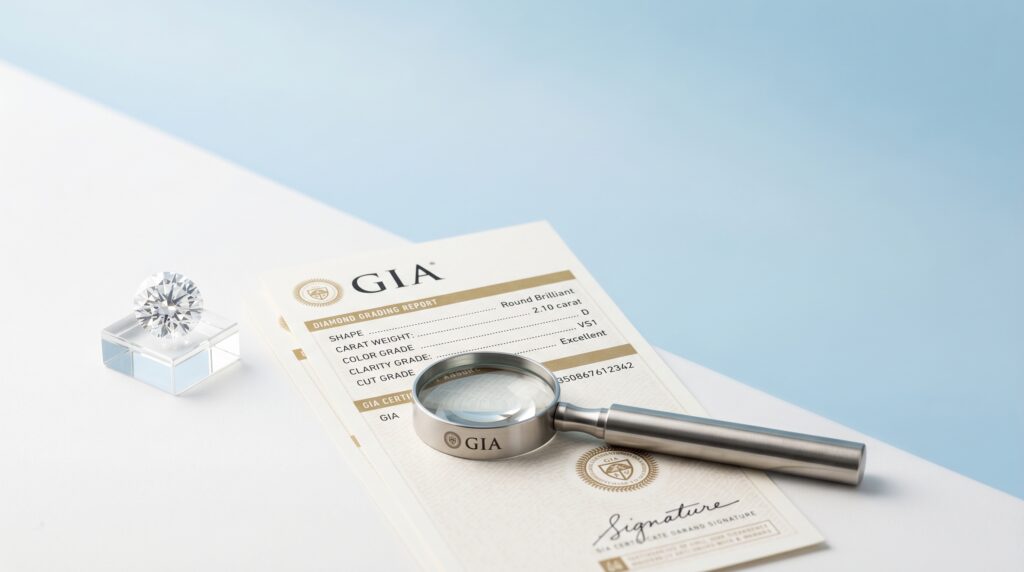
Diamond Certification Numbers: How They Protect You
Every certificate issued by a major lab carries a unique diamond certification number, a numerical identifier that links the physical document to the lab’s permanent database record. This number is the single most important verification tool available to buyers.
Here is why diamond certification numbers matter:
- They enable instant online verification of all graded characteristics.
- They detect certificate forgery, a fake document will not match the database.
- Many GIA-graded diamonds have the report number laser-inscribed on the girdle, allowing physical confirmation under magnification.
- They support resale and insurance claims by providing a traceable, authoritative grade history.
When purchasing any certified diamond online, always verify the certification number before payment is completed. This single step prevents the most common forms of diamond misrepresentation.
Visit Lepdo Diamonds’ policies page to understand how transparent, certified diamond sourcing works in practice.
In short:
- Diamond certification numbers are unique identifiers that enable real-time database verification.
- Always verify the certification number against the issuing lab’s official online database before purchasing.
- GIA diamonds often carry laser-inscribed report numbers on the girdle for additional physical confirmation.
Diamond Certification Pricing: What Does It Cost?
Diamond certification fees vary by lab, stone size, and service level. These fees are typically paid by the manufacturer or cutter and factored into the stone’s wholesale price.
Approximate Certification Fee Ranges (2024–2025)
- GIA grading report: $80–$200+ depending on carat weight and service tier.
- IGI grading report: $50–$150, often faster turnaround than GIA.
- HRD grading report: €60–€180, with various service speed options.
- AGS grading report: $80–$180 with specialized cut grading.
- EGL grading report: $30–$80, lower fees reflecting lighter service infrastructure.
The certification fee is a small fraction of a diamond’s total value, but it has an outsized impact on marketability and resale. For stones above 0.50 carat, the investment in a GIA or IGI certificate almost always pays for itself in buyer confidence and pricing clarity.
How Certification Affects the Final Price to the Consumer
A GIA-certified 1.00-carat round brilliant in G/VS1 will trade at a significant premium over an EGL-certified stone with the same stated grade, precisely because the GIA grade is trusted and the EGL grade carries uncertainty. The certificate is not separate from the value of the diamond. It is part of the value.
Why Choosing the Right Supplier Matters
In the diamond industry, the quality of your certification is only as reliable as the integrity of your supplier. Here is what to look for in a supplier partner, whether you’re a manufacturer, retailer, wholesaler, or individual buyer:
Quality Consistency
A trustworthy supplier sources from certification labs with consistent, verifiable standards. They do not mix GIA and EGL stones in a lot without clear disclosure. They do not present EGL grades as equivalent to GIA grades. Every stone is represented accurately, certificate-forward.
Pricing Advantage
Direct-from-manufacturer sourcing eliminates middleman markups and provides access to certified stones at competitive wholesale prices. For retailers and jewelry brands, this margin advantage is critical for both profitability and competitive pricing to end consumers.
Customization
The right supplier can match your certification requirements to your market. Need GIA for a luxury bridal collection? IGI for a lab-grown fashion line? HRD for European distribution? A manufacturer with deep lab relationships and broad inventory can fulfill these requirements systematically, not on a case-by-case scramble.
Trust and Transparency
The best suppliers proactively share certification documentation, welcome independent verification, and provide clear return and dispute policies. They understand that the certificate is a promise, and they stand behind it.
Conclusion: The Certificate Is the Foundation of Trust
In the diamond industry, trust is built on transparency, and transparency begins with certification. A reliable diamond certification from a respected lab is not a formality or a nice-to-have. It is the document that turns a beautiful stone into a verifiable, tradeable, insurable asset.
For end consumers, it is protection from misrepresentation. For retailers, it is the foundation of pricing integrity. For wholesalers and manufacturers, it is the language of commerce, the shared vocabulary that makes the global diamond trade function.
Understanding the differences between GIA, IGI, HRD, AGS, and EGL certified diamonds, and knowing how to verify a certificate number before you commit, puts you in control of every transaction, regardless of which side of the counter you’re on.
The right certification, from the right lab, sourced through the right supplier, is one of the best investments you can make in any diamond purchase.
If you are looking for high-quality certified diamonds, GIA, IGI, or otherwise, contact Lepdo Diamonds for expert consultation or competitive pricing. Our team works with manufacturers, wholesalers, retailers, and individual buyers across the USA to deliver certified diamonds with complete transparency and documentation you can trust.
FAQ: Diamond Certification
1. What is diamond certification?
Diamond certification is an official grading report from an independent gemological laboratory documenting a diamond’s quality characteristics, including Cut, Color, Clarity, and Carat weight. It provides an objective, verifiable description of the stone.
2. Which diamond certification is best?
GIA is widely regarded as the best diamond certification for natural diamonds due to its strict, consistent standards and universal acceptance. AGS is the best for cut-focused buyers. IGI is the preferred lab for lab-grown diamonds.
3. What is the difference between GIA and IGI certified diamonds?
GIA is the stricter, more established lab focused primarily on natural diamonds. IGI is highly trusted for lab-grown diamonds and broadly accepted in retail. For natural diamonds, GIA grades are considered the more conservative and reliable benchmark.
4. Are EGL certified diamonds worth buying?
EGL certified diamonds can offer value for informed buyers who understand the grading gap. EGL grades tend to be 1–3 color grades and 1–2 clarity grades more lenient than GIA. If priced accordingly and purchased with full knowledge, EGL stones can represent good value, particularly in fashion jewelry and sub-1-carat purchases.
5. How do I verify a diamond certification number?
Visit the issuing lab’s official website and enter the report number in their online verification tool. GIA uses gia.edu, IGI uses igiworldwide.com, and HRD uses hrdantwerp.com. The database will display all graded characteristics, compare them against the listing exactly.
6. Does diamond certification affect resale value?
Yes, significantly. GIA and IGI certified diamonds are accepted by most estate buyers, auction houses, and insurance appraisers. EGL certified stones may face questions or discounting at resale. Certification from a trusted lab is one of the strongest factors in long-term diamond value retention.
7. What is HRD certification?
HRD Antwerp is Belgium’s premier diamond certification authority, founded in 1973. It is one of the most respected labs in European diamond trading, with grading standards comparable to GIA. HRD certification is particularly valuable for diamonds entering European retail or wholesale markets.
8. Can a diamond have more than one certification?
Yes. Diamonds can be re-submitted to any lab for grading at any time. Some buyers re-certify EGL stones through GIA to establish a more universally accepted grade. This is common practice and perfectly legitimate.