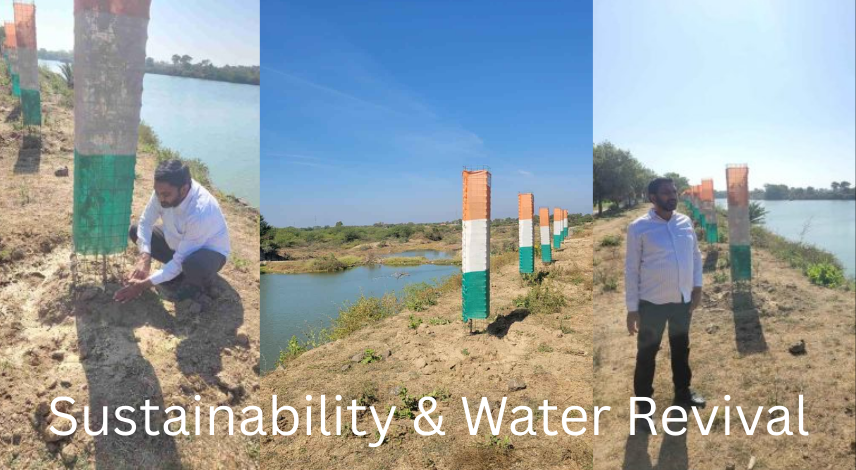

Sustainability is not just an environmental idea; it is a responsibility shared by every individual, community, and business. Sustainability & Water Revival have become especially critical over the past decade, as climate change, water scarcity, and ecological imbalance continue to challenge the way we view our relationship with nature. As groundwater levels drop and green cover reduces drastically, communities, especially in rural India, face the direct consequences of extreme weather, crop failure, and water shortages.
Lepdo Group believes that true growth is only meaningful when it protects the future of the planet. With this belief guiding our CSR efforts, LEPDO has taken a long-term approach toward sustainability and water revival. This initiative grew from the understanding that environmental challenges cannot be solved overnight and require consistent, on-ground action.
Our work includes planting native trees, creating water reservoirs at the village level, restoring traditional water structures, and supporting farmers through natural methods of environmental regeneration. These efforts are rooted in local needs and practical solutions rather than short-term fixes.
This blog looks at our sustainability journey, how it started, why it matters, and the progress made so far. It also shares our vision for the future. If you care about nature, rural communities, or want to understand what meaningful environmental CSR looks like in practice, this is where the story begins.
Why Sustainability Matters Today More Than Ever
The pressure on nature is becoming harder to ignore. Rapid urban growth, loss of green cover, degrading soil, and changing climate patterns are slowly disrupting the balance that communities depend on.
There are several reasons sustainability has become so important today.
Climate change is accelerating. Rising temperatures are affecting agriculture, water availability, and public health in ways that are already being felt on the ground.
Groundwater levels are steadily falling. In many villages, access to water has become a year-round challenge rather than a seasonal one.
Food security is under threat. Poor soil health leads to lower crop yields, directly impacting farmers’ incomes and long-term livelihoods.
Urban pollution continues to rise. Expanding concrete spaces and shrinking green areas are damaging air quality and overall quality of life.
Biodiversity is disappearing at an alarming pace. Native plants and animal species are being lost, weakening local ecosystems.
Sustainability is no longer a choice or an ideal. It has become a necessity for protecting both people and the planet.
The Importance of Water Revival
India is among the top water-stressed countries in the world. Nearly 600 million people face water scarcity at least part of the year.
Rural areas are often hit the hardest. Over time, systems that once supported water availability have weakened or disappeared.
Rainwater is no longer collected or stored effectively. Traditional reservoirs and ponds have dried up due to neglect. Rivers and smaller water bodies continue to shrink, especially during long dry seasons. At the same time, the soil has lost much of its natural ability to retain water.
Water revival efforts focus on reversing this damage. By capturing rainwater, conserving existing sources, and restoring traditional water structures, communities are better equipped to manage water throughout the year and build long-term resilience.
Lepdo Group’s Sustainability & Water Revival Mission
At Lepdo Group, sustainability isn’t a one-time project, it is an ongoing responsibility. Our mission is simple:
“Restore green cover. Replenish water. Regenerate life.”
Below are the core pillars of our CSR initiative.
1. Plantation of Native Trees
Tree plantation is one of the core parts of LEPDO’s sustainability work, with a clear focus on native and climate-resilient species. These trees are better suited to local conditions and survive with minimal intervention.
Native trees require less water, improve soil health over time, and support local birds and wildlife. They are also more resilient to harsh weather and provide long-term benefits such as shade, fruits, and improved air quality for nearby communities.
Some of the native tree species we commonly plant include neem, banyan, peepal, ashoka, mango, gulmohar, and jamun.
The impact of this plantation work is visible over time. Soil erosion reduces as root systems strengthen the land. Oxygen levels improve while carbon impact lowers. Farmers benefit from natural shade during long working hours in the fields, and improved soil structure helps recharge groundwater naturally.
These trees are planted along village roads, near schools, on open community land, along farm boundaries, and in shared public spaces, areas where they can serve people for generations.
2. Building and Reviving Village Water Reservoirs
For rural communities, water reservoirs are not optional, they are essential for survival. LEPDO’s water revival work focuses on restoring traditional systems while creating new storage where needed.
This includes constructing new ponds and check dams, deepening existing water bodies, removing accumulated silt to increase storage capacity, strengthening embankments, and redirecting natural rainwater channels for better recharge.
Revived reservoirs help farmers replenish groundwater levels, support irrigation during dry months, protect crops during water-scarce periods, and reduce dependence on external water sources. Over time, these structures play a key role in building climate resilience at the village level.
The types of water bodies restored through this initiative include traditional village ponds (talavs), check dams, farm ponds, stepwell-based structures, and natural rainwater catchment areas.
Execution Strategy: How LEPDO Ensures Sustainable Impact
Every sustainability project begins with careful planning and close involvement from the community. LEPDO’s approach is built around understanding local needs and working alongside the people who are directly affected.
Selecting target villages
Villages are chosen based on clear on-ground challenges. Priority is given to areas with poor rainwater harvesting, limited water storage, recurring drought-like conditions, declining green cover, and communities that depend heavily on farming for their livelihood.
Ground surveys and field studies
Before any work begins, the team conducts detailed surveys to understand local conditions. This includes studying water flow patterns, soil type, groundwater depth, village geography, and the condition of traditional water structures. These insights help shape solutions that are practical and long-lasting.
Working with local volunteers
Community participation is central to the process. LEPDO works closely with village leaders, school teachers, farmers, and local youth groups. Their involvement ensures that projects are maintained, respected, and sustained over time.
Long-term monitoring
The work doesn’t stop once a project is completed. The team regularly tracks tree survival and growth, water percolation levels, improvements in soil quality, and reservoir water levels after each monsoon. This ongoing review helps measure impact and make necessary improvements.
Impact Overview: How Our Efforts Have Helped Communities
Below is a performance snapshot of our Sustainability & Water Revival impact.
| Impact Category | Details & Numbers |
|---|---|
| Native Trees Planted | 10,000+ saplings |
| Reservoirs Constructed/Revived | 8 major village projects |
| Groundwater Level Rise | 1.5–2 meters (avg) |
| Farmer Families Benefited | 1,200+ |
| Soil Fertility Improved | 30–45% depending on region |
| Water Storage Capacity | Millions of liters added |
Real Stories from the Ground
A farmer’s field comes back to life
In a drought-prone village, a local farmer had been struggling for years with dry soil and repeated crop failure. Water from the nearby pond had almost disappeared, leaving his fields dependent on irregular rainfall. After LEPDO helped revive the pond, moisture slowly returned to the land. Within the next farming season, his harvest improved by nearly 40%, giving him renewed confidence in his livelihood.
Native trees bring back local life
In several villages where neem and banyan trees were planted, residents began noticing small but meaningful changes. Birds returned to nest, butterflies became more common, and pollinators reappeared in nearby fields. These signs, shared by villagers themselves, reflected a gradual but visible improvement in the local ecosystem.
Cooler spaces for learning
Around rural schools, newly planted native trees now provide much-needed shade. Classrooms and playground areas stay cooler, making it easier for children to study and spend time outdoors. For students and teachers alike, these trees have quietly improved everyday school life.
Why LEPDO Focuses on Native Trees Instead of Imported Species
Fast-growing imported tree species may look attractive, but over time, they often do more harm than good. In many cases, they disturb the natural balance rather than support it.
Non-native trees usually consume large amounts of water, which puts extra pressure on already stressed groundwater sources. They also fail to support local insects, birds, and pollinators that depend on native plants for survival. In some cases, these species damage soil fertility or spread aggressively, crowding out native vegetation.
Native tree species, on the other hand, are naturally suited to the local climate and soil. They require far less maintenance, survive extreme weather conditions, and play a vital role in preserving biodiversity. By supporting local ecosystems, native trees help restore balance rather than disrupt it.
This is why native tree plantation remains a central part of LEPDO’s CSR work, not just to plant trees, but to strengthen local ecology sustainably.
Why Water Revival Is a Long-Term, High-Impact CSR Strategy
Water revival is not a short-term solution. Its impact grows over time and continues to benefit communities long after the initial work is done.
When water sources are restored, groundwater levels improve, and agriculture becomes more reliable. Farmers are able to grow better crops, livestock stay healthier, and villages gain access to more dependable drinking water. With improved water availability, many families are less forced to migrate to cities in search of work.
Restored water bodies also help capture and store monsoon rainfall more effectively, reducing water stress during dry seasons. Over the years, this has created stronger, more resilient rural communities.
Water revival is not charity. It is about empowering communities with resources they can rely on for generations.
Also Read: Food Relief During COVID: How LEPDO Supported 500+ Families During the Pandemic
FAQs – Sustainability & Water Revival
1. What is the core purpose of Lepdo’s sustainability initiative?
To restore green cover, conserve water, and support rural agriculture.
2. Why does Lepdo focus on native trees?
They require less water, survive longer, and support local ecosystems.
3. How many reservoirs has Lepdo revived so far?
More than 8 major village-level reservoirs and check dams.
4. How does water revival help farmers?
It boosts irrigation, improves crop output, and stabilizes income.
5. Does Lepdo monitor tree growth?
Yes, sapling growth and survival are monitored regularly.
6. Are communities involved in these projects?
Absolutely. Local volunteers and farmers are active partners.
7. How does reservoir revival increase groundwater levels?
It slows runoff, allowing water to percolate deep into soil layers.
8. Is sustainability a long-term mission for Lepdo Group?
Yes, sustainability is embedded in Lepdo’s operations and future vision.